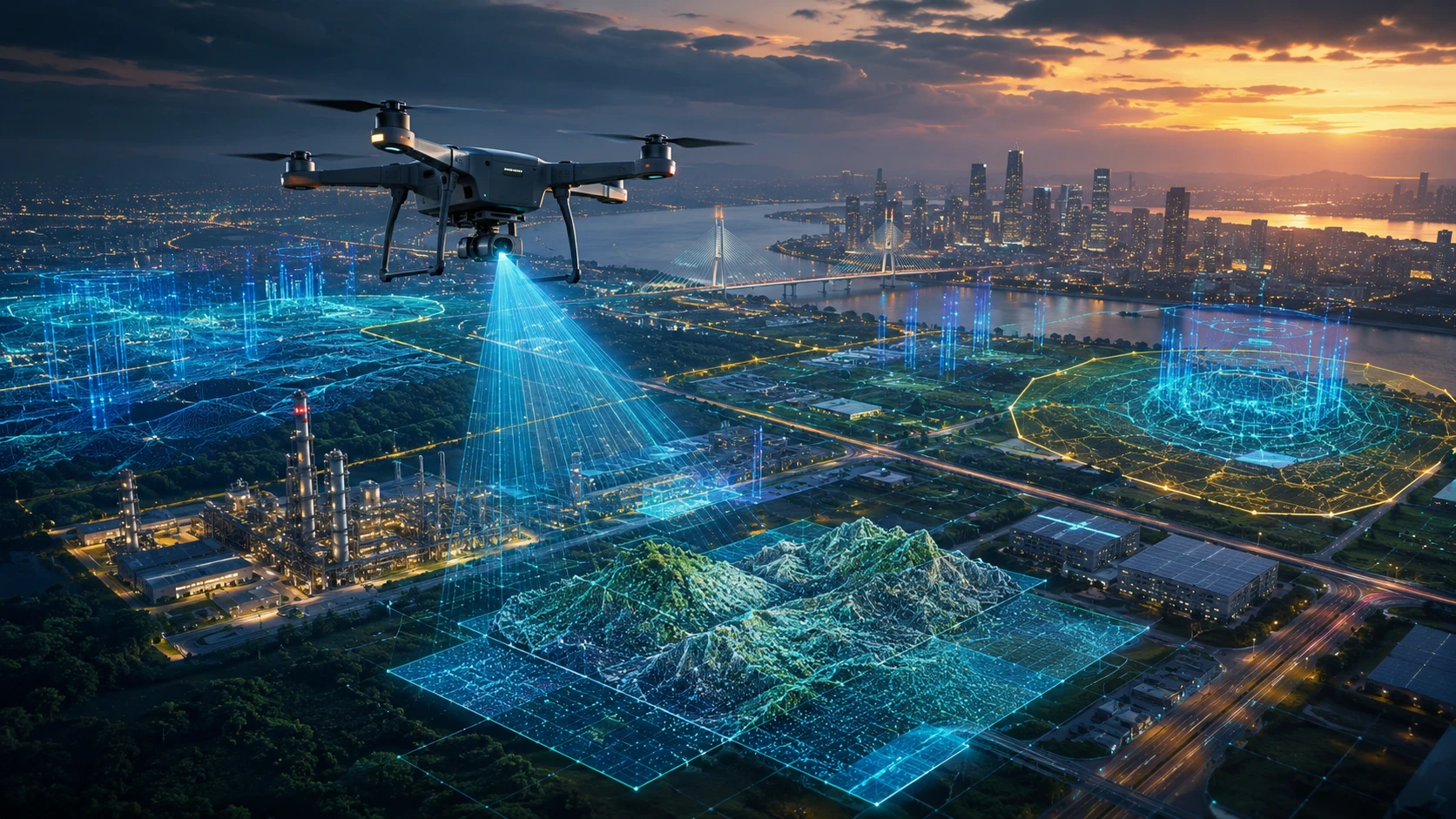
Understanding drone rules 2021 India is essential for any business planning to use drones for surveying, mapping, inspections, agriculture, construction monitoring, security, media, or infrastructure documentation. The Drone Rules, 2021 created a simpler and more digital-first framework for drone operations in India, while later amendments updated important parts of the certification process.
For businesses, the main idea is simple: drone operations must be planned around drone registration, pilot certification, airspace zones, permissions, safety, privacy, and operational responsibility. A drone is not just a camera in the sky. It is a regulated aircraft system operating in shared airspace.
This guide explains the key rules in business-friendly language so that project owners, facility managers, contractors, government vendors, enterprise teams, and drone service buyers can understand what matters before starting a drone project.
What are Drone Rules 2021 in India?
Drone Rules 2021 are India’s main regulatory framework for unmanned aircraft systems, commonly called drones. They define how drones are classified, registered, certified, operated, and controlled for safe use in Indian airspace.
The rules apply to drone manufacturers, owners, operators, pilots, training organisations, service providers, and businesses using drone services. They are especially important for commercial drone operations because businesses must ensure that the drone, pilot, and flight plan are compliant.
The Drone Rules, 2021 are built around a digital compliance ecosystem. Important activities such as drone registration, airspace checking, and operational permissions are linked to the Digital Sky platform and related government systems.
For businesses, the rules matter because they reduce uncertainty. A company planning drone work can check the drone category, site location, airspace zone, pilot requirement, and operational restrictions before the project begins.
The rules cover areas such as:
- Drone classification
- Drone registration
- Unique Identification Number
- Type certification
- Remote Pilot Certificate
- Remote Pilot Training Organisations
- Airspace zones
- Operational restrictions
- Safety requirements
- Import, manufacturing, and ownership compliance
- Penalties for violations
Which drone categories should businesses understand?
Businesses should understand drone categories because compliance requirements depend partly on the drone’s weight class and intended use. Drone Rules 2021 classify unmanned aircraft systems into nano, micro, small, medium, and large categories.
Here is a simple category breakdown:
| Drone category | Maximum all-up weight | Common business relevance |
|---|---|---|
| Nano | Up to 250 g | Limited lightweight use cases |
| Micro | More than 250 g and up to 2 kg | Basic visual documentation and small inspections |
| Small | More than 2 kg and up to 25 kg | Common for professional mapping, agriculture, and inspections |
| Medium | More than 25 kg and up to 150 kg | Specialised industrial and logistics applications |
| Large | More than 150 kg | Highly specialised operations |
Most professional business use cases involve micro or small category drones. Surveying, mapping, agriculture spraying, infrastructure monitoring, industrial inspection, and enterprise documentation often need drones with better payload capacity, flight stability, sensors, and operational capability.
The category affects pilot requirements, training needs, operational planning, permissions, and risk assessment. A business should not assume that all drones are treated equally under the rules.
For teams interested in formal drone capability, Skyglimps Technologies LLP offers DGCA-certified drone training in Kolkata for learners and organisations seeking structured drone education.
What is Digital Sky and why does it matter?
Digital Sky is India’s digital platform for drone-related compliance and operational workflows. Businesses use the Digital Sky ecosystem to understand airspace restrictions, drone-related permissions, registration processes, and drone operation requirements.
For a business, Digital Sky matters because it connects drone operations with regulatory visibility. It helps operators and service providers check whether a site falls in a green, yellow, or red zone and whether additional permissions may be required.
Important Digital Sky-linked functions include:
- Airspace map checking
- Drone registration support
- Unique Identification Number-related workflows
- Remote Pilot Certificate access
- RPTO information
- Permission-related workflows
- Regulatory updates
Businesses should ask their drone service provider whether they check Digital Sky before flying. This is especially important for projects near airports, government facilities, defence-sensitive areas, ports, industrial zones, high-security assets, and dense urban locations.
A drone survey or inspection should never begin only because the site owner has given permission. The airspace must also be checked.
What are green, yellow, and red zones for drone operations?
Green, yellow, and red zones define how easy or restricted drone operations are in a particular airspace. Green zones are the least restrictive, yellow zones require permission, and red zones are highly restricted.
A simple explanation is:
| Zone | Meaning for businesses |
| Green zone | Drone operations are generally easier, subject to applicable rules and safety requirements |
| Yellow zone | Permission is required before flying |
| Red zone | Drone operations are allowed only with Central Government permission |
The green zone generally includes airspace up to 400 feet or 120 metres in areas not marked yellow or red, along with specific lower-height areas near operational airports as defined by the rules. Yellow zones are controlled areas where permission is required. Red zones are highly restricted and should be treated as no-fly unless specific Central Government permission is granted.
For businesses in Kolkata, West Bengal, and Eastern India, airspace checking is critical. A project site near an airport, sensitive government building, defence facility, port, industrial asset, or urban security zone may need additional review before a drone can be flown.
Before approving a drone project, ask the drone team:
- What is the airspace zone for this site?
- Is any prior permission required?
- Who will handle permission checks?
- What height and area will the drone cover?
- Are there any site-level restrictions?
- Will the flight follow visual line of sight and safety requirements?
What is a UIN and when does a drone need it?
A UIN, or Unique Identification Number, is the registration identity assigned to a drone through the applicable digital process. For business operations, using a properly registered and compliant drone is a basic requirement.
Businesses should treat drone registration like vehicle registration. The drone must be identifiable and traceable under the applicable framework. This helps create accountability in professional operations.
A company hiring a drone vendor should ask:
- Is the drone registered?
- Does the drone have a valid UIN where required?
- Is the drone suitable for commercial use?
- Is the drone category appropriate for the work?
- Does the drone meet the relevant certification requirement?
- Who owns and operates the drone?
This is particularly important for enterprise and government-linked work. If a vendor uses an unregistered or non-compliant drone, the project owner may face operational, safety, and reputational risk.
What is type certification for drones?
Type certification confirms that a drone model meets applicable technical and safety requirements under India’s drone framework. For many business operations, drone type certification is an important compliance check before the drone is used commercially.
The type certificate process is meant to ensure that drones meet defined design and safety standards. This is especially relevant when a drone is manufactured, imported, sold, or used for professional operations in regulated categories.
Businesses do not need to become type certification experts, but they should ask the right questions before hiring a vendor or purchasing a drone.
Key questions include:
- Is the drone type-certified where required?
- Is the drone suitable for the intended work?
- Is the payload approved and safe for the mission?
- Is the drone maintained properly?
- Are flight logs and maintenance records available?
- Is the drone category suitable for the operating environment?
For example, a lightweight drone used for simple visual documentation is different from a drone used for LiDAR mapping, agriculture spraying, thermal inspection, or infrastructure monitoring. Higher-risk operations require stronger compliance and planning.
What certificate does a drone pilot need in India?
In 2026, the correct certification for eligible professional drone pilots in India is the Remote Pilot Certificate, commonly called RPC. The older drone pilot licence terminology has been replaced, and the RPC is issued through a DGCA-authorised Remote Pilot Training Organisation.
This is one of the most important updates for businesses to understand. If a vendor says “licence,” ask whether the pilot has a valid Remote Pilot Certificate.
A Remote Pilot Certificate matters because it confirms that the pilot has completed structured training and assessment through an authorised training route. Professional drone pilots must understand regulations, safety, weather, flight planning, emergency handling, and operational discipline.
For professional drone pilot certification in India, a candidate must be at least 18 years old and should have passed Class 10 or equivalent. The RPC is valid for 10 years from the date of issue unless suspended or cancelled under applicable rules.
Skyglimps Technologies LLP provides DGCA-certified drone pilot training for learners in Kolkata and Eastern India who want to build a certified drone career.
What operating rules should businesses follow before a drone project?
Businesses should follow basic operating rules before every drone project, including airspace checks, site permission, certified pilot verification, drone registration, safety planning, and privacy protection. These steps reduce legal, operational, and safety risks.
Before starting a drone survey, inspection, shoot, or monitoring assignment, the business should confirm:
- The site has been checked on the airspace map.
- The drone is registered where required.
- The pilot has valid certification where required.
- The drone category matches the project.
- The flight area is safe for people and property.
- The site owner has authorised the activity.
- Local security or administrative requirements are addressed.
- The weather is suitable.
- Emergency procedures are clear.
- Data privacy expectations are agreed.
Businesses should also avoid flying over crowds, sensitive locations, private properties, or restricted areas without proper permission and planning. Drone data can include images of people, assets, land, buildings, vehicles, and operational activity. This makes privacy and data handling important.
For construction, infrastructure, irrigation, mining, or industrial projects, drone operations should be coordinated with the site manager before the flight.
How do Drone Rules 2021 affect drone surveys and mapping?
Drone Rules 2021 affect drone surveys and mapping by defining how drones, pilots, airspace, and operations must be handled before aerial data is captured. A drone survey must be planned as a compliant flight operation, not just as a data collection task.
Drone surveys often involve large sites, repeated flights, mapping sensors, ground control points, technical deliverables, and project teams. Compliance helps ensure that the work is safe and usable.
For drone survey and mapping projects, businesses should check:
- Site location and airspace zone
- Drone category and registration
- Pilot certification
- Permission requirements
- Survey area boundary
- Flight altitude
- Ground control requirements
- Data deliverables
- Safety plan
- Data ownership and privacy
Skyglimps Technologies LLP supports 2D Surveying & Mapping for organisations that need structured aerial mapping and project documentation.
For more advanced spatial outputs, businesses can explore 3D LiDAR & GIS Solutions depending on the site and deliverables required.
What should businesses ask a drone service provider?
Businesses should ask a drone service provider about compliance, pilot certification, drone registration, airspace checking, insurance, safety planning, deliverables, and data handling. A professional vendor should answer clearly before the project begins.
Use this checklist before hiring:
| Question | Why it matters |
| Is the pilot certified? | Confirms professional training and safety awareness |
| Is the drone registered? | Confirms traceability and compliance |
| Have you checked the airspace zone? | Avoids restricted or permission-required flights |
| Is permission required for this site? | Prevents last-minute operational delays |
| What drone category will be used? | Matches equipment to project risk |
| What deliverables are included? | Prevents confusion after the flight |
| How will safety be managed? | Protects people, property, and assets |
| How will data be handled? | Protects privacy and business information |
| What happens if weather changes? | Ensures realistic planning |
| Do you have project experience? | Improves execution quality |
A compliant drone service provider will not promise to fly anywhere at any time. It will first check whether the flight is safe, legal, and technically suitable.
Why choose Skyglimps Technologies for compliant drone operations?
Skyglimps Technologies LLP is a Kolkata-based drone services company and DGCA-certified Remote Pilot Training Organisation serving government and enterprise clients across Eastern India. The company supports drone services and training across surveying, mapping, inspections, surveillance, documentation, and related workflows.
Skyglimps Technologies, a DGCA-certified RPTO in Kolkata, is positioned for businesses that need drone services with compliance awareness and practical field understanding. This is especially important for enterprises, government-linked projects, infrastructure contractors, industrial teams, and organisations operating in sensitive or complex project environments.
For businesses in Kolkata, West Bengal, and Eastern India, working with a local drone team can improve coordination, site understanding, documentation, and follow-up communication.
FAQ: Drone Rules 2021 India
Drone Rules 2021 India are the main rules governing drone classification, registration, certification, pilot training, airspace zones, permissions, operations, and penalties for drone use in India.
Permission depends on airspace zone, drone category, location, and operation type. Green zones are less restrictive, yellow zones require permission, and red zones need Central Government permission.
The correct certificate in 2026 is the Remote Pilot Certificate, or RPC. The older drone pilot licence terminology has been replaced under the current framework.
Digital Sky is India’s digital drone platform for airspace maps, drone registration, training organisation information, remote pilot certificate access, and related drone compliance workflows.
Yes. Businesses can use drones for surveys, inspections, mapping, monitoring, agriculture, documentation, and aerial data capture when the drone, pilot, airspace, and operation are compliant.
A UIN is a Unique Identification Number assigned to a drone through the applicable registration process. It helps identify and trace drones used in India.
Certified and compliant drone service providers reduce safety, legal, operational, and data risks. They understand pilot certification, drone registration, airspace checks, site safety, and deliverable planning.
Make drone compliance part of project planning
Drone Rules 2021 India created a clearer framework for drone use across business, government, and enterprise applications. For companies, the most important lesson is simple: plan compliance before the flight.
Check the drone, the pilot, the airspace, the site, the permission requirement, the safety plan, and the data policy before starting any drone project. This reduces risk and helps ensure the final output can be used confidently.
If your organisation wants to understand drone operations, pilot certification, or business-ready drone training in Kolkata, West Bengal, or Eastern India, connect with Skyglimps Technologies LLP through the DGCA-certified drone training hub and choose the right training or service pathway.