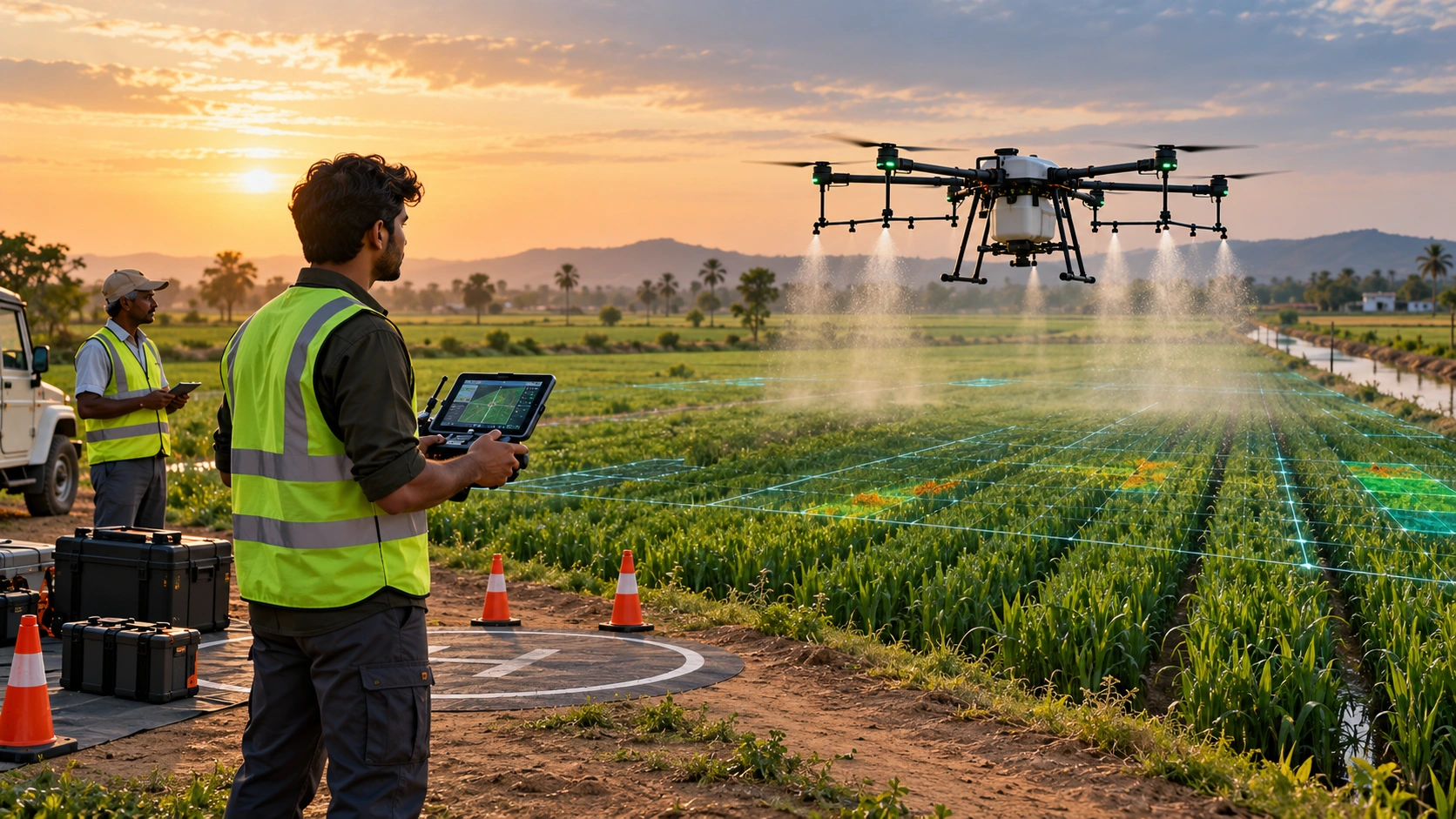
Agriculture is becoming one of the most important application areas for drone technology in India. Drones are being used for activities such as crop monitoring, nutrient application, pesticide spraying, field assessment and precision agriculture.
This has created a growing need for people who know how to operate agricultural drones safely and efficiently.
An agriculture drone pilot is not simply someone who knows how to fly a drone. The role combines drone operation with agricultural application skills, equipment handling, field safety and knowledge of the specific mission being performed.
In simple terms:
An agriculture drone pilot operates drones to perform agricultural tasks such as crop spraying, input application, monitoring and field data collection.
For professional drone operations, the applicable Remote Pilot Certificate (RPC) and drone requirements must be followed. DGCA’s current guidance requires RPC holders to operate within the applicable drone category, sub-category and class, use applicable type-certified and registered drones, check airspace before every flight and follow safety requirements.
So, if you are considering agriculture drone piloting as a career, there are two things you need to develop:
Certified drone-piloting skills + agriculture-specific operational skills
What Does an Agriculture Drone Pilot Do?
The exact work depends on the agricultural project, but an agriculture drone pilot may be responsible for:
- Preparing the drone before the mission
- Checking batteries and equipment
- Planning the flight
- Checking the applicable airspace
- Preparing the spraying system
- Calibrating the equipment
- Operating the drone over agricultural fields
- Applying permitted agricultural inputs
- Monitoring spray coverage
- Managing batteries during field operations
- Maintaining flight and application records
- Performing basic post-flight checks
- Coordinating with farmers and field teams
Agricultural drone operations can involve both spraying and data-based applications.
ICAR programmes have demonstrated agricultural drones for fertilizer and pesticide application, crop monitoring, crop health assessment and precision agriculture.
This means an agriculture drone pilot can potentially work in several different types of agricultural projects rather than only pesticide spraying.
Why Are Drones Being Used in Agriculture?
Agricultural drones can help address several practical challenges faced by farmers and agricultural service providers.
According to the Government of India’s information on agricultural mechanisation, drones can provide benefits such as:
- Faster field operations
- Reduced spraying time
- Better input application efficiency
- Reduced wastage of fertilizers and pesticides
- Lower water use in ultra-low-volume applications
- Reduced direct exposure of workers to hazardous chemicals
The government has also highlighted the potential of drones to create direct and indirect employment opportunities in agriculture.
ICAR has conducted agricultural drone demonstrations involving nutrient, fertilizer and crop-protection applications across multiple crops and regions.
For an agriculture drone pilot, this creates opportunities to work as part of:
Farmer service teams → FPOs → Agricultural companies → Drone service providers → Government programmes → Research and demonstration projects
Do You Need a DGCA Certificate to Become an Agriculture Drone Pilot?
For professional operations where remote-pilot certification is applicable, you need the appropriate Remote Pilot Certificate (RPC).
The official terminology today is Remote Pilot Certificate, not the older “drone pilot licence” terminology. The Drone (Amendment) Rules, 2022 replaced the earlier remote pilot licence terminology with RPC and provide for certification through an authorised Remote Pilot Training Organisation (RPTO).
The important point is that an RPC is linked to the applicable:
- UAS category
- Sub-category
- Class
DGCA’s current RPC verification system displays these endorsement details for certified pilots.
Therefore, before enrolling in training, understand the type of agricultural drone you intend to operate.
What Drone Category Is Used for Agricultural Operations?
Drone classification is based on the maximum all-up weight, including payload.
Under the Drone Rules framework:
| Category | Maximum All-Up Weight |
|---|---|
| Nano | Up to 250 g |
| Micro | More than 250 g to 2 kg |
| Small | More than 2 kg to 25 kg |
| Medium | More than 25 kg to 150 kg |
| Large | More than 150 kg |
Agricultural drones can therefore fall into different classes depending on their design and payload.
This matters because your training and pilot certification need to match the applicable drone class.
Do not choose a course simply because it says “agriculture drone training.” Check which drone category and certification pathway it actually covers.
What Is Agriculture Drone Pilot Training?
Agriculture drone pilot training should ideally combine professional drone operation with agriculture-specific application knowledge.
General DGCA remote-pilot training covers areas such as:
- Drone regulations
- Airspace
- Flight fundamentals
- Aerodynamics
- Weather and meteorology
- Drone maintenance
- Risk assessment
- Safety
- Payload operations
- Drone data
- Simulator training
- Practical flying
- Assessment
DGCA’s training framework includes drone equipment maintenance, risk assessment, safety and payload operations in addition to flight training.
For agricultural work, additional practical knowledge can include:
- Spraying systems
- Nozzle selection
- Spray coverage
- Droplet management
- Field planning
- Agricultural inputs
- Safe handling procedures
- Crop-specific application practices
- Battery management
- Field-level troubleshooting
ICAR’s agricultural drone training programmes have specifically included drone spray protocols, safe pesticide use, nano-fertilizer application and hands-on demonstrations.
Is Agriculture-Specific Training Different From a Regular Drone Pilot Course?
Yes, they can serve different purposes.
A standard professional drone pilot course teaches you how to operate the aircraft safely and follow the applicable aviation framework.
Agriculture-specific training adds knowledge about how the drone is used on a farm.
For example:
General Pilot Training
You learn:
How to fly the drone safely.
Agriculture Training
You learn:
How to use the drone appropriately for agricultural applications.
This distinction is important.
Someone may be an excellent drone pilot but still need additional training before undertaking agricultural spraying work.
Similarly, someone with agricultural knowledge may still need formal drone-pilot training and practical flight experience.
The strongest agriculture drone professionals understand both.
What Do You Learn in Agriculture Drone Pilot Training?
A well-rounded training programme can be divided into four areas.
1. Drone Flying
You learn:
- Take-off
- Landing
- Hovering
- Manoeuvring
- Flight control
- Mission planning
- Emergency procedures
2. Drone Equipment
You learn about:
- Batteries
- Motors
- Propellers
- Controllers
- Sensors
- Spray systems
- Payloads
3. Agricultural Applications
You learn how drones can be used for:
- Crop spraying
- Nutrient application
- Crop monitoring
- Field assessment
- Precision agriculture
4. Field Safety
You learn to consider:
- Weather
- Wind
- People
- Animals
- Buildings
- Power lines
- Trees
- Field boundaries
- Chemical handling
The objective is not simply to make the drone fly.
It is to make the complete agricultural operation safe, controlled and repeatable.
What Does a Typical Agriculture Drone Spraying Job Look Like?
An agricultural spraying mission generally begins before the drone takes off.
Step 1: Understand the Field
The pilot or field team identifies:
- Field boundaries
- Crop
- Crop condition
- Obstacles
- Nearby people
- Water bodies
- Power lines
Step 2: Check the Flight Environment
The pilot checks the applicable airspace and operational restrictions before flying.
DGCA’s current guidance requires pilots to check the DigitalSky airspace information before every flight.
Step 3: Inspect the Drone
The pilot checks:
- Batteries
- Propellers
- Motors
- Spray system
- Tank
- Controller
- Sensors
Step 4: Prepare the Application
The agricultural input must be prepared according to the applicable product instructions, agricultural guidance and permitted application requirements.
India’s Insecticides Rules contain specific requirements for aerial spraying, including use of approved insecticides and formulations at approved concentrations and heights and appropriate safety precautions.
Step 5: Plan the Mission
The pilot determines the appropriate:
- Flight route
- Height
- Speed
- Coverage
- Battery requirements
Step 6: Fly
The drone performs the planned application while the pilot monitors the aircraft and field conditions.
Step 7: Check the Result
The operator checks whether the mission was completed properly and records the relevant information.
Step 8: Maintain the Equipment
The drone and spraying system are cleaned, inspected and prepared for the next operation.
Is Crop Spraying the Only Job of an Agriculture Drone Pilot?
No.
Crop spraying is one important application, but agriculture drones can also support other activities.
Crop Monitoring
Drones can capture aerial imagery to help assess field conditions.
Crop Health Assessment
Specialised sensors can potentially provide information that helps identify differences in crop condition.
Field Mapping
Drone imagery can be used to create maps of agricultural land.
Irrigation Planning
Aerial information can support understanding of field conditions and irrigation-related planning.
Plant Counting and Assessment
Drone imagery can assist with crop and plant assessment depending on the equipment and workflow.
Nutrient Application
Agricultural drones can be used for certain nutrient and fertilizer applications.
ICAR has demonstrated drone applications involving crop monitoring, health assessment, soil and irrigation management, nutrient application and spraying.
This means an agriculture drone pilot can develop beyond basic spraying operations and specialise in precision agriculture and aerial data applications.
What Skills Does an Agriculture Drone Pilot Need?
Flying skills are only one part of the job.
A strong agriculture drone pilot should develop:
Drone Skills
- Flight control
- Mission planning
- Battery management
- Payload operation
- Basic maintenance
Agriculture Knowledge
- Crop types
- Crop growth stages
- Agricultural inputs
- Application methods
- Field conditions
Safety Skills
- Weather assessment
- Safe distance
- Chemical handling
- Emergency procedures
- Equipment checks
Technical Skills
- GPS-based flight
- Mission-planning software
- Basic troubleshooting
- Digital reporting
Communication Skills
The pilot may need to coordinate with:
- Farmers
- Agronomists
- Field supervisors
- FPOs
- Drone companies
- Agricultural departments
An agriculture drone pilot therefore works at the intersection of aviation, technology and agriculture.
Who Can Become an Agriculture Drone Pilot?
The career can be suitable for:
- Students
- Agriculture graduates
- Farmers
- Rural entrepreneurs
- Drone enthusiasts
- Existing drone pilots
- Agriculture professionals
- Mechanical/electronics learners
- People interested in precision agriculture
You do not necessarily need to come from an agriculture degree background to develop drone skills.
For example, SkyGlimps currently lists agriculture professionals among the people who can enrol in its DGCA-Certified Small Category Drone Pilot Training. The programme currently requires candidates to be at least 18 years old, have passed Class 10 or equivalent, provide accepted government-issued ID and meet its medical fitness requirement.
However, candidates should confirm the current eligibility requirements with the selected RPTO before enrolment.
What Career Opportunities Are Available for Agriculture Drone Pilots?
An agriculture drone pilot can potentially work with:
Drone Service Companies
Companies provide drone-based services directly to farmers and agricultural organisations.
Agricultural Companies
Fertilizer, crop-protection and agricultural technology companies may use drones for field operations and demonstrations.
FPOs and Farmer Groups
Farmer Producer Organisations can use drone services for agricultural applications.
Government Projects
Agricultural departments and government-supported programmes can use drones for demonstrations, training and field applications.
Research Institutions
Institutions such as ICAR and agricultural universities use drones for research, demonstrations and precision-agriculture applications.
Entrepreneurship
A trained pilot can potentially build a Drone-as-a-Service model where farmers pay for agricultural drone services rather than purchasing and maintaining their own aircraft.
Government programmes have specifically promoted drone-based agricultural services and entrepreneurship. The Namo Drone Didi scheme, for example, was designed to provide drones to selected women SHGs so they could provide rental agricultural services to farmers.
What Is the Namo Drone Didi Scheme?
Namo Drone Didi is a Government of India initiative focused on using drones to provide agricultural services through selected women Self-Help Groups.
The scheme was approved with an outlay of ₹1,261 crore and included support for drone packages, training and agricultural applications.
The drone package included:
- Drone with spraying assembly
- Batteries
- Chargers
- Nozzles
- Anemometer
- pH meter
- Insurance
- Maintenance support
- Drone pilot training
- Agriculture-specific training
One member of the selected SHG was to receive training that combined mandatory drone pilot training with additional training for agricultural nutrient and pesticide applications.
The scheme is an important example of how drone technology is being connected with agricultural services, rural entrepreneurship and employment.
How Much Agriculture Knowledge Does a Drone Pilot Need?
You do not necessarily need to become an agronomist to operate an agriculture drone.
However, you should understand enough about agricultural operations to know:
- What the mission is intended to achieve
- What crop is being treated
- What application method is required
- How the equipment should be configured
- What safety precautions apply
- When weather conditions are unsuitable
- How to follow the applicable product instructions and SOPs
For pesticide applications, pilots should never independently improvise chemical concentration or application instructions.
The agricultural input, formulation, concentration and application method must follow the applicable regulatory requirements, product label and authorised agricultural guidance.
ICAR’s agriculture drone training programmes specifically emphasise standard spray protocols and safe use of pesticides and nutrients.
Does SkyGlimps Offer Training for Agriculture Drone Pilots?
SkyGlimps currently offers DGCA-Certified Small Category Drone Pilot Training and specifically lists agriculture professionals among its intended learners. The current six-day programme includes regulatory knowledge, flight fundamentals, weather, maintenance, risk assessment, safety, payload operations, simulator training, practical flying, solo-flight progression and final flying assessment.
The programme is conducted with classroom training in New Town, Kolkata, and practical flying at the Singur, West Bengal flying ground.
For someone planning an agriculture drone career, this can provide the professional pilot foundation. Agriculture-specific application training should then be added where the intended job involves spraying, nutrient application or other specialised agricultural workflows.
Explore SkyGlimps DGCA-Certified Drone Training
Agriculture Drone Pilot Career Path
If you are starting from zero, a practical pathway can look like this:
Step 1: Learn Drone Fundamentals
Understand how drones, batteries, controllers, sensors and payloads work.
Step 2: Complete Applicable Pilot Training
Join an authorised RPTO for the relevant drone category and complete the required training and assessment.
Step 3: Obtain the Applicable RPC
Complete the certification process for the applicable pilot category/class.
Step 4: Learn Agricultural Applications
Develop practical knowledge of:
- Spraying
- Nutrient application
- Crop monitoring
- Field mapping
Step 5: Get Field Experience
Work with:
- Drone companies
- Agricultural service providers
- FPOs
- Research institutions
- Agricultural organisations
Step 6: Build a Specialisation
You could specialise in:
Agricultural spraying
or:
Precision agriculture
or:
Crop monitoring and mapping
Step 7: Explore Entrepreneurship
Once you have sufficient experience, you can consider providing agricultural drone services independently or through a Drone-as-a-Service model.
What Should You Check Before Choosing an Agriculture Drone Training Course?
Before paying for a course, check:
- Is the training organisation authorised for the relevant pilot certification?
- Which drone category does the course cover?
- Is practical flying included?
- Is simulator training included?
- Is maintenance covered?
- Is agriculture-specific training included?
- Will you get hands-on experience with an agricultural drone?
- Does the programme cover spraying equipment?
- Are safety and field procedures taught?
- What certification is issued after successful completion?
The most important distinction is:
A certificate saying “agriculture drone course” is not automatically the same as an RPC.
If your career goal involves professional drone operation, understand exactly what certification the programme provides.
Frequently Asked Questions
An agriculture drone pilot is a trained drone operator who uses drones for agricultural applications such as crop spraying, nutrient application, crop monitoring, field assessment and precision-agriculture operations.
For professional drone operations where remote-pilot certification is applicable, the pilot needs the appropriate Remote Pilot Certificate and must operate within the applicable drone category, class and regulatory requirements.
The foundation is applicable professional remote-pilot training through an authorised RPTO. Agriculture-specific training should then cover practical agricultural applications such as spraying systems, payload operation, field procedures and safe application practices.
Yes. A pilot can work for drone service companies, agricultural organisations, FPOs, research institutions or other organisations that provide the equipment. Owning a drone is not necessarily a prerequisite for starting a career.
It can be a promising specialisation for people interested in combining aviation, technology and agriculture. Government and ICAR initiatives have demonstrated agricultural drone applications and supported training, demonstrations and drone-based agricultural services.
Start Your Agriculture Drone Career With the Right Skills
Becoming an agriculture drone pilot involves much more than learning how to control a drone.
The complete skill set can be understood as:
Drone Training → RPC → Agricultural Application Training → Field Experience → Specialisation
A professional pilot needs to understand the aircraft, airspace, safety procedures and mission planning. An agriculture-focused pilot also needs to understand how the drone is being used in the field.
Agricultural drones are already being demonstrated and deployed for applications ranging from crop spraying and nutrient application to crop monitoring and precision agriculture. Government and ICAR programmes have also supported agricultural drone demonstrations, training and service models.
For beginners, the best approach is to build the foundation first.
Learn to operate the drone safely.
Understand the applicable DGCA requirements.
Complete the appropriate certification pathway.
Then develop agriculture-specific skills.
For aspiring pilots in Kolkata and West Bengal, SkyGlimps currently provides DGCA-Certified Small Category Drone Pilot Training, with classroom training in New Town and practical flying at Singur. Agriculture professionals are specifically included among its intended learners.
The future of agriculture is increasingly connected with precision technology, automation and data-driven decision-making. For people interested in drones and farming, agriculture drone operations can provide a practical way to enter this growing technology ecosystem.
The goal is not simply to become someone who can fly a drone. It is to become someone who can use drone technology to deliver a useful agricultural service safely and professionally.