FPV drone flying offers a very different experience from conventional camera-drone flying.
Instead of watching the drone from the ground, an FPV pilot uses a live video feed from the drone’s onboard camera, usually through FPV goggles, to experience the flight from the aircraft’s perspective.
FPV drones are widely associated with:
- Racing
- Freestyle flying
- Cinematic videography
- Action sports
- Event content
- Industrial and specialised applications
However, learning FPV flying involves more than simply buying a drone and putting on a pair of goggles.
A proper learning path usually looks like:
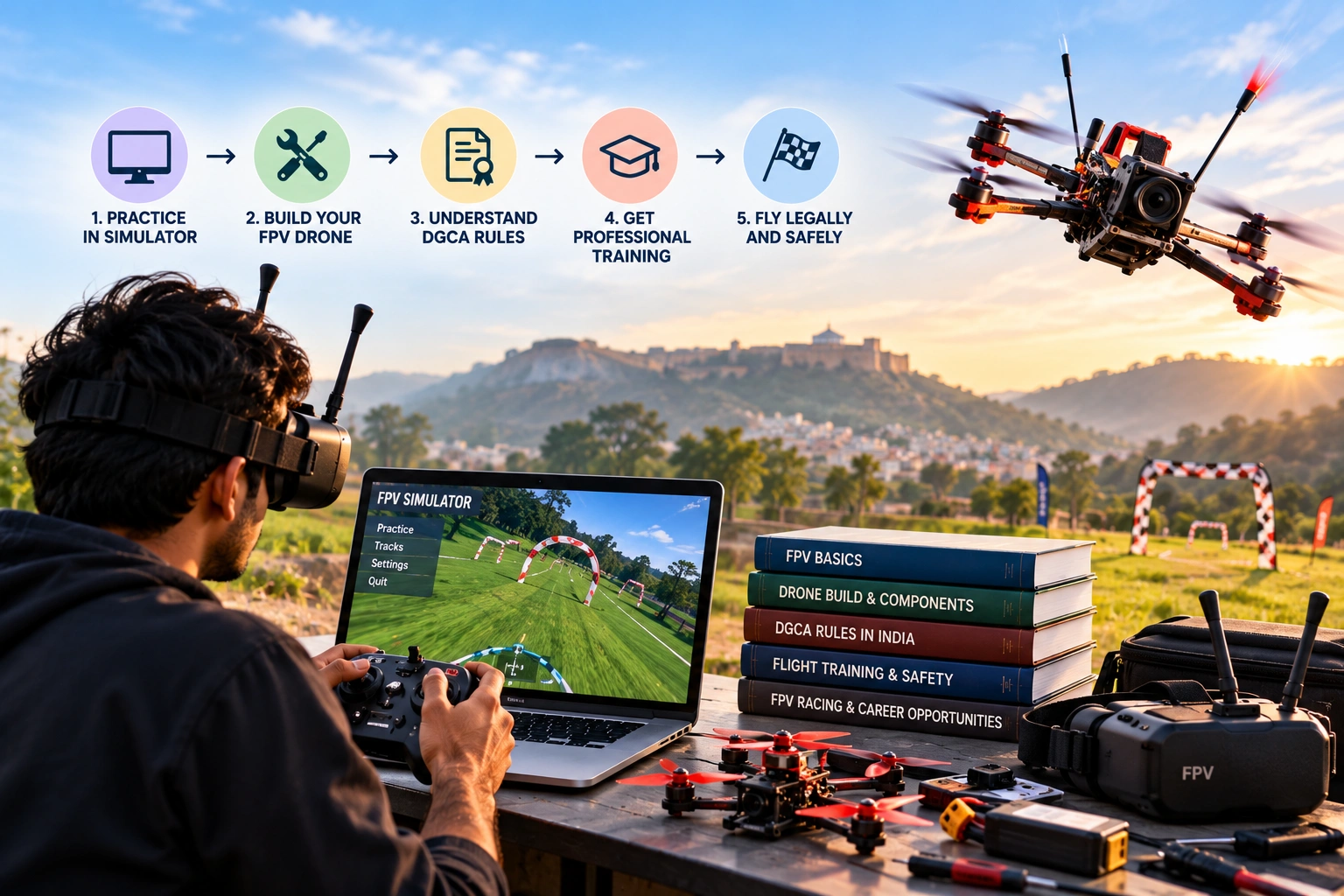
Simulator → Basic Controls → Drone Building → Safety → First Flight → Manoeuvres → Advanced FPV Skills
If you are looking for an FPV drone course, choose training that teaches both how to fly an FPV drone and how the aircraft itself works.
What Is FPV Drone Flying?
FPV stands for First Person View.
An FPV drone uses an onboard camera to transmit a live video feed to the pilot. The pilot views this feed through FPV goggles or another compatible display while controlling the aircraft using a radio transmitter.
This creates a more immersive flying experience than traditional drone operation.
FPV drones are commonly used for:
- Drone racing
- Freestyle flying
- Cinematic shots
- Real estate content
- Sports videos
- Automotive videos
- Event production
- Tourism content
- Social media videos
The flying style is also different.
Traditional camera drones are generally designed to be stable and easy to control.
FPV drones are often designed for speed, agility and rapid manoeuvring.
That is why FPV training requires a different learning approach.
Why Should You Learn FPV Drone Flying on a Simulator First?
For beginners, a simulator is one of the most useful ways to develop basic FPV control before flying a physical aircraft.
FPV drones can feel difficult to control initially because the pilot needs to coordinate multiple controls simultaneously.
A simulator allows you to practise without risking:
- The drone
- Batteries
- Propellers
- Camera equipment
- Surrounding property
What Can You Practise on an FPV Simulator?
A simulator can help you learn:
- Throttle control
- Pitch
- Roll
- Yaw
- Turns
- Orientation
- Altitude control
- Forward flight
- Reverse movement
- Basic manoeuvres
- Recovery after losing orientation
The objective is not to become an expert on the simulator.
The objective is to develop enough muscle memory that your first real flight is about learning the aircraft rather than trying to understand every control simultaneously.
What Is the Best Way for a Beginner to Learn FPV Flying?
A structured learning progression is usually more effective than trying advanced tricks immediately.
Stage 1: Understand the Controls
Learn what each stick movement does.
You should understand:
- Throttle
- Pitch
- Roll
- Yaw
Before attempting fast flying, you should be able to predict how the drone will react to your inputs.
Stage 2: Practise on a Simulator
Spend enough time developing basic control.
Focus on:
- Smooth throttle
- Straight flight
- Controlled turns
- Orientation
- Recovery
Stage 3: Learn the Drone Hardware
Understand how the major components work together.
Stage 4: Build or Assemble an FPV Drone
Hands-on assembly helps you understand the aircraft rather than treating it as a black box.
Stage 5: Start With Controlled Real-World Flights
Begin in an appropriate, safe flying environment and practise basic movements.
Stage 6: Learn FPV Manoeuvres
Once basic control becomes comfortable, progress to:
- Circuits
- Turns
- Diving
- Climbing
- Power loops
- Split-S manoeuvres
- Freestyle movements
Advanced manoeuvres should only be attempted after developing reliable basic control.
What Components Are Used in an FPV Drone?
One of the major differences between FPV and many consumer camera drones is the level of hardware knowledge involved.
A typical FPV drone can include several separate components.
FPV Frame
The frame forms the physical structure of the drone.
It holds the motors, electronics, battery and camera system.
Motors
FPV drones generally use four motors on a standard quadcopter configuration.
Motor selection affects:
- Speed
- Thrust
- Efficiency
- Flight characteristics
Electronic Speed Controllers
ESCs control the speed of the motors based on commands from the flight controller.
Flight Controller
The flight controller is one of the central electronic systems of the drone.
It processes sensor information and pilot inputs to control the aircraft.
FPV Camera
The camera provides the live video feed used by the pilot.
Video Transmitter
The video transmitter sends the camera feed to the pilot’s goggles or display.
Radio Receiver
The receiver communicates the pilot’s control inputs to the drone.
Battery
FPV drones commonly use LiPo batteries designed to provide high current for demanding flight.
Propellers
Propeller size and pitch influence the drone’s flight characteristics and efficiency.
FPV Goggles
The goggles allow the pilot to view the live feed from the aircraft.
Understanding these components is one of the reasons a good FPV drone course can be more valuable than simply purchasing a ready-to-fly drone.
Why Learn to Build an FPV Drone?
Building an FPV drone teaches you how the aircraft actually works.
Instead of simply knowing how to operate the transmitter, you begin to understand:
- Where the motors are connected
- How the flight controller works
- How the ESCs interact with the motors
- How the receiver communicates with the controller
- How the camera connects to the video system
- How the battery powers the aircraft
- How different components can be replaced
This becomes particularly useful when the drone crashes.
FPV flying involves more physical impact than many conventional drone applications, especially during freestyle practice.
Knowing how to diagnose and replace components can reduce downtime and help you maintain the aircraft.
What Should You Learn in an FPV Drone Course?
A good beginner-oriented programme should combine theory, simulator practice, hardware and real flying.
FPV Fundamentals
You should understand:
- FPV terminology
- Drone components
- Flight controls
- Flight modes
- Battery basics
- Basic maintenance
Simulator Training
The simulator should provide structured practice rather than simply giving you access to software.
Drone Building
You should learn how the major components are assembled and connected.
Configuration
Depending on the course, you may learn how to configure the flight controller, receiver and other systems.
Troubleshooting
A useful course should teach you how to identify common technical problems.
Practical Flying
After simulator practice and hardware familiarisation, students should progress to supervised real-world flying.
Safety
Safety should cover both flight operations and equipment handling.
What Is the Difference Between FPV and a Normal Camera Drone?
The biggest difference is the flying experience and aircraft design.
| FPV Drone | Conventional Camera Drone |
|---|---|
| Designed for agility and speed | Designed for stability |
| Pilot uses live FPV feed | Pilot usually views external camera feed |
| Often manually controlled | Often assisted by automated flight systems |
| Can perform aggressive manoeuvres | Usually prioritises smooth aerial footage |
| More hands-on maintenance | Often more integrated hardware |
| Common in racing and freestyle | Common in photography, mapping and inspection |
| Greater learning curve | Generally easier for beginners |
Neither type is universally better.
They are designed for different purposes.
A conventional camera drone may be more appropriate for surveying or stable aerial photography.
An FPV drone may be better when the project requires speed, dynamic movement or immersive cinematic footage.
Is FPV Drone Flying Difficult for Beginners?
FPV flying has a steeper learning curve than many GPS-assisted camera drones.
The difficulty comes from having to coordinate several controls while maintaining awareness of the drone’s orientation and movement.
For a beginner, the most difficult skills can include:
- Controlling throttle
- Maintaining altitude
- Understanding orientation
- Coordinating roll and yaw
- Recovering from mistakes
- Judging speed
- Flying through obstacles
This is why simulator training is so useful.
Instead of learning through repeated crashes, you can practise the same movement many times in a controlled digital environment.
The goal is to move from:
Conscious control → Muscle memory → Predictable flight → Creative flying
What FPV Flight Modes Should Beginners Learn?
FPV drones can be configured with different flight modes, depending on the aircraft and setup.
Stabilised Modes
These can help beginners become familiar with basic drone control.
Angle-Based Flying
The drone assists with stabilisation and limits certain movements, making it easier to learn basic control.
Acro Mode
Acro mode gives the pilot much greater manual control and is commonly associated with advanced FPV flying.
The drone does not automatically level itself after the pilot releases the controls.
This makes Acro mode powerful but considerably more difficult for beginners.
A sensible learning path is:
Simulator → Basic assisted control → Intermediate control → Acro practice → Advanced manoeuvres
The exact progression depends on the aircraft, instructor and training programme.
How Long Does It Take to Learn FPV Flying?
There is no fixed timeline because learning speed depends on:
- Previous drone experience
- Simulator practice
- Training quality
- Frequency of practice
- Aircraft setup
- Flight environment
- Individual coordination
A beginner may understand the controls relatively quickly but need significantly more practice to fly smoothly.
A useful progression is:
First Phase
Learn the controls and simulator environment.
Second Phase
Develop basic real-world flight control.
Third Phase
Practise turns, circuits and orientation.
Fourth Phase
Learn Acro control and more dynamic movements.
Fifth Phase
Develop a specialised skill such as racing, freestyle or cinematic FPV.
Consistency matters more than trying to become advanced in a few days.
What Are the Rules for Flying FPV Drones in India?
FPV flying does not mean that normal drone regulations stop applying.
DGCA’s current guidance for Remote Pilot Certificate holders states that pilots must operate applicable type-certified and registered drones, check airspace on DigitalSky before every flight, follow the applicable zone requirements, maintain safe distances and keep the drone within Visual Line of Sight (VLOS). BVLOS operations require specific approval.
The Drone Rules define VLOS as an operation where the remote pilot or observer maintains direct unaided visual contact with the unmanned aircraft.
This is particularly important for FPV pilots because goggles can limit the pilot’s direct view of the aircraft.
What Does This Mean for FPV Pilots?
You should not assume that wearing FPV goggles automatically allows you to fly beyond visual line of sight.
Before flying, understand:
- Applicable drone category
- Airspace zone
- Registration requirements
- Pilot certification requirements
- VLOS requirements
- Site restrictions
- Safety requirements
- Applicable permissions
An observer may be relevant to maintaining visual contact, but simply having another person present does not automatically authorise BVLOS operations.
The applicable DGCA rules and approvals must always be followed.
Does an FPV Drone Course Automatically Give You a DGCA Remote Pilot Certificate?
No.
This distinction is important.
An FPV course may be designed to teach:
- FPV building
- Simulator flying
- Flight controls
- Hardware
- Freestyle
- Racing
- Cinematic flying
That does not automatically mean the course is a DGCA-authorised Remote Pilot Certificate programme.
DGCA states that training for the grant of an RPC is conducted through a DGCA-authorised Remote Pilot Training Organisation (RPTO).
Therefore, before enrolling, check what the course actually provides.
Ask:
Is this an FPV skills course?
or:
Is this a DGCA-authorised pilot certification programme?
These can be two different forms of training.
Can You Learn FPV Flying Without Building a Drone?
Yes.
You can learn basic FPV flying using:
- A simulator
- A ready-to-fly FPV drone
- A trainer aircraft
- A pre-built drone
However, learning to build your own aircraft can provide a deeper understanding of the technology.
If you want to work professionally with FPV systems, hardware knowledge can be a valuable additional skill.
What Safety Practices Should FPV Beginners Follow?
FPV drones can be fast and powerful, so safety should be part of the learning process from the beginning.
Before Flying
Check:
- Frame condition
- Propellers
- Motors
- Battery
- Radio connection
- Video feed
- Flight controller
- Surrounding area
While Configuring the Drone
Avoid unnecessary risks.
When working on a powered drone, especially while configuring motors or testing systems, follow proper bench-safety procedures and keep propellers removed whenever the setup does not require them.
Battery Safety
LiPo batteries require careful handling.
Follow the manufacturer’s charging and storage instructions and use appropriate charging equipment.
Do not use visibly damaged or swollen batteries.
During Flight
Maintain awareness of:
- People
- Buildings
- Vehicles
- Trees
- Power lines
- Other aircraft
- The drone’s remaining battery
A good FPV pilot is not only fast.
A good FPV pilot knows when not to fly.
What Can You Use FPV Drones For?
FPV drones have applications beyond racing.
FPV Cinematography
Dynamic camera movement makes FPV particularly useful for:
- Films
- Advertisements
- Automotive videos
- Hotels
- Real estate
- Sports
- Tourism
- Events
Drone Racing
Competitive racing requires:
- Speed
- Precision
- Fast reactions
- Track awareness
Freestyle
Freestyle focuses on creative manoeuvres and aerial tricks.
Commercial Content
Businesses can use FPV footage for social media, campaigns and brand films.
Specialised Inspection
Some specialised applications may use FPV platforms for accessing or viewing difficult environments, subject to the applicable regulatory and operational requirements.
The value of FPV comes from the combination of speed, perspective and manoeuvrability.
How Can You Turn FPV Flying Into a Career?
If you want to pursue FPV professionally, focus on more than flying skills.
Build a combination of:
Flying + Building + Cinematography + Maintenance + Safety + Portfolio
Step 1: Learn the Basics
Understand drone hardware and FPV terminology.
Step 2: Practise on a Simulator
Develop control before risking a physical drone.
Step 3: Learn to Build
Understand how the aircraft is assembled.
Step 4: Learn Real-World Flying
Start with controlled flights and progress gradually.
Step 5: Choose a Specialisation
You could focus on:
- FPV cinematography
- Racing
- Freestyle
- Real estate
- Automotive content
- Sports
- Events
- Commercial advertising
Step 6: Build a Showreel
A professional FPV pilot needs a strong portfolio.
Show different:
- Speeds
- Camera movements
- Environments
- Subjects
- Transitions
Step 7: Learn Client Workflows
Professional work also involves:
- Understanding the brief
- Planning the flight
- Risk assessment
- Location checks
- Shooting
- Data backup
- Editing
- Delivery
This is what separates a hobby pilot from a professional FPV operator.
What Should You Look for in an FPV Drone Course?
Before enrolling, evaluate the course carefully.
Does It Include Simulator Training?
Simulator practice is particularly valuable for beginners.
Does It Include Drone Building?
Building helps you understand the aircraft and troubleshoot problems.
Is Practical Flying Included?
Real-world flying is essential for developing actual flight confidence.
Does It Teach Safety?
Safety should cover both flight operations and battery/equipment handling.
Does It Teach Troubleshooting?
Knowing how to identify and fix basic problems is valuable for FPV pilots.
Does It Explain Indian Drone Rules?
A professional course should explain the applicable regulatory environment and make clear what the course does and does not certify.
Is It a Certification Course or a Skills Course?
This should be clearly stated before you enrol.
Where Can You Learn FPV Drone Flying in India?
SkyGlimps currently offers an FPV Drone Building & Training programme in Kolkata as part of its drone training portfolio.
The programme is described as a hands-on FPV training programme where participants learn to build an FPV drone from scratch and explore simulator scenarios and controls.
This type of training is particularly useful for learners who want to understand both sides of FPV:
How to fly the drone + How the drone works
SkyGlimps also offers separate DGCA-certified small-category pilot training for learners who need the formal professional pilot certification pathway. The current DGCA programme includes simulator training, practical flying, maintenance, risk assessment, night flying and final flying assessment.
This distinction is important because FPV skills training and DGCA pilot certification are not automatically the same course.
Explore SkyGlimps FPV and Drone Training Programs
Frequently Asked Questions
An FPV drone course teaches the skills required to operate First Person View drones. Depending on the programme, it can include simulator practice, drone building, flight controls, hardware, troubleshooting, safety and practical flying.
Yes. Beginners can start with simulator training before progressing to real-world flying. A structured learning path makes it easier to develop control and reduce unnecessary crashes.
The requirement depends on the drone and intended operation. Where an RPC is applicable, the pilot needs the appropriate certification. A general FPV skills course does not automatically provide an RPC, so candidates should verify the certification scope of the training provider.
FPV flying is subject to India’s applicable drone rules and operational requirements. DGCA’s current guidance requires applicable RPC holders to maintain VLOS, check DigitalSky airspace information before flight and follow the relevant zone, safety and registration requirements.
Yes. A simulator can help beginners develop throttle, pitch, roll, yaw, orientation and recovery skills before they start flying a physical FPV drone.
Start Learning FPV Drone Flying the Right Way
Learning FPV drone flying in India is not simply about buying an FPV drone and putting on goggles.
A strong learning path is:
Simulator → Controls → Drone Building → Safety → Practical Flying → Advanced Manoeuvres → Specialisation
The simulator helps you develop control.
Building teaches you how the aircraft works.
Practical flying develops real-world confidence.
And understanding India’s drone regulations helps you operate responsibly.
For professional aspirations, you should also distinguish between an FPV drone course focused on skills and a DGCA-authorised pilot training programme leading to the applicable Remote Pilot Certificate pathway.
If your goal is FPV cinematography, racing or freestyle, develop specialised flying skills and build a strong portfolio.
If your goal is professional drone operations, combine FPV skills with the appropriate certification and regulatory knowledge.
SkyGlimps currently provides hands-on FPV Drone Building & Training in Kolkata, including drone building from scratch and simulator-based FPV control practice. It also provides a separate DGCA-certified small-category drone pilot training pathway for learners seeking professional pilot training.
The most important thing is to learn progressively.
Don’t start by trying to fly faster. Start by learning to fly better.
Once you can control the aircraft confidently, understand its hardware and operate safely, you can begin turning FPV flying into a specialised skill—and potentially into a professional career.