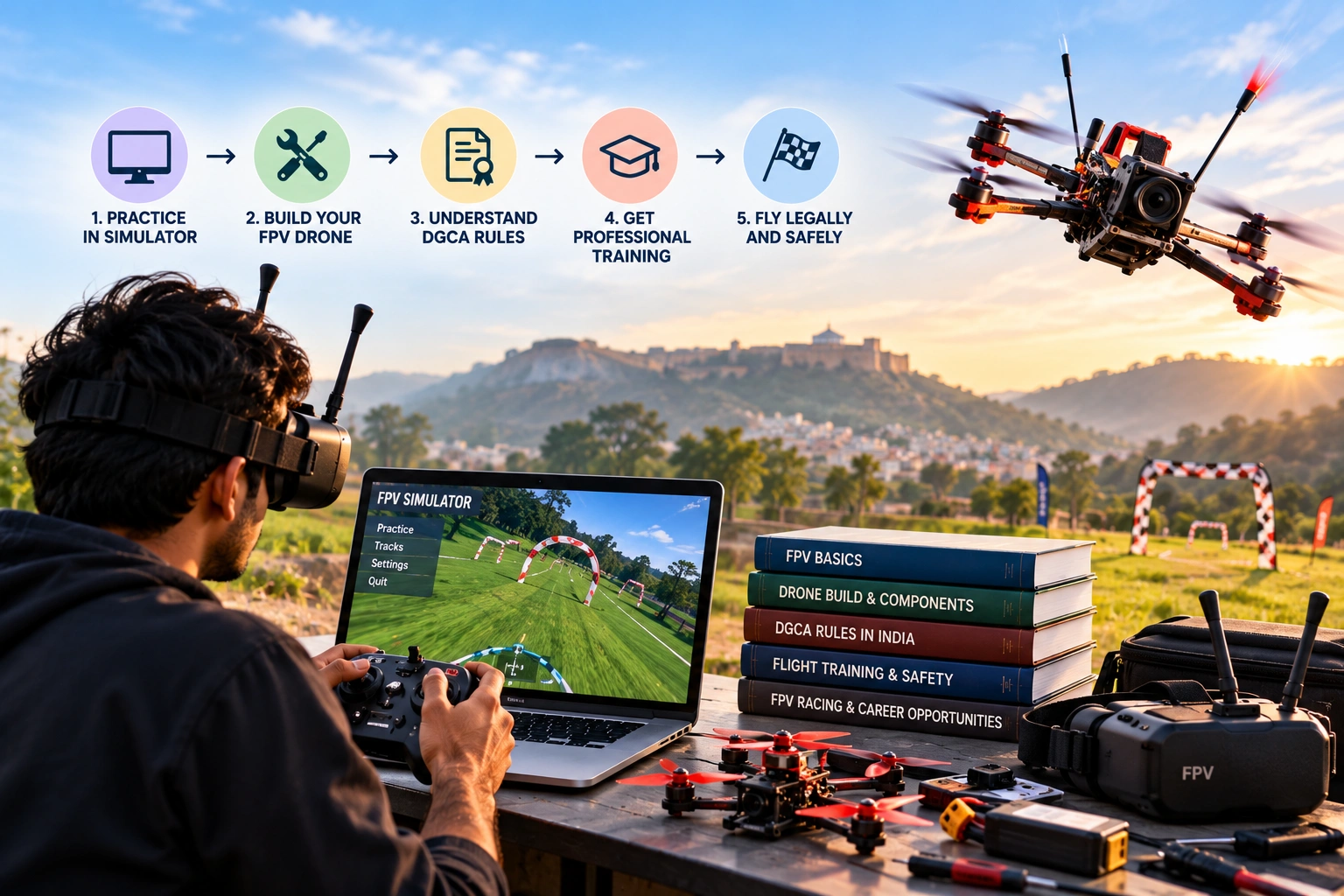
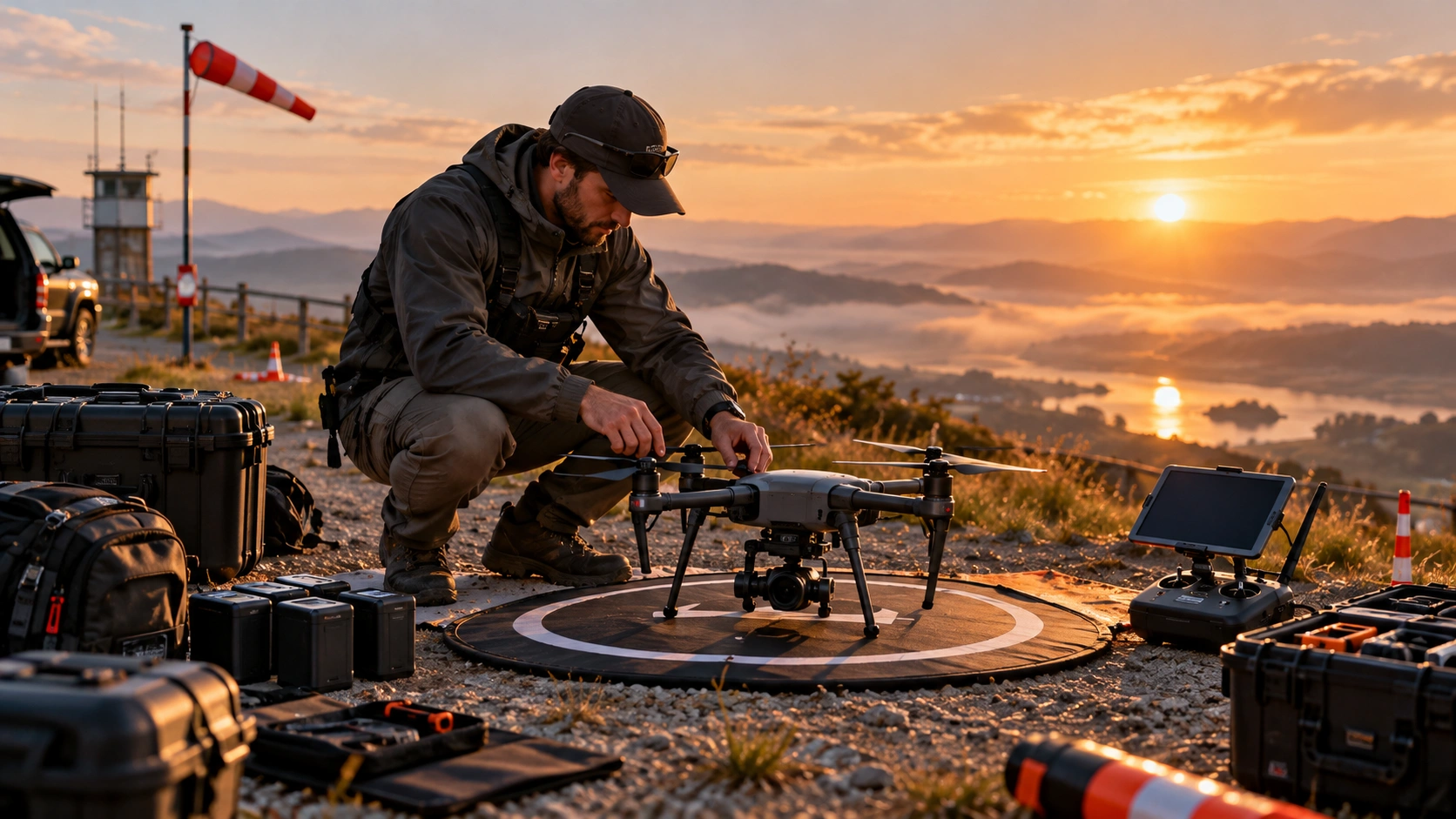
A drone flight should never begin simply because the drone has a charged battery and appears ready to take off.
Professional drone pilots follow a pre-flight checklist to verify the aircraft, flight environment, airspace, batteries, controls, payload and safety conditions before every operation.
A proper drone pre-flight checklist can help identify problems before they become flight incidents.
The basic sequence is:
Location → Airspace → Weather → Aircraft → Battery → Controls → Payload → Safety → Take-off
DGCA’s current guidance specifically instructs Remote Pilot Certificate holders to perform pre-flight checks according to the drone manufacturer’s checklist before every flight. It also requires pilots to check airspace on DigitalSky, maintain VLOS, operate applicable type-certified and registered drones, follow weather limitations and ensure required insurance is valid.
A checklist therefore isn’t just a training exercise. It is part of professional flight discipline.
Why Is a Drone Pre-Flight Checklist Important?
Even a well-maintained drone can develop a problem between flights.
A pilot may discover:
- A damaged propeller
- A loose component
- A low battery
- A blocked sensor
- Poor GPS reception
- A damaged cable
- An incorrect flight setting
- An unsuitable weather condition
- An airspace restriction
- A problem with the payload
Finding these issues before take-off is much safer than discovering them while the drone is already airborne.
A checklist also helps pilots avoid relying on memory.
When a pilot flies frequently, it can be easy to think:
“I checked everything yesterday.”
But yesterday’s conditions do not guarantee today’s conditions.
The aircraft, location, weather, airspace and mission can all be different.
What Should You Check Before Flying a Drone?
A professional pre-flight inspection can be divided into several stages.
1. Confirm the Flight Location
Start by confirming exactly where the drone will operate.
Check:
- Take-off location
- Landing location
- Planned flight area
- Nearby buildings
- Roads
- People
- Power lines
- Trees
- Structures
- Other potential obstacles
The flight area should be suitable for the planned operation.
For commercial or professional work, also confirm that you have the necessary site or client permissions.
2. Check the DigitalSky Airspace Status
Airspace should be checked before every flight.
DGCA’s current guidance specifically instructs RPC holders to check airspace on the DigitalSky platform before every flight. It also states that pilots must obtain the applicable permission for Yellow or Red Zones and must comply with the relevant operating requirements.
Do not assume that because a location was suitable yesterday, it is automatically suitable today.
Check the current status for the exact operating location.
3. Check Temporary Restrictions
In addition to the normal airspace status, pilots should look for any temporary restrictions or notifications affecting the planned operation.
These can be particularly important around:
- Airports
- Large public events
- Government facilities
- Security-sensitive locations
- Temporary flight restrictions
- Other restricted areas
A trained pilot checks the current information rather than relying on an old screenshot or previous flight plan.
What Weather Conditions Should Drone Pilots Check?
Weather can significantly affect drone performance and flight safety.
Before flying, check:
- Wind speed
- Wind direction
- Rain
- Visibility
- Temperature
- Thunderstorms
- Cloud conditions
- Forecast changes
Wind
Strong or gusty winds can affect:
- Battery consumption
- Flight stability
- Position holding
- Return-to-home performance
- Landing
A drone that is comfortable in calm conditions may behave differently in strong wind.
Rain
Do not assume that a drone is safe to fly in rain simply because it can remain airborne.
Check the manufacturer’s specifications and operating limitations.
DGCA’s current RPC guidance states that drones should be flown only in weather conditions permitted by the drone’s type certificate.
Visibility
Poor visibility can make it difficult to maintain safe visual contact with the aircraft.
For professional operations, weather should be assessed before take-off and monitored during the flight.
What Aircraft Checks Should Be Included in a Drone Pre-Flight Checklist?
Once the location, airspace and weather have been assessed, inspect the aircraft.
Check the Frame
Look for:
- Cracks
- Damage
- Loose parts
- Signs of previous impact
- Unusual movement
A damaged frame can affect flight stability.
Check the Propellers
Inspect every propeller for:
- Cracks
- Chips
- Bends
- Deformation
- Incorrect installation
- Loose mounting
Damaged propellers can create vibration and affect aircraft performance.
Check the Motors
Rotate the motors as appropriate during the ground inspection and look for:
- Unusual resistance
- Debris
- Visible damage
- Loose mounting
- Abnormal movement
Do not operate damaged motors simply because the drone still powers on.
Check Landing Gear
If the drone has landing gear, inspect it for cracks, looseness or damage.
This is especially important because landing gear can absorb impact during previous operations.
How Should You Check the Drone Battery?
Battery condition is one of the most important parts of a pre-flight inspection.
Check:
- Battery charge level
- Physical condition
- Swelling
- Damage
- Connector condition
- Temperature
- Battery installation
- Remaining battery cycles, where applicable
A battery that appears charged is not necessarily a healthy battery.
What Should You Never Ignore?
Do not use a battery that is visibly:
- Swollen
- Cracked
- Damaged
- Leaking
- Abnormally hot
Follow the battery manufacturer’s charging, storage and handling instructions.
For longer missions, calculate whether the available battery capacity is sufficient for the planned operation rather than assuming that the advertised flight time will always be achievable.
What Should You Check on the Remote Controller?
Before take-off, confirm that the controller is ready.
Check:
- Controller battery
- Control sticks
- Buttons and switches
- Screen
- Connection to the aircraft
- Antenna position
- Flight mode
- Control inputs
Make sure the controls are responding correctly before take-off.
A controller setting accidentally left from a previous flight can create an unnecessary risk.
What Should You Check in the Flight App?
If your drone uses a flight-control application, review the settings before starting the mission.
Check:
- Aircraft connection
- GPS status
- Home point
- Return-to-home settings
- Maximum altitude
- Maximum distance
- Flight mode
- Battery information
- Compass or sensor warnings
- Firmware or system warnings
- Map information
Return-to-Home Settings
The pilot should understand exactly what the drone will do if the connection is lost or the return-to-home function is activated.
Check the configured return altitude against the surrounding environment.
Do not blindly accept a default setting.
How Do You Check GPS and Navigation Systems?
Depending on the drone, navigation may rely on GPS/GNSS and other onboard sensors.
Before take-off, check whether the aircraft reports the expected navigation status.
Look for:
- Adequate satellite reception
- Home-point confirmation
- Compass or navigation warnings
- Sensor warnings
- Positioning status
Do not rush into take-off if the aircraft reports a significant navigation warning.
The correct response depends on the drone manufacturer’s procedures and the specific warning.
What Should You Check During a Control Test?
Before leaving the ground, pilots can verify that the aircraft responds correctly to control inputs.
This can include checking:
- Throttle
- Yaw
- Pitch
- Roll
- Flight-mode response
- Camera or gimbal controls
- Other mission-specific controls
DGCA’s remote-pilot training material includes equipment setup and inspection, pre-flight checks, controls checks and practical take-off procedures as part of pilot training.
This is why trained pilots do not treat the first seconds of flight as the time to discover whether the controls work.
How Should the Drone Payload Be Checked?
The payload depends on the mission.
It could be:
- RGB camera
- Thermal camera
- Mapping camera
- Survey sensor
- Spraying system
- Lighting equipment
- Other specialised equipment
Before flight, check:
- Secure mounting
- Cable connections
- Power connection
- Memory card
- Storage capacity
- Camera settings
- Lens condition
- Gimbal movement
- Sensor configuration
For mapping missions, also confirm that the camera settings and mission parameters are appropriate before starting the flight.
What Safety Checks Should Be Completed Before Take-Off?
The pilot should look at the area from an operational perspective rather than only checking the aircraft.
Confirm:
- People are clear of the immediate take-off area
- Vehicles are not entering the operating area
- No unexpected aircraft are nearby
- Obstacles are identified
- The take-off area is stable
- The landing area is available
- Emergency landing options are understood
- The pilot can maintain visual contact
DGCA’s current guidance requires RPC holders to maintain Visual Line of Sight and maintain safe distances from people and property.
What Should You Check Before a Commercial Drone Flight?
Professional flights often require additional checks beyond the aircraft itself.
Before a commercial assignment, confirm:
- Client requirements
- Site permission
- Flight location
- Airspace status
- Pilot certification
- Drone registration
- Applicable insurance
- Weather
- Equipment
- Batteries
- Payload
- Data-storage capacity
- Emergency procedures
This becomes particularly important for projects such as:
- Construction surveys
- Infrastructure inspections
- Real estate photography
- Agricultural operations
- Industrial inspections
- Mapping
- Aerial cinematography
The more complex the mission, the more important structured preparation becomes.
Drone Pre-Flight Checklist for Professional Pilots
A simple checklist can be divided into the following sequence:
| Check | What to Verify |
|---|---|
| Location | Take-off area, landing area and obstacles |
| Airspace | Current DigitalSky status and applicable restrictions |
| Permissions | Required approvals and site permissions |
| Weather | Wind, rain, visibility and operating conditions |
| Aircraft | Frame, motors, propellers and landing gear |
| Battery | Charge, condition and installation |
| Controller | Battery, connection and controls |
| Navigation | GPS/GNSS, home point and warnings |
| Flight Settings | Altitude, distance, flight mode and RTH |
| Payload | Camera, sensor, gimbal and connections |
| Safety | People, property, obstacles and emergency options |
| Documentation | Required records, insurance and mission details |
This checklist can be adapted to the specific aircraft and mission.
The manufacturer’s checklist should always take priority for aircraft-specific inspection requirements.
What Is the Difference Between a Pre-Flight Check and Drone Maintenance?
These two processes are related but not the same.
Pre-Flight Check
A pre-flight check happens before an individual flight.
It focuses on whether the aircraft and operating environment are ready right now.
Maintenance
Maintenance is performed according to the manufacturer’s maintenance schedule and procedures.
It can involve:
- Component inspection
- Cleaning
- Part replacement
- Firmware-related procedures
- Battery assessment
- Motor checks
- Repair
- Documentation
DGCA’s current guidance states that pilots should ensure drone maintenance has been carried out according to the manufacturer’s maintenance manual.
A drone can therefore be properly maintained and still require a complete pre-flight inspection before its next flight.
What Happens If a Drone Fails a Pre-Flight Check?
Do not simply take off because the problem appears minor.
The correct response depends on the issue.
Minor Operational Issue
If a setting is incorrect, correct it before flight and verify the aircraft again.
Equipment Problem
If a component is damaged or malfunctioning, follow the manufacturer’s procedures and repair or replace it before flying.
Weather Problem
Delay the flight until conditions become suitable.
Airspace Problem
Do not begin the operation until the applicable requirements are satisfied.
Safety Problem
Reassess the location or mission.
A professional pilot should be comfortable saying:
“The flight is not ready yet.”
Safety should take priority over meeting an arbitrary schedule.
Why Do Trained Drone Pilots Use Checklists?
Checklists are not a sign that a pilot lacks experience.
They are a way of making experienced behaviour consistent.
A trained pilot may perform hundreds of flights, but the same basic questions still need to be answered:
Is the aircraft safe?
Is the location suitable?
Is the airspace clear for this operation?
Is the weather acceptable?
Are the controls working?
Is the battery healthy?
Can I maintain visual contact?
What happens if something goes wrong?
DGCA’s training framework itself includes risk assessment, safety management, emergency procedures, equipment setup, inspection and pre-flight checks as part of remote-pilot training.
What Should Beginners Learn About Pre-Flight Checks?
If you are learning to become a professional drone pilot, do not treat the checklist as something you memorise only for an examination.
Understand why each check matters.
For example:
Why inspect propellers?
Because damage can affect thrust and stability.
Why check batteries?
Because battery condition directly affects flight endurance and reliability.
Why check airspace?
Because a location that looks physically safe may still have an applicable airspace restriction.
Why check weather?
Because wind, rain and visibility can change the safety of the operation.
Why check the home point?
Because automated return functions depend on correct positioning and configuration.
Understanding the reason behind each check makes it much easier to apply the checklist correctly in real-world situations.
How Does Pre-Flight Training Prepare Professional Drone Pilots?
A structured drone pilot course should teach more than basic stick movements.
DGCA’s training syllabus includes:
- Air law
- Airspace
- Flight principles
- Weather and meteorology
- Drone equipment maintenance
- Risk assessment
- Emergency procedures
- Payload operation
- Drone data
- Practical flight training
Its practical syllabus also includes equipment setup and inspection, pre-flight checks, control checks, take-off, landing, emergency procedures and other flight exercises.
This gives new pilots an understanding of why preparation is an essential part of professional drone operations.
Where Can You Learn Professional Drone Pilot Training in India?
If you want to become a professional drone pilot, look for training that combines classroom knowledge, simulator practice, practical flying, safety procedures and assessment.
SkyGlimps currently offers DGCA-Certified Small Category Drone Pilot Training in Kolkata. Its programme includes regulatory training, flight fundamentals, weather, maintenance, risk assessment, safety, payload operations, simulator training, practical flying and final flying assessment.
The programme also includes practical exposure to equipment and flight procedures, helping learners understand that professional drone operation begins before the aircraft takes off.
Explore SkyGlimps DGCA-Certified Drone Training
Frequently Asked Questions
A drone pre-flight checklist is a systematic set of checks performed before take-off to verify the aircraft, batteries, controls, payload, airspace, weather, location and safety conditions.
At minimum, check the flight location, DigitalSky airspace status, weather, aircraft condition, propellers, batteries, controller, navigation status, flight settings, payload and surrounding area. DGCA also requires applicable pilots to follow the manufacturer’s pre-flight checklist.
DigitalSky provides the applicable airspace information and restrictions for drone operations. DGCA’s current guidance specifically instructs RPC holders to check the platform before every flight.
No. The issue should be corrected or assessed according to the manufacturer’s procedures before the flight begins. If the aircraft, weather, airspace or operating environment is unsuitable, the flight should be delayed or cancelled.
DGCA’s current guidance for RPC holders states that pilots should perform pre-flight checks according to the OEM checklist before every flight. Professional training also includes pre-flight checks and equipment inspection as part of practical flight preparation.
Make the Pre-Flight Check Part of Every Flight
A professional drone flight begins long before the aircraft leaves the ground.
The pilot first checks the location, airspace and weather.
Then comes the aircraft, battery, controller, navigation system and payload.
Finally, the pilot checks the people, property, obstacles, emergency procedures and overall operating environment.
The process can be summarised as:
Plan → Check → Confirm → Fly → Monitor → Land → Document
A checklist may take only a few minutes, but it can prevent problems that are much more difficult to handle once the drone is airborne.
For aspiring pilots, learning how to perform these checks correctly should be part of professional drone training—not something added after learning how to fly.
SkyGlimps’ DGCA-Certified Small Category Drone Pilot Training in Kolkata includes practical flight preparation, equipment inspection, simulator training, safety, maintenance, risk assessment and supervised practical flying.
The objective of professional drone training is not simply to teach someone how to make a drone take off.
It is to teach them how to plan the operation, assess the risks, operate the aircraft safely and make informed decisions before, during and after every flight.
That is why a trained pilot does not ask only:
“Can I fly today?”
They first ask:
“Is everything ready for me to fly safely today?”