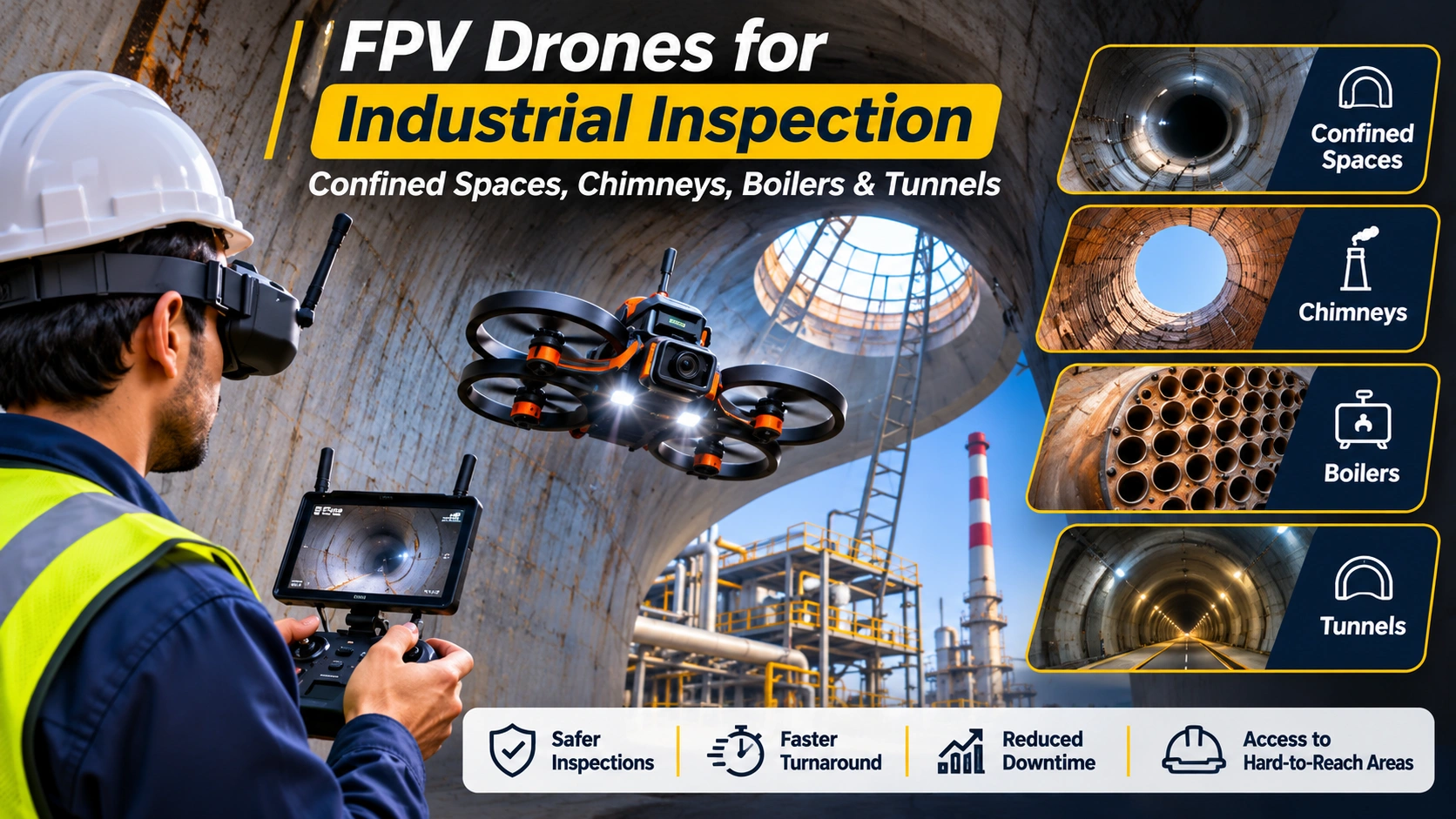
Industrial facilities contain many areas that are difficult, expensive or potentially hazardous for people to inspect.
Examples include:
- Storage tanks
- Industrial chimneys
- Boilers
- Tunnels
- Shafts
- Silos
- Process vessels
- Large ducts
- Underground infrastructure
- Hard-to-access structures
Traditionally, inspections in these environments may require scaffolding, rope access, shutdowns or confined-space entry procedures.
Specialised drones can provide another option.
A properly selected and operated FPV drone for confined space inspection can allow an inspection team to capture close-range visual information while keeping personnel outside the immediate inspection area.
However, there is an important distinction between a normal recreational FPV drone and a professional indoor inspection platform.
A racing or freestyle FPV drone is not automatically suitable for industrial inspection.
Professional confined-space inspection may require:
Collision protection + Powerful lighting + Reliable communication + GPS-denied navigation + High-resolution cameras + Appropriate operational procedures
Specialist inspection drones are already being used for tanks, boilers, chimneys, tunnels and other enclosed industrial environments. (Association for Drones)
What Is FPV Drone Confined Space Inspection?
FPV drone confined space inspection uses a drone equipped with a live camera feed that allows the pilot to see the environment from the aircraft’s perspective.
This can be particularly useful when the drone needs to:
- Enter through a small opening
- Fly close to internal walls
- Navigate around structures
- Inspect elevated surfaces
- Operate where GPS is unavailable
- Capture visual evidence from difficult angles
The pilot can see the live video feed while controlling the aircraft remotely.
In professional inspection environments, the drone may also carry:
- High-resolution RGB cameras
- Thermal cameras
- LiDAR
- Powerful lighting
- Other specialised sensors
The objective is not simply to fly inside a confined area.
It is to capture useful inspection data that helps engineers and maintenance teams make decisions.
Why Are FPV Drones Useful for Confined Space Inspection?
The biggest advantage is access.
A conventional inspection may require personnel to physically enter an enclosed structure or install access equipment before the inspection can begin.
A drone can sometimes enter the space first and provide an initial visual assessment.
This can help teams determine:
- Whether visible damage exists
- Where defects may be located
- Whether additional inspection is necessary
- Where personnel may eventually need to focus
- Whether access equipment is actually required
Specialist indoor drone systems are designed specifically for environments such as tanks, boilers, chimneys and tunnels, where collision tolerance and GPS-free navigation can be important. (Multinnov)
This can make the initial inspection faster and reduce unnecessary exposure to difficult environments.
How Are FPV Drones Different From Normal Inspection Drones?
Not every drone is designed for confined spaces.
A conventional GPS-assisted camera drone is generally designed for outdoor flight.
Inside a building, tank or chimney, GPS may be unavailable and there may be:
- Poor lighting
- Narrow openings
- Metal structures
- Dust
- Repetitive surfaces
- Weak communication
- Tight clearances
A specialised FPV or indoor inspection platform is designed around these challenges.
| Standard Camera Drone | Specialised Indoor FPV/Inspection Drone |
|---|---|
| Primarily outdoor use | Designed for difficult indoor environments |
| Often relies on GPS/GNSS outdoors | Can use GPS-denied navigation |
| Limited collision tolerance | Often uses protective structures |
| General photography | Inspection-focused imagery |
| Less suitable for tight spaces | Designed for confined access |
| Conventional flight environment | Complex industrial environment |
A professional inspection team should select the platform according to the environment rather than assuming that any FPV drone can perform the job.
Can FPV Drones Inspect Industrial Chimneys?
Yes, specialised drones can be used for suitable chimney and stack inspections.
Industrial chimneys can be difficult to inspect manually because of their:
- Height
- Internal geometry
- Vertical walls
- Restricted access
- Potentially difficult working conditions
A drone can fly through suitable openings and capture visual information from the internal structure.
Potential inspection targets can include:
- Internal lining
- Cracks
- Surface deterioration
- Deposits
- Corrosion
- Joints
- Structural features
- Areas requiring closer investigation
Specialist drone inspection providers use indoor platforms for chimneys and stacks because these environments can require GPS-independent navigation and collision protection. (ScoutDI)
Why Is FPV Useful Inside a Chimney?
The first-person camera view allows the pilot to make precise movements while maintaining visual awareness of the drone’s surroundings.
This can be particularly useful when:
- The space is dark
- The structure is tall
- The drone needs to stay close to the wall
- The inspection requires detailed visual footage
- The aircraft must navigate around internal structures
However, the chimney must be assessed for temperature, airflow, contamination, communication and other site-specific conditions before flight.
How Can Drones Help With Boiler Inspection?
Boilers and combustion chambers can contain large internal areas with difficult access.
During an appropriate shutdown and after the asset has been safely prepared, a specialist inspection drone can capture visual information from:
- Boiler walls
- Tubes
- Refractory surfaces
- Internal structures
- Deposits
- Visible cracks
- Areas of deterioration
This can provide an initial condition assessment before maintenance personnel enter the space.
Specialist confined-space drone inspection providers list boilers among the applications where drones can capture visual data while personnel remain outside the inspection area. (Association for Drones)
The drone does not automatically replace detailed inspection.
Instead, it can help answer:
Where should the inspection team look more closely?
Can FPV Drones Inspect Tunnels?
Tunnels are another environment where drone inspection can be useful.
Applications can include:
- Road tunnels
- Railway tunnels
- Utility tunnels
- Mining tunnels
- Drainage structures
- Industrial passages
A drone can capture visual information from:
- Tunnel walls
- Ceilings
- Structural elements
- Lighting systems
- Pipework
- Cable routes
- Visible cracks
- Water ingress
- Deposits
- Other accessible features
LiDAR can also be added to suitable platforms to create three-dimensional information about the tunnel.
Specialist inspection platforms are used for tunnels and other GPS-denied environments where conventional outdoor drone navigation may not work reliably. (Summit Infrastructure)
What Defects Can FPV Inspection Drones Help Identify?
The exact defects depend on the asset and sensor, but visual drone inspection can help document conditions such as:
Cracks
High-resolution imagery can document visible cracks in:
- Concrete
- Refractory surfaces
- Structural elements
- Internal walls
The image can help identify the location and appearance of a crack, but determining its structural significance may require engineering assessment.
Corrosion
Drone imagery can document visible corrosion on:
- Steel structures
- Tanks
- Chimneys
- Pipework
- Industrial components
Surface Deterioration
Drones can capture:
- Peeling
- Spalling
- Coating damage
- Surface wear
- Deposits
- Material deterioration
Deformation
Close-range imagery can help identify visible changes in the shape or alignment of components.
Deposits and Blockages
In some industrial environments, drones can document:
- Material deposits
- Ash accumulation
- Dust
- Debris
- Obstructions
The drone’s role is primarily to capture evidence. Final engineering diagnosis should be performed by appropriately qualified personnel.
Can Thermal Cameras Be Used With Industrial Inspection Drones?
Yes, thermal imaging can add another layer of information where the platform and operating environment support it.
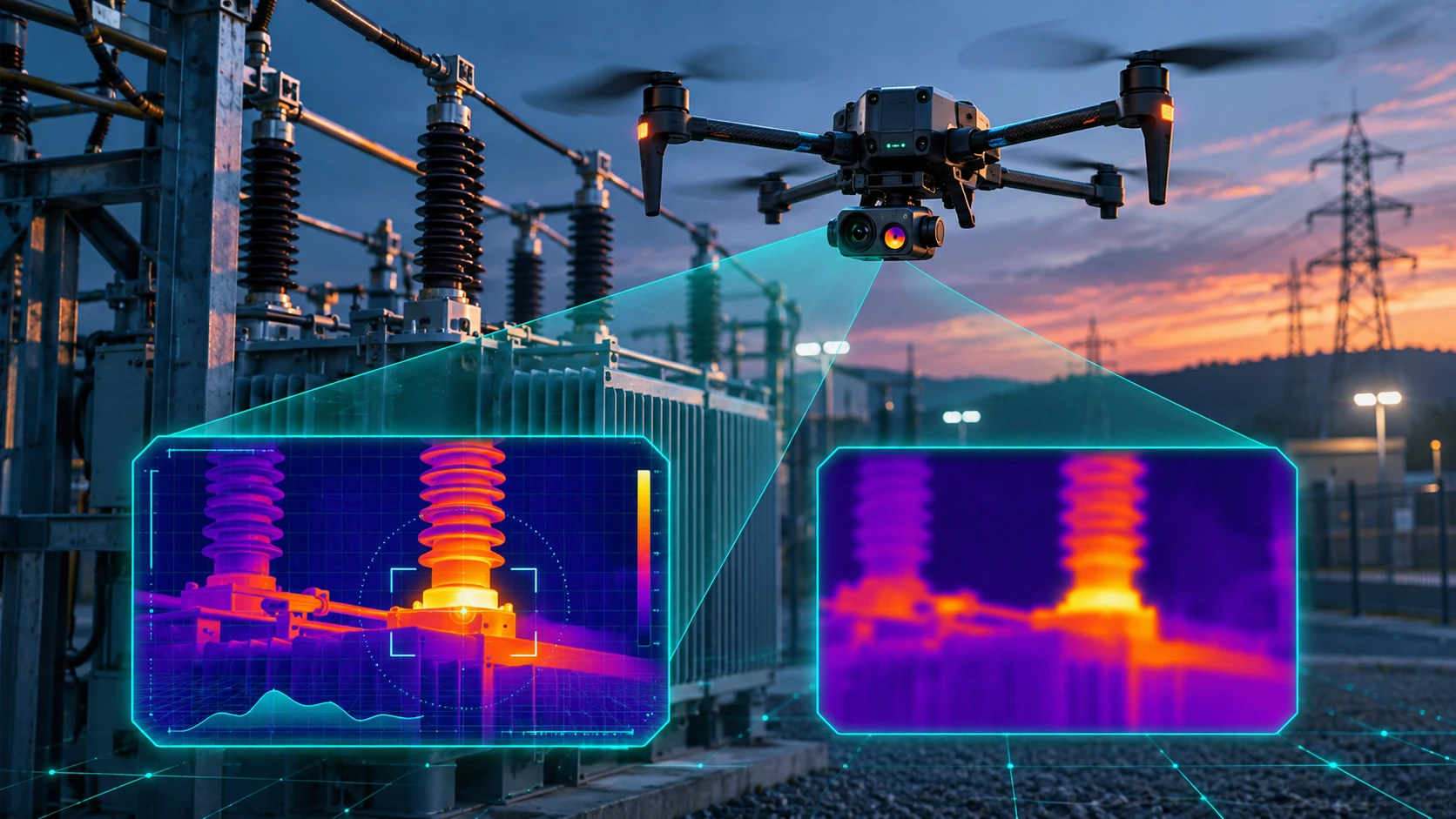
A thermal camera can detect differences in apparent surface temperature that may not be visible through an RGB camera.
Potential applications include:
- Equipment overheating
- Heat-loss areas
- Insulation issues
- Thermal leakage
- Abnormal heat patterns
- Certain electrical or mechanical anomalies
SkyGlimps currently provides Thermal & RGB Inspection services using synchronised visual and infrared data, with applications across industrial facilities, infrastructure, energy and utilities. SkyGlimps Thermal & RGB Inspection Services
However, thermal data must be interpreted according to the asset, operating condition and environmental factors.
A thermal anomaly is a finding requiring investigation, not automatically proof of a specific defect.
What Role Does LiDAR Play in Confined Space Inspection?
LiDAR can provide three-dimensional information about an enclosed environment.
Instead of only collecting photographs, a suitable LiDAR-equipped drone can create point-cloud data that helps represent:
- Internal geometry
- Distances
- Structural surfaces
- Tunnel profiles
- Asset dimensions
- Spatial relationships
This can be useful for:
- Tunnel mapping
- Tank documentation
- Chimney geometry
- Industrial structures
- 3D asset records
- Repeat inspections
For large or complex industrial assets, combining RGB + Thermal + LiDAR can provide a more complete dataset than using visual imagery alone.
What Makes Confined Space Drone Inspection Difficult?
Industrial indoor flight is technically challenging.
GPS May Not Be Available
Inside tunnels, tanks and chimneys, conventional GNSS positioning may not work.
The drone may therefore need:
- Visual-inertial navigation
- LiDAR-based positioning
- SLAM
- Manual control
- Other localisation technologies
Research into industrial confined-space drone inspection has identified GPS-denied environments, poor lighting, magnetic interference, communication challenges and repetitive structures as important technical problems. (SAGE Journals)
Communication Can Be Difficult
Concrete, steel and underground structures can affect radio communication.
Long tunnels can also create problems when the drone moves far away from the pilot or around bends.
Before deployment, the team should understand:
- Expected communication range
- Potential dead zones
- Recovery procedures
- Emergency landing options
Lighting Can Be Poor
Industrial interiors can be completely dark.
A suitable inspection platform therefore needs sufficient lighting to capture useful imagery.
Collision Risk Is Higher
Inside a confined environment, there may be very little room for error.
The drone can encounter:
- Walls
- Pipes
- Beams
- Cables
- Structural members
- Internal equipment
This is why collision-tolerant platforms can be particularly valuable.
Why Are Caged FPV Drones Useful for Industrial Inspection?
A protective cage can help protect the drone’s propellers and internal components when the aircraft contacts a wall or structure.
This can be especially useful in environments where:
- GPS is unavailable
- Space is limited
- Visibility is poor
- Contact with surfaces is possible
However, a protective cage does not make every drone suitable for every hazardous environment.
The aircraft must still be appropriate for the:
- Temperature
- Atmosphere
- Dust
- Moisture
- Chemical conditions
- Communication environment
- Required inspection objective
This distinction is critical for industrial projects.
Can Drones Completely Eliminate Confined-Space Entry?
Not always.
Drone inspection can reduce or delay the need for personnel to enter a difficult space, but it does not automatically eliminate every form of human inspection.
A drone may identify:
“There is a possible crack in this area.”
An engineer or inspection specialist may still need to perform:
- Close visual inspection
- Thickness measurement
- Ultrasonic testing
- Other NDT
- Physical verification
- Engineering assessment
Therefore, the best approach is often:
Drone Screening → Finding Identification → Technical Verification → Engineering Decision
This hybrid workflow can reduce unnecessary human exposure while keeping detailed technical assessment where it is actually needed.
What Safety Checks Are Required Before Confined Space Drone Inspection?
Safety planning becomes even more important when a drone is being used inside an industrial environment.
Before flight, the inspection team should assess:
- Asset condition
- Access opening
- Temperature
- Atmosphere
- Gas hazards
- Dust
- Moisture
- Internal airflow
- Communication
- Emergency recovery
- Battery limitations
- Personnel location
- Other equipment operating nearby
A drone should never be assumed to be safe for an explosive, toxic or oxygen-deficient environment simply because it can physically enter the space.
Site-specific risk assessment and appropriately rated equipment may be required.
Industry guidance on confined-space drone inspection similarly emphasises that equipment suitability depends on the environment and that hazardous atmospheres may require specially certified equipment. (Association for Drones)
What Should an Industrial Drone Inspection Report Include?
The value of a drone inspection is not limited to the video captured during the flight.
A useful report should connect findings to the asset and location.
Depending on the project, deliverables can include:
- Inspection video
- High-resolution still images
- Thermal imagery
- 3D point cloud
- Location-tagged findings
- Defect register
- Asset references
- Annotated images
- Severity or priority classification
- Inspection summary
- Recommended follow-up
SkyGlimps’ inspection workflow similarly focuses on RGB and thermal imagery, annotated findings, asset references, hotspot registers and structured inspection reports. (SkyGlimps)
The objective should be to help the maintenance or engineering team answer:
Where is the issue?
What does it look like?
Which asset is affected?
What should be investigated next?
How Can FPV Drones Reduce Industrial Inspection Costs?
The cost benefit does not come simply from the drone being cheaper than a human inspection.
The potential savings can come from reducing the need for:
- Scaffolding
- Elevated access equipment
- Extensive preparation
- Initial confined-space entry
- Large inspection teams
- Unnecessary shutdown-related access work
Specialist drone inspections can therefore be particularly valuable when conventional access is expensive or time-consuming.
However, the actual saving depends on the asset, inspection scope, drone capability and site conditions.
A drone inspection should be evaluated based on the complete inspection workflow, not simply the cost of operating the aircraft.
What Industries Can Use FPV Drone Inspection?
Industrial drone inspection can support several sectors.
Power Generation
Potential applications include:
- Boilers
- Chimneys
- Cooling structures
- Industrial facilities
Oil and Gas
Applications can include:
- Tanks
- Vessels
- Process structures
- Chimneys
- Confined industrial areas
Mining
Drones can support inspection of:
- Shafts
- Tunnels
- Underground structures
- Difficult-access areas
Infrastructure
Applications can include:
- Tunnels
- Bridges
- Culverts
- Large structures
Manufacturing
Drones can support visual inspection of:
- Factory structures
- Equipment
- Warehouses
- High-level areas
The exact application depends on the drone platform, environment and safety requirements.
Is a Standard FPV Drone Suitable for Industrial Inspection?
Not necessarily.
This is one of the most important distinctions to understand.
A standard freestyle or racing FPV drone is generally designed for speed, agility and recreational or cinematic flying.
Industrial inspection requires different priorities:
Safety + Stability + Collision Tolerance + Lighting + Data Quality + Navigation + Reliability
A specialised inspection drone may therefore be a better choice than a conventional FPV racing platform.
SkyGlimps’ FPV training programme teaches participants to build an FPV drone and practise simulator scenarios and controls, while its separate inspection services use specialised thermal and RGB workflows for industrial and infrastructure applications. SkyGlimps FPV Drone Training
This distinction is important for anyone considering FPV as a professional skill.
Where Can Businesses Use Drone Inspection in India?
SkyGlimps provides drone inspection services for industrial, infrastructure, energy and utility applications, including thermal and RGB inspection workflows.
Its current service portfolio covers:
- Industrial facilities
- Power and energy
- Utilities
- Solar assets
- Infrastructure
- Buildings
- Difficult-to-access areas
Explore SkyGlimps Drone Inspection Services
For a confined-space project, the appropriate drone platform should be selected after reviewing the asset, access opening, atmosphere, temperature, communication conditions, inspection objective and required deliverables.
Frequently Asked Questions
1. What is FPV drone confined space inspection?
FPV drone confined space inspection uses a drone with a live first-person camera view to inspect difficult or enclosed environments such as tanks, chimneys, boilers and tunnels while keeping inspection personnel outside the immediate area where practical.
2. Can FPV drones inspect inside chimneys and boilers?
Specialised inspection drones can be used in suitable chimneys and boilers, particularly during planned shutdowns and after the asset has been made safe for inspection. The platform must be appropriate for the environment and operating conditions.
3. Can drones inspect tunnels without GPS?
Yes. Specialist indoor inspection drones can use technologies such as visual-inertial navigation, LiDAR or SLAM to operate in GPS-denied environments. The exact navigation method depends on the platform and tunnel conditions.
4. Can an industrial drone replace human inspection?
Not in every situation. Drones can provide visual screening and help locate areas requiring closer examination, but detailed NDT, measurements and engineering assessment may still require qualified personnel.
5. Are normal FPV racing drones suitable for confined-space inspection?
Not automatically. Industrial confined-space inspection often requires collision protection, suitable lighting, reliable navigation, communication and equipment appropriate for the environment. A standard racing or freestyle FPV drone may not provide these capabilities.
Use FPV Technology Where Traditional Inspection Becomes Difficult
Industrial inspection is moving beyond the question of whether a person can physically reach an asset.
The more useful question is:
“Can we collect reliable inspection data without unnecessarily putting people into difficult environments?”
This is where specialised FPV and indoor inspection drones can provide value.
For confined spaces, they can provide an initial visual assessment.
For chimneys, they can capture internal surfaces from difficult vertical positions.
For boilers, they can document internal structures during suitable shutdown conditions.
For tunnels, they can capture visual information and, where supported, three-dimensional spatial data.
The workflow can be summarised as:
Plan → Assess Risk → Select Platform → Inspect → Capture Data → Identify Findings → Verify → Report → Maintain
The most important point is that FPV drone confined space inspection is not simply FPV flying in a smaller room.
Industrial inspection requires the right aircraft, sensors, navigation system, lighting, safety procedures and reporting workflow.
When these elements are combined correctly, drones can help inspection teams access difficult environments, reduce unnecessary exposure to hazards and create a digital record that engineers and maintenance teams can use for better decisions.
For organisations working with industrial assets, the value of the drone is ultimately measured not by how impressive the flight looks, but by how useful the inspection data becomes after the flight is complete.