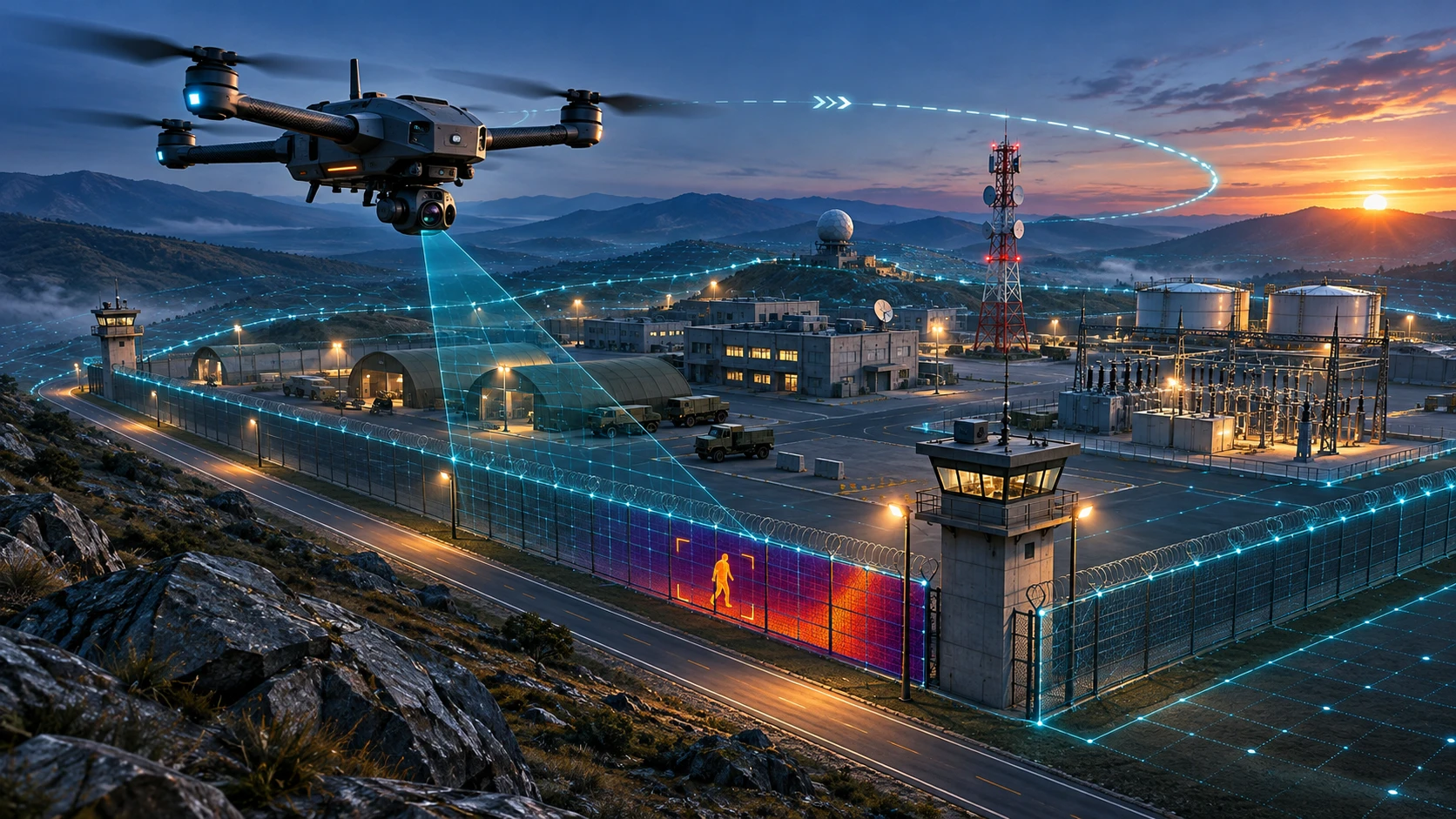
Perimeter security becomes increasingly difficult when a facility covers a large area, contains multiple access points, or includes open spaces that are difficult to monitor continuously from fixed cameras.
Defence installations, power plants, ports, industrial facilities, warehouses, mining sites and other critical infrastructure often require multiple layers of security rather than relying on a single monitoring system.
This is where drone perimeter security can add value.
A drone can provide a mobile aerial view of a site, helping security teams observe large outdoor areas, review incidents, monitor changing conditions and assess locations that may not be continuously visible through fixed cameras.
However, drones should not be viewed as a replacement for CCTV, access control or established security procedures.
The more effective approach is usually:
Fixed Security Systems + Mobile Aerial Monitoring + Human Response + Centralised Situational Awareness
India’s Ministry of Home Affairs has already specified integration of drone and radar feeds with perimeter intrusion detection software in its qualitative requirements for perimeter security systems.
This indicates an important direction for modern perimeter security: different sensors and surveillance systems working together rather than operating independently.
What Is Drone Perimeter Security?
Drone perimeter security is the use of drones to provide aerial monitoring of the outer areas surrounding a protected facility.
Depending on the project, the drone may provide:
- Live video
- Aerial imagery
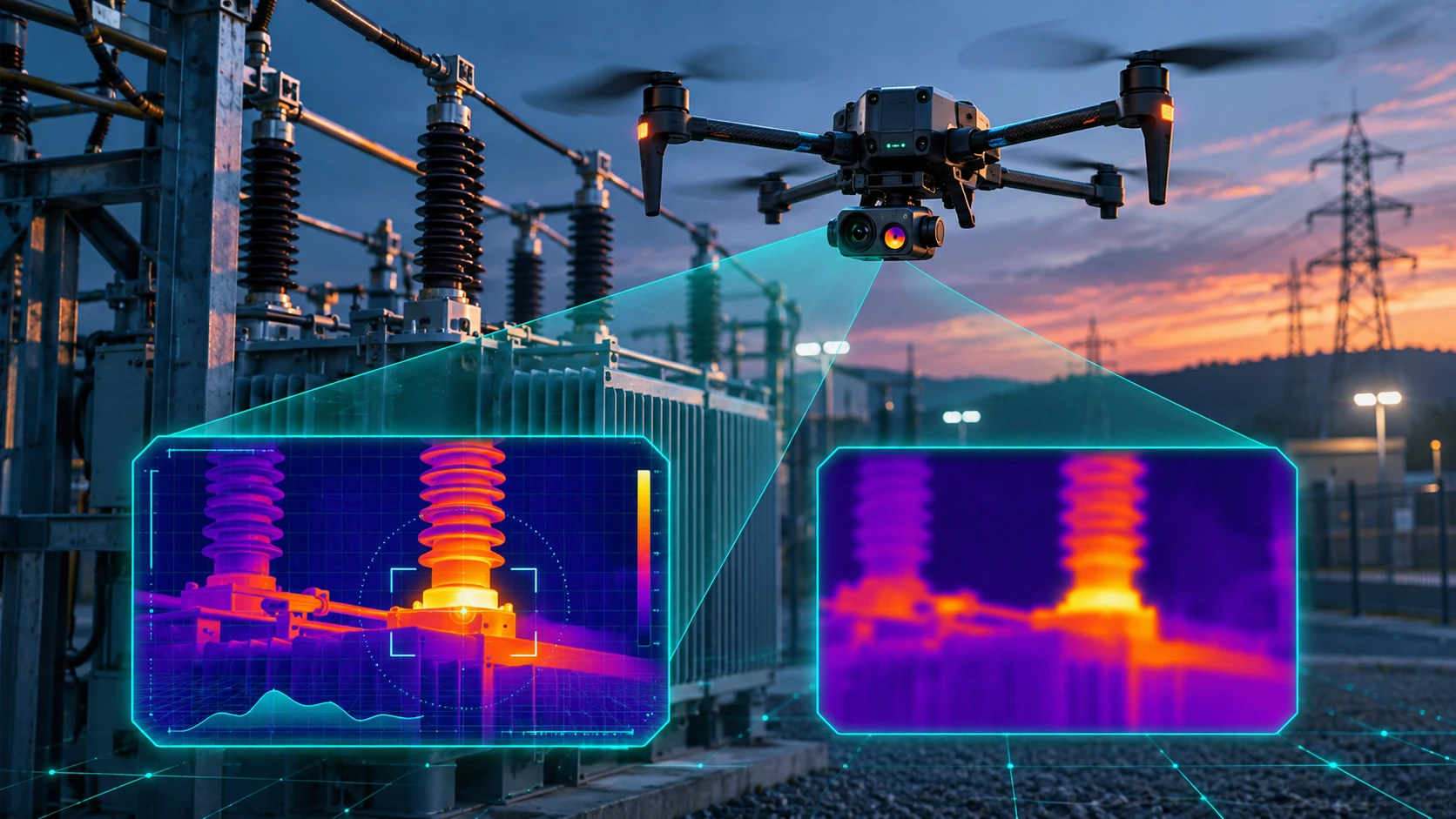
- Thermal imagery
- Mobile observation
- Incident assessment
- Perimeter patrol support
- Situational awareness
- Post-incident documentation
The main advantage is mobility.
A fixed camera observes a defined field of view.
A drone can move across an approved monitoring area and provide an aerial perspective when the security team needs additional visibility.
This can be particularly useful for large or changing environments where installing enough fixed cameras to cover every outdoor area would be difficult or expensive.
Why Are Drones Useful for Large Perimeters?
A large facility may contain:
- Boundary walls
- Open land
- Roads
- Storage yards
- Warehouses
- Utility areas
- Water bodies
- Parking zones
- Construction areas
- Remote sections
Some of these areas may not require continuous camera coverage but may still need periodic observation.
A drone can provide additional visibility without requiring permanent camera infrastructure at every location.
This makes aerial monitoring particularly useful for:
Large Industrial Facilities
Security teams can observe yards, boundary areas, storage zones and other outdoor locations.
Power and Energy Facilities
Aerial monitoring can support observation around large utility sites and infrastructure areas.
Ports and Logistics Facilities
Drones can provide an aerial overview of large open operational areas.
Mining and Industrial Sites
Large sites often have changing terrain, temporary work areas and remote sections that are difficult to monitor from fixed positions.
Government and Defence Facilities
Where authorised, aerial monitoring can provide an additional observation layer alongside established security systems.
How Does Drone Surveillance Compare With CCTV?
The two technologies serve different purposes.
| Requirement | CCTV | Drone Surveillance |
|---|---|---|
| Fixed monitoring | Excellent | Limited |
| Continuous recording | Excellent | Mission-dependent |
| Large open-area visibility | Limited by camera placement | Strong |
| Mobile observation | Limited | Strong |
| Gate monitoring | Excellent | Usually unnecessary |
| Remote perimeter review | Limited | Useful |
| Incident overview | Fixed perspective | Mobile aerial perspective |
| 24/7 monitoring | Well suited | Not normally the primary role |
| Emergency aerial assessment | Limited | Useful |
CCTV is therefore still essential for fixed locations such as entrances, gates, buildings and critical access points.
Drones add a mobile aerial layer.
SkyGlimps’ existing Live Aerial Surveillance service is designed around real-time drone feeds for sites, restricted zones, emergency locations and high-risk areas, making it a natural extension of fixed surveillance infrastructure.
How Can Drones Support Perimeter Patrols?
A drone can be used as an additional observation tool during scheduled or event-driven security operations.
For example, a security team may use aerial monitoring to review:
- Outer boundary areas
- Large open spaces
- Remote sections of a facility
- Access roads
- Storage yards
- Temporary construction zones
- Areas affected by weather or other events
The purpose is not simply to fly continuously.
Instead, the drone can be deployed when additional aerial visibility is useful.
This makes drone patrols different from conventional fixed surveillance.
The security team can decide when aerial observation is required based on:
- Scheduled monitoring
- Security alerts
- Site activity
- Emergency situations
- Weather events
- Infrastructure changes
- Specific operational requirements
Can Thermal Cameras Improve Drone Perimeter Security?
Yes, thermal imaging can provide another layer of information, particularly when visibility is reduced.
An RGB camera records visible light.
A thermal camera records differences in infrared radiation and displays apparent temperature patterns.
Depending on the environment and equipment, thermal imagery can help security teams identify areas requiring attention when conventional visual imagery is less informative.
Potential applications include:
- Night-time observation
- Large outdoor areas
- Industrial facilities
- Infrastructure monitoring
- Emergency response
- Search support
- Heat-related anomalies
However, thermal imagery should not automatically be interpreted as proof of a security incident.
A thermal anomaly is an observation that may require further verification.
The effectiveness of thermal monitoring also depends on weather, surface materials, distance, camera specifications and environmental conditions.
How Can Drones Work Alongside Existing Perimeter Security Systems?
The strongest security architecture usually combines multiple layers.
For example:
Perimeter Sensors → CCTV → Drone Feed → Control Room → Human Verification → Response
This approach is more useful than treating the drone as a standalone security system.
The Ministry of Home Affairs’ PIDS requirements provide an example of integrated perimeter security, including fixed/PTZ CCTV, perimeter intrusion detection and command-and-control software. The same requirements also specify that drone and radar feeds can be integrated with PIDS software.
This type of integration can help operators move from:
“Something may have happened.”
to:
“We have additional aerial information to assess what happened.”
The drone therefore becomes another source of situational information within the wider security architecture.
What Happens When a Security Alert Occurs?
A drone can support incident assessment rather than acting as the entire response system.
A simplified workflow can be:
1. Alert
An existing security system generates an alert.
2. Verification
Security personnel review available CCTV, sensor or other information.
3. Aerial Assessment
If appropriate and authorised, a drone can provide additional aerial visibility.
4. Information Sharing
The live feed or relevant imagery can be shared with the authorised control team.
5. Ground Response
Security personnel follow the site’s established response procedures.
6. Documentation
Relevant imagery or video can be retained according to the organisation’s security and data policies.
The key principle is:
Drone surveillance supports decision-making; it does not replace trained security personnel or established incident-response procedures.
Can Drone Perimeter Security Work at Night?
Yes, provided the aircraft, sensors, operating procedures and permissions are suitable for the mission.
Night operations can be particularly useful because conventional visible-light imagery may become less effective.
A suitable drone platform may use:
- Low-light cameras
- Infrared capabilities
- Thermal cameras
- Navigation systems appropriate for the operating environment
However, night drone operations require additional planning around:
- Visibility
- Lighting
- Navigation
- Weather
- Battery management
- Site safety
- Airspace requirements
- Take-off and landing
The specific operating rules depend on the location, operator and nature of the facility.
How Can Drones Support Critical Infrastructure Security?
Critical infrastructure often covers large areas and may contain assets spread across different sections of a site.
Examples include:
- Power generation facilities
- Ports
- Petroleum infrastructure
- Coal facilities
- Large industrial plants
- Water infrastructure
- Transport infrastructure
- Government facilities
The Central Industrial Security Force has specifically identified sectors including power, petroleum, coal and ports within its sector-focused security structure. In October 2026, CISF also announced an MoU with IIT Hyderabad’s TiHAN to strengthen institutional expertise in drone and anti-drone technology for critical infrastructure security.
This demonstrates that drone technology is becoming part of broader security capability development rather than being treated only as a conventional aerial-camera tool.
What Role Can Drones Play in Defence Installations?
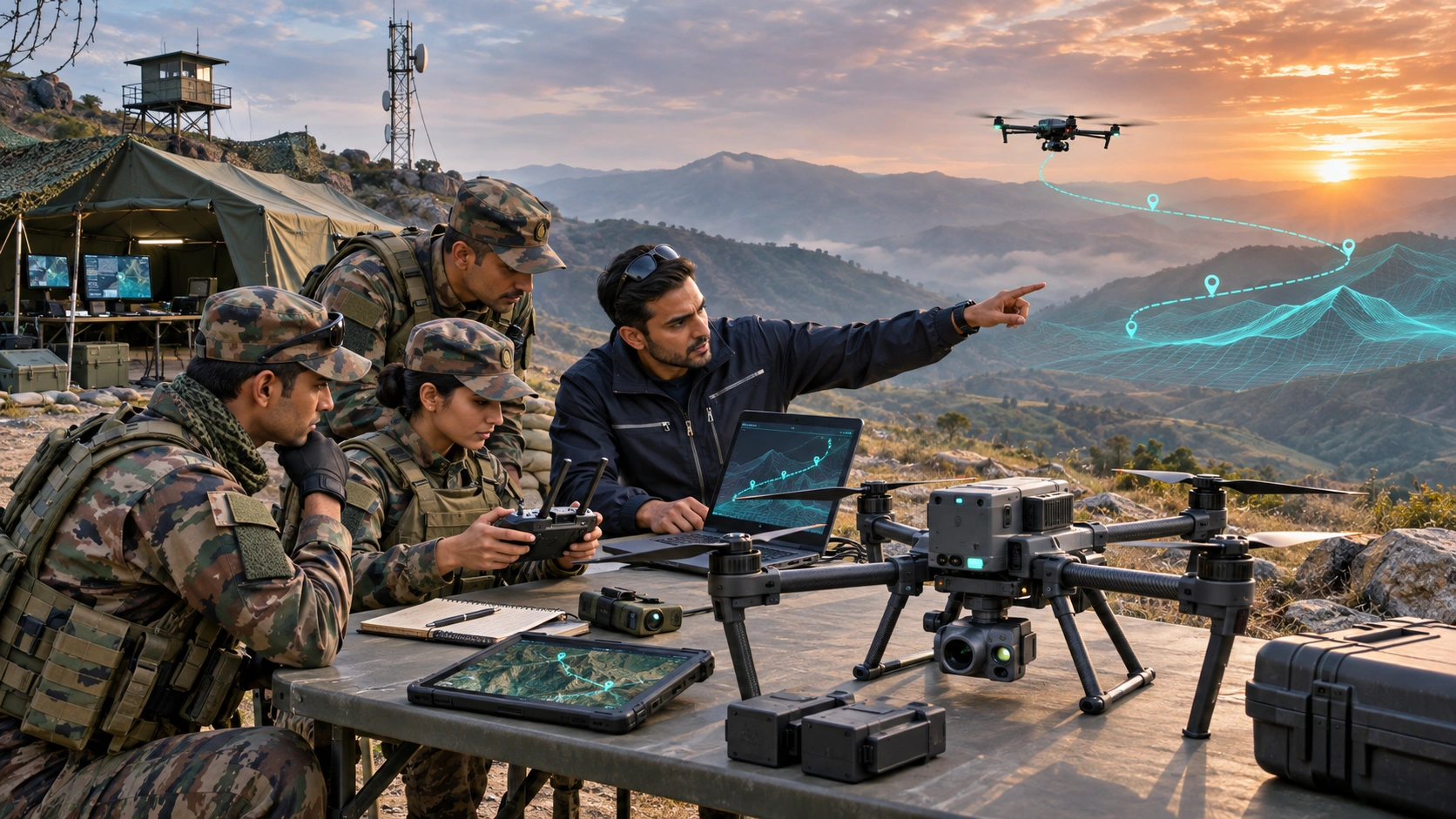
For defence installations, the exact use of drones must be determined by the authorised organisation and applicable security procedures.
At a high level, drones can support:
- Aerial situational awareness
- Site observation
- Perimeter monitoring
- Incident assessment
- Infrastructure documentation
- Emergency assessment
- Training and operational readiness
However, defence applications require a higher level of operational control because facilities may involve sensitive locations, restricted information and specialised security procedures.
A drone surveillance provider should therefore work within the installation’s authorised operating framework rather than treating defence-site operations like ordinary commercial aerial photography.
What About Drone Threat Detection?
Perimeter security has another important dimension: protecting the facility from unauthorised drones.
This is different from using a drone for surveillance.
A modern security strategy may therefore involve two separate capabilities:
Drone-Based Surveillance
Used by authorised teams to observe the site.
Counter-UAS / Anti-Drone Security
Used to detect, identify and respond to unauthorised drone activity according to authorised procedures.
These systems should not be confused.
The growing importance of this distinction is reflected in current Indian security initiatives. CISF’s 2026 partnership with TiHAN specifically covers both drone and anti-drone technology and includes plans for a dedicated Centre of Excellence.
For critical infrastructure, organisations may therefore need to consider both using drones responsibly and understanding the risks created by unauthorised UAS activity.
Can Drones Replace Fixed Perimeter Cameras?
Generally, no.
A drone is not a practical substitute for continuous fixed monitoring of critical access points.
Fixed cameras are better suited to:
- Gates
- Entry points
- Buildings
- Corridors
- Control areas
- Vehicle checkpoints
- Other permanently monitored locations
Drones are better suited to:
- Large open areas
- Remote sections
- Changing sites
- Incident assessment
- Temporary monitoring
- Aerial situational awareness
The best solution is often layered.
CCTV provides continuity.
Drones provide mobility.
Sensors provide alerts.
Security personnel provide judgement and response.
What Should a Drone Perimeter Security Plan Include?
A professional security drone programme should begin with the operational requirement rather than the aircraft.
The planning process should define:
- Security objective — What does aerial monitoring need to achieve?
- Approved monitoring area — Which areas can legally and operationally be observed?
- Operating schedule — When is aerial monitoring required?
- Drone and payload — Which platform and camera are appropriate?
- Control-room workflow — Who receives and evaluates the feed?
- Communication — How does the drone team coordinate with site security?
- Emergency procedures — What happens if the aircraft cannot continue the mission?
- Data management — Who can access recordings and how long are they retained?
- Compliance — What permissions, airspace and site-specific requirements apply?
- Reporting — What information should be documented after each mission?
This creates a repeatable operational framework rather than treating each drone flight as an isolated activity.
What Are the Limitations of Drone Perimeter Security?
Drone surveillance is powerful, but it has practical limitations.
Battery Endurance
Most multirotor drones cannot remain airborne indefinitely.
Weather
Strong wind, rain, poor visibility and other conditions can affect operations.
Airspace and Permissions
Drone operations must comply with applicable aviation and site requirements.
Human Oversight
A live aerial feed still needs trained personnel who can interpret what they see.
Communication
The monitoring workflow depends on reliable communication between the drone, pilot and authorised monitoring team.
Privacy and Data Security
Security footage can contain sensitive information and must be handled appropriately.
Not a 24/7 Replacement
Drones are generally best used as a mobile monitoring layer, while fixed systems provide continuous coverage.
Understanding these limitations is essential when designing a professional security solution.
How Should Security Teams Use Drone Data Responsibly?
Security surveillance involves sensitive information, particularly around defence installations and critical infrastructure.
Organisations should therefore establish clear controls for:
- Who can operate the drone
- Who can view the live feed
- Who can access recordings
- Where data is stored
- How long data is retained
- When footage can be shared
- What constitutes an authorised flight
- How incidents are documented
The goal should be to collect only the information required for the defined security purpose.
This becomes particularly important when aerial monitoring extends beyond the organisation’s own property or involves members of the public.
How Can Drone Perimeter Security Support Emergency Response?
The usefulness of a drone is not limited to routine security patrols.
Aerial monitoring can also provide rapid situational information during:
- Industrial incidents
- Fires
- Flooding
- Storm damage
- Infrastructure failures
- Large public events
- Access-road blockages
- Emergency evacuations
Aerial imagery can help teams understand the broader situation before sending personnel into an unfamiliar or potentially hazardous area.
SkyGlimps lists emergency locations, high-risk areas and situational awareness among the applications of its Live Aerial Surveillance service.
This makes the drone useful as an information-gathering layer during time-sensitive situations.
What Should Organisations Look for in a Drone Security Partner?
Choosing a drone provider for a security-sensitive site requires more than checking whether the provider owns a drone.
Organisations should evaluate:
Operational Experience
Has the provider worked on industrial, infrastructure, government or security-related projects?
Pilot Capability
Are the pilots appropriately trained for the proposed operation?
Mission Planning
Does the provider conduct site-specific planning and risk assessment?
Camera Capability
Can the system provide the required visual or thermal information?
Live Monitoring
Can the feed be provided to the authorised security team when required?
Reporting
Will the provider supply structured reports or relevant footage after the mission?
Data Handling
Are security recordings handled according to the client’s requirements?
Compliance
Can the provider identify the applicable flight, site and airspace requirements before operating?
SkyGlimps’ stated project workflow includes requirement analysis, mission planning, permissions, risk assessment, drone data capture, quality assurance and report/data delivery.
How Can SkyGlimps Support Drone Perimeter Security?
SkyGlimps provides Live Aerial Surveillance for real-time monitoring of sites, restricted zones, emergency locations and high-risk areas.
Its broader drone capabilities include:
- Live aerial surveillance
- Thermal and RGB inspection
- 2D surveying and mapping
- 3D LiDAR and GIS
- Infrastructure monitoring
- Documentation and progress tracking
The company identifies law enforcement, security, infrastructure, utilities and industrial operations among the sectors that can use its drone services.
For a security-sensitive project, the appropriate workflow can be designed around:
Site Requirement → Risk Assessment → Mission Planning → Approved Drone Operation → Live Monitoring → Incident Assessment → Reporting
For organisations considering aerial monitoring as part of a broader security system, the Live Aerial Surveillance service provides a relevant starting point.
Frequently Asked Questions
Drone perimeter security is the use of authorised drones to provide mobile aerial monitoring around a facility. It can support perimeter observation, incident assessment, situational awareness and emergency response alongside fixed security systems.
No. CCTV is better suited to continuous monitoring of fixed locations, while drones provide mobile aerial visibility. A layered combination of CCTV, sensors, aerial monitoring and human response is generally more practical.
Yes. Thermal cameras can provide additional information in low-light conditions and can help identify areas requiring investigation. However, thermal observations should be verified and interpreted in context rather than automatically treated as security incidents.
Potentially, but operations around defence installations are subject to the authorised organisation’s security procedures, permissions and applicable regulations. Defence-site drone operations should only be conducted within the approved operational framework.
Drones can provide mobile aerial visibility across large industrial and infrastructure sites, support incident assessment, monitor remote outdoor areas and provide additional information to security teams. They work best as one layer within a broader security architecture.
Building a Layered Perimeter Security System With Drones
The strongest case for drone perimeter security is not that drones can replace every existing security technology.
They cannot.
The real value is their ability to add mobility, aerial perspective and rapid situational awareness to a security system that already includes fixed cameras, sensors, access control and trained personnel.
A well-designed system can be viewed as:
Detection → Verification → Aerial Assessment → Human Decision → Response → Documentation
This approach is particularly relevant for large industrial facilities, critical infrastructure, restricted areas and other sites where fixed cameras cannot provide complete context across every outdoor location.
For defence installations, the requirements become even more specialised, and all drone operations must remain within the authorised security and regulatory framework.
For commercial and industrial facilities, the same principle applies: start with the security objective, define the monitoring area, select the appropriate drone and payload, establish the control-room workflow, and clearly define how the resulting information will be handled.
The future of perimeter security is therefore unlikely to be about CCTV versus drones.
It is more likely to be about CCTV + sensors + aerial monitoring + intelligent control rooms + trained human response.
When these layers are designed to work together, drones can provide the additional aerial visibility needed to understand large, changing and difficult-to-monitor environments more effectively.