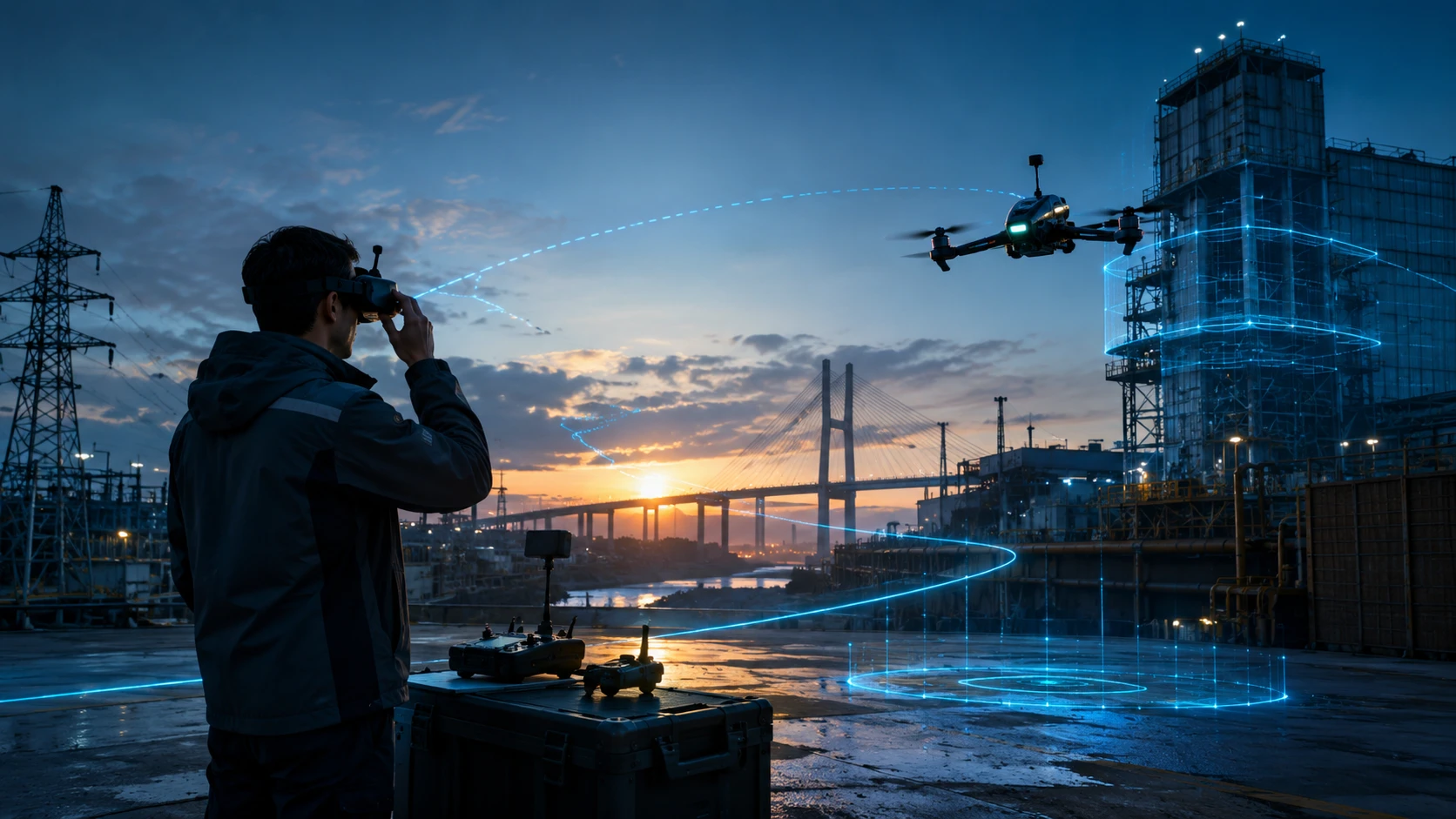
FPV drone training inspection skills are becoming increasingly useful for pilots who want to work in industrial inspection, confined-space documentation, asset monitoring, and complex site data capture. Unlike standard camera drone flying, FPV training helps pilots develop closer control, faster reaction, spatial awareness, and confidence in tight or obstacle-rich environments.
Industrial inspection work often involves assets that are difficult, risky, or time-consuming to inspect manually. These may include factories, tanks, warehouses, bridges, chimneys, power assets, plants, ducts, rooftops, trusses, and confined spaces. A trained FPV pilot can support inspection teams by capturing visual data from angles that are difficult to reach safely from the ground.
This guide explains how FPV drone training prepares pilots for industrial inspection work, what skills matter most, and why certification, safety, and operational discipline are essential.
What is FPV drone training for inspection?
FPV drone training for inspection teaches pilots how to operate drones using a live first-person camera view while navigating near structures, obstacles, and complex environments. The goal is to build control, awareness, and precision for professional inspection use cases.
FPV stands for First Person View. In FPV flying, the pilot sees the drone’s camera feed in real time through goggles or a screen. This creates a more immersive flying experience compared with normal line-of-sight camera drone operation.
For inspection work, FPV training can help pilots learn:
- Close-range navigation
- Obstacle awareness
- Smooth indoor movement
- Camera angle control
- Slow inspection passes
- Emergency recovery
- Confined-space discipline
- Visual documentation techniques
- Coordination with inspection teams
- Safer flight behaviour around assets
FPV inspection is not about racing or aggressive flying. Industrial inspection needs controlled movement, steady footage, safety awareness, and careful decision-making.
Skyglimps Technologies LLP offers FPV Drone Building & Training for learners who want to understand FPV systems, drone handling, and practical flight skills.
Why is FPV useful for industrial inspection work?
FPV is useful for industrial inspection because it gives the pilot a closer visual perspective while flying around structures, inside spaces, or near difficult-to-access assets. This helps inspection teams collect visual evidence without immediate manual access.
Industrial sites often include:
- High roofs
- Tall structures
- Chimneys
- Tanks
- Warehouses
- Bridges
- Pipe racks
- Boilers
- Ducts
- Towers
- Confined spaces
- Steel frames
- Plant equipment
- Utility corridors
Traditional inspection may require scaffolding, rope access, cranes, shutdowns, or confined-space entry. Drones can help reduce the need for immediate human access during the first visual review. This can improve safety, reduce time, and help maintenance teams decide what needs closer inspection.
FPV drone pilots are especially useful when the site requires manual control and spatial judgement. Automated mapping flights are excellent for open-area surveys, but FPV skills are valuable when the environment is tight, irregular, or obstacle-heavy.
How is FPV inspection different from normal drone flying?
FPV inspection is different from normal drone flying because the pilot must control the drone from a live camera perspective while maintaining awareness of nearby structures, obstacles, signal quality, and inspection objectives. It requires stronger reflexes and spatial judgement.
A normal camera drone flight may focus on stable aerial images, wide views, and GPS-assisted movement. FPV inspection may involve closer movement, lower speed, tighter turns, and manual positioning around structures.
| Skill area | Standard drone flying | FPV inspection flying |
|---|---|---|
| Main view | Line-of-sight or screen view | First-person camera view |
| Flying style | Stable and open-area movement | Close-control and obstacle-aware movement |
| Common use | Mapping, photography, outdoor documentation | Asset inspection, indoor review, confined spaces |
| Risk area | Airspace, weather, site control | Obstacles, signal loss, tight spaces, asset proximity |
| Pilot focus | Capture quality and safe coverage | Precision, spacing, orientation, and inspection detail |
A pilot trained only for outdoor visual flights may struggle in tight inspection environments. FPV training helps develop the muscle memory and confidence needed for complex inspection movement.
What industrial assets can FPV-trained pilots inspect?
FPV-trained pilots can support inspection of industrial assets where access is difficult, elevated, restricted, or risky. The drone captures visual data for engineers, maintenance teams, safety teams, or asset managers to review.
Common inspection targets include:
- Factory roofs
- Industrial sheds
- Storage tanks
- Chimneys and stacks
- Boilers
- Ducts
- Warehouses
- Pipe racks
- Bridges and undersides
- Steel structures
- Cooling towers
- Utility corridors
- Power plant areas
- Telecom and utility assets
- Confined spaces
The pilot’s role is to collect clean, useful, and properly framed visual data. The final technical interpretation should be done by qualified engineers, inspectors, or asset specialists.
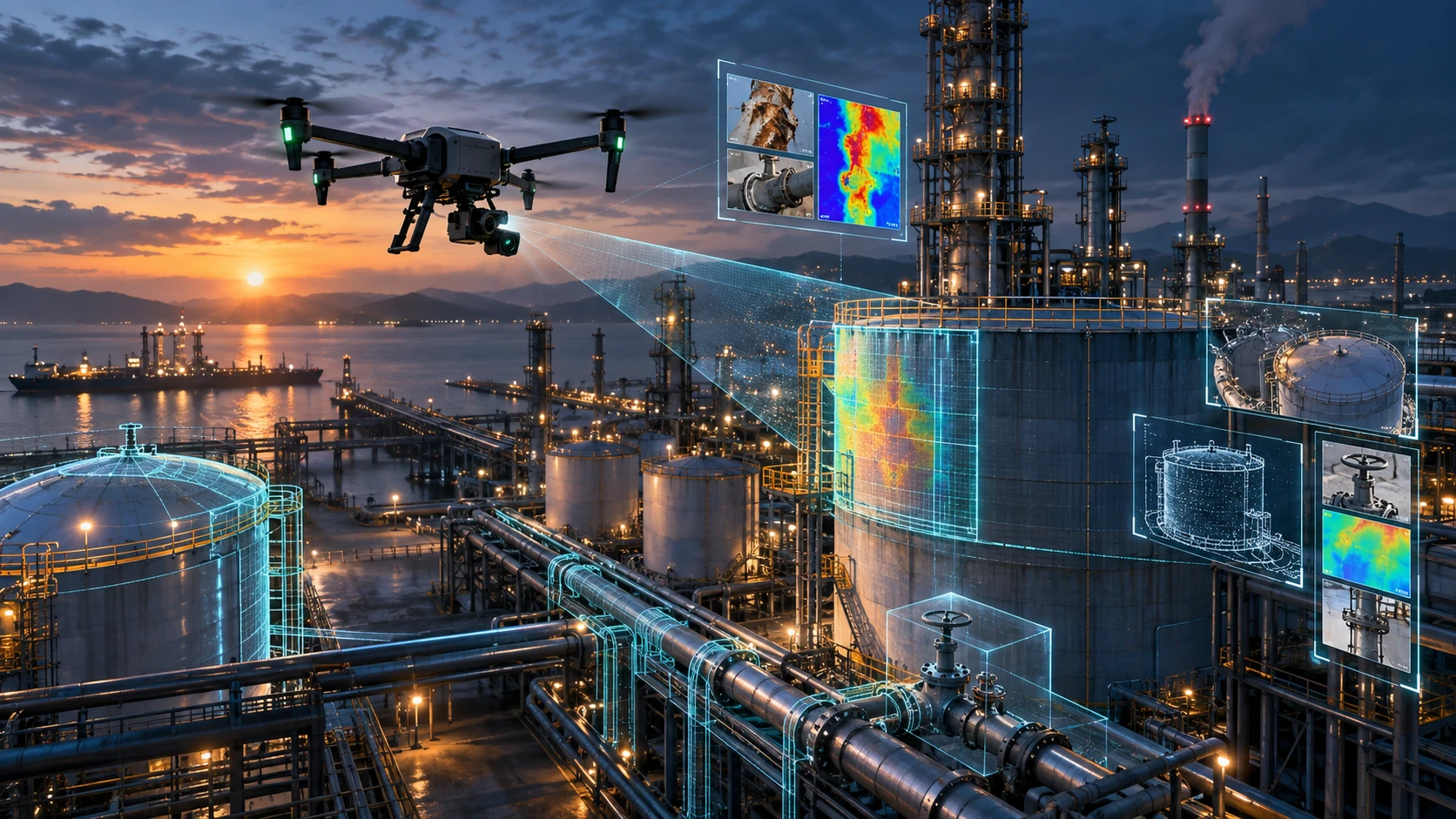
For heat-related or external asset inspections, FPV data may also be combined with Thermal & RGB Inspections where the project requires visual and thermal review.
How does FPV training improve close-control flying?
FPV training improves close-control flying by teaching pilots to manage speed, angle, distance, and movement while navigating near structures. This is important because industrial inspection often requires slow and deliberate flight, not fast flying.
Close-control skills include:
- Flying slowly without drifting
- Holding position near an asset
- Turning smoothly in limited space
- Managing throttle precisely
- Maintaining safe distance from surfaces
- Moving through openings carefully
- Avoiding sudden stick inputs
- Recovering from orientation confusion
- Keeping the inspection subject in frame
In industrial work, shaky or rushed footage may not be useful. The inspection team needs to see cracks, corrosion, deformation, leakage signs, loose parts, deposits, damage, or obstruction clearly.
Good FPV training teaches pilots to prioritise control over speed.
How does FPV training prepare pilots for confined spaces?
FPV training prepares pilots for confined spaces by building awareness of limited visibility, signal behaviour, obstacle proximity, airflow disturbance, lighting conditions, and emergency exit planning. These conditions are very different from open outdoor flying.
Confined-space inspection may include tanks, ducts, chimneys, large pipes, boilers, or internal industrial structures. These environments can be dark, metallic, dusty, narrow, and GPS-denied.
Pilots must understand:
- Indoor flight control
- Low-light navigation
- Propeller wash effects
- Signal interruption risks
- Drone orientation in tight spaces
- Entry and exit planning
- Battery time limitations
- Collision risk
- Communication with the ground team
- Emergency stop or recovery process
Not every FPV drone is suitable for confined-space inspection. Protective frames, lighting, camera quality, and stable control are important. Industrial inspection drones may be designed differently from racing FPV drones.
FPV training helps students understand these differences before working on real sites.
Why is safety discipline important in FPV inspection?
Safety discipline is essential because FPV inspection may happen near industrial assets, people, machinery, electrical equipment, confined spaces, or sensitive infrastructure. A skilled pilot must know when not to fly.
Before an FPV inspection, the team should review:
- Site permission
- Airspace restrictions
- Asset condition
- Worker movement
- Machinery operation
- Electrical hazards
- Confined-space risks
- Signal interference
- Take-off and landing area
- Emergency landing options
- Drone suitability
- Battery condition
- Communication plan
FPV flying should not be treated like entertainment inside an industrial site. Every movement should support the inspection objective and follow a safe operating plan.
For outdoor operations in India, drone pilots should also understand applicable DGCA rules, airspace requirements, and Remote Pilot Certificate expectations where relevant.
What should pilots learn about VLOS, observers, and compliance?
Pilots should understand that FPV flying must be planned within applicable operational rules, including visual line-of-sight expectations, observer coordination, and site safety requirements. FPV goggles do not remove the need for compliant operations.
In many professional situations, a remote pilot, observer, or support team may be required to maintain situational awareness. This is especially important when the pilot is viewing the drone through goggles and cannot directly see surrounding site conditions.
A professional FPV inspection team should define:
- Who is the remote pilot?
- Who is the visual observer, if needed?
- Who communicates with site safety personnel?
- What is the flight boundary?
- What happens during signal loss?
- What happens during low battery?
- What assets must be avoided?
- What inspection path will be followed?
- When should the flight be stopped?
Compliance is part of professional credibility. A trained FPV pilot should be able to fly skillfully and operate responsibly.
What technical knowledge supports FPV inspection work?
FPV inspection work requires technical knowledge of drone components, cameras, batteries, video transmission, frames, propellers, lighting, control modes, and failsafe behaviour. Pilots who understand the system can manage risk better.
Important technical areas include:
| Technical area | Why it matters |
| Camera angle | Affects inspection framing and navigation |
| Video link | Determines how reliably the pilot sees the feed |
| Battery health | Affects flight time and safety margin |
| Propeller guards | Helps reduce damage risk in close spaces |
| Lighting | Improves visibility in dark inspection zones |
| Frame design | Affects durability and confined-space suitability |
| Flight controller | Controls stability and response |
| Failsafe settings | Helps manage signal-loss scenarios |
| Recording setup | Ensures inspection footage is captured properly |
Skyglimps’ FPV Drone Building & Training pathway can be useful because understanding the drone system helps pilots troubleshoot and operate with more confidence.
A pilot who only knows how to fly may panic when something behaves unexpectedly. A pilot who understands the drone’s build and systems can respond more calmly.
How does FPV training support better inspection footage?
FPV training supports better inspection footage by teaching pilots to frame defects clearly, maintain smooth movement, control distance, and capture enough visual context for review. Inspection footage must be useful, not only cinematic.
Good inspection footage should show:
- The asset location
- The defect or area of concern
- Surrounding context
- Multiple angles where needed
- Clear lighting
- Slow movement
- Stable framing
- Enough detail for technical review
For example, if inspecting a steel structure, the video should help the engineer understand where the issue is located and what it looks like. Flying too fast, too close, or too shakily can make the footage difficult to use.
A trained FPV pilot learns to think like an inspection partner, not just a drone operator.
What industries need FPV-trained inspection pilots?
FPV-trained inspection pilots can support industries where assets are elevated, internal, complex, or difficult to access manually. The strongest opportunities are in sectors that require recurring maintenance and visual documentation.
Industries that may use FPV inspection include:
- Manufacturing
- Power plants
- Warehousing
- Oil and gas facilities
- Steel and cement plants
- Infrastructure projects
- Bridges and highways
- Utilities
- Mining and industrial sites
- Real estate and large facilities
- Logistics parks
- Public-sector infrastructure
These industries often need inspection support for safety, maintenance planning, shutdown planning, and asset documentation.
For broader industrial applications, Skyglimps also supports Documentation & Progress Tracking for organisations that need dated records and inspection evidence over time.
How can FPV pilots build an inspection career?
FPV pilots can build an inspection career by combining drone control skills with safety training, asset knowledge, reporting discipline, and industry-specific inspection workflows. Flying skill alone is not enough.
A practical career path may include:
- Learn basic drone regulations and safe operations.
- Build FPV control skills in safe training environments.
- Understand drone hardware and maintenance.
- Practise slow inspection-style flying.
- Learn how industrial assets are inspected.
- Build sample inspection footage.
- Learn report documentation basics.
- Assist experienced inspection teams.
- Develop skills in thermal, RGB, LiDAR, or mapping workflows.
- Build a portfolio with approved sample work.
A strong pilot should be able to explain what was inspected, how data was captured, what limitations existed, and what follow-up review may be needed.
What mistakes should FPV inspection beginners avoid?
FPV inspection beginners should avoid flying too fast, getting too close to assets, ignoring signal risk, skipping safety checks, and treating industrial sites like practice grounds. Professional inspection needs patience and discipline.
Common mistakes include:
- Rushing through the asset
- Flying without a clear inspection path
- Not checking battery margins
- Ignoring lighting needs
- Forgetting to record footage
- Flying too close to surfaces
- Losing orientation in tight spaces
- Flying without an observer or support team where needed
- Ignoring site safety instructions
- Using the wrong drone for the environment
- Overpromising inspection accuracy
- Not documenting limitations
In inspection work, the safest flight is usually the most valuable flight. A pilot who captures clean, controlled footage without creating risk becomes far more useful to industrial clients.
Why choose Skyglimps Technologies for FPV drone training?
Skyglimps Technologies LLP is a Kolkata-based drone services company and DGCA-certified Remote Pilot Training Organisation serving learners, government teams, and enterprise clients across Eastern India. The company supports drone training and professional drone workflows across surveying, mapping, LiDAR, GIS, inspections, documentation, surveillance, and FPV applications.
Skyglimps Technologies, a DGCA-certified RPTO in Kolkata, is positioned for learners who want to understand drones as real industrial tools, not only recreational devices. For students and professionals in Kolkata, West Bengal, and Eastern India, FPV training can become a practical skill pathway for inspection, documentation, indoor navigation, and advanced drone control.
FPV drone training inspection skills are most useful when they are combined with safety awareness, compliance knowledge, technical understanding, and real project discipline.
FAQ: FPV Drone Training Inspection
FPV drone training for inspection teaches pilots to control drones using a live first-person camera view for close-range, obstacle-aware, and industrial inspection-style flying.
Yes. FPV skills help pilots navigate around structures, inside facilities, and near difficult-to-access assets where controlled visual inspection footage is needed.
FPV drones can support confined-space visual inspection when the drone, pilot, safety plan, lighting, and site conditions are suitable. Some spaces may require specialised inspection drones.
No. FPV racing focuses on speed and agility. FPV inspection focuses on slow control, safety, framing, asset visibility, and useful documentation.
For professional drone operations in India, pilots should understand applicable DGCA requirements and complete the required training or certification pathway where relevant.
Important skills include close-control flying, obstacle awareness, camera framing, emergency handling, safety planning, technical knowledge, and inspection documentation.
Manufacturing, power, infrastructure, warehouses, bridges, utilities, mining, industrial plants, and large facilities can use FPV inspection pilots for visual asset documentation.
Build FPV skills for serious inspection work
FPV drone training inspection skills can prepare pilots for a more advanced and practical drone career. Industrial inspection work requires more than flying fast. It requires control, patience, safety awareness, technical understanding, and the ability to capture useful visual evidence.
For students, drone pilots, and professionals in Kolkata, West Bengal, and Eastern India, FPV training can support future opportunities in industrial inspection, confined-space documentation, infrastructure review, and asset monitoring.
If you want to learn FPV systems, improve close-control flying, and understand how FPV skills apply to professional drone work, connect with Skyglimps Technologies LLP through the FPV Drone Building & Training page and explore the right training pathway for your goals.