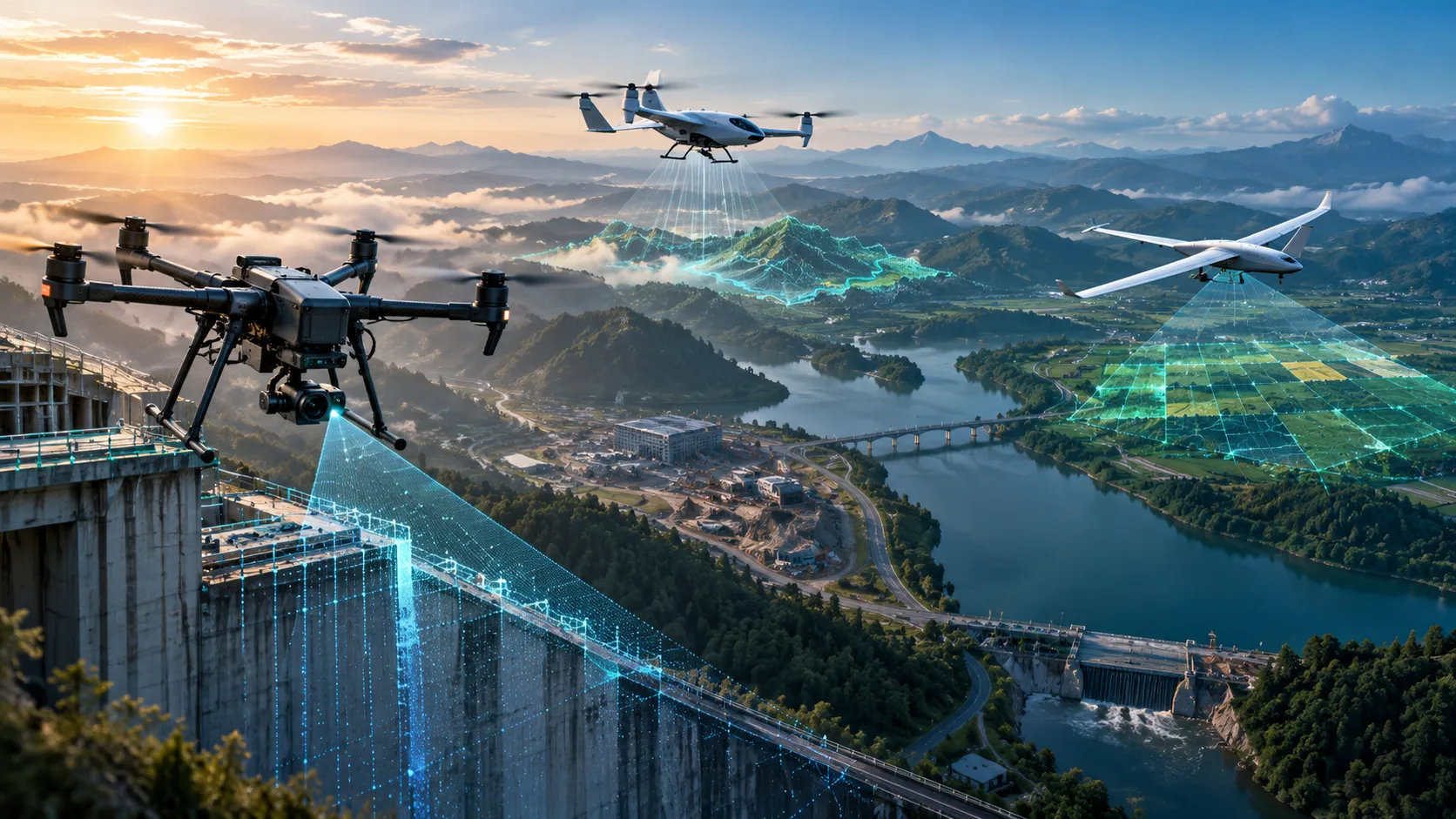
Understanding the types of drones is important for anyone planning to enter drone training, surveying, mapping, inspection, agriculture, cinematography, or industrial drone work. Not every drone is designed for the same job. A small multirotor drone may be ideal for close inspection, while a fixed-wing drone may be better for large-area mapping. A hybrid VTOL drone can combine vertical take-off with longer-range forward flight.
For students and professionals in India, this distinction matters because drone training is not only about learning how to fly. A good pilot should understand drone platforms, mission requirements, payloads, flight limitations, safety, and industry applications.
This guide explains the main types of drones, how they work, where they are used, and how learners can choose the right training path.
What are the main types of drones?
The main types of drones used in professional and training environments are multirotor drones, fixed-wing drones, hybrid VTOL drones, and single-rotor drones. Each type has a different design, flight behaviour, endurance, payload capacity, and use case.
The most common drone types include:
| Drone type | Basic meaning | Best suited for |
|---|---|---|
| Multirotor drone | Drone with multiple rotors, such as quadcopters or hexacopters | Training, photography, inspection, small-area mapping |
| Fixed-wing drone | Aircraft-like drone with wings | Long-range mapping and large-area surveys |
| Hybrid VTOL drone | Fixed-wing style drone with vertical take-off and landing ability | Corridor mapping, large sites, mixed-access terrain |
| Single-rotor drone | Helicopter-style drone with one main rotor | Specialised payload or endurance applications |
| FPV drone | First-person-view drone flown through live camera view | Close-control flying, indoor navigation, inspection practice |
For most beginner drone pilots, multirotor drones are the starting point because they are easier to launch, hover, control, and practise with. For advanced survey and infrastructure applications, fixed-wing and hybrid VTOL platforms may become more relevant.
What is a multirotor drone?
A multirotor drone is a drone that flies using multiple rotors that generate lift and control movement. Common examples include quadcopters, hexacopters, and octocopters.
Multirotor drones can take off and land vertically, hover in one place, move slowly around objects, and capture stable images or videos. This makes them highly useful for training and professional work where close control is important.
Common uses of multirotor drones include:
- Drone pilot training
- Aerial photography
- Videography
- Real estate documentation
- Construction progress tracking
- Solar panel inspection
- Power distribution inspection
- Building inspection
- Short-range mapping
- Agriculture field observation
- Security and surveillance support
Multirotor drones are popular because they are flexible. A pilot can launch them from small open areas, hover near a subject, and capture detailed images from multiple angles. This makes them useful in cities, construction sites, industrial areas, and training fields.
However, multirotor drones usually have shorter flight endurance than fixed-wing drones because they spend more energy staying in the air. For very large survey areas, another platform may be more efficient.
Skyglimps Technologies LLP offers DGCA-certified drone training in Kolkata for learners and organisations that want structured drone training with industry application context.
What is a fixed-wing drone?
A fixed-wing drone is an aircraft-style drone that uses wings to generate lift while moving forward. It does not hover like a multirotor drone, but it can usually cover larger areas more efficiently.
Fixed-wing drones are useful when the mission requires longer flight time, wider coverage, and efficient movement across open land or long corridors.
Common uses of fixed-wing drones include:
- Large-area land mapping
- Agriculture field surveys
- Road corridor mapping
- Pipeline route mapping
- Mining site mapping
- Forest and environmental surveys
- Disaster assessment
- Coastal or riverine mapping
- Infrastructure corridor documentation
A fixed-wing drone is usually less suitable for tight urban spaces, close inspection, or hovering near assets. It needs more planning for launch, recovery, turning radius, and site safety.
For survey professionals, fixed-wing drones can be valuable because large mapping missions often need efficient coverage. But they require stronger mission planning and a better understanding of flight behaviour.
What is a hybrid VTOL drone?
A hybrid VTOL drone combines vertical take-off and landing with fixed-wing-style forward flight. It can take off like a multirotor and then transition into efficient forward flight like a fixed-wing aircraft.
VTOL stands for Vertical Take-Off and Landing. Hybrid VTOL drones are useful when a project needs longer coverage but the site does not have enough runway or open recovery space for a conventional fixed-wing drone.
Hybrid VTOL drones are used for:
- Transmission-line corridor mapping
- Road and highway surveys
- Canal and waterway mapping
- Large infrastructure projects
- Mining and quarry mapping
- Agriculture surveys
- Pipeline corridors
- Disaster response mapping
- Remote or mixed-terrain survey missions
The advantage is flexibility. The drone can launch vertically from a limited area and still cover more ground than many standard multirotor drones. This is useful for long linear assets such as transmission lines, highways, canals, and pipelines.
Hybrid VTOL platforms are more advanced than basic multirotors. They require careful mission planning, trained operators, and strong understanding of transition behaviour, wind conditions, payloads, and emergency procedures.
What is a single-rotor drone?
A single-rotor drone is a helicopter-style unmanned aircraft with one main rotor and usually a tail rotor for control. It can hover like a helicopter and may support specialised payload or endurance requirements.
Single-rotor drones are less common for beginner training than multirotor drones. They are usually used in specialised applications where the platform design offers a specific advantage.
Possible uses include:
- Heavier payload applications
- Specialised surveying
- Research projects
- Industrial testing
- Agriculture payload operations
- Long-endurance hovering applications
Single-rotor platforms can be more complex to operate and maintain. They may also involve higher safety risk because of larger rotor systems. For most students, multirotor training is a more practical starting point.
What is an FPV drone?
An FPV drone is a drone flown using a first-person camera view, usually through goggles or a screen. FPV stands for First Person View.
FPV drones are known for close-control flying, quick response, and immersive operation. They are commonly associated with racing and cinematic flying, but FPV skills can also support inspection-style applications when used responsibly.
FPV drones can be useful for:
- Close-control training
- Indoor flying practice
- Aerial cinematography
- Confined-space navigation practice
- Industrial visual documentation
- Bridge or structure inspection support
- Advanced manual control development
FPV flying requires strong discipline. It should not be treated as only entertainment when used in professional environments. A pilot must understand site safety, observer coordination, signal quality, battery limits, and operational rules.
Skyglimps offers FPV Drone Building & Training for learners who want to understand FPV systems, drone handling, and technical drone-building skills.
How are drones classified by weight in India?
In India, drones are also classified by weight categories such as nano, micro, small, medium, and large. This classification is important because regulatory requirements, operating conditions, and training needs may vary by category.
The commonly referenced weight classes are:
| Drone category | Maximum all-up weight |
|---|---|
| Nano | Less than or equal to 250 grams |
| Micro | More than 250 grams and less than or equal to 2 kg |
| Small | More than 2 kg and less than or equal to 25 kg |
| Medium | More than 25 kg and less than or equal to 150 kg |
| Large | More than 150 kg |
Students should not confuse platform type with weight category. “Multirotor” describes the design. “Small category” describes the weight class. A multirotor drone can fall into different weight categories depending on its size and payload.
For professional training, learners should check which drone category and class an RPTO is authorised to train for before enrolling.
How are drones classified by use case?
Drones can also be classified by use case, such as training drones, survey drones, inspection drones, agriculture drones, FPV drones, cinematography drones, and surveillance drones. This helps businesses choose the right platform for the job.
A use-case comparison:
| Use case | Common drone type | Typical output |
|---|---|---|
| Beginner training | Multirotor | Flying skill and safety practice |
| Surveying and mapping | Multirotor, fixed-wing, hybrid VTOL | Orthomosaics, DEMs, contours, maps |
| Inspection | Multirotor, FPV, thermal drone | Images, videos, thermal findings |
| Agriculture | Multirotor, fixed-wing, hybrid VTOL | Crop maps, spray operations, field records |
| Cinematography | Multirotor, FPV | Aerial video and creative visuals |
| Surveillance | Multirotor, fixed-wing, hybrid VTOL | Live monitoring and aerial observation |
| LiDAR mapping | Multirotor, hybrid VTOL | Point clouds and 3D spatial data |
The best drone is not always the most expensive drone. It is the drone that fits the mission, payload, safety requirement, and final deliverable.
Which type of drone is best for training?
For most beginners, a multirotor drone is the best starting point for training because it can hover, take off vertically, land easily, and respond clearly to pilot inputs. It helps students learn control, orientation, safety, and flight discipline.
Multirotor training helps students practise:
- Take-off and landing
- Hovering
- Forward and backward movement
- Side movement
- Turning
- Orientation control
- Basic manoeuvres
- Emergency response
- Pre-flight checks
- Post-flight checks
After basic training, students can explore specialised platforms depending on their career goal. Survey-focused learners may study mapping drones. Inspection-focused learners may study RGB, thermal, or FPV workflows. Advanced infrastructure teams may use LiDAR or hybrid VTOL platforms.
The training path should follow the career direction.
Which type of drone is best for surveying and mapping?
For surveying and mapping, multirotor, fixed-wing, and hybrid VTOL drones can all be useful depending on the size, terrain, accuracy needs, and deliverables. The platform should be chosen after understanding the project.
A simple selection guide:
| Project condition | Suitable drone type |
|---|---|
| Small site | Multirotor |
| Construction project | Multirotor |
| Large open land | Fixed-wing or hybrid VTOL |
| Long corridor | Fixed-wing or hybrid VTOL |
| High-detail inspection plus mapping | Multirotor |
| Limited launch area but large coverage | Hybrid VTOL |
| LiDAR survey | Multirotor or hybrid VTOL depending on payload and site |
For mapping projects, the drone must capture data that can be processed into usable deliverables such as orthomosaic maps, DEMs, DSMs, contours, point clouds, and GIS files.
For learners interested in mapping careers, Skyglimps also provides a Drone Mapping & Surveying Course focused on how drone data supports real survey workflows.
Which type of drone is best for inspections?
For inspections, multirotor and FPV drones are often useful because they can fly slowly, hover, and capture close visual data around assets. Thermal drones may be used when heat patterns need to be reviewed.
Inspection drone applications include:
- Power distribution lines
- Solar panels
- Rooftops
- Industrial structures
- Bridges
- Chimneys
- Warehouses
- Towers
- Construction sites
- Confined or difficult access areas
Multirotor drones are useful for stable external inspection. FPV drones can help in close-control or indoor visual documentation where suitable. Thermal drones can help identify heat anomalies in electrical, solar, or industrial assets.
For inspection work, the drone is only one part of the process. The pilot must also understand safety distance, image quality, reporting, asset references, and field coordination.
Which type of drone is best for agriculture?
Agriculture drones may include multirotor, fixed-wing, or hybrid VTOL platforms depending on whether the work involves spraying, crop monitoring, mapping, or large-area field surveys. The correct choice depends on the field size and operation.
Agriculture use cases include:
- Crop monitoring
- Farm mapping
- Spraying operations
- Plant health observation
- Irrigation planning support
- Soil and field documentation
- Large-area crop surveys
Multirotor drones are often used for spraying and smaller farm operations because they can fly slowly and maintain controlled movement. Fixed-wing and hybrid VTOL drones are more suitable for larger mapping missions where coverage matters.
Agriculture drone work also requires awareness of weather, wind, crop conditions, chemical safety where spraying is involved, and safe operation around people and property.
How should students choose the right drone type to learn?
Students should choose the right drone type based on their career goal, not only on popularity or price. A student interested in surveying needs different exposure from a student interested in cinematography or industrial inspection.
A practical learning path:
- Start with multirotor basics.
- Learn drone rules and safety.
- Understand airspace and site planning.
- Practise stable manual control.
- Learn mission planning.
- Explore mapping, inspection, FPV, or cinematography.
- Understand payloads such as RGB, thermal, multispectral, or LiDAR.
- Build a simple portfolio.
- Learn reporting and data handling.
- Choose a specialised career path.
A good drone pilot should understand why a certain drone is selected for a mission. Flying skill matters, but platform selection also matters.
What mistakes should beginners avoid when comparing drone types?
Beginners should avoid assuming that one drone type is best for every job. Each platform has strengths and limitations.
Common mistakes include:
- Choosing a drone only by camera quality
- Ignoring flight endurance
- Not checking payload needs
- Using a multirotor for very large sites without planning
- Using fixed-wing drones where hovering is required
- Ignoring launch and landing requirements
- Confusing weight category with drone type
- Ignoring DGCA training requirements
- Not checking spare parts and maintenance
- Ignoring software and data-processing needs
- Buying before understanding career goals
Students should learn first, then invest. Training helps avoid costly mistakes.
Why choose Skyglimps Technologies for drone training?
Skyglimps Technologies LLP is a Kolkata-based drone services company and DGCA-certified Remote Pilot Training Organisation serving learners, government teams, and enterprise clients across Eastern India. The company supports drone training and professional drone workflows across surveying, mapping, LiDAR, GIS, inspections, documentation, surveillance, FPV, and aerial applications.
Skyglimps Technologies, a DGCA-certified RPTO in Kolkata, is positioned for students and organisations that want to understand drones as professional tools, not just gadgets.
For learners in Kolkata, New Town, West Bengal, and Eastern India, structured training can help connect drone platform knowledge with real applications such as construction monitoring, mining surveys, irrigation mapping, power inspection, agriculture, and aerial documentation.
Understanding the types of drones is a useful first step. The next step is learning how to operate drones safely and apply them correctly in real work.
FAQ: Types of Drones
The main types of drones include multirotor drones, fixed-wing drones, hybrid VTOL drones, single-rotor drones, and FPV drones.
Multirotor drones are usually best for beginners because they can hover, take off vertically, land easily, and help students practise basic control.
Multirotor drones are useful for small sites, while fixed-wing and hybrid VTOL drones are better for larger areas and long corridors.
A hybrid VTOL drone can take off and land vertically like a multirotor and then fly forward efficiently like a fixed-wing drone.
Multirotor and FPV drones are commonly useful for inspection because they can fly slowly, hover, and capture close visual data around assets.
These are weight categories used in India. Nano drones are up to 250 grams, micro drones are above 250 grams up to 2 kg, and small drones are above 2 kg up to 25 kg.
Beginners should first learn safe multirotor flying, then specialise based on career goals such as surveying, inspection, agriculture, FPV, or cinematography.
Learn the right drone for the right career path
Understanding the types of drones helps students and professionals choose the right training path. Multirotor drones are practical for beginners, inspection, photography, and small-area mapping. Fixed-wing drones are useful for large-area surveys. Hybrid VTOL drones are valuable for long corridors and mixed-terrain projects. FPV drones help build close-control flying skills.
A successful drone career starts with safe flying and grows through specialisation. The best pilots understand not only how to fly, but also which drone suits which mission.