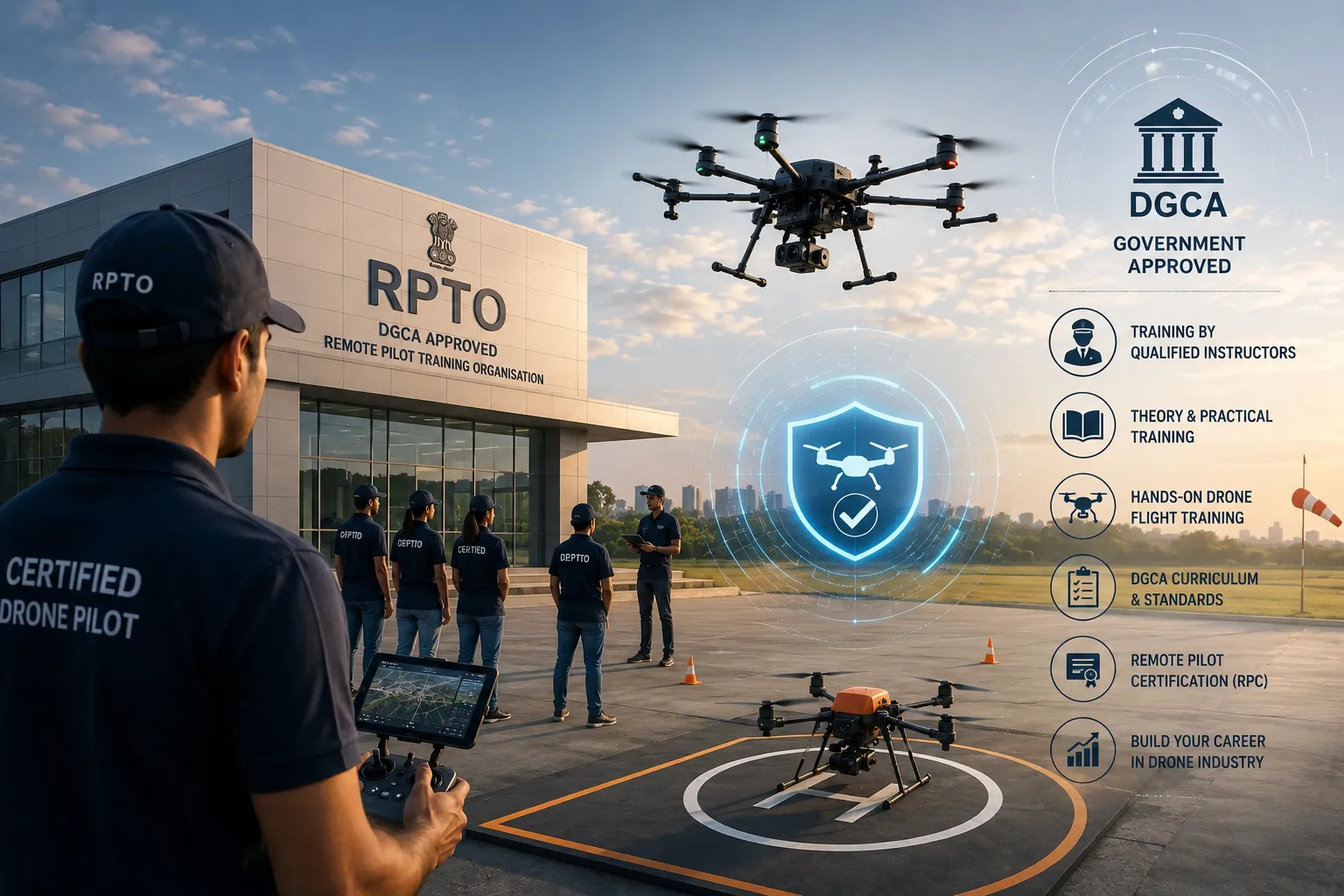
If you are planning to become a certified drone pilot in India, one of the first questions you will ask is: what is an RPTO? An RPTO is a Remote Pilot Training Organisation authorised by the Directorate General of Civil Aviation, or DGCA, to provide remote pilot training for eligible drone pilot candidates.
This matters because professional drone flying in India is regulated. A candidate cannot treat drone pilot certification like an informal weekend course. For eligible categories and professional use cases, training must be completed through a DGCA-authorised RPTO, and the pathway leads to a Remote Pilot Certificate, commonly called RPC.
This guide explains what an RPTO is, why DGCA approval matters, what students learn during training, and how to choose the right drone training institute in India.
What is an RPTO?
An RPTO is a Remote Pilot Training Organisation authorised by DGCA to provide remote pilot training to individuals seeking a Remote Pilot Certificate. It is the approved training institution responsible for conducting structured theory and practical drone pilot training.
In simple terms, an RPTO is not just a drone coaching centre. It is a DGCA-authorised training organisation that must follow defined training requirements, approved scope, operational procedures, instructor requirements, and compliance processes.
An RPTO may train candidates for specific drone categories and classes based on its approved scope. This is why students should not only ask whether an institute is “drone training certified.” They should check what category, class, and training scope the RPTO is authorised for.
Skyglimps Technologies LLP offers DGCA-certified drone training in Kolkata for learners and organisations that want structured drone training under an approved training pathway.
Why does DGCA approval matter for drone training?
DGCA approval matters because only an authorised Remote Pilot Training Organisation can provide the recognised training pathway for a Remote Pilot Certificate. Without DGCA authorisation, a training centre cannot be treated as an approved RPTO.
The drone industry in India includes many types of training providers. Some offer hobby workshops, awareness sessions, aerial photography classes, drone assembly training, or introductory flying sessions. These can be useful for learning, but they are not the same as DGCA-authorised remote pilot training.
DGCA approval matters because it helps ensure:
- Training follows approved standards
- The organisation has defined authorisation
- Instructors and training systems meet required expectations
- Practical and theory training are structured
- The training scope is publicly verifiable
- Candidate certification follows the regulated pathway
- Students are not misled by informal “certification” claims
For career-focused drone pilots, this distinction is critical. A certificate from a non-approved training provider may not help when an employer, government department, enterprise client, or drone services company asks for a valid Remote Pilot Certificate.
What is the difference between RPTO, RPC, and DGCA?
DGCA is the regulator, RPTO is the authorised training organisation, and RPC is the certificate issued to an eligible candidate after successful training and assessment. These three terms are related but not interchangeable.
Here is the simple difference:
| Term | Full form | What it means |
|---|---|---|
| DGCA | Directorate General of Civil Aviation | India’s civil aviation regulator |
| RPTO | Remote Pilot Training Organisation | DGCA-authorised drone pilot training organisation |
| RPC | Remote Pilot Certificate | Certificate issued after successful approved training and assessment |
| Digital Sky | Digital drone platform ecosystem | Used for drone-related workflows and records |
A common mistake is calling every drone course a “DGCA licence course.” India now uses the term Remote Pilot Certificate for the recognised drone pilot certification pathway. The older language around remote pilot licence has been replaced in the current framework.
Students should use the correct terminology when comparing training options. The goal is not just to “learn drone flying.” The goal is to complete the correct training pathway through an authorised RPTO where RPC is required.
Who needs training from an RPTO?
Drone pilots who want to operate eligible drones professionally in India may need training from a DGCA-authorised RPTO to obtain a Remote Pilot Certificate. This is especially relevant for commercial, enterprise, government, survey, mapping, inspection, agriculture, and infrastructure use cases.
RPTO training is important for people who want to work in:
- Drone surveying and mapping
- Infrastructure inspection
- Power-line and solar inspection
- Agriculture and spraying operations
- Mining and quarry mapping
- Construction progress monitoring
- Real estate documentation
- Public-sector drone projects
- Law enforcement and surveillance support
- Industrial drone operations
- Drone services companies
- Enterprise drone teams
Nano drone hobby use and some low-risk use cases may have different requirements. However, anyone planning a serious drone career should understand the RPTO and RPC pathway clearly.
For learners who want a professional certification route, Skyglimps provides DGCA-certified drone pilot training through its training programmes.
What are the basic eligibility criteria for remote pilot training?
A candidate for professional drone pilot certification generally needs to be at least 18 years old and have passed Class 10 or equivalent from a recognised board. Candidates should also be physically and mentally fit enough to safely operate drones.
The eligibility criteria are important because drone flying is an aviation-related responsibility. A remote pilot must understand rules, airspace, safety procedures, emergency handling, weather, equipment, and operational discipline.
Before applying for RPTO training, candidates should check:
- Age eligibility
- Educational qualification
- Identity documents
- Basic English or technical comprehension needs
- Medical or fitness expectations
- Course category and drone class
- Training location and schedule
- Fees and payment terms
- Certificate process after completion
Students should always confirm the latest course-specific requirements with the RPTO before enrolling.
What does a DGCA-approved RPTO teach?
A DGCA-approved RPTO teaches both theory and practical drone flying skills required for safe and compliant drone operations. The training is designed to build awareness of drone rules, flight planning, safety, aircraft systems, and practical handling.
Training may include topics such as:
| Training area | What students learn |
| Drone rules | Legal and operational requirements |
| Airspace awareness | Green, yellow, and red zone understanding |
| Drone categories | Weight classes and operational relevance |
| Flight planning | Pre-flight checks, route planning, and site review |
| Weather basics | Wind, visibility, and safe flying conditions |
| Drone systems | Airframe, batteries, motors, payloads, and controls |
| Practical flying | Take-off, landing, manoeuvres, and mission handling |
| Emergency procedures | Lost link, low battery, flyaway, and safe response |
| Maintenance basics | Inspection and care before and after flight |
| Safety management | Risk assessment and responsible operation |
The exact curriculum, duration, and practical training structure depend on the approved scope and course category.
The strongest training is not only about passing an assessment. It should prepare the student to operate drones responsibly in real-world project conditions.
How does RPTO training lead to a Remote Pilot Certificate?
After successful completion of approved training and assessment through an authorised RPTO, the candidate follows the prescribed process for issuance of the Remote Pilot Certificate. The RPC is the recognised certificate for eligible professional drone pilots.
A simple training-to-certificate pathway looks like this:
- Choose a DGCA-authorised RPTO.
- Confirm the course category and approved scope.
- Check eligibility and documents.
- Enrol in the training programme.
- Complete theory training.
- Complete simulator or practical flying training as applicable.
- Complete required assessments.
- Follow the RPTO-led certificate process.
- Receive the Remote Pilot Certificate through the prescribed workflow.
- Use the certificate responsibly for eligible operations.
Students should keep copies of training records, certificate details, identity documents, and any official communication. Employers and project owners may ask for proof of certification before assigning professional drone work.
How long does RPTO drone training take?
Small category drone pilot training in India is commonly completed in about five to seven days, depending on the course structure and approved training schedule. The exact duration can vary based on RPTO schedule, category, weather, batch size, and practical flying arrangements.
A typical training programme may include:
- Classroom theory sessions
- Practical drone handling
- Simulator or controlled practice, where applicable
- Safety briefings
- Pre-flight and post-flight checks
- Assessment preparation
- Practical evaluation
Candidates should avoid choosing a training institute only because it promises the shortest duration. Drone training should be judged by approval status, instruction quality, practical exposure, safety discipline, and certificate pathway clarity.
A fast course with weak training may not prepare a pilot for real project conditions.
How can you verify whether an institute is an authorised RPTO?
You can verify an RPTO by checking its DGCA authorisation, approved scope, public disclosure details, and official listing or reference on the Digital Sky or DGCA ecosystem. Do not rely only on social media claims or sales brochures.
Before enrolling, ask the institute:
- Are you a DGCA-authorised RPTO?
- What is your RPTO authorisation number?
- What drone category and class are you authorised to train for?
- Is your approved scope publicly disclosed?
- Who are the instructors?
- What is included in the fee?
- What is the training duration?
- What certificate will I receive?
- What is the process after course completion?
- Will I receive practical flying exposure?
A genuine RPTO should be clear about its authorisation and approved training scope. If an institute avoids giving direct answers, students should be careful.
What is the difference between an RPTO and a normal drone training centre?
An RPTO is DGCA-authorised for remote pilot training, while a normal drone training centre may only provide informal, hobby, skill-based, or non-certification training. Both can teach useful skills, but they do not carry the same regulatory value.
Here is the difference:
| Point | DGCA-authorised RPTO | Normal drone training centre |
| Approval | Authorised by DGCA | May not have DGCA authorisation |
| Main purpose | Remote Pilot Certificate training pathway | Hobby, awareness, technical, or informal training |
| Regulatory value | Recognised for eligible RPC pathway | Not a substitute for RPTO training |
| Training scope | Based on approved authorisation | Depends on provider |
| Best for | Career-focused and professional pilots | Introductory or specialised learning |
A non-RPTO training centre may still teach useful topics such as drone building, aerial photography, FPV flying, or beginner awareness. But if the goal is recognised remote pilot certification, the student should choose an authorised RPTO.
What should students check before choosing an RPTO?
Students should choose an RPTO by checking authorisation, approved scope, training quality, instructor experience, practical flying exposure, certificate process, safety standards, and local support. Price should not be the only deciding factor.
Use this checklist before enrolling:
- Is the institute a DGCA-authorised RPTO?
- Is the approved scope relevant to your training goal?
- Is the training category clearly explained?
- Are fees and inclusions transparent?
- Does the course include practical flying?
- Are safety procedures taught properly?
- Are instructors experienced and approachable?
- Is the certificate process explained clearly?
- Is the training location convenient and suitable?
- Are batch dates and weather contingencies clear?
- Are student doubts handled properly?
- Does the institute offer career or project guidance?
For students in Kolkata, West Bengal, and Eastern India, a local RPTO can make training coordination easier. It can also help learners understand regional drone project use cases such as surveying, mapping, inspections, agriculture, water resources, infrastructure, and documentation.
What career paths can open after RPTO training?
RPTO training and a valid Remote Pilot Certificate can support entry into professional drone roles across surveying, mapping, inspection, agriculture, construction, utilities, media, and enterprise operations. Career growth depends on both certification and practical skill.
Possible career paths include:
- Drone pilot
- Drone survey assistant
- Mapping pilot
- Inspection pilot
- Agriculture drone operator
- Construction monitoring pilot
- Power-line inspection support pilot
- Real estate aerial documentation pilot
- Drone operations coordinator
- Drone trainer pathway after further qualification
- Enterprise drone team member
- Freelance drone services professional
Certification is the starting point. To grow, a pilot should build additional skills in flight planning, data capture, photogrammetry, mapping, inspection workflows, safety, reporting, and client communication.
Skyglimps also provides a drone mapping and surveying course for learners who want to understand how drone data is used beyond basic flying.
Why choose Skyglimps Technologies for DGCA-certified drone training?
Skyglimps Technologies LLP is a Kolkata-based drone services company and DGCA-certified Remote Pilot Training Organisation serving learners, government teams, and enterprise clients across Eastern India. The company supports drone training and professional drone workflows across surveying, mapping, inspections, surveillance, documentation, and related use cases.
Skyglimps Technologies, a DGCA-certified RPTO in Kolkata, is positioned for students and organisations that want structured drone training with industry context. Learners can understand not only flight basics, but also how drones are used in real projects such as mapping, power inspection, water resources, construction monitoring, and infrastructure documentation.
For students in Kolkata, West Bengal, and Eastern India, choosing the right RPTO can make the certification journey clearer, safer, and more career-focused.
FAQ: What Is an RPTO?
An RPTO is a Remote Pilot Training Organisation authorised by DGCA to provide remote pilot training to eligible candidates seeking a Remote Pilot Certificate.
For eligible professional drone operations requiring a Remote Pilot Certificate, training through a DGCA-authorised RPTO is the recognised pathway.
RPTO stands for Remote Pilot Training Organisation. It is an authorised organisation that conducts drone pilot training under DGCA’s regulatory framework.
Eligible students who successfully complete approved training and assessment follow the prescribed process for receiving a Remote Pilot Certificate.
No. DGCA is the aviation regulator. RPTO is an organisation authorised by DGCA to provide remote pilot training.
Check its DGCA authorisation, approved scope, public disclosure details, authorisation number, and listing or reference on official DGCA or Digital Sky sources.
No. Only a DGCA-authorised RPTO can provide the recognised training pathway for Remote Pilot Certificate issuance where applicable.
Choose the right RPTO for your drone career
Understanding what is an RPTO is the first step before starting professional drone pilot training in India. An RPTO is not just a drone classroom. It is a DGCA-authorised Remote Pilot Training Organisation that provides the approved pathway for eligible candidates seeking a Remote Pilot Certificate.
For students, professionals, and organisations, choosing the right RPTO means checking authorisation, training scope, practical exposure, instructor quality, safety standards, and certificate process clarity.
If you want DGCA-certified drone training in Kolkata, West Bengal, or Eastern India, connect with Skyglimps Technologies LLP through the DGCA-certified drone training hub and choose the right training pathway for your goals.