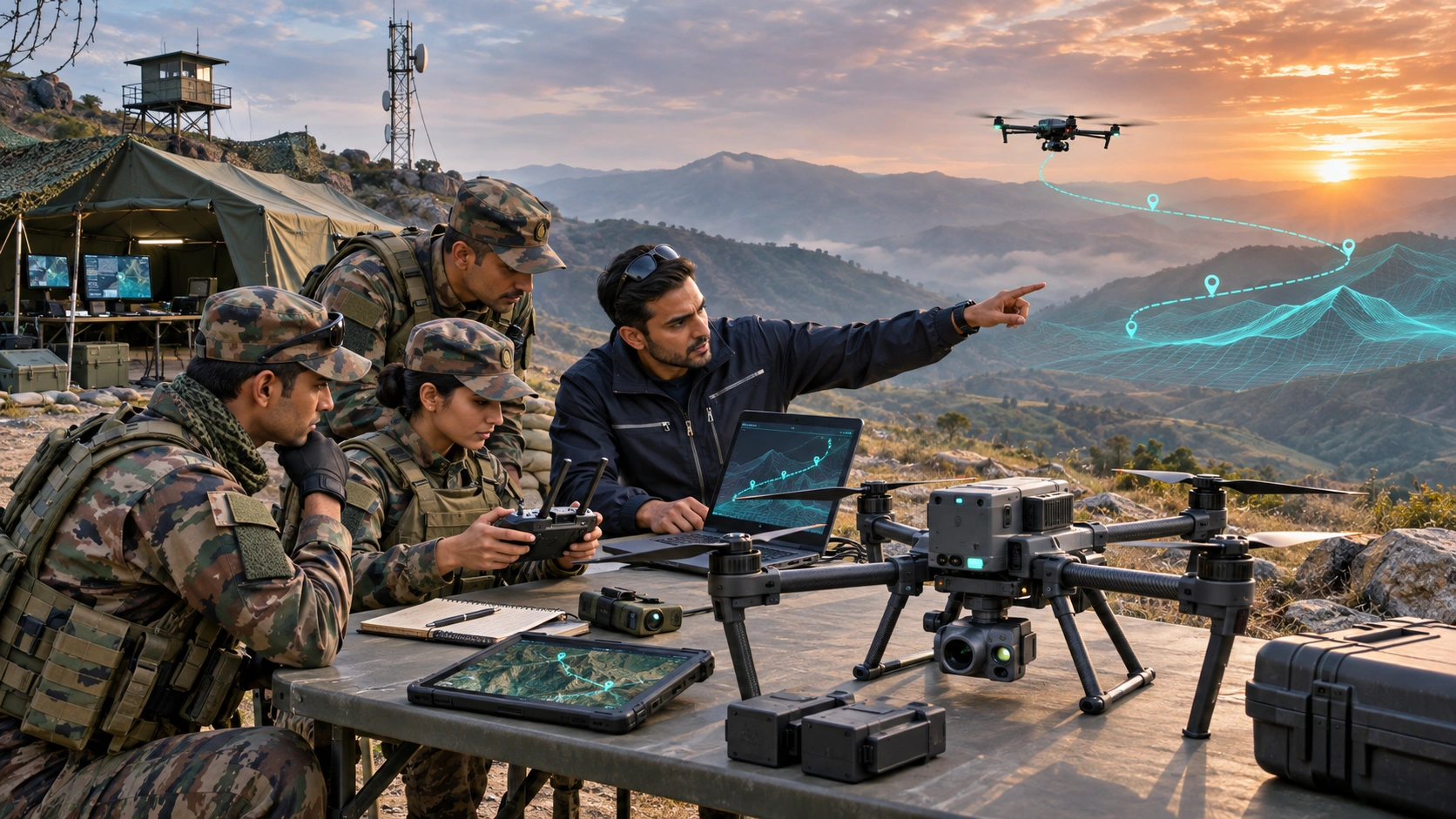
Drones are increasingly becoming part of professional aviation, surveying, inspection, monitoring and other operational workflows. For defence organisations, this creates a growing need for personnel who understand not only how to control an unmanned aircraft, but also how to operate it safely, systematically and professionally.
A key question is whether a DGCA-certified drone training curriculum can meet the requirements of defence personnel.
The answer requires an important distinction.
DGCA drone training can provide a structured aviation and remote-pilot foundation, but it should not be treated as a complete substitute for service-specific military training, authorisation or operating procedures.
India’s Drone Rules, 2021 specifically exclude unmanned aircraft systems belonging to or used by the Navy, Army, Air Force and other Union forces from their scope. Therefore, defence organisations must follow the rules and authorisations applicable to their own operations.
At the same time, a standardised remote-pilot curriculum can still be valuable for building foundational skills such as flight control, safety, weather awareness, maintenance, risk assessment and structured flight procedures.
Why Is Drone Training Important for Defence Personnel?
Operating a drone professionally requires more than learning the controls of a particular aircraft.
Personnel need to understand how different systems behave, how environmental conditions affect flight and how to identify risks before an aircraft takes off.
A structured training programme can build knowledge in areas such as:
- Drone systems and components
- Flight fundamentals
- Aerodynamics
- Weather and meteorology
- Pre-flight procedures
- Risk assessment
- Safety management
- Battery and equipment handling
- Maintenance
- Payload awareness
- Simulator-based practice
- Practical flight control
- Emergency response
These skills can provide a common technical foundation even when the organisation later adds its own platform-specific or mission-specific training.
What Does DGCA-Certified Drone Training Actually Provide?
Under India’s current civil drone framework, a Remote Pilot Certificate is issued through a DGCA-authorised Remote Pilot Training Organisation for the applicable training category and class. The Ministry of Civil Aviation currently describes DGCA-authorised RPTOs as organisations that must meet requirements relating to infrastructure, personnel, equipment, training methodology, safety and quality assurance.
This creates a structured training environment rather than informal drone lessons.
A professional curriculum can cover both classroom and practical components.
For example, SkyGlimps’ current DGCA-certified Small Category Drone Pilot Training includes regulatory knowledge, flight fundamentals, ATC procedures, Radio Telephony, aerodynamics, meteorology, maintenance, risk assessment, safety, Threat & Error Management, payload operations, simulator training, practical flying, night flying operations and final flying assessment.
For defence personnel, these fundamentals can form the baseline layer of a broader training programme.
How Does a DGCA Curriculum Fit Defence Training?
The best approach is not to replace military training with a civilian drone course.
Instead, think of the curriculum as having two layers:
Layer 1: Standardised Remote-Pilot Foundation
This covers general aviation and drone-operating skills.
Layer 2: Defence-Specific Training
This covers the organisation’s own aircraft, procedures, security requirements, communications, data policies, operating environment and role-specific responsibilities.
The result can look like:
DGCA Foundation → Platform Training → Unit Procedures → Application Training → Assessment
This structure allows personnel to develop transferable drone skills while still being trained according to their organisation’s requirements.
Which Parts of DGCA Training Are Most Useful for Defence Personnel?
Not every module has equal importance for every role.
Several areas are particularly useful as foundational training.
1. Flight Fundamentals
Personnel should understand:
- Take-off and landing
- Hovering
- Direction and orientation
- Basic manoeuvres
- Altitude control
- Flight stability
- Controller inputs
These fundamentals help pilots build consistent aircraft-handling skills.
2. Aerodynamics
Understanding how an aircraft responds to:
- Wind
- Weight
- Payload
- Propulsion
- Control inputs
can make pilots more capable of recognising abnormal behaviour.
3. Weather and Meteorology
Weather directly affects drone performance.
Training should help personnel understand:
- Wind
- Visibility
- Temperature
- Rain
- Atmospheric conditions
- Weather-related operational limitations
This becomes particularly important when drone operations are conducted outside controlled training environments.
4. Risk Assessment and Safety
A professional operator should identify hazards before flight rather than reacting to them after take-off.
Risk assessment can consider:
- People
- Structures
- Terrain
- Aircraft condition
- Weather
- Battery status
- Communications
- Take-off and landing areas
- Operational restrictions
5. Maintenance
A trained pilot should understand basic aircraft condition checks.
This can include:
- Propellers
- Motors
- Batteries
- Aircraft frame
- Controllers
- Payloads
- Firmware or system status
- Physical damage
The exact maintenance responsibility will depend on the aircraft and organisation.
6. Simulator Training
Simulation allows personnel to practise flight control before operating the physical aircraft.
It can help with:
- Orientation
- Basic manoeuvres
- Control coordination
- Repetition
- Confidence building
- Scenario-based learning
DGCA-authorised RPTOs are required to maintain appropriate training infrastructure, including flight simulators suitable for the category and class of training being offered.
What Should Be Added to a Defence-Oriented Drone Curriculum?
A defence organisation may need training that goes beyond a standard pilot syllabus.
The additional modules should be determined by the organisation and its authorised procedures.
Platform-Specific Training
Personnel should become familiar with the actual aircraft they are expected to operate.
This can include:
- Aircraft configuration
- Controller
- Payload
- Battery system
- Operating limitations
- Maintenance procedures
- Manufacturer documentation
Organisation-Specific SOPs
A military unit may have its own procedures for:
- Equipment issue and return
- Pre-flight authorisation
- Flight documentation
- Data handling
- Maintenance
- Incident reporting
- Storage
- Communications
These should be taught separately from the general aviation foundation.
Application-Specific Training
Training can also be designed around the intended role.
For example:
- Aerial mapping
- Infrastructure documentation
- Terrain mapping
- Inspection
- Asset monitoring
- Disaster assessment
- Training and simulation
- Aerial photography
The curriculum should match what the personnel are actually expected to do.
Does DGCA Certification Mean a Defence Pilot Is Fully Qualified for Military Drone Operations?
No.
This is one of the most important points to understand.
A DGCA Remote Pilot Certificate, where applicable, demonstrates completion of an approved remote-pilot training and assessment pathway. It does not automatically qualify a person for every type of drone, every mission or every military operating environment.
Defence organisations may have separate:
- Qualification requirements
- Platform authorisations
- Internal SOPs
- Security procedures
- Training standards
- Command approvals
- Data-handling requirements
Therefore, DGCA training and military qualification should be viewed as complementary where both are relevant, not interchangeable.
The current DGCA framework itself ties an RPC to the applicable category, sub-category and class of training.
Can Defence Personnel Learn Surveying and Mapping Alongside Drone Flying?
Yes, and this can be particularly useful for personnel whose responsibilities involve geospatial information.
Drone training can be combined with:
- Photogrammetry
- Orthomosaic generation
- Digital elevation models
- 3D modelling
- GIS
- Ground Control Points
- RTK/PPK
- Terrain mapping
- Change detection
This creates a broader skill set:
Pilot → Data Capture → Data Processing → Spatial Analysis
Instead of simply producing aerial photographs, trained personnel can learn how drone data becomes a usable mapping product.
This type of application-specific training can be particularly relevant for engineering, infrastructure, terrain and asset-documentation roles.
Can Drone Training Be Adapted for Defence Organisations?
Yes.
A standard course can provide the foundation, while a customised programme can address the organisation’s specific requirements.
SkyGlimps currently offers Customized Drone Training for companies, institutions and government bodies. Its programme can be designed around a specific application, project, job role or organisational requirement.
For a defence-oriented training programme, the structure could therefore be:
Foundation Module
Drone fundamentals, aircraft systems, flight principles and safety.
Regulatory and Aviation Module
Applicable aviation concepts, airspace awareness and operational responsibilities.
Technical Module
Aircraft systems, batteries, maintenance and payload awareness.
Practical Module
Simulator training followed by instructor-supervised flight practice.
Application Module
Mapping, inspection, documentation or another approved organisational use case.
Organisation Module
Unit-specific SOPs, documentation, security and operational procedures.
Assessment
Practical and theoretical assessment appropriate to the training objective.
This approach makes the training more relevant than simply putting every participant through an identical generic programme.
What Skills Should Defence Personnel Develop Before Operating Independently?
A well-designed programme should develop competence across several areas.
| Skill Area | Expected Capability |
|---|---|
| Aircraft handling | Controlled and consistent flying |
| Flight planning | Preparing a safe and appropriate mission |
| Weather | Understanding environmental limitations |
| Maintenance | Identifying basic aircraft issues |
| Risk assessment | Recognising hazards before flight |
| Safety | Applying pre-flight and operational procedures |
| Data capture | Collecting usable aerial information |
| Payload awareness | Understanding the effect of payloads |
| Simulator use | Practising procedures before live flight |
| Reporting | Recording relevant flight and equipment information |
The exact competency standard should be defined by the organisation and the aircraft being used.
Why Is Practical Training Important?
Drone operation is a physical skill as well as a theoretical subject.
A person may understand:
- Airspace
- Aerodynamics
- Weather
- Drone components
but still struggle to control an aircraft smoothly.
That is why practical flying is an important part of professional training.
SkyGlimps’ current small-category programme progresses from classroom and simulator training into instructor-supervised practical flying, followed by solo-flight progression and a final flying assessment.
For organisational training, practical sessions can also be adapted around the type of aircraft and application being taught.
Should Defence Personnel Learn Multiple Types of Drones?
It depends on their role.
A pilot who will operate a specific multirotor platform may initially benefit more from becoming highly competent on that platform than from learning several unrelated aircraft.
However, broader exposure can help personnel understand differences between:
- Multirotor aircraft
- Fixed-wing aircraft
- Hybrid VTOL systems
- FPV systems
- Payload-equipped platforms
The important principle is to distinguish general aviation knowledge from platform qualification.
Knowing how one drone operates does not automatically qualify someone to operate another.
How Can Training Help Defence Personnel Transition Into Civilian Drone Careers?
This is another important benefit of structured drone education.
Personnel leaving defence services may already have valuable experience in:
- Discipline
- Safety procedures
- Equipment handling
- Technical operations
- Team coordination
- Field environments
Adding formally structured drone skills can help create pathways into civilian applications such as:
- Surveying
- Mapping
- Infrastructure inspection
- Industrial inspection
- Agriculture
- Aerial documentation
- Drone services
- GIS and geospatial operations
For civilian operations where an applicable RPC is required, candidates should complete the relevant training and certification pathway through an authorised RPTO.
The Ministry of Civil Aviation currently identifies drone operations in surveying, inspection and agriculture among professional drone career applications.
What Should Defence Organisations Look for in a Drone Training Provider?
Before selecting a training partner, organisations should evaluate more than the course price.
Important questions include:
Certification and Authorisation
- Is the organisation appropriately authorised for the applicable DGCA training?
- What drone category and class does the programme cover?
- What assessment process is followed?
Practical Infrastructure
- Are suitable training drones available?
- Is simulator training provided?
- Is there an appropriate flying area?
- How much practical flying does each trainee receive?
Instructor Capability
- Are instructors appropriately authorised and experienced?
- Do they understand real-world drone operations?
- Can they adapt the curriculum to the participants’ skill level?
Customisation
- Can application-specific modules be added?
- Can the training be delivered for a group?
- Can the programme be aligned with organisational workflows?
DGCA’s current RPTO framework specifically requires authorised organisations to maintain suitable infrastructure, qualified personnel, training equipment, training procedures and quality-assurance processes.
How Can SkyGlimps Support Defence-Oriented Drone Training?
SkyGlimps operates a DGCA-authorised Remote Pilot Training Organisation in Kolkata and currently provides DGCA-certified Small Category Drone Pilot Training.
Its standard programme covers regulatory knowledge, flight fundamentals, ATC procedures, aerodynamics, weather, maintenance, risk assessment, safety, payload operations, simulator training, practical flying, night flying operations and final flying assessment.
For organisations requiring something beyond the standard curriculum, SkyGlimps also provides customised training for government bodies and organisations.
A defence-oriented programme can therefore be structured around the participants’ existing experience, intended drone platform and approved organisational objectives.
Explore SkyGlimps DGCA-Certified Drone Training
Frequently Asked Questions
DGCA-certified training can provide a structured remote-pilot foundation, but India’s Drone Rules, 2021 contain an exclusion for UAS belonging to or used by the Navy, Army, Air Force and other Union forces. Defence organisations therefore need to follow the rules and authorisations applicable to their own operations.
Not automatically. Where DGCA certification is applicable, the RPC demonstrates completion of the relevant training and assessment pathway. Military operations may have additional service-specific qualifications, platform requirements, SOPs and authorisations.
A structured programme can cover flight fundamentals, aerodynamics, weather, maintenance, risk assessment, safety, simulator training, practical flying, payload awareness and other operational fundamentals. The exact curriculum depends on the training category and organisational requirements.
Yes. A training programme can combine a standard remote-pilot foundation with organisation-specific modules covering the approved aircraft, operational procedures, application workflows, safety requirements and other authorised training objectives.
Yes. Drone skills can transfer into civilian applications such as surveying, mapping, inspection, infrastructure monitoring and aerial documentation. Where an RPC is required for civilian operations, the relevant DGCA certification pathway should be completed.
Building a Stronger Drone Skill Set for Defence Personnel
The future of professional drone operations will require more than people who know how to move a drone in the air.
Personnel need to understand the aircraft, environment, risks, data and operating procedures surrounding every flight.
For defence organisations, the strongest approach is therefore not to treat a DGCA curriculum as a complete military qualification.
Instead, it can serve as a structured aviation foundation covering areas such as:
Flight Fundamentals → Safety → Weather → Maintenance → Risk Assessment → Simulator Training → Practical Flying → Assessment
That foundation can then be extended with authorised, organisation-specific training covering the aircraft, applications and procedures relevant to the personnel’s responsibilities.
For defence personnel, this layered approach can create a more consistent technical baseline while allowing the organisation to maintain its own operational standards.
And for personnel moving into civilian drone careers, the same foundational skills can provide a pathway into surveying, mapping, inspection and other professional applications.
Ultimately, effective drone training for defense personnel should not be measured only by whether someone can fly a drone.
It should be measured by whether the trainee can prepare correctly, operate safely, understand the aircraft, recognise risks, collect useful data and follow the procedures required for the environment in which the drone is being used.