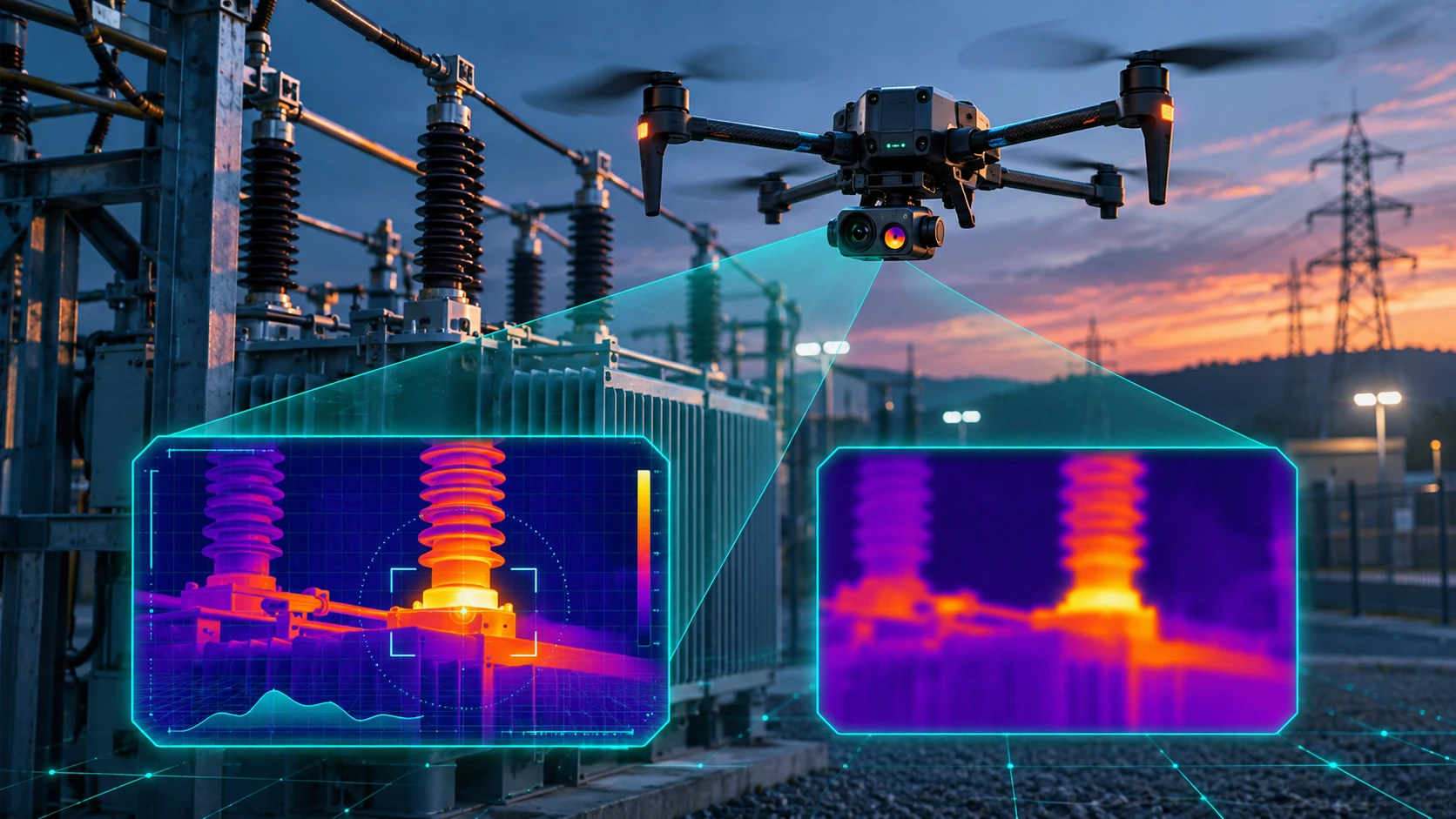
Thermal cameras can reveal problems that ordinary RGB cameras cannot see. They can show heat patterns across solar panels, electrical components, industrial equipment, roofs and other assets.
But not every thermal camera provides the same type of information.
One of the most important distinctions for professional drone inspections is radiometric vs non-radiometric thermal camera technology.
A non-radiometric thermal camera can produce a thermal image that helps inspectors identify relative hot and cold areas.
A radiometric thermal camera goes further by retaining temperature information that can be analysed across individual pixels, allowing inspectors to obtain quantitative temperature measurements when the camera, environment and measurement parameters are properly configured.
This difference matters when an inspection report needs to answer more than:
“Where is the hotspot?”
It may also need to answer:
“How hot is it, how much hotter is it than comparable components, and does the temperature difference justify further investigation?”
That is where radiometric capability becomes particularly valuable.
What Is a Radiometric Thermal Camera?
A radiometric thermal camera captures infrared information that can be used to calculate temperature values for image pixels.
Instead of treating the thermal image only as a visual representation of heat, radiometric data can support quantitative analysis.
Depending on the camera and software, an inspector may be able to analyse:
- Spot temperatures
- Minimum and maximum temperatures
- Temperature differences
- Temperature ranges
- Areas of interest
- Temperature trends
- Hotspot severity
- Post-flight measurements
FLIR explains that radiometric thermal cameras can record temperature information for individual pixels, allowing the data to be analysed after the inspection.
For drone inspections, this means the thermal dataset can potentially be used for more detailed engineering analysis rather than only visual anomaly detection.
What Is a Non-Radiometric Thermal Camera?
A non-radiometric thermal camera primarily provides a thermal image showing relative differences in infrared energy.
It can still be extremely useful.
For example, an inspector may identify:
- A noticeably hotter solar module
- An unusual heat pattern on electrical equipment
- A warm mechanical component
- A thermal bridge
- A suspicious area on a roof
The key limitation is that the image should not automatically be treated as a precise temperature measurement for every pixel.
A thermal image can show that one area appears hotter than another without providing the same level of quantitative temperature information available from a radiometric dataset.
This makes non-radiometric systems particularly suitable for qualitative thermography, where identifying patterns and anomalies is the primary objective.
Radiometric vs Non-Radiometric Thermal Camera: What Is the Main Difference?
The simplest distinction is:
Non-radiometric = primarily visual thermal information
Radiometric = thermal information plus quantitative temperature data
| Factor | Radiometric Thermal Camera | Non-Radiometric Thermal Camera |
|---|---|---|
| Thermal image | Yes | Yes |
| Shows heat patterns | Yes | Yes |
| Relative hot/cold comparison | Yes | Yes |
| Pixel-level temperature data | Typically available | Generally not available |
| Post-flight temperature analysis | Yes | Limited |
| Quantitative reporting | Stronger | More limited |
| Detailed hotspot analysis | Strong | Strong for qualitative analysis |
| Equipment complexity | Higher | Usually lower |
| Cost | Generally higher | Generally lower |
| Best suited for | Quantitative inspection | Qualitative screening |
The exact capabilities vary between camera models, so inspectors should always verify the manufacturer’s technical specification rather than relying only on the term “radiometric.”
Why Does Radiometric Data Matter for Drone Inspections?
Temperature can provide information that a normal thermal image alone cannot fully quantify.
Consider an electrical component that appears warmer than nearby components.
A non-radiometric camera may clearly reveal the anomaly.
A radiometric system can potentially allow the inspector to measure:
Component A → 72°C
Comparable Component B → 49°C
The difference may then become part of the inspection analysis.
However, the temperature number should never be treated as automatically accurate simply because the camera is radiometric.
Radiometric temperature measurement depends on factors such as:
- Emissivity
- Reflected apparent temperature
- Distance
- Atmospheric conditions
- Humidity
- Camera characteristics
- Target material
- Viewing conditions
FLIR specifically notes that emissivity, reflections and atmospheric effects can influence non-contact temperature measurements.
So the correct principle is:
Radiometric capability enables quantitative measurement; correct measurement practice makes that data meaningful.
When Is a Non-Radiometric Thermal Camera Enough?
A non-radiometric camera can be suitable when the inspection objective is primarily to identify thermal patterns rather than produce precise temperature measurements.
Examples can include:
Initial Solar Screening
The inspection team may want to locate modules or areas showing unusual thermal behaviour for further investigation.
General Asset Monitoring
A facility may need to identify visibly abnormal heat patterns across a large number of assets.
Search and Situational Awareness
The main objective may be locating heat signatures rather than measuring exact temperatures.
Preliminary Inspection
Thermal imaging may be used as an initial screening tool before a more detailed engineering inspection.
In these cases, qualitative thermal information may provide sufficient value.
When Should Drone Inspectors Prefer a Radiometric Camera?
Radiometric capability becomes more valuable when temperature itself is part of the decision-making process.
Examples include:
- Electrical inspections
- Solar plant inspections
- Industrial equipment monitoring
- Mechanical inspections
- Building diagnostics
- Condition monitoring
- Preventive maintenance
- Comparative temperature analysis
For example, if a client wants a report showing the temperature of identified solar hotspots or electrical components, a radiometric camera is generally more appropriate.
FLIR notes that quantitative thermography becomes important when inspectors need temperature information for every pixel and post-flight analysis.
How Does Radiometric Thermal Imaging Help Solar Inspections?
Solar plants are one of the clearest examples of where radiometric and non-radiometric thermal capabilities can be compared.
A thermal camera can identify panels or areas that appear warmer than their surroundings.
Possible findings can include:
- Hotspots
- Abnormal thermal patterns
- Uneven heating
- Module-level anomalies
- String-related anomalies
RGB imagery can then provide visual context.
For example:
Thermal image: Identifies a hotspot.
RGB image: Shows the corresponding module, physical condition and surrounding environment.
If the camera is radiometric, the inspection team can also analyse the temperature associated with the thermal anomaly.
However, temperature interpretation still depends on inspection conditions. Solar irradiance, wind, module condition, viewing angle and other factors can affect thermal results.
Therefore, a thermal hotspot should generally be treated as an inspection finding requiring interpretation, not automatically as proof of a specific component failure.
How Does Radiometric Thermal Imaging Help Electrical Inspections?
Electrical equipment can develop abnormal heating because of issues such as poor connections, excessive resistance or load-related conditions.
Thermal inspection can help identify components that are behaving differently from comparable equipment.
Radiometric data adds another layer because inspectors can quantify the temperature difference.
For example:
Normal reference component → lower temperature
Suspect component → higher temperature
The difference may help maintenance teams prioritise further investigation.
SkyGlimps’ Thermal & RGB Inspection workflow combines thermal and visual data for applications including electrical issues, equipment overheating, solar inspection and infrastructure monitoring. Explore Thermal & RGB Inspections
The important point is that thermal data supports inspection and prioritisation; the final diagnosis may still require qualified electrical or engineering assessment.
Why Is Emissivity Important in Radiometric Inspection?
One of the biggest mistakes in thermal inspection is assuming that the temperature displayed by a radiometric camera is automatically the true surface temperature.
It is not that simple.
Emissivity describes how effectively a surface emits infrared radiation.
Different materials can have very different emissivity characteristics.
High-emissivity surfaces are generally easier to measure accurately.
Highly reflective or low-emissivity materials can be more challenging because reflected infrared radiation can influence the measurement.
FLIR identifies emissivity as one of the key parameters that must be considered when performing accurate radiometric measurements.
This is especially important for drone inspectors working around:
- Bare metals
- Shiny equipment
- Reflective roofs
- Polished surfaces
- Glass
- Metallic electrical components
The inspector needs to understand the material being measured rather than simply recording the camera’s displayed number.
Does Distance Affect Radiometric Temperature Measurement?
Yes.
The distance between the thermal camera and the target can affect temperature measurement because atmospheric absorption and atmospheric radiation influence the infrared energy reaching the camera.
Radiometric systems can compensate for distance when the correct measurement parameters are provided.
This becomes particularly relevant for drone inspections because the camera may be operating several metres or more away from the target.
Therefore, flight planning should consider:
- Required stand-off distance
- Target size
- Camera resolution
- Thermal lens
- Environmental conditions
- Required measurement accuracy
Flying closer is not automatically better. The camera needs to capture enough pixels across the target while maintaining safe and appropriate operating distance.
Why Does Target Size Matter?
A thermal measurement becomes more useful when the target occupies enough pixels in the image.
A very small electrical component captured from too far away may not provide enough spatial information for reliable measurement.
FLIR’s radiometric guidance recommends ensuring sufficient pixels cover the target and notes that increasing target coverage can improve measurement quality.
This means drone inspectors should consider thermal resolution and target size together.
A high-resolution thermal sensor can provide more useful detail, but only when the inspection is planned so that the target is adequately represented in the image.
Can a Radiometric Camera Replace RGB?
No.
Radiometric thermal data and RGB imagery provide different information.
Thermal tells you about heat patterns.
RGB tells you about visible physical condition and context.
For example, a thermal image may identify a hotspot on a solar module.
The corresponding RGB image can help determine:
- Which module is affected
- Whether visible damage exists
- Whether dirt or debris is present
- Whether vegetation is shading the module
- What surrounding components look like
This is why professional inspection workflows often combine both datasets.
SkyGlimps describes its Thermal & RGB Inspection process as simultaneous RGB and thermal capture followed by data fusion and actionable reporting.
What Should a Drone Inspector Check Before a Radiometric Flight?
A radiometric inspection should be planned more carefully than simply selecting a thermal camera and launching the drone.
Before the flight, check:
Asset Condition
Is the equipment operating under the condition that needs to be inspected?
Thermal Load
For electrical or mechanical inspections, is the asset sufficiently loaded for meaningful thermal differences to appear?
Weather
Consider:
- Wind
- Cloud cover
- Rain
- Ambient temperature
- Humidity
- Solar radiation
Camera Settings
Confirm appropriate:
- Emissivity
- Reflected temperature
- Distance
- Atmospheric parameters
- Measurement range
Flight Geometry
Plan a suitable:
- Altitude
- Viewing angle
- Stand-off distance
- Flight path
- Overlap where required
RGB Coverage
Ensure the visual camera can identify the asset corresponding to each thermal finding.
This planning stage can have as much influence on the usefulness of the final inspection as the camera itself.
What Should a Radiometric Thermal Inspection Report Include?
A professional report should make findings easy for engineers and maintenance teams to understand.
Depending on the project, the report may include:
- Asset identification
- Thermal image
- RGB image
- Location
- Temperature measurement
- Reference temperature
- Temperature difference
- Inspection conditions
- Observation
- Priority
- Recommended follow-up
- Supporting notes
For example:
Asset: Transformer connection
Thermal observation: Higher temperature than comparable connection
Measured temperature: Project-specific recorded value
Reference: Comparable component
Assessment: Requires technical review
This is more useful than simply attaching hundreds of thermal photographs without identifying the important findings.
SkyGlimps’ inspection service describes deliverables including annotated visuals, hotspot identification, temperature analytics and digital inspection reports depending on project scope.
What Are the Biggest Mistakes in Radiometric Drone Inspection?
Several mistakes can reduce the value of otherwise expensive thermal equipment.
Treating Every Temperature Reading as Accurate
Radiometric capability does not remove the need for correct measurement parameters.
Ignoring Emissivity
Reflective materials can create misleading temperature readings.
Flying Too Far Away
Small components may occupy too few pixels.
Ignoring Weather
Wind, clouds and changing environmental conditions can influence thermal patterns.
Inspecting at the Wrong Time
Some assets need to be operating under representative conditions for thermal differences to become meaningful.
Using Thermal Without RGB Context
A hotspot without clear asset identification can make maintenance follow-up difficult.
Treating Anomalies as Confirmed Failures
A thermal anomaly is often a reason for further investigation, not automatically a final diagnosis.
Saving Only Ordinary JPEG Images
If quantitative analysis is required, the inspection workflow should preserve the thermal information needed for post-processing. Some radiometric systems store thermal information within specialised image files that allow later measurement and analysis.
How Should You Choose Between Radiometric and Non-Radiometric Cameras?
Start with the inspection question, not the camera specification.
Ask:
Do you only need to locate anomalies?
A non-radiometric thermal system may be sufficient for qualitative screening.
Do you need temperature values?
A radiometric camera is more appropriate.
Will the report compare temperatures?
Radiometric data becomes significantly more useful.
Is the inspection for preventive maintenance?
Radiometric information can provide additional quantitative evidence.
Are you inspecting electrical or industrial equipment?
Radiometric capability is often more valuable when temperature differences need to be documented.
Is the project primarily visual?
RGB may still be more important than either thermal camera type.
Is the inspection high-value or technically sensitive?
A combined radiometric thermal + RGB workflow can provide stronger evidence and context.
The correct equipment should therefore be selected according to the deliverable and decision the inspection needs to support.
Radiometric vs Non-Radiometric: Which One Is Better?
There is no universal winner.
A radiometric camera provides more information, but that does not mean every project needs it.
Choose Non-Radiometric When:
- The objective is qualitative thermal screening
- The main requirement is identifying relative hot/cold patterns
- Exact temperature measurement is not required
- The project has a lower quantitative-analysis requirement
Choose Radiometric When:
- Temperature values matter
- Hotspot severity needs to be assessed
- Post-flight thermal analysis is required
- Temperature comparisons are important
- The report needs quantitative thermal findings
- The inspection supports engineering or maintenance decisions
Choose Radiometric + RGB When:
- Both thermal anomalies and physical condition matter
- Asset identification is important
- Detailed inspection reports are required
- Maintenance teams need actionable findings
The key is not to purchase the most advanced camera simply because it has more features.
The key is to match sensor capability to inspection requirements.
What Should Clients Ask a Drone Inspection Provider?
Before commissioning a thermal drone inspection, clients should ask:
- Is the thermal camera radiometric?
- Can temperature data be analysed after the flight?
- What thermal resolution does the camera provide?
- How will emissivity be handled?
- Will RGB imagery be captured alongside thermal data?
- How will thermal anomalies be identified?
- Will temperature values be included in the report?
- How will each finding be linked to the correct asset?
- What environmental conditions are required?
- What limitations will be documented?
These questions can prevent a common problem: receiving attractive thermal images but not enough usable information to support maintenance decisions.
How Can SkyGlimps Support Thermal Drone Inspections?
SkyGlimps provides Thermal & RGB Inspection services using drone-based visual and infrared data for infrastructure, energy, solar, industrial facilities and other inspection applications.
Its inspection workflow combines thermal and RGB capture, processing and reporting to help identify issues such as heat anomalies, electrical faults, failing solar panels, moisture-related patterns, insulation gaps and equipment overheating.
For projects where temperature analysis is required, the inspection scope should specify the required thermal measurement capability, reporting requirements and asset conditions before the flight.
The SkyGlimps Thermal & RGB Inspection service can be used to discuss the appropriate inspection workflow based on the asset, location and objective.
Frequently Asked Questions
A radiometric thermal camera can provide quantitative temperature information from thermal data, while a non-radiometric camera primarily provides a visual representation of relative heat patterns. The exact capabilities vary by camera model.
No. If the objective is only to identify relative hot and cold areas, a non-radiometric system may be sufficient. Radiometric capability becomes more important when temperature measurement and post-flight analysis are required.
No. Accurate radiometric measurement also depends on emissivity, reflected radiation, distance, atmospheric conditions, camera calibration and other measurement parameters.
Thermal imagery can identify a heat anomaly, while RGB imagery provides visual context and helps identify the exact component or physical condition associated with the finding. Combined data can therefore make inspection reports easier to interpret.
For industrial inspections where temperature values, hotspot severity and post-flight quantitative analysis matter, a radiometric thermal camera is generally more suitable. For preliminary qualitative screening, a non-radiometric camera may be sufficient.
The Right Thermal Camera Depends on the Inspection Objective
The difference between radiometric vs non-radiometric thermal camera technology ultimately comes down to the type of information the inspection needs to produce.
A non-radiometric camera can be highly effective for identifying thermal patterns and locating areas that require attention.
A radiometric camera adds another layer by providing quantitative temperature information that can be analysed and compared after the flight.
But radiometric capability is not a substitute for good thermography practice.
The quality of a thermal inspection depends on the complete workflow:
Right Sensor → Correct Flight Conditions → Suitable Viewing Geometry → Proper Measurement Parameters → Thermal + RGB Context → Expert Interpretation → Clear Reporting
For solar plants, electrical infrastructure and industrial equipment, radiometric data can help maintenance teams move beyond simply seeing a hotspot to understanding the temperature characteristics of the anomaly.
For general screening and situational awareness, a non-radiometric system may provide enough information without the additional complexity and cost.
The most important question for drone inspectors is therefore not:
“Is this camera radiometric?”
It is:
“What information does the client need to make the next maintenance or engineering decision?”
Once that question is answered, the appropriate thermal sensor, flight methodology and reporting workflow become much easier to define.