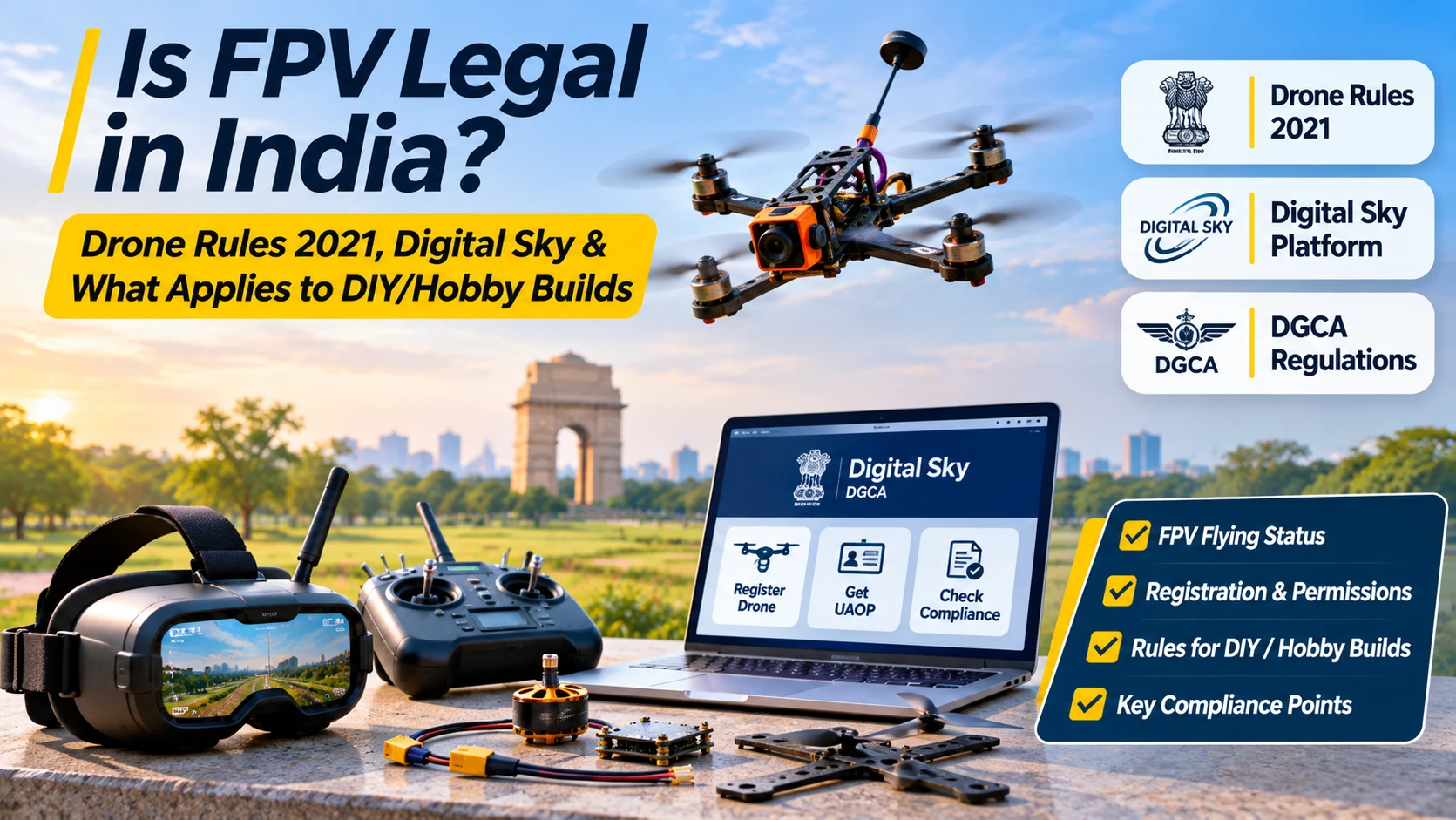
If you are searching “is FPV drone legal in India?”, the short answer is:
FPV flying is not separately prohibited in India, but an FPV drone must still comply with the drone rules that apply to the aircraft and the operation.
India’s Drone Rules, 2021 do not create a separate regulatory category called “FPV.” Instead, unmanned aircraft are classified by factors such as their aircraft type, sub-category, weight and intended use. The rules specifically recognise model remotely piloted aircraft systems, including systems up to 25 kg used for educational, research, design, testing or recreational purposes and operated within visual line of sight.
This distinction is important for FPV enthusiasts because an FPV racing or freestyle build may be treated differently from an FPV drone being used for paid filming, inspection or another professional activity.
So the real question is not simply:
“Is FPV legal?”
It is:
“Does this particular FPV drone and this particular flight comply with the applicable Indian drone requirements?”
Is FPV Flying Specifically Banned in India?
No specific provision in the Drone Rules, 2021 creates a blanket ban on FPV drones as a technology.
The rules classify UAS into categories including aeroplane, rotorcraft and hybrid UAS, with sub-categories including remotely piloted aircraft systems, model remotely piloted aircraft systems and autonomous UAS. “FPV” describes how the pilot views and controls the aircraft; it is not itself a separate category under the Drone Rules.
However, FPV flying can create additional compliance considerations because the pilot normally uses goggles or a screen to see the camera feed.
DGCA’s current guidance for Remote Pilot Certificate holders states that pilots must keep the drone within Visual Line of Sight (VLOS) and check the Digital Sky airspace information before every flight.
Therefore:
FPV technology can be used, but FPV goggles do not automatically give permission to conduct a BVLOS flight.
What Does “FPV” Actually Mean?
FPV stands for First Person View.
An FPV drone generally has a forward-facing camera that sends a live video feed to:
- FPV goggles
- A monitor
- A screen-based controller
- Another compatible viewing device
The pilot uses this video feed to control the aircraft.
FPV systems are commonly used for:
- Racing
- Freestyle flying
- Cinematic footage
- Training
- Technical experimentation
- Educational projects
- Hobby flying
The technology itself does not determine whether the flight is commercial, recreational, compliant or non-compliant.
The aircraft, purpose, weight, location and operating method all matter.
What Do the Drone Rules 2021 Say About Model or DIY Drones?
This is one of the most important parts for hobby FPV pilots.
The Drone Rules define a model remotely piloted aircraft system as a remotely piloted aircraft system with an all-up weight of not more than 25 kg, used only for:
- Educational purposes
- Research
- Design
- Testing
- Recreational purposes
and operated within visual line of sight.
This means a DIY FPV build can potentially fall within the model RPAS category if it satisfies the definition.
But there is an important limitation.
Simply building a drone yourself does not automatically make it a model RPAS.
The aircraft and its operation must satisfy the regulatory definition.
For example:
DIY FPV quad + recreational use + within VLOS + ≤25 kg
may fit the model RPAS definition.
But:
DIY FPV quad + paid commercial filming
does not fit the recreational-only requirement of the model RPAS definition.
Similarly:
DIY FPV aircraft + BVLOS operation
would not satisfy the model RPAS definition requiring operation within VLOS.
Do DIY FPV Drones Need Type Certification?
The Drone Rules specifically exempt model remotely piloted aircraft systems and nano UAS from the requirement to obtain a type certificate.
This is important for hobby builders because a qualifying home-built model does not have to follow the same type-certification pathway as a conventional commercial drone model.
However, this should not be confused with a blanket exemption from every other requirement.
Type certification and registration are separate issues.
The rules separately deal with UIN registration, while pilot certification and airspace requirements are also addressed separately.
Therefore, a DIY builder should not reason:
“My drone is home-built, so no drone rules apply.”
That is not a safe interpretation.
What Weight Categories Apply to FPV Drones?
The Drone Rules classify UAS according to maximum all-up weight, including payload:
| Category | Maximum All-Up Weight |
|---|---|
| Nano | Up to 250 g |
| Micro | More than 250 g to 2 kg |
| Small | More than 2 kg to 25 kg |
| Medium | More than 25 kg to 150 kg |
| Large | More than 150 kg |
These weight categories matter because pilot certification and other regulatory requirements can change depending on the category.
For example, many hobby FPV builds fall within the micro category, but the actual classification must be based on the applicable all-up weight rather than simply the frame size or marketing description.
Do FPV Pilots Need a Remote Pilot Certificate?
The current terminology is Remote Pilot Certificate (RPC).
The Drone (Amendment) Rules, 2022 replaced the earlier Remote Pilot Licence terminology with Remote Pilot Certificate. The current Ministry of Civil Aviation framework confirms that an RPC issued through a DGCA-authorised Remote Pilot Training Organisation is the applicable professional pilot credential where required.
There are two important exemptions from the RPC requirement:
1. Nano UAS
A person operating a nano UAS does not require an RPC under the stated exemption.
2. Micro UAS Used for Non-Commercial Purposes
A micro UAS operated for non-commercial purposes is also exempt from the RPC requirement.
The explicit RPC exemptions are therefore based on the drone category and nature of operation.
This is particularly relevant to hobby FPV pilots.
For example, a qualifying micro FPV drone used purely for recreational, non-commercial flying can fall within the RPC exemption.
But a pilot should not assume the same exemption applies when the aircraft is used for paid work.
What If a DIY FPV Drone Is Used for Commercial Work?
This is where many hobby builds can move into a different regulatory situation.
Suppose someone builds an FPV drone and uses it for:
- Paid filmmaking
- Commercial photography
- Real-estate videos
- Inspection services
- Advertising
- Event coverage
- Client projects
The fact that the aircraft was built by the pilot does not automatically make the commercial operation exempt.
A model RPAS is defined around educational, research, design, testing or recreational use. Commercial work therefore needs to be assessed under the requirements applicable to the actual drone and operation.
For professional operations, the pilot should verify:
- Applicable drone category
- Sub-category
- Type-certification requirement
- UIN/registration requirement
- RPC requirement
- Airspace
- VLOS requirements
- Insurance
- Any additional permissions
Does FPV Goggles Mean the Flight Is BVLOS?
Not automatically, but this is an important area of caution.
DGCA’s current guidance says pilots must keep applicable drone operations within Visual Line of Sight and specifically states that BVLOS operations should not be conducted without specific approval.
The Drone Rules also define a model RPAS as one operated within VLOS.
An FPV pilot wearing goggles may primarily see the camera feed rather than the aircraft itself.
Therefore, a pilot should not assume that seeing the aircraft through FPV goggles is equivalent to maintaining direct visual observation of the aircraft.
Likewise, simply having another person standing nearby should not be treated as a blanket authorisation for BVLOS operation.
The exact operating arrangement should be checked against the applicable DGCA requirements before flight.
Can You Fly an FPV Drone in a Green Zone?
A green-zone location generally does not require prior airspace permission under the Drone Rules, subject to the applicable restrictions and pre-flight verification.
The Ministry of Civil Aviation states that India’s Drone Airspace Map divides low-level airspace into Green, Yellow and Red Zones, with no prior permission required for operations in Green Zones. DGCA guidance nevertheless instructs pilots to check Digital Sky before every flight.
This means:
Green Zone ≠ “fly without checking anything.”
Before an FPV flight, the pilot should verify:
- Current airspace status
- Temporary restrictions
- Site restrictions
- Applicable altitude
- VLOS requirements
- Safety conditions
Airspace zoning can also be dynamic, so relying on an old screenshot or a previous flight is not sufficient.
What Is the Difference Between Digital Sky and eGCA?
This is another area where drone information can become confusing.
Digital Sky
Digital Sky remains important for the drone airspace map and flight-related airspace information.
Pilots should use the current Digital Sky information to determine the applicable zone and restrictions before flying.
eGCA
The Ministry of Civil Aviation currently states that regulatory applications such as drone registration, type certificates and Remote Pilot Certificates are handled through the DGCA’s eGCA platform, while Digital Sky continues to provide the drone airspace map and related services.
In simple terms:
eGCA → Regulatory applications and certification
Digital Sky → Airspace map and flight-related information
Both can therefore be relevant to a professional drone operator.
Does a DIY FPV Drone Need a UIN?
This question requires more care than simply saying “yes” or “no.”
The Drone Rules state that a UAS must be registered and obtain a Unique Identification Number unless it is exempted from the UIN requirement under the rules. The registration process is separate from the type-certification exemption for model RPAS.
This means:
No type certificate required ≠ automatically no UIN required.
There is also a current DGCA notice stating that registration of non-type-certified UAS has been temporarily suspended until further notice.
Because a qualifying model RPAS is exempt from type certification, DIY builders should verify the current DGCA/eGCA registration pathway applicable to their exact build before operating it.
This is particularly important for home-built aircraft because a standard commercial drone registration workflow may not map directly to a DIY model.
What About a 5-Inch FPV Racing Drone?
A typical 5-inch FPV racing or freestyle build is often well below 2 kg, although the actual weight depends on the configuration.
If the aircraft is:
- Within the micro weight category
- Used for non-commercial recreational purposes
- Operated within the applicable VLOS requirements
- Flown in an allowed area
- Otherwise compliant with applicable rules
the pilot may fall within the RPC exemption for non-commercial micro UAS.
However, the pilot should still check the applicable requirements for registration, UIN, airspace and radio equipment rather than assuming that “5-inch FPV” is itself a legal exemption.
The frame size is not the legal classification.
The applicable weight and operation determine the regulatory treatment.
Can You Build Your Own FPV Drone in India?
Building an FPV drone from components is different from importing a complete drone.
India’s DGFT import policy prohibits import of drones in completely built-up, semi-knocked-down or completely knocked-down form, subject to specified exceptions. The same policy states that import of drone components is free.
Therefore, the regulatory position for a DIY builder can be different from someone importing a complete ready-to-fly aircraft.
For example, a person may assemble an FPV aircraft using separately sourced:
- Frame
- Motors
- ESC
- Flight controller
- Radio receiver
- Video transmitter
- Camera
- Battery
- Propellers
But import and use of individual wireless/RF equipment can also involve separate Department of Telecommunications/WPC requirements.
The DoT states that Equipment Type Approval is relevant to wireless communication equipment operating in de-licensed bands, while drones have specific ETA treatment.
So DIY construction should be considered from both the aviation and wireless-spectrum compliance perspective.
What About FPV Video Transmitters and Radio Frequencies?
An FPV drone does not only involve aviation rules.
It also uses radio equipment.
The aircraft may contain:
- Radio-control transmitter/receiver
- Video transmitter
- Telemetry equipment
- GPS/GNSS equipment
- Other RF modules
The Department of Telecommunications’ WPC framework regulates wireless equipment and frequency use in India. Its current ETA guidance specifically notes that drones are treated separately from ordinary products under the ETA process.
Therefore, FPV builders should avoid assuming that an imported radio or video transmitter is automatically lawful simply because it works technically.
The frequency, power, equipment approval and applicable Indian wireless requirements should be checked.
Can You Fly an FPV Drone for Racing or Freestyle?
Recreational racing and freestyle can potentially fall within the recreational-purpose side of the model RPAS definition when the aircraft meets the applicable conditions, including the 25 kg maximum weight and VLOS requirement.
But the flying location still matters.
A suitable FPV practice area should be:
- In an appropriate airspace zone
- Away from uninvolved people
- Suitable for safe operation
- Consistent with the applicable VLOS requirement
- Free from relevant temporary restrictions
The fact that an event is called an “FPV race” does not create a separate exemption from India’s airspace and safety framework.
Can You Use a DIY FPV Drone for Paid Cinematic Flying?
You should not assume that you can.
A DIY FPV drone used for commercial cinematography needs to be evaluated under the requirements applicable to the specific aircraft and commercial operation.
The recreational model-RPAS definition does not cover commercial filmmaking because it expressly limits the model category to educational, research, design, testing or recreational purposes.
For professional FPV cinematography, the operator should therefore consider a compliant aircraft, applicable certification, registration, pilot qualification and airspace requirements before accepting paid work.
What About Indoor FPV Flying?
Indoor flying can reduce some airspace-related issues because the aircraft may remain inside an enclosed environment, but it should not automatically be treated as outside every regulatory or safety consideration.
The pilot should still consider:
- Whether the aircraft is actually inside an enclosed premises
- Whether other people are present
- Property-owner permission
- Safety
- RF equipment
- Battery handling
- Fire risk
- Applicable drone requirements
A large warehouse, exhibition venue or industrial building may also have its own security and operating restrictions.
The safest approach is to evaluate the actual location rather than assuming:
“Indoor = no rules.”
What Should an FPV Pilot Check Before Every Flight?
A simple compliance checklist can prevent many avoidable problems.
1. Drone
Check:
- All-up weight
- Aircraft condition
- Battery
- Propellers
- Motors
- Flight controller
- Radio link
- Video link
2. Regulatory Status
Confirm:
- Applicable UAS category
- Sub-category
- UIN/registration requirement
- RPC requirement
- Type-certification status or exemption
3. Airspace
Check the current Digital Sky map for:
- Green Zone
- Yellow Zone
- Red Zone
- Temporary restrictions
- Other applicable notifications
4. VLOS
Confirm that the planned operation can comply with the applicable VLOS requirement.
Do not assume that FPV goggles automatically make a flight VLOS-compliant.
5. Site Safety
Check:
- People
- Buildings
- Roads
- Vehicles
- Trees
- Power lines
- Other aircraft
- Emergency landing areas
6. Weather
Check:
- Wind
- Rain
- Visibility
- Temperature
- Other conditions that could affect the aircraft
DGCA’s current public guidance similarly tells pilots to check airspace, maintain VLOS, maintain safe distances, perform pre-flight checks and operate within the aircraft’s permitted weather conditions.
Common Misunderstandings About FPV Legality in India
“FPV drones are illegal in India.”
Too broad.
FPV is not itself identified as a prohibited category. The legality depends on the aircraft and operation.
“DIY drones are completely exempt.”
Incorrect.
A qualifying model RPAS may be exempt from type certification, but that does not mean every DIY build is automatically exempt from every requirement.
“If it weighs under 250 g, I can fly anywhere.”
Incorrect.
Nano status can affect certification requirements, but airspace and safety rules still matter.
“FPV goggles mean I can fly beyond line of sight.”
Incorrect.
DGCA guidance requires applicable operations to remain within VLOS unless an appropriate BVLOS approval applies.
“Green Zone means I don’t need to check Digital Sky.”
Incorrect.
DGCA specifically instructs pilots to check Digital Sky before every flight.
“An RPC makes any FPV drone legal.”
Incorrect.
Pilot certification and aircraft compliance are separate issues.
Can FPV Skills Be Used Professionally?
Yes.
FPV skills can be useful in areas such as:
- Cinematic production
- Industrial documentation
- Real-estate visuals
- Tourism content
- Event filming
- Indoor visualisation
- Specialised inspection support
However, professional use should not be confused with recreational FPV.
The regulatory requirements for a paid operation can differ significantly from those for a hobby flight.
If you want to develop FPV skills systematically, SkyGlimps has also published a practical guide on how to learn FPV drone flying in India, covering simulator practice, building, flying and training.
For professional drone operations, the SkyGlimps DGCA-certified drone training programme provides a separate pathway for candidates seeking the applicable Remote Pilot Certificate training.
What Should Beginners Do Before Flying a DIY FPV Drone?
A sensible learning and compliance path is:
Simulator → Build Knowledge → Ground Testing → Safe Flight Area → Basic Flight Skills → Regulatory Understanding → Advanced FPV Skills
Before the first outdoor flight, beginners should understand:
- How the flight controller works
- How failsafe operates
- How to disarm the motors
- Battery safety
- Radio link limitations
- Video-link limitations
- Pre-flight inspection
- VLOS requirements
- Digital Sky airspace checking
- Emergency procedures
This is particularly important with manually flown FPV aircraft because they can respond quickly to control inputs and may be operated differently from camera drones designed primarily for automated stabilised flight.
A Simple Compliance Matrix for FPV Drones
| FPV Scenario | Key Regulatory Question |
|---|---|
| Nano FPV hobby drone | Does the flight comply with airspace and safety rules? |
| Micro FPV hobby drone | Is it genuinely non-commercial and within applicable requirements? |
| DIY model RPAS ≤25 kg | Does it meet the model-RPAS definition? |
| DIY FPV for paid filming | Does the aircraft and pilot meet professional operating requirements? |
| FPV with goggles | Can the operation still comply with VLOS requirements? |
| FPV in Green Zone | Has Digital Sky been checked immediately before flight? |
| FPV in Yellow Zone | Has the required permission been obtained? |
| FPV in Red Zone | Is the required Central Government permission available? |
| DIY imported components | Are applicable WPC/RF requirements satisfied? |
| Complete imported FPV drone | Does the import fall within the permitted exceptions? |
The table is a practical summary, not a substitute for checking the current DGCA, Digital Sky, eGCA and WPC requirements for a specific operation. India’s regulatory framework has been amended over time, and current government guidance should take precedence.
How Can SkyGlimps Help With Professional Drone Training?
For people who want to move beyond hobby flying into professional drone work, understanding the regulatory framework is as important as learning aircraft control.
SkyGlimps’ DGCA-certified drone training curriculum includes areas such as:
- Drone regulatory framework
- Flight fundamentals
- ATC procedures
- Aerodynamics
- Weather and meteorology
- Maintenance
- Risk assessment
- Safety
- Simulator training
- Practical flying
- Final flying assessment
The current programme is designed for candidates entering professional drone applications and is conducted through SkyGlimps’ DGCA-authorised RPTO.
The important distinction is that an FPV skills course and a DGCA Remote Pilot Certificate programme are not necessarily the same thing.
Anyone choosing training should verify exactly what certification the course provides.
Frequently Asked Questions
FPV flying is not separately prohibited by the Drone Rules, 2021. However, an FPV operation must comply with the requirements applicable to the specific aircraft, including its category, purpose, airspace, VLOS and other applicable conditions.
DIY construction is not automatically prohibited. A qualifying model RPAS can be exempt from type certification when it is within the 25 kg limit and used for educational, research, design, testing or recreational purposes within VLOS. Other requirements, including registration, airspace and radio compliance, must be considered separately.
It depends on the aircraft and operation. The explicit RPC exemptions cover nano UAS and micro UAS operated for non-commercial purposes. A commercial or larger FPV operation should not be assumed to be exempt.
FPV goggles can be used as part of an FPV system, but goggles do not automatically authorise BVLOS operation. DGCA guidance requires applicable drone operations to remain within VLOS unless the appropriate approval applies.
India’s DGFT policy prohibits imports of complete drones in CBU, SKD and CKD form, subject to specified exceptions, while drone components are listed as free to import. Wireless equipment can also have separate WPC requirements.
So, Is FPV Drone Flying Legal in India?
The most accurate answer is:
Yes, FPV flying can be lawful in India, but there is no blanket “FPV exemption.”
The rules apply according to the aircraft and the operation, not simply according to whether the pilot uses FPV goggles.
A hobby FPV build can potentially fall within the model RPAS framework when it meets the definition:
Up to 25 kg + educational/research/design/testing/recreational use + VLOS
Such a model RPAS is exempt from type certification.
But that does not mean every DIY FPV aircraft is automatically exempt from all regulatory requirements.
For a practical compliance check, think in this order:
1. What drone is it?
Determine its weight, aircraft type and applicable sub-category.
2. Why are you flying it?
Recreational, educational, testing and commercial operations can have different implications.
3. Where are you flying?
Check the current Digital Sky airspace map before every flight.
4. Can you maintain VLOS?
FPV goggles should not be treated as automatic permission for BVLOS operations.
5. Does the pilot need an RPC?
Check the specific exemption based on the drone category and purpose.
6. Does the aircraft need registration/UIN or type certification?
Do not confuse a type-certification exemption with a blanket registration exemption.
7. Are the radio components compliant?
Consider applicable WPC/DoT requirements for RF equipment.
8. Are you importing a complete drone or components?
India’s import policy treats complete drones and components differently.
The key takeaway for FPV enthusiasts is simple:
FPV is a way of flying, not a licence to ignore India’s drone rules.
If you are flying a small hobby FPV build responsibly in an appropriate location and within the applicable requirements, the technology itself is not what makes the operation illegal.
The important part is ensuring that the aircraft, pilot, airspace, purpose and method of operation all fit the applicable Indian regulatory framework before take-off.