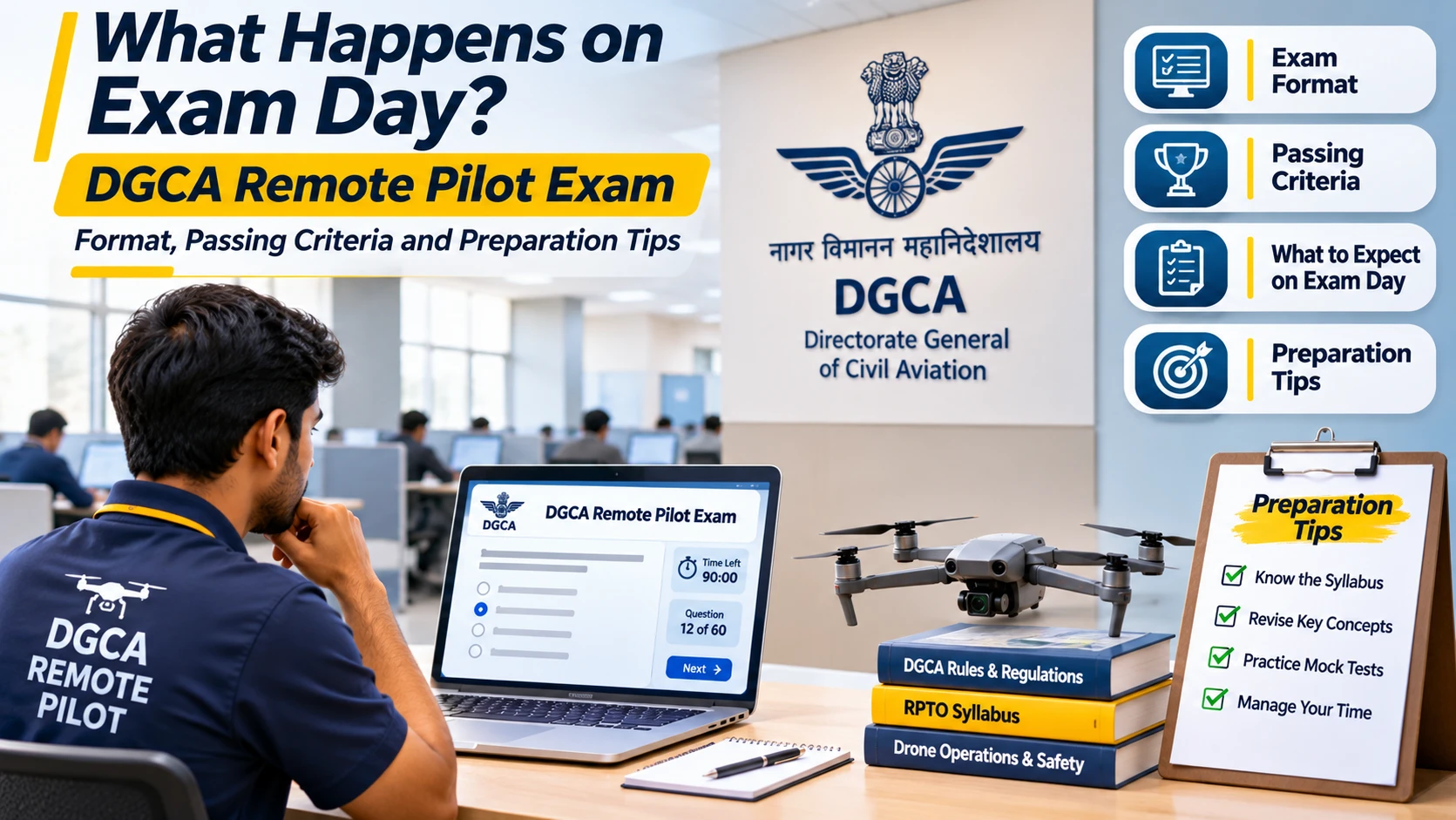
Preparing for your DGCA remote pilot assessment can feel challenging, especially if you have never attended an aviation-related examination before. You may be wondering how many questions you need to answer, what subjects to study, whether practical flying is tested, and what happens if you do not pass.
Understanding the DGCA drone pilot exam format helps you prepare with greater confidence.
In India, remote pilot certification involves theoretical knowledge, practical flying skills and safety awareness. Candidates complete the required training and assessments through a Directorate General of Civil Aviation (DGCA)-authorised Remote Pilot Training Organisation (RPTO).
This guide explains what to expect on assessment day, how passing criteria work, which subjects deserve attention and how to prepare for both theory and practical tests.
What Is the DGCA Remote Pilot Examination?
The DGCA remote pilot examination is the assessment process used to determine whether a trainee has developed the knowledge and flying competence required for the relevant drone category.
It generally includes two main components:
- Theory assessment: Evaluates knowledge of drone regulations, airspace, aerodynamics, meteorology, maintenance and flight safety.
- Practical assessment: Evaluates the ability to operate a drone safely, perform required manoeuvres and respond appropriately to operational situations.
Both components matter because a professional drone pilot must understand not only how to control an aircraft but also when and where it can be flown safely.
Under India’s Drone (Amendment) Rules, 2022, the earlier remote pilot licence requirement was replaced by the Remote Pilot Certificate framework.
For eligible candidates, successful completion of the applicable authorised training and assessments is an essential part of obtaining this certificate.
What Is the DGCA Drone Pilot Exam Format?
The DGCA drone pilot exam format combines theoretical assessment with practical skill evaluation.
DGCA’s Drone Training Circular 02 of 2022 establishes the training syllabus and competency-based assessment framework. However, the exact written-paper structure is determined through the authorised RPTO’s accepted training procedures.
Here is what candidates should understand:
| Exam Component | What to Expect |
|---|---|
| Theory examination | Questions covering the prescribed theoretical syllabus |
| Question format | Objective questions or other formats specified by the RPTO |
| Examination environment | Supervised or appropriately invigilated assessment |
| Practical assessment | Flying skills, manoeuvres and operational safety |
| Passing requirements | Satisfactory performance under the RPTO’s applicable criteria |
| Retest process | Conducted according to the RPTO’s documented procedures |
Some training organisations use multiple-choice questions for theory assessments. However, candidates should not assume that every RPTO follows an identical number of questions, examination duration or marking scheme.
Before your examination, confirm the current format directly with your training organisation.
Is the Remote Pilot Exam Conducted Through DGCA Pariksha?
The routine remote pilot assessment should not be confused with the DGCA Pariksha examinations used for other aviation qualifications, such as conventional commercial pilot licensing.
Remote pilot training and assessment for an RPC are conducted through a DGCA-authorised RPTO.
Your training organisation should explain the assessment venue, schedule, question format, required documents and evaluation procedure.
Which Subjects Are Covered in the DGCA Drone Pilot Theory Exam?
The examination follows the applicable training syllabus, which covers regulations, aviation fundamentals and safe drone operations.
1. Drone Rules and Aviation Regulations
Candidates should understand the Drone Rules, 2021, relevant amendments, drone classifications and the responsibilities of remote pilots.
Important concepts include operating permissions, regulatory compliance and restrictions affecting drone flights.
2. Airspace Classification and Flight Restrictions
Understanding airspace is essential for safe flying.
Prepare topics such as:
- Green, yellow and red airspace zones
- Visual Line of Sight (VLOS) operations
- Airspace restrictions and permissions
- Flight planning and operational limitations
3. Principles of Flight and Aerodynamics
The examination may evaluate your understanding of how drones generate lift, maintain stability and respond to control inputs.
Focus on basic aerodynamic principles, aircraft orientation and the differences between rotorcraft, aeroplane and hybrid configurations.
4. Weather and Meteorology
Weather directly affects drone safety.
Candidates should understand wind conditions, visibility, rainfall, temperature and other weather factors that influence flight decisions.
5. Drone Maintenance and Emergency Procedures
This section involves equipment inspection, battery management, basic maintenance and operational risk assessment.
It is also important to understand what to do during low-battery situations, communication problems or unexpected flight conditions.
6. Payload Operations and Drone Data
Depending on the training syllabus, candidates may encounter basic questions about payload handling, installation, utilisation and introductory drone data processing.
Rather than memorising answers alone, focus on understanding how these subjects relate to real drone operations.
What Happens on DGCA Remote Pilot Exam Day?
The exact schedule varies between training organisations. However, candidates can generally expect the following assessment process.
Step 1: Reporting and Verification
Arrive at the designated training or examination venue at the time communicated by your RPTO.
You may be required to present identification or complete administrative verification.
Confirm whether you need to carry your government-issued ID, training documents or any additional paperwork.
Step 2: Examination Briefing
Before the assessment begins, the instructor or examiner should explain the relevant procedures.
These may include examination rules, time limits, question instructions and conduct requirements.
Pay attention to instructions about permitted materials, submission procedures and how to report any technical difficulty.
Step 3: Theory Examination
During the theory assessment, candidates demonstrate their understanding of the subjects covered during training.
Read each question carefully, identify the exact situation described and avoid rushing through questions about regulations or safety procedures.
If your assessment uses an objective-question format, review your answers when the examination rules permit.
Step 4: Practical Flying Assessment
The practical flying test may take place separately from the theory assessment, depending on your course schedule.
Candidates are assessed on skills relevant to their aircraft category and approved training syllabus.
For multirotor training, preparation commonly involves:
- Pre-flight inspection and safety checks
- Controlled take-off and landing
- Hovering and altitude control
- Pitch, roll and yaw control
- Turns and flight patterns
- Aircraft orientation and recovery
- Emergency procedures and safe decision-making
The goal is to demonstrate consistent control and safe operation, not aggressive flying or unnecessary speed.
For a detailed breakdown of the manoeuvres, read our DGCA drone practical test preparation guide.
Step 5: Results and Next Steps
After the assessments, the RPTO evaluates the candidate’s performance against its applicable standards.
Candidates who successfully complete the required training and assessments can proceed through the relevant Remote Pilot Certificate process.
The certificate should not be assumed to be issued immediately after completing the examination. Administrative processing and applicable requirements must also be fulfilled.
What Are the DGCA Drone Pilot Exam Passing Criteria?
To successfully complete the remote pilot training assessment, candidates must satisfy the applicable theoretical and practical requirements.
Theory Passing Marks
A 70% theory passing threshold is sometimes mentioned in drone training material. However, candidates should not assume that 70% is a universal DGCA-mandated cutoff for every RPTO.
The DGCA training syllabus and Training and Procedures Manual framework reviewed do not specify one nationwide question count, examination duration or theory passing percentage applicable to every course.
Your authorised training organisation should confirm:
- The minimum theory score required
- The examination marking system
- Whether any subject-wise requirements apply
- The conditions for reassessment
Practical Test Passing Criteria
Practical evaluation focuses on demonstrated competence.
Examiners may consider whether the candidate can maintain aircraft control, perform required manoeuvres, follow operating procedures and respond safely to abnormal situations.
The practical test is not simply a written examination with percentage-based marks.
Candidates need to demonstrate the required flying competence under the RPTO’s applicable assessment procedure.
What Happens If You Fail?
An unsuccessful assessment does not necessarily mean the end of your drone training journey.
Depending on the RPTO’s procedures, you may receive additional instruction, corrective practice or an opportunity for reassessment.
The retest rules, any additional charges and applicable training requirements should be confirmed with your RPTO.
How Should You Prepare for the DGCA Drone Pilot Exam?
Effective preparation combines theoretical understanding, regular revision and practical flying experience.
Understand the Syllabus Before Studying
Start with the subjects prescribed for your course and aircraft category.
Create a revision checklist covering regulations, airspace, meteorology, aerodynamics, maintenance and safety procedures.
This helps prevent important topics from being overlooked.
Practise Application-Based Questions
Learning definitions is useful, but understanding operational situations is more valuable.
For example, consider what a pilot should do when weather conditions deteriorate, a battery warning appears or a planned flight enters restricted airspace.
These scenarios develop the decision-making skills required for safe operations.
Revise Drone Regulations Carefully
Pay particular attention to the rules governing permissions, pilot responsibilities and airspace restrictions.
Use current regulatory guidance rather than relying exclusively on outdated notes or informal question banks.
Take Practical Training Seriously
Simulator sessions and supervised flying help candidates develop control confidence.
Practise smooth take-offs, stable hovering, directional changes and landing procedures.
Also develop familiarity with pre-flight checks, emergency responses and the equipment used during your training.
Ask Your Instructor About the Assessment
Your instructor can explain which topics and manoeuvres are included in your particular course assessment.
Clarify the theory format, practical evaluation standards and any areas where you need improvement.
What Should You Do One Day Before the Exam?
The final day should focus on revision rather than attempting to learn the entire syllabus again.
Use this simple preparation checklist:
- Review key drone regulations and airspace concepts.
- Revise meteorology, aerodynamics and safety procedures.
- Practise important theory questions.
- Revisit your instructor’s notes and previous mistakes.
- Confirm your reporting time, venue and required documents.
- Avoid unnecessary last-minute flying practice.
- Get adequate sleep before the assessment.
A prepared candidate should be able to explain important concepts clearly and apply them to realistic flying situations.
What Are the Most Common Mistakes Candidates Should Avoid?
Several preparation mistakes can affect examination performance.
Memorising without understanding: Drone safety questions often require practical judgment. Understand the reasons behind operating procedures.
Ignoring airspace regulations: Knowing how to fly a drone is not sufficient if you cannot identify where flying is permitted.
Neglecting practical skills: Candidates should prepare for the flying assessment as seriously as the theory examination.
Overlooking pre-flight checks: Equipment inspection, battery condition and operational safety are important parts of professional drone flying.
Assuming every RPTO has the same exam format: Always follow the current assessment instructions provided by your authorised training organisation.
How Does SkyGlimps Prepare Candidates for Remote Pilot Assessment?
SkyGlimps Technologies offers DGCA-Certified Small Category Drone Pilot Training in Kolkata, West Bengal.
The programme combines theoretical knowledge with simulator training and supervised practical flying.
Its current six-day course structure includes:
- Days 1–2: Drone regulations, aerodynamics, meteorology, maintenance, risk assessment and related theoretical subjects.
- Day 3: Theory assessment, simulator training and basic assembly and maintenance.
- Days 4–5: Instructor-supervised practical flying and progression towards solo flight.
- Day 6: Night flying operations and the final flying test.
Classroom training takes place in New Town, Kolkata, while practical flying is conducted at the training ground in Singur, West Bengal.
The programme is designed for students, aspiring drone pilots and professionals seeking structured training in safe drone operations.
Explore the SkyGlimps DGCA-Certified Drone Pilot Training programme to understand the curriculum, eligibility requirements and training arrangements.
Frequently Asked Questions
The DGCA drone pilot exam format includes theoretical knowledge assessment and practical flying evaluation through an authorised RPTO. The exact written examination format and marking procedure depend on the organisation’s applicable training and assessment procedures.
There is no single universal theory passing percentage established in the DGCA circulars reviewed for this guide. Candidates should confirm the qualifying marks and practical assessment standards directly with their authorised RPTO.
The examination can be manageable with proper training and revision. Candidates should understand drone regulations, airspace, meteorology, flight fundamentals and safety procedures while developing the practical skills required for their drone category.
Yes. Practical flying assessment is an important component of the authorised remote pilot training pathway. Candidates must demonstrate relevant aircraft control, operational awareness and safe flying skills.
Reassessment may be possible under the training organisation’s documented procedures. The requirements for additional training, retest eligibility and applicable fees should be confirmed directly with the RPTO.
Conclusion: Prepare for the DGCA Drone Pilot Exam With Confidence
Understanding the DGCA drone pilot exam format is an important step towards becoming a competent remote pilot in India.
The assessment is designed to establish whether candidates possess the theoretical knowledge, practical flying skills and safety awareness required for responsible drone operations.
Focus on learning the prescribed syllabus, understanding aviation regulations, practising flight procedures and following your instructor’s guidance.
For those planning to pursue professional drone training, SkyGlimps Technologies provides structured DGCA-Certified Small Category Drone Pilot Training in Kolkata.
Learn more about the DGCA Remote Pilot Certificate process or visit SkyGlimps Technologies to explore available training opportunities.
Build the knowledge, confidence and practical skills needed to begin your journey as a trained drone pilot.