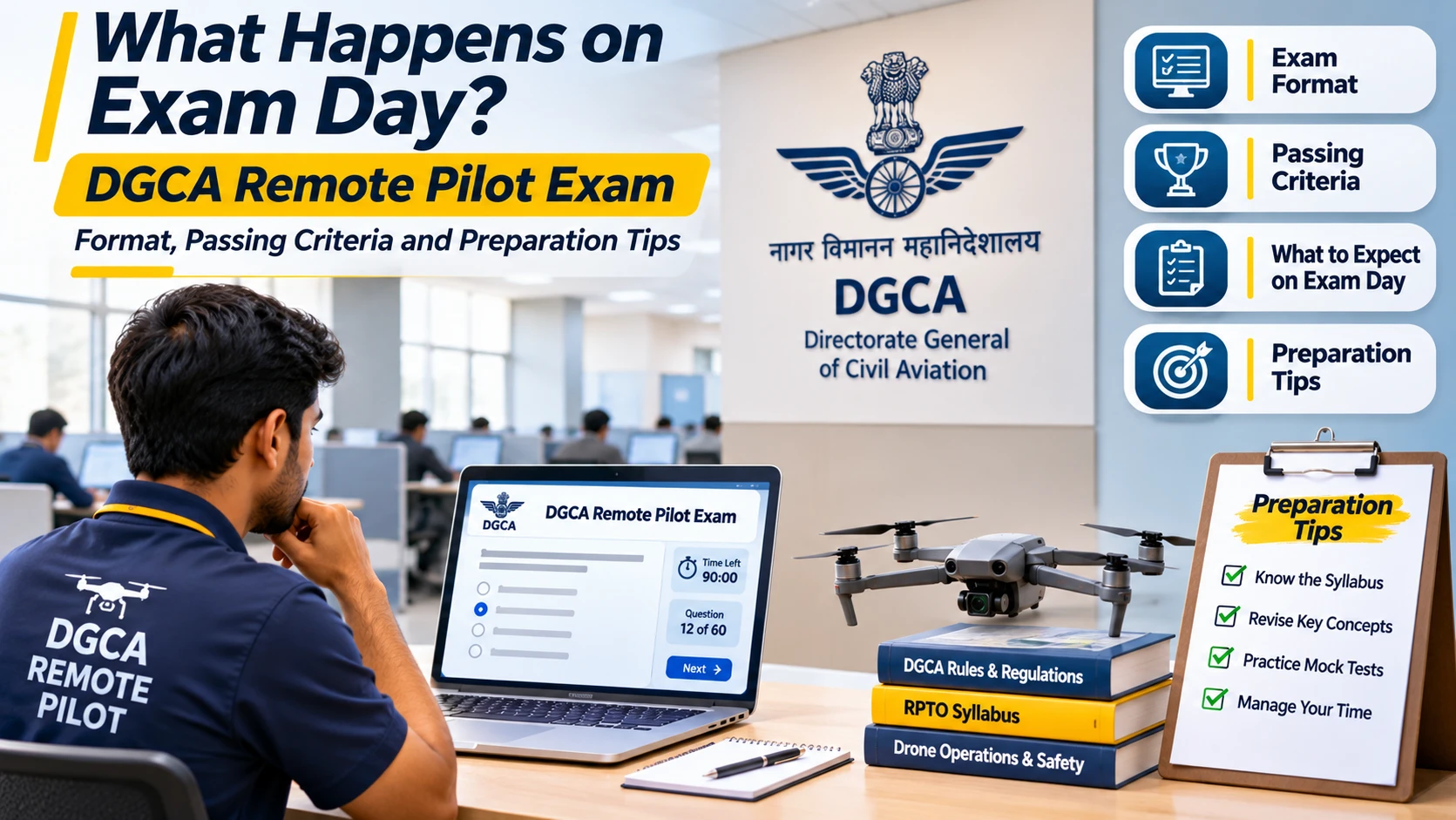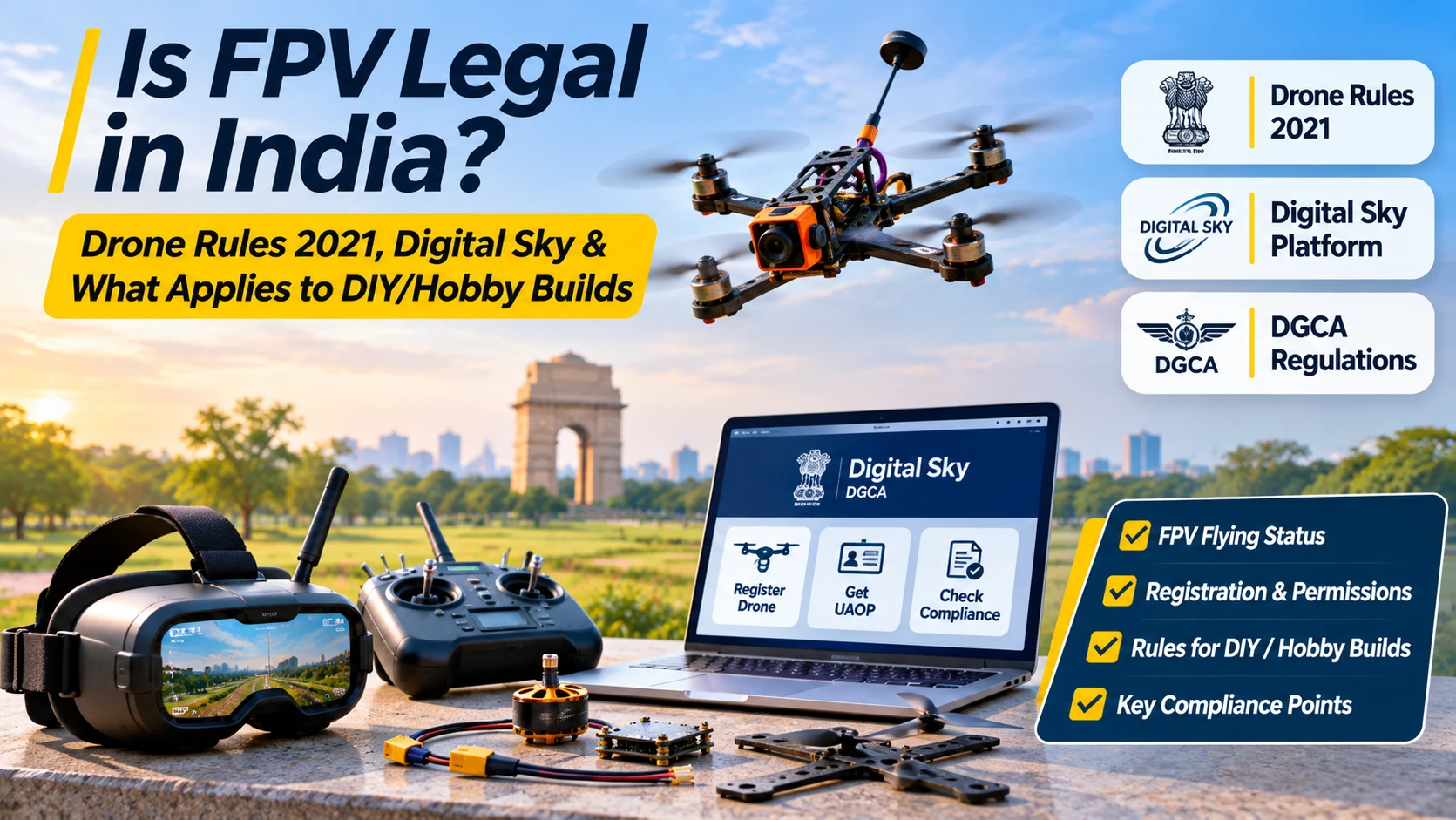
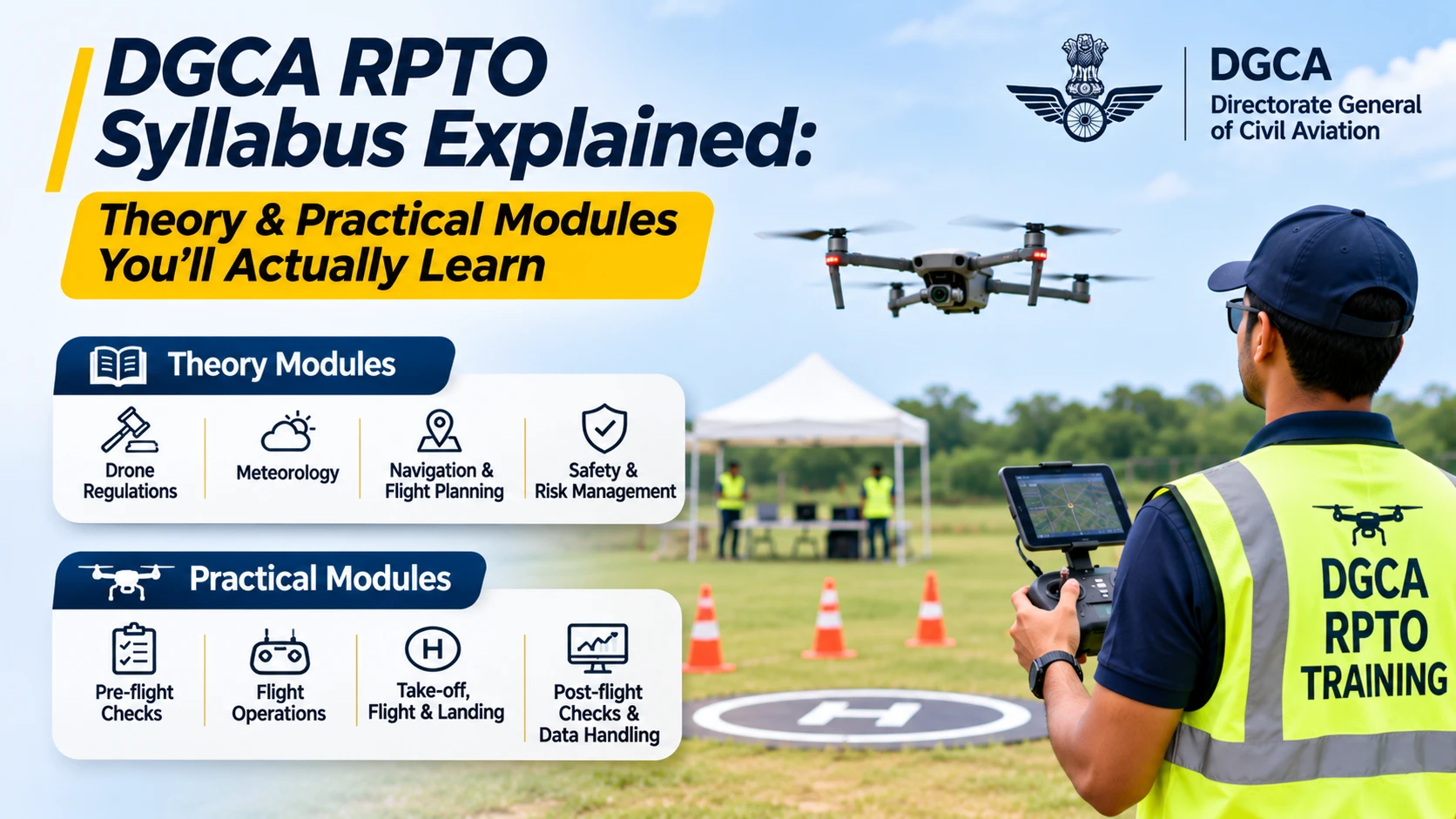
If you are planning to become a certified drone pilot in India, understanding the DGCA RPTO syllabus is one of the first steps before enrolling in a training programme.
Many beginners assume drone pilot training is mainly about learning to take off, fly and land a drone. In reality, professional drone training involves much more.
The curriculum covers aviation regulations, airspace, aerodynamics, weather, equipment maintenance, operational safety, flight simulators and practical flying skills.
The Directorate General of Civil Aviation (DGCA) establishes the minimum training framework that authorised Remote Pilot Training Organisations (RPTOs) must follow.
This guide explains what the DGCA drone training syllabus includes, how theory and practical modules work, how long training takes and what skills you can expect to develop.
What Is the DGCA RPTO Syllabus?
The DGCA RPTO syllabus is the prescribed training framework used by authorised Remote Pilot Training Organisations to prepare individuals for drone operations and the applicable Remote Pilot Certificate (RPC).
Its purpose is to ensure that trainees develop the knowledge, practical ability and safety awareness required to operate drones responsibly.
Under Drone Training Circular 02 of 2022, remote pilot training is organised into two principal components:
Ground Class (Theory Training): Covers regulations, airspace, flight principles, meteorology, aircraft systems, maintenance, safety and operational planning.
Flying Class (Practical Training): Covers flight simulator exercises, basic assembly and maintenance, instructor-supervised flying, solo-flight progression and practical assessment.
The detailed syllabus varies according to aircraft category, weight class and the type of operation for which training is authorised.
For example, the training requirements for a Small-category rotorcraft pilot are not necessarily identical to those for a Medium-category aircraft or specialised Beyond Visual Line of Sight (BVLOS) operations.
What Theory Subjects Are Included in the DGCA RPTO Syllabus?
The theory component builds the foundation for safe and legally compliant drone operations.
Although the circular lists a broad range of subjects, the exact modules taught depend on the applicable training category and syllabus annexure.
1. Drone Rules and Aviation Regulations
One of the first subjects introduces India’s aviation regulatory framework.
Candidates learn about the Drone Rules, 2021, relevant amendments and the responsibilities associated with operating unmanned aircraft.
Important subjects include drone classification, registration, certification, operating requirements and pilot responsibilities.
Understanding these rules helps pilots recognise the legal requirements associated with different operations.
2. Airspace and Air Traffic Control Procedures
Not every location is automatically suitable for drone flying.
This module explains airspace classifications, restricted operating areas and the role of air traffic control.
Trainees are introduced to concepts such as Visual Line of Sight (VLOS), airspace restrictions, aviation notifications and the basics of ATC procedures.
Introductory radio telephony is also included in the syllabus.
These subjects help trainees understand why flight planning and airspace checks are essential before launching a drone.
3. Principles of Flight and Aerodynamics
A drone pilot should understand how an aircraft remains airborne and responds to control inputs.
The syllabus introduces basic aerodynamic principles, including lift, drag, thrust and weight.
Candidates also study the characteristics of different aircraft configurations:
- Rotorcraft and multirotor drones
- Fixed-wing aircraft
- Hybrid drone systems
The objective is to understand how these aircraft operate and how their flight characteristics differ.
For example, a multirotor drone can hover in position, while a conventional fixed-wing drone relies on forward movement to generate lift.
4. Weather and Meteorology
Weather conditions can significantly affect drone performance.
This module covers wind, temperature, atmospheric pressure, cloud formation, visibility and hazardous weather conditions.
Candidates also learn how weather affects flight stability and operational decisions.
The practical value of this knowledge is straightforward: a trained pilot should be able to identify conditions that make flying unsafe.
5. Drone Equipment and Maintenance
A professional drone pilot must understand the equipment being operated.
This module introduces aircraft components, ground control systems and routine maintenance.
Depending on the aircraft, trainees may examine motors, propellers, batteries, flight controllers, communication systems and other essential components.
Maintenance knowledge is especially important for identifying faults before they become flight safety risks.
6. Risk Assessment, Safety and Emergency Procedures
Flight safety is a central part of the DGCA RPTO syllabus.
Candidates learn to identify operational risks and make appropriate decisions when conditions change.
Subjects include safety management, risk assessment, emergency planning and human factors such as crew coordination and threat and error management.
For example, pilots should understand how to respond to low battery warnings, equipment malfunctions or unexpected weather changes.
7. Payload Operations and Drone Data
The syllabus also introduces payload installation, utilisation and basic drone data concepts.
Payloads may include cameras, sensors or other mission-specific equipment.
Candidates learn why payload weight, aircraft balance and operating limitations must be considered during flight planning.
Introductory drone data topics may include image interpretation, aerial data collection and basic processing concepts.
Advanced drone surveying, photogrammetry and GIS workflows generally require additional specialised training beyond introductory remote pilot certification.
What Practical Training Is Included in the DGCA Drone Pilot Course?
The practical component transforms classroom knowledge into actual flying ability.
DGCA’s training framework includes simulator exercises, basic aircraft assembly and maintenance, practical flying and assessment.
Flight Simulator Training
Simulator training introduces aircraft controls in a controlled environment.
Depending on the applicable syllabus, exercises may include:
- Pre-flight checks and control familiarisation
- Take-off and landing procedures
- Hovering and directional control
- Climbing, descending and turning
- Circuit flying and flight patterns
- Aircraft disorientation and recovery
- Abnormal and emergency procedures
Simulator sessions allow trainees to practise control inputs and understand flight behaviour before progressing to live operations.
Basic Assembly and Maintenance
Candidates receive practical exposure to drone equipment and its components.
Exercises may cover basic assembly, disassembly, equipment inspection and maintenance procedures.
The aim is to develop confidence in handling aircraft systems and recognising equipment-related safety concerns.
Instructor-Supervised Flying
Practical flying takes place under the supervision of authorised instructors.
Trainees gradually develop skills such as controlled take-offs, stable hovering, directional movement, turns and safe landings.
Instructors observe how candidates manage the aircraft, follow operating procedures and respond to instructions.
The training also develops situational awareness, which is essential when operating near obstacles or changing environmental conditions.
Solo Flying and Final Skill Assessment
As trainees demonstrate sufficient competence, they may progress towards solo flying under the applicable training procedures.
The final assessment evaluates whether candidates can safely perform the required manoeuvres.
Pilots must demonstrate controlled aircraft operation, appropriate decision-making and compliance with safety procedures.
For more information on flight preparation, read the SkyGlimps Drone Pre-Flight Checklist.
How Long Does the DGCA RPTO Training Course Take?
According to DGCA Drone Training Circular 02 of 2022, the basic Category 1 VLOS training framework provides approximately:
| Training Component | DGCA Syllabus Duration |
|---|---|
| Theory or Ground Class | 2 days |
| Practical Training, including simulator | 3–6 days |
| Total Basic Training | Approximately 5–8 days |
These are syllabus durations, not a guarantee that every training organisation will follow the same daily schedule.
An RPTO may extend the training duration or syllabus based on the aircraft category, class and training requirements.
The same circular separately describes a more extensive Category 2 BVLOS curriculum. It should not be confused with the standard basic VLOS training programme.
What Does a Six-Day DGCA Drone Training Course Look Like?
For an example of how the prescribed subjects can be arranged, SkyGlimps Technologies offers a six-day DGCA-Certified Small Category Drone Pilot Training programme in Kolkata.
Its published curriculum follows this structure:
| Day | Training Modules |
|---|---|
| Day 1 | Drone Rules, aviation regulations, flight fundamentals, ATC procedures and aerodynamics |
| Day 2 | Meteorology, maintenance, risk assessment, safety, payloads and introductory drone data |
| Day 3 | Theory assessment, simulator training and basic assembly and maintenance |
| Day 4 | Instructor-supervised practical flying |
| Day 5 | Practical flying and progression towards solo flight |
| Day 6 | Night flying operations and final flying assessment |
The programme combines regulatory education with practical aircraft handling.
Night flying exercises in a training programme should not be interpreted as automatic permission to conduct unrestricted night operations after certification. Actual operations remain subject to applicable regulations and permissions.
SkyGlimps conducts classroom training in New Town, Kolkata, and practical flying sessions at its designated flying ground in Singur, West Bengal.
Is the DGCA RPTO Syllabus the Same for All Drone Categories?
No. The prescribed syllabus depends on the aircraft category, weight class and type of operation.
DGCA distinguishes between aircraft such as rotorcraft, aeroplanes and hybrid systems.
Its training framework also distinguishes VLOS and BVLOS operations.
The aircraft’s weight classification is another important consideration.
For example, a Small-category drone weighs more than 2 kg and up to 25 kg, including payload. Medium-category drones weigh more than 25 kg and up to 150 kg.
A pilot must ensure that the training and certificate endorsement correspond to the intended aircraft class.
Read our Small Category Drone License Guide to understand how drone classifications relate to professional pilot certification in India.
How Are Trainees Assessed During DGCA RPTO Training?
The DGCA training framework emphasises competency-based assessment.
This means a candidate must demonstrate the required knowledge, operational abilities and safety awareness rather than simply memorising theoretical information.
Theory Assessment
Candidates are evaluated on the applicable subjects covered during classroom training.
The precise examination format, question count and qualifying criteria should be confirmed with the authorised RPTO.
Practical Assessment
During practical evaluation, instructors assess the candidate’s aircraft handling and safe operating ability.
Depending on the aircraft and approved syllabus, this can involve take-off, hovering, manoeuvring, landing and emergency-response procedures.
The assessments are intended to establish whether the candidate has achieved the competence required for the relevant training category.
What Skills Will You Have After Completing RPTO Training?
Successful completion of the required training and assessments helps candidates establish a foundation in professional drone operations.
Depending on the course and aircraft class, trainees should develop knowledge of:
- Indian drone regulations and airspace restrictions
- Fundamental aircraft controls and flight behaviour
- Pre-flight inspections and basic maintenance
- Weather assessment and flight safety
- Risk identification and emergency procedures
- Simulator operation and practical flying
- Safe flight planning and operational responsibilities
However, basic RPTO training does not automatically make someone an expert in every commercial drone application.
Specialised fields such as aerial surveying, agricultural operations, industrial inspections and advanced mapping may require additional equipment-specific training and experience.
How Can You Choose the Right DGCA-Authorised RPTO?
Before enrolling in a drone pilot course, confirm the organisation’s current DGCA authorisation and the training scope covered by that authorisation.
Also evaluate the course curriculum, instructor qualifications, simulator facilities, practical flying arrangements and assessment process.
Ask how much supervised flying is included and whether the training matches the aircraft category you intend to operate.
A useful course should focus on developing genuine operational skills rather than treating certification as the only objective.
Why Consider SkyGlimps for DGCA Drone Pilot Training in Kolkata?
SkyGlimps Technologies combines its experience in drone services with structured Small-category remote pilot training.
Its work across surveying, inspections and geospatial applications provides industry context for students interested in professional drone operations.
The six-day course includes theoretical instruction, simulator exercises, supervised flying, maintenance training and final assessments.
It is designed for beginners, students, engineers, surveyors, photographers and professionals exploring drone-related career opportunities.
SkyGlimps currently offers DGCA-Certified Small Category training; candidates looking for Medium-category certification should consult an RPTO authorised for that category.
Explore the DGCA-Certified Drone Pilot Training Programme at SkyGlimps for curriculum, eligibility and enrolment information.
Frequently Asked Questions
The DGCA RPTO syllabus covers drone regulations, airspace, aerodynamics, meteorology, aircraft maintenance, safety, risk assessment, payload operations, introductory drone data, simulator exercises and practical flying. The applicable subjects depend on the training category and aircraft class.
Yes. Practical training and flying assessments form part of the applicable remote pilot training syllabus. Candidates must demonstrate the required aircraft control and operational safety skills.
DGCA’s basic Category 1 VLOS syllabus provides approximately 5–8 days, including theory and practical training. Individual RPTO programmes may vary within the applicable training framework.
Yes. Simulator training is part of the prescribed flying-class syllabus. It allows candidates to practise aircraft controls, flight manoeuvres and abnormal situations in a controlled environment.
Yes, provided they meet the applicable eligibility requirements. SkyGlimps’ Small Category course specifies a minimum age of 18 years, Class 10 qualification or equivalent, valid identification and a medical fitness certificate.
Conclusion: Understand the DGCA RPTO Syllabus Before Enrolling
The DGCA RPTO syllabus is designed to prepare individuals for responsible drone operations through a combination of theoretical knowledge, practical flying and safety-based assessment.
From understanding aviation regulations and weather conditions to performing controlled manoeuvres and emergency procedures, each module contributes to developing a competent remote pilot.
Before choosing a training organisation, review the curriculum, confirm DGCA authorisation and ensure that the programme matches your intended aircraft category.
For aspiring drone pilots in Kolkata and West Bengal, SkyGlimps Technologies offers structured DGCA-Certified Small Category Drone Pilot Training with classroom education, simulator practice and supervised flying.
Build your foundation in professional drone operations with training focused on knowledge, safety and practical flying skills.