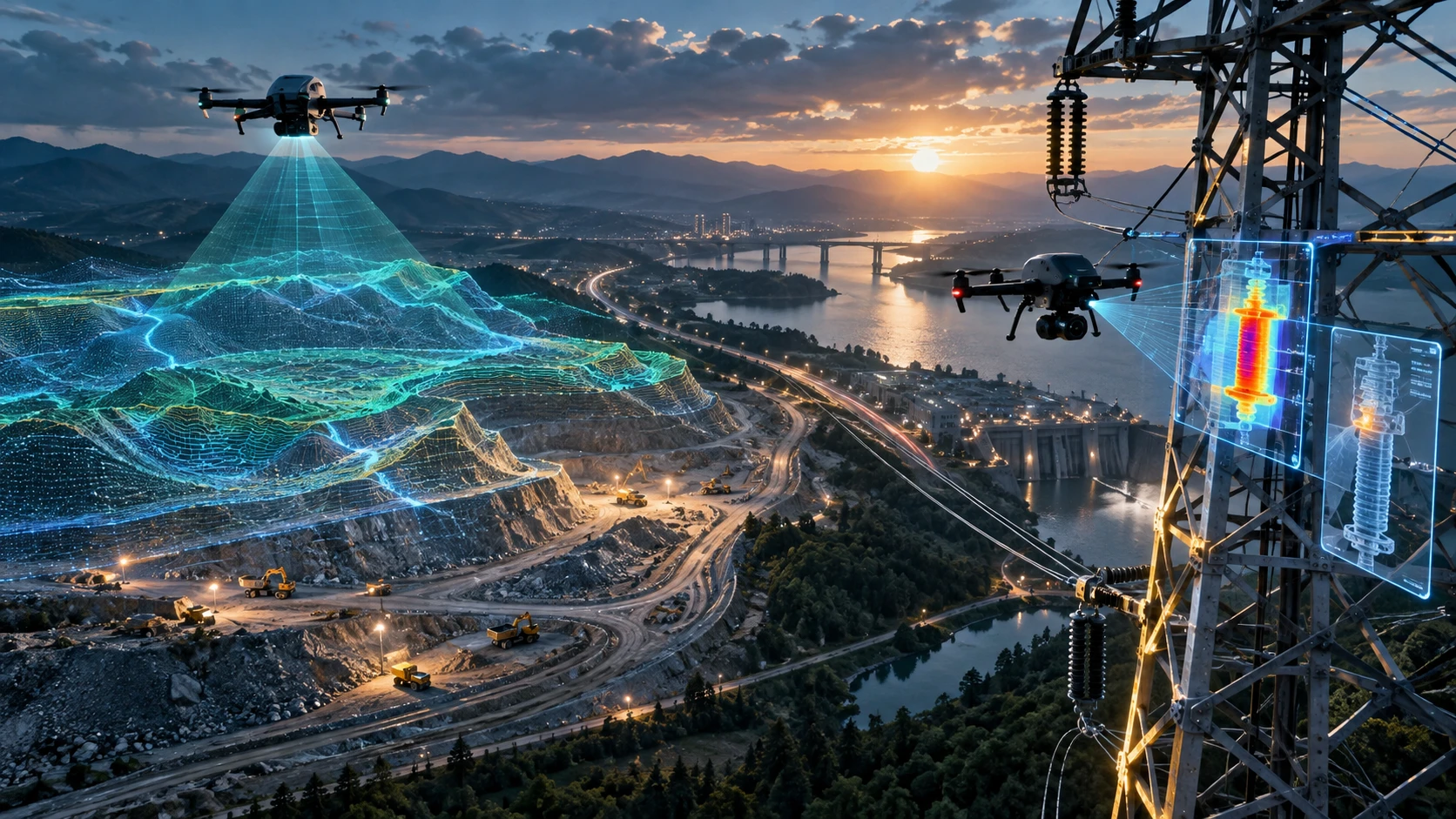

Drone thermal inspection power lines is becoming an important maintenance method for utilities, power transmission companies, industrial operators, and infrastructure teams. By combining thermal cameras with high-resolution RGB imagery, drones can help identify abnormal heating patterns, damaged components, loose connections, corrosion indicators, and other visible issues across transmission line assets.
Traditional inspection methods often require ground patrols, tower climbing, shutdown planning, or expensive aerial access. Drone-based inspection gives asset teams a safer and faster way to review conductors, insulators, clamps, jumpers, transformers, towers, and related power infrastructure.
For power and energy teams in Kolkata, West Bengal, and Eastern India, drone thermal inspection can support preventive maintenance, outage risk reduction, asset documentation, and better decision-making across large or difficult-to-access power corridors.
What is drone thermal inspection for power lines?
Drone thermal inspection for power lines uses a drone-mounted thermal camera to detect temperature differences across electrical assets. These temperature patterns help inspection teams identify components that may be overheating, overloaded, loose, corroded, damaged, or performing abnormally.
Thermal inspection works because electrical faults often create heat before they lead to visible failure. A loose connector, poor contact point, overloaded conductor, or damaged component may show a higher temperature than surrounding parts. A thermal camera captures this heat pattern and converts it into a thermal image.
A drone thermal inspection may cover:
- Transmission lines
- Distribution lines
- Power towers
- Conductors
- Jumpers
- Clamps and connectors
- Insulators
- Substation components
- Transformers
- Switchgear zones
- Solar and power utility assets
The drone does not repair the fault. It gives the maintenance team visual and thermal evidence so they can prioritise inspection, repair, shutdown planning, or further ground verification.
Skyglimps Technologies LLP provides Thermal & RGB Inspections for organisations that need aerial inspection support for power, infrastructure, and industrial assets.
Why are power utilities using drones for thermal inspection?
Power utilities use drones for thermal inspection because drones can capture asset data faster, safer, and with better visual coverage than many manual inspection methods. This is especially useful for long corridors, difficult terrain, tall towers, and live infrastructure where direct access is risky.
Power line inspection is challenging because transmission networks are spread across wide areas. Lines may pass through fields, water bodies, industrial zones, forest edges, hilly land, rail crossings, roads, or restricted operational sites. Manual inspection teams may need significant time and safety planning to physically access each location.
Drones help utilities by offering:
- Faster visual inspection of long line sections
- Reduced need for tower climbing
- Safer viewing of elevated assets
- Thermal detection of abnormal heating
- RGB evidence for visible defects
- Repeatable inspection records
- Better documentation for maintenance teams
- Improved prioritisation of repairs
For businesses and utilities, the biggest advantage is early detection. A thermal anomaly can be reviewed before it becomes a serious fault, outage, equipment failure, or safety incident.
Drone inspection is not a replacement for all electrical testing or engineering checks. It is a powerful screening and documentation method that helps maintenance teams decide where to focus deeper inspection.
What problems can thermal drones detect on power lines?
Thermal drones can help detect abnormal heat patterns that may indicate loose connections, overloaded components, damaged clamps, poor contact points, corrosion-related heating, or failing electrical equipment. RGB images can also show visible structural or surface defects.
Common issues that drone thermal inspection can help identify include:
| Asset area | Possible finding | Why it matters |
|---|---|---|
| Connectors | Hotspots from poor contact | Can indicate resistance and failure risk |
| Clamps | Abnormal heating | May suggest looseness or corrosion |
| Jumpers | Uneven temperature | Can show load or connection issues |
| Conductors | Localised heating | May indicate physical or electrical stress |
| Insulators | Visible cracks or contamination | Can affect insulation performance |
| Towers | Corrosion or structural concerns | Supports maintenance planning |
| Transformers | Abnormal thermal pattern | May require further technical inspection |
| Substation assets | Hot terminals or joints | Helps prioritise electrical maintenance |
A thermal anomaly does not automatically confirm a final diagnosis. It indicates where the maintenance team should investigate further. Electrical engineers may need load data, ground testing, historical inspection records, and physical verification before deciding the corrective action.
The value of drone thermal inspection lies in narrowing down the problem areas quickly and safely.
How does RGB inspection support thermal inspection?
RGB inspection supports thermal inspection by providing clear visual images of the asset, component location, physical condition, and surrounding environment. Thermal data shows heat patterns, while RGB data shows what the component actually looks like.
Thermal images alone can be difficult to interpret without visual context. A hotspot must be matched to the correct component, tower, span, connector, clamp, or substation asset. RGB imagery helps the inspection team identify the exact location and visible condition of the issue.
RGB inspection can help detect:
- Broken or damaged insulators
- Corrosion on tower members
- Missing or damaged hardware
- Sagging or misaligned components
- Vegetation encroachment
- Nesting or foreign objects
- Physical wear
- Surface damage
- Structural abnormalities
The strongest inspection workflow combines thermal and RGB data. Thermal imagery highlights abnormal heating, and RGB imagery confirms asset identity and visible condition.
For power utilities and industrial operators, this combination helps create clearer inspection reports. Maintenance teams can review the thermal image, RGB image, tower reference, location, and recommended follow-up action together.
How accurate is drone thermal inspection for power lines?
Drone thermal inspection is effective for identifying temperature anomalies when the inspection is planned correctly, but its reliability depends on camera quality, distance, angle, weather, load condition, emissivity settings, and operator skill. The best results come from controlled inspection planning and proper interpretation.
Thermal accuracy is affected by several real-world factors:
- Sunlight and solar heating
- Wind speed
- Rain or humidity
- Ambient temperature
- Distance from the component
- Viewing angle
- Camera resolution
- Thermal sensitivity
- Electrical load at the time of inspection
- Surface material and emissivity
- Reflections from metallic parts
- Image focus and stability
For example, inspecting during poor weather or low-load conditions may reduce the usefulness of thermal readings. A component may not show a meaningful hotspot if the line is not carrying enough load. Similarly, reflective metal surfaces can create misleading thermal patterns if not interpreted carefully.
This is why drone thermal inspection should be performed by trained teams who understand both flight safety and inspection limitations. The output should be treated as inspection evidence, not as an automatic engineering conclusion.
What is the ideal workflow for a drone power line thermal inspection?
A professional drone power line thermal inspection should follow a structured workflow covering scope definition, airspace review, safety planning, flight execution, data capture, analysis, reporting, and maintenance follow-up. A clear process improves data quality and reduces operational risk.
A typical workflow includes:
- Define the inspection objective.
- Identify the line, tower numbers, span, or asset section.
- Review site access and safety conditions.
- Check airspace and permission requirements.
- Confirm inspection timing and load conditions.
- Plan drone flight path and viewing angles.
- Capture thermal and RGB data.
- Record location and asset references.
- Review thermal anomalies.
- Match thermal findings with RGB images.
- Prepare inspection report.
- Prioritise maintenance action.
- Conduct ground verification where required.
For utility corridors, planning is especially important. The team must consider tower height, conductor position, electromagnetic environment, wind, public safety, road crossings, vegetation, and emergency landing areas.
Drone inspection should be coordinated with the utility’s operations and maintenance team. Site managers, safety officers, and technical engineers should agree on the inspection scope before flights begin.
For power-sector projects, Skyglimps also supports drone applications across power, energy, and utilities where aerial inspection, mapping, and documentation can improve asset visibility.
What deliverables should utilities expect from a drone thermal inspection?
Utilities should expect structured deliverables such as thermal images, RGB images, location-tagged findings, hotspot references, inspection summaries, and maintenance-priority reports. The exact deliverables should be defined before the inspection begins.
Common deliverables may include:
| Deliverable | Purpose |
| Thermal image set | Shows abnormal temperature patterns |
| RGB image set | Provides visual context and asset condition |
| Hotspot register | Lists suspected thermal anomalies |
| Location-tagged findings | Connects issues to towers, spans, or components |
| Inspection summary | Gives a practical overview of findings |
| Priority classification | Helps maintenance teams rank follow-up |
| Before-after comparison | Useful for repeat inspections |
| PDF report | Shareable documentation for teams |
| GIS or map reference | Supports asset management workflows |
A good report should not only show images. It should help the maintenance team understand what was inspected, what was found, where the issue appears, and what needs follow-up.
For recurring inspections, drone data can also support documentation and progress tracking by creating repeatable visual records over time.
When should utilities schedule thermal inspections?
Utilities should schedule thermal inspections before high-demand seasons, after major weather events, during preventive maintenance cycles, and when abnormal performance or repeated faults are suspected. Timing affects how useful the thermal data will be.
Thermal inspections are most useful when electrical assets are operating under meaningful load. If the line or component is lightly loaded, some faults may not produce strong thermal patterns.
Useful inspection windows include:
- Pre-monsoon maintenance cycles
- Post-storm inspection
- Summer peak-load periods
- Before major shutdown planning
- After repeated tripping or faults
- During annual preventive maintenance
- Before commissioning or handover
- After repair work for confirmation
In Eastern India, weather planning is important because monsoon conditions, humidity, wind, and storms can affect both drone flying and thermal data quality. Utilities should plan inspection windows with weather, load, safety, and access conditions in mind.
Repeat inspections are also valuable. Comparing thermal records across months or seasons can help identify whether a component is stable, worsening, or resolved after maintenance.
Is drone thermal inspection safer than manual inspection?
Drone thermal inspection can improve safety by reducing the need for personnel to climb towers, approach live assets, or enter difficult terrain for initial inspection. It allows teams to review elevated and hard-to-access components from a safer distance.
Manual inspection still has a role. Engineers may need ground testing, close physical inspection, shutdown work, or repair activity. But drones can reduce unnecessary exposure during early-stage assessment.
Drone inspection improves safety by:
- Reducing tower climbing for preliminary checks
- Limiting access to risky terrain
- Keeping personnel away from live electrical assets
- Capturing data from elevated viewpoints
- Reducing repeated manual patrol effort
- Supporting better maintenance planning
- Improving documentation before repair teams are deployed
Safety depends on proper execution. Drone flights near power lines require trained pilots, safe stand-off distance, careful flight planning, and coordination with utility teams. Power line corridors are not suitable for casual drone flying.
A drone thermal inspection should always be handled as a professional operation with clear safety procedures.
How should businesses choose a drone thermal inspection partner?
Businesses should choose a drone thermal inspection partner by checking drone compliance, pilot capability, thermal imaging experience, safety process, reporting quality, and understanding of power infrastructure. A good partner should deliver usable inspection intelligence, not only images.
Ask these questions before hiring:
- Do you provide both thermal and RGB inspection?
- Have you inspected power or utility assets before?
- How do you plan flights near transmission lines?
- What safety distance and procedures do you follow?
- What deliverables are included?
- Will findings be location-tagged?
- How are thermal anomalies classified?
- What are the inspection limitations?
- Can you repeat the survey for comparison?
- How will the report support maintenance planning?
A low-cost drone operator may capture images, but power line inspection requires more discipline. The team must understand site safety, asset visibility, flight restrictions, thermal limitations, and report structure.
For enterprises and utilities, the inspection partner should also understand data confidentiality, site coordination, and asset-critical reporting.
Why choose Skyglimps Technologies for drone thermal inspections?
Skyglimps Technologies LLP is a Kolkata-based drone services company and DGCA-certified Remote Pilot Training Organisation serving government and enterprise clients across Eastern India. The company supports drone services across thermal and RGB inspections, mapping, surveillance, documentation, and training.
Skyglimps Technologies, a DGCA-certified RPTO in Kolkata, is positioned for organisations that need structured drone inspection workflows with safety and compliance awareness. For power utilities, industrial operators, infrastructure teams, and enterprise clients in Kolkata, West Bengal, and Eastern India, local coordination can help improve planning, field execution, and reporting.
Power line inspection requires more than flight capability. It requires safety discipline, clear deliverables, technical documentation, and coordination with maintenance teams. A professional drone inspection workflow helps turn aerial data into practical maintenance insight.
FAQ: Drone Thermal Inspection Power Lines
Drone thermal inspection for power lines uses thermal cameras mounted on drones to detect abnormal heat patterns in conductors, connectors, clamps, insulators, towers, and related electrical assets.
Thermal drones can help identify hotspots from loose connections, poor contact, overloaded components, corrosion-related heating, damaged clamps, and abnormal equipment behaviour requiring further inspection.
Thermal drone inspection is faster and safer for initial screening of elevated or hard-to-access assets. Manual inspection is still needed for physical verification, testing, and repair.
Thermal data shows abnormal heat patterns, while RGB images show the physical component and visible condition. Together, they create clearer inspection reports for maintenance teams.
Power lines should be inspected during preventive maintenance cycles, before peak load seasons, after storms, after repeated faults, and when abnormal asset behaviour is suspected.
Drone thermal inspection can help identify potential problem areas before failure, allowing maintenance teams to prioritise corrective action. It supports outage risk reduction but does not guarantee prevention.
Drone inspection near transmission lines can be safe when performed by trained pilots with proper planning, stand-off distance, weather checks, site coordination, and utility safety protocols.
Improve power line maintenance with thermal drone data
Drone thermal inspection power lines is a practical way for utilities and businesses to improve asset visibility, detect abnormal heating, reduce inspection risk, and plan maintenance more effectively. It helps teams identify where further technical investigation is needed before small issues become major failures.
For power transmission lines, substations, industrial electrical assets, and utility corridors in Kolkata, West Bengal, and Eastern India, drone-based thermal and RGB inspection can support safer and more informed maintenance planning.
If your organisation needs aerial thermal inspection for power lines or electrical infrastructure, connect with Skyglimps Technologies LLP through the Thermal & RGB Inspections service page and share your asset type, location, inspection objective, and reporting requirements.