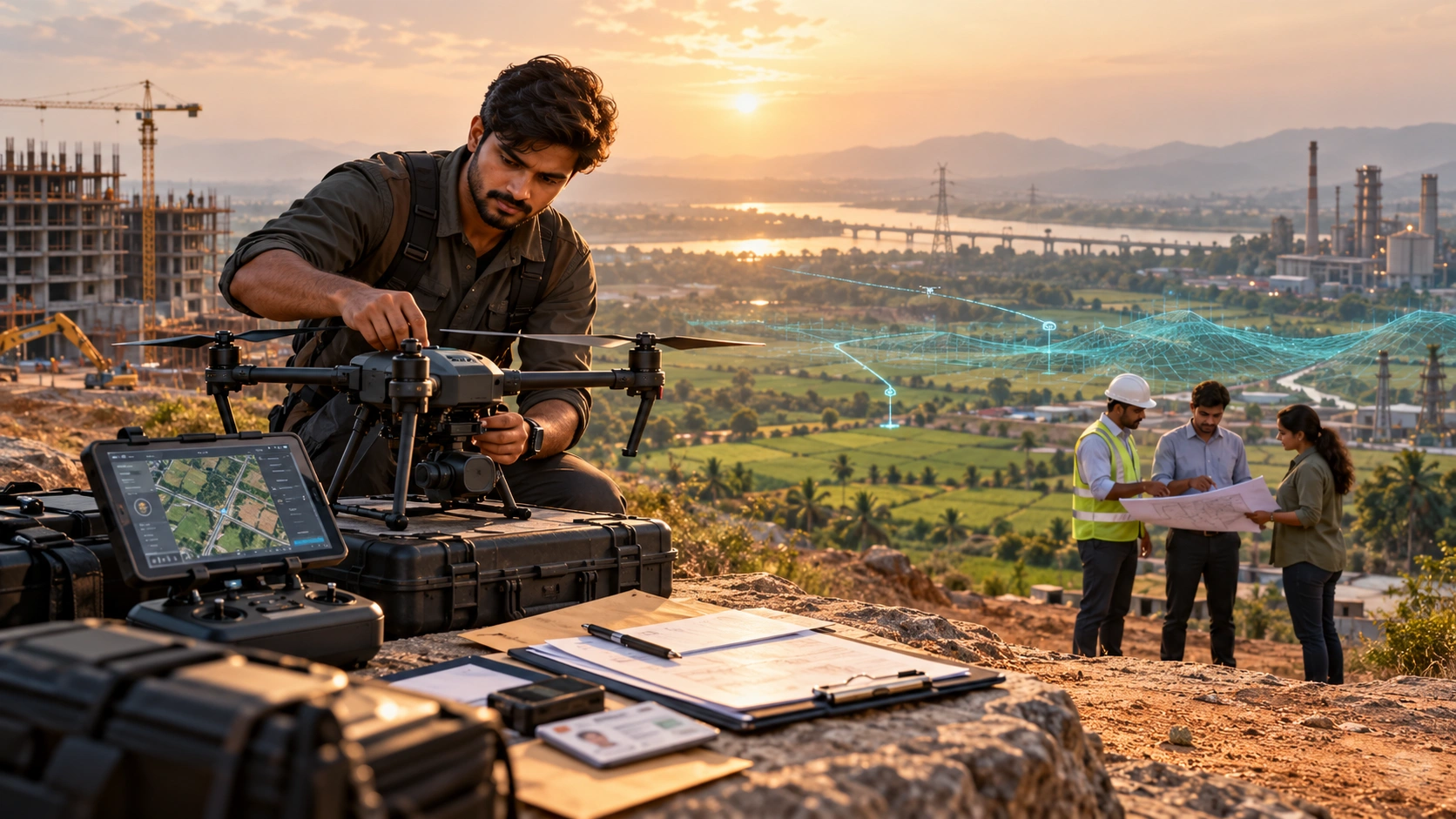
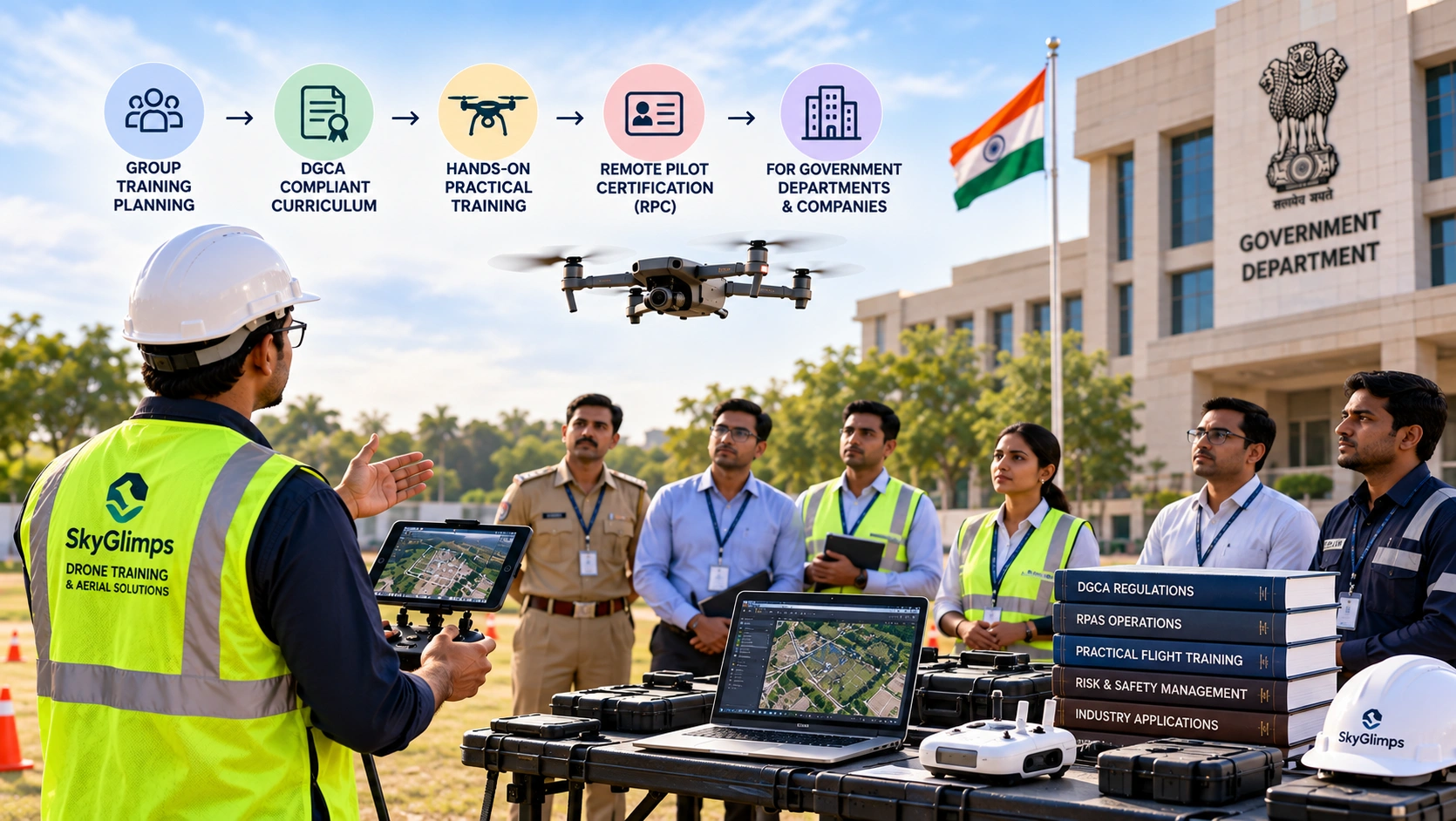
Drones are increasingly being used by government departments, infrastructure organisations and private companies for surveying, mapping, inspection, surveillance, agriculture, construction monitoring and other operational tasks.
As drone use expands, organisations face an important question:
How can an entire team be trained to use drones professionally instead of sending employees for separate individual courses?
This is where group drone training can become useful.
Government departments and companies can organise training for multiple employees around their operational requirements. Depending on the objective, the programme can cover general drone operations, regulatory requirements, practical flying or specialised applications such as mapping, inspection, surveillance and documentation.
However, there is an important distinction between group training and group certification.
Training can be organised as a batch for an organisation, but where a Remote Pilot Certificate (RPC) is required, certification applies to individual trainees who complete the applicable training and successfully pass the required assessments.
DGCA’s training framework requires authorised Remote Pilot Training Organisations (RPTOs) to provide the prescribed training to individuals seeking an applicable Remote Pilot Certificate.
This makes organisational training possible while still maintaining individual pilot competency and certification.
What Is Group Drone Training?
Group drone training is a structured training programme in which multiple employees from the same organisation learn drone operations together.
Instead of sending employees individually to different batches, an organisation can work with a training provider to create a programme around its team requirements.
For example, a government department may train:
- Survey officers
- Engineers
- GIS professionals
- Field inspectors
- Technical staff
- Project personnel
- Drone operators
A private company may train:
- Survey teams
- Construction engineers
- Inspection personnel
- Agriculture teams
- GIS professionals
- Security personnel
- Technical operators
The training can be designed around the organisation’s intended use of drones.
SkyGlimps currently offers customized drone training for companies, institutions and government bodies, with the curriculum designed around organisational requirements, job roles and specific applications.
Why Are Government Departments Using Drone Training?
Government departments often manage projects that cover large geographical areas or require frequent field inspections.
Drones can support workflows such as:
- Land surveying
- Infrastructure mapping
- Road monitoring
- Construction documentation
- Irrigation mapping
- Agriculture monitoring
- Disaster response
- Surveillance
- Asset inspection
- Urban planning
- Environmental documentation
Training internal personnel can help organisations develop an in-house understanding of drone operations.
Instead of relying entirely on an external drone operator for every task, a department can develop employees who understand the basics of:
Planning → Flying → Data Capture → Safety → Documentation
The exact level of internal capability required depends on the department’s responsibilities and operational model.
Why Do Companies Need Group Drone Training?
Companies may use drones for very different reasons.
A construction company may need drones for:
- Site surveys
- Progress monitoring
- Earthwork measurement
- Documentation
An infrastructure company may require:
- Corridor mapping
- Asset inspection
- 3D mapping
- Project monitoring
An agricultural organisation may need:
- Field mapping
- Crop monitoring
- Agricultural data collection
A security organisation may require:
- Aerial surveillance
- Situational awareness
- Event monitoring
Because these applications are different, a generic drone workshop may not be sufficient.
The organisation should first identify what employees are expected to do with the drone and then select the appropriate training structure.
What Is the Difference Between Group Drone Training and a Regular Drone Course?
The biggest difference is the training objective.
A regular individual course is generally designed around the requirements of individual learners.
Group training can be designed around:
- Organisation
- Department
- Job roles
- Project requirements
- Equipment
- Application
- Skill level
- Number of trainees
For example:
| Individual Training | Group/Organisational Training |
|---|---|
| Designed for one learner | Designed for a team |
| Fixed course structure may be used | Curriculum can be customised |
| Individual learning objective | Department/project objective |
| General practical training | Role-specific practical training |
| Individual assessment | Multiple trainees assessed individually where applicable |
| Personal career development | Organisational capability building |
This makes group training particularly useful when an organisation wants several employees to develop a common operational skill set.
Does Group Training Mean Everyone Gets One DGCA Certificate?
No.
This is one of the most important points organisations should understand.
The training can be conducted as a group, but an RPC is an individual pilot credential.
DGCA’s training framework is designed for individuals seeking the applicable Remote Pilot Certificate, and the certification records the relevant category, sub-category and class associated with the pilot’s training and endorsement.
Therefore, if an organisation sends 10 employees for applicable DGCA remote pilot training, it should not think of the outcome as:
10 employees → 1 organisation-level drone licence
Instead, where RPC certification applies, the process is closer to:
Organisation → Group Training Batch → Individual Training → Individual Assessment → Individual RPC
Each employee needs to satisfy the applicable requirements and successfully complete the relevant training and assessment.
How Does Group DGCA Training Work?
The process can be divided into several stages.
Stage 1: Organisation Identifies the Requirement
The department or company first decides why it wants drone training.
For example:
“Our survey team needs to conduct drone-based mapping.”
or:
“Our inspection team needs to collect aerial inspection data.”
or:
“Our department wants employees capable of operating drones for infrastructure monitoring.”
The objective determines the training requirement.
Stage 2: Identify the Employees
The organisation selects the employees who will participate.
For example:
- 5 engineers
- 3 surveyors
- 2 GIS professionals
The group does not necessarily need to have identical job roles, but the training objective should be clear.
Stage 3: Verify Eligibility
The training provider checks the applicable eligibility requirements for the selected programme.
For DGCA-certified training, the requirements depend on the applicable category, class and current regulatory framework.
The organisation should provide the required trainee information and documentation before the training begins.
Stage 4: Select the Training Category
The organisation needs to identify what type of drone operation the employees will be trained for.
This can involve considerations such as:
- Drone category
- UAS class
- Intended operation
- Flight environment
- Application
- Equipment
The appropriate training should match the drones the employees are expected to operate.
Stage 5: Create the Training Programme
For an organisational batch, the training provider can structure the programme around the organisation’s needs.
The programme may include:
- Drone fundamentals
- Regulations
- Airspace
- Flight principles
- Safety
- Weather
- Maintenance
- Risk assessment
- Practical flying
- Simulator training
- Payload operations
- Application-specific training
DGCA’s prescribed training syllabus includes subjects such as air law, airspace, flight principles, aerodynamics, weather, maintenance, risk assessment, safety, payload operations and an introduction to drone data and analysis.
What Does the Practical Training Look Like?
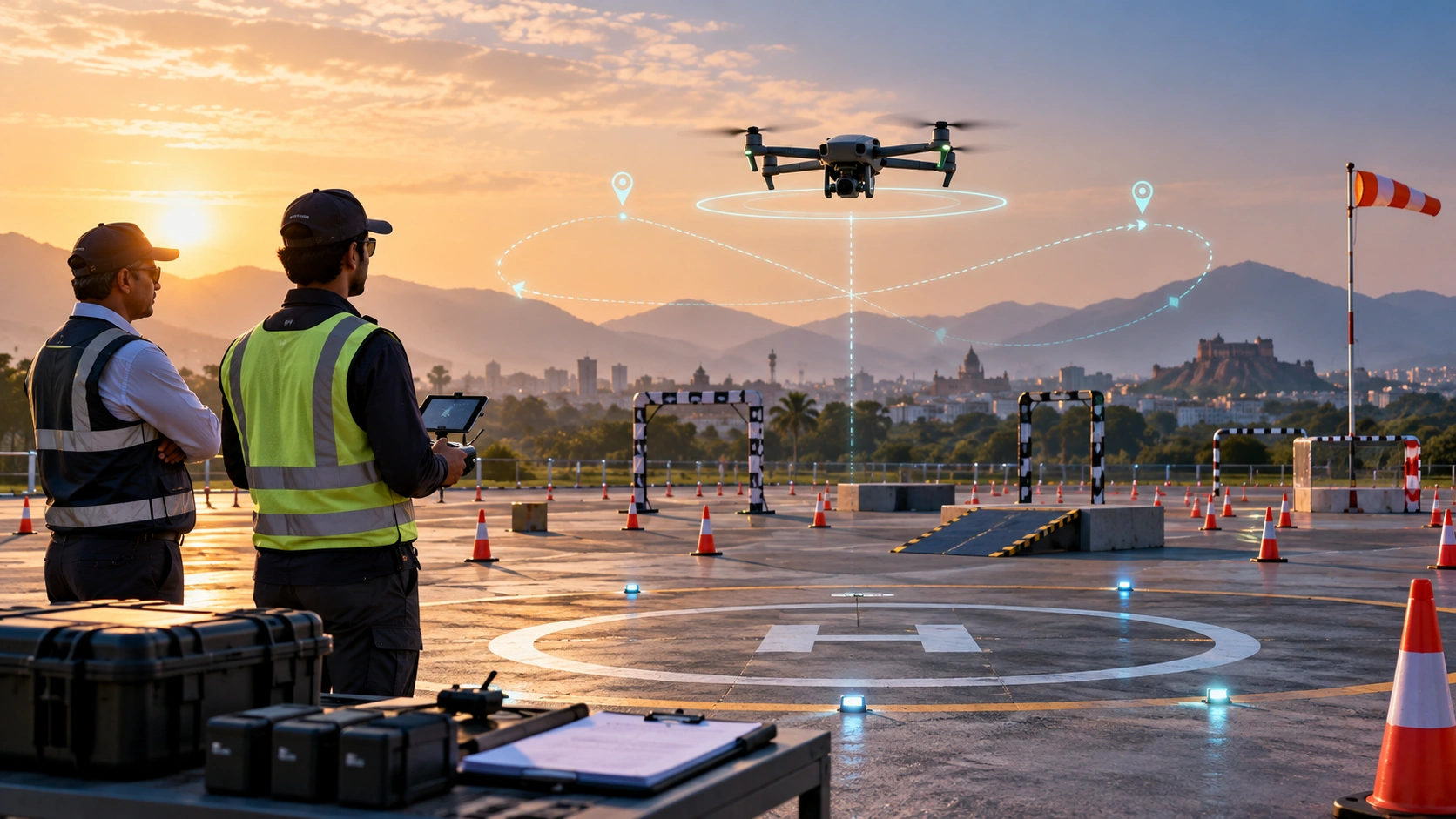
Practical training is an important part of professional drone pilot development.
Employees can progressively learn:
Basic Controls
- Take-off
- Landing
- Hovering
- Climbing
- Descending
- Pitch
- Roll
- Yaw
Flight Manoeuvres
Depending on the applicable programme, training can include:
- Turns
- Circuit patterns
- Circles
- Figure-of-eight
- Orientation
- Recovery procedures
Operational Skills
Employees can also learn:
- Pre-flight checks
- Flight planning
- Safety procedures
- Battery management
- Aircraft inspection
- Mission preparation
Application-Specific Skills
The practical training can then be connected to the organisation’s actual work.
For example:
Survey team → Mapping mission
Inspection team → Asset inspection
Construction team → Site documentation
Security team → Aerial surveillance
This is where customised group training can provide greater value than a generic introductory workshop.
Can Government Employees Receive DGCA Training as a Group?
Yes, an organisation can arrange training for a group of employees through an appropriately authorised RPTO when the training is for an applicable Remote Pilot Certificate pathway.
DGCA’s framework defines an RPTO as an organisation authorised to impart remote pilot training to individuals seeking an RPC.
SkyGlimps currently states that its customized drone training can be designed for government bodies, companies, institutions and corporate teams, with training aligned to department objectives, project workflows, safety requirements and real-world drone applications.
However, organisations should verify that the specific training being proposed is within the provider’s applicable DGCA authorisation and scope if an RPC is required.
Not every customised drone workshop automatically results in DGCA certification.
What Can Be Included in Government Employee Drone Training?
A government department may require a combination of general drone knowledge and application-specific training.
A possible programme structure could include:
Module 1: Drone Fundamentals
Employees learn:
- Drone components
- Sensors
- Batteries
- Controllers
- Payloads
- Flight modes
Module 2: Regulations and Safety
Employees learn:
- Applicable drone rules
- Airspace awareness
- Pre-flight checks
- Operational restrictions
- Safety procedures
- Risk assessment
Module 3: Practical Flying
Employees practise:
- Take-off
- Landing
- Hovering
- Turns
- Direction control
- Basic manoeuvres
Module 4: Mission Planning
Employees learn how to:
- Define the mission
- Select the operating area
- Plan the flight
- Consider weather
- Assess risks
- Prepare the equipment
Module 5: Application Training
This depends on the department.
For example:
Survey Department: Mapping and surveying
Irrigation Department: Canal and waterway mapping
Urban Development: Site mapping and documentation
PWD: Infrastructure monitoring
Agriculture Department: Agricultural mapping
Forest Department: Aerial documentation and monitoring
Disaster Management: Situational assessment
Police/Security: Aerial surveillance
The exact curriculum should be based on the department’s actual responsibilities.
How Can Companies Customise Group Drone Training?
Companies can use the same approach.
First identify the business application.
Construction Company
Training can focus on:
- Site mapping
- Progress documentation
- Earthwork
- Aerial imagery
- Survey workflows
Mining Company
Training can focus on:
- Mine mapping
- Stockpile surveys
- Volume calculations
- Terrain data
- Site documentation
Power Company
Training can focus on:
- Infrastructure inspection
- Thermal and RGB data
- Transmission corridors
- Asset documentation
Agriculture Company
Training can focus on:
- Field mapping
- Crop monitoring
- Aerial data collection
- Agricultural workflows
Security Company
Training can focus on:
- Live aerial surveillance
- Situational awareness
- Operational procedures
- Safe drone deployment
SkyGlimps’ customized training offering specifically allows organisations to focus the curriculum on applications such as mapping, inspection, FPV, media, surveillance and documentation.
What Is the Ideal Number of Employees for Group Training?
There is no single group size that works for every organisation.
The appropriate batch size depends on:
- Number of available instructors
- Number of drones
- Flying-ground capacity
- Practical training requirements
- Training duration
- Skill level
- Application
- Number of trainees requiring assessment
For practical flying, too many trainees using too few aircraft can reduce individual hands-on time.
Therefore, organisations should discuss the expected number of participants with the training provider before finalising the batch.
A good group training programme should balance:
Team size + Instructor capacity + Equipment + Practical flying time
Why Is Practical Exposure Important for Government Employees?
Government employees may understand their department’s operational requirements very well but have limited experience with drones.
Classroom training can explain:
- Drone technology
- Regulations
- Flight principles
- Safety
- Mission planning
But practical sessions allow employees to experience:
- Aircraft controls
- Take-off
- Landing
- Flight orientation
- Battery management
- Site conditions
- Weather considerations
- Operational procedures
This is especially important when the organisation plans to use drones regularly.
Employees should understand what can go wrong during an actual field mission and how to respond safely.
Can Group Training Include Drone Mapping?
Yes.
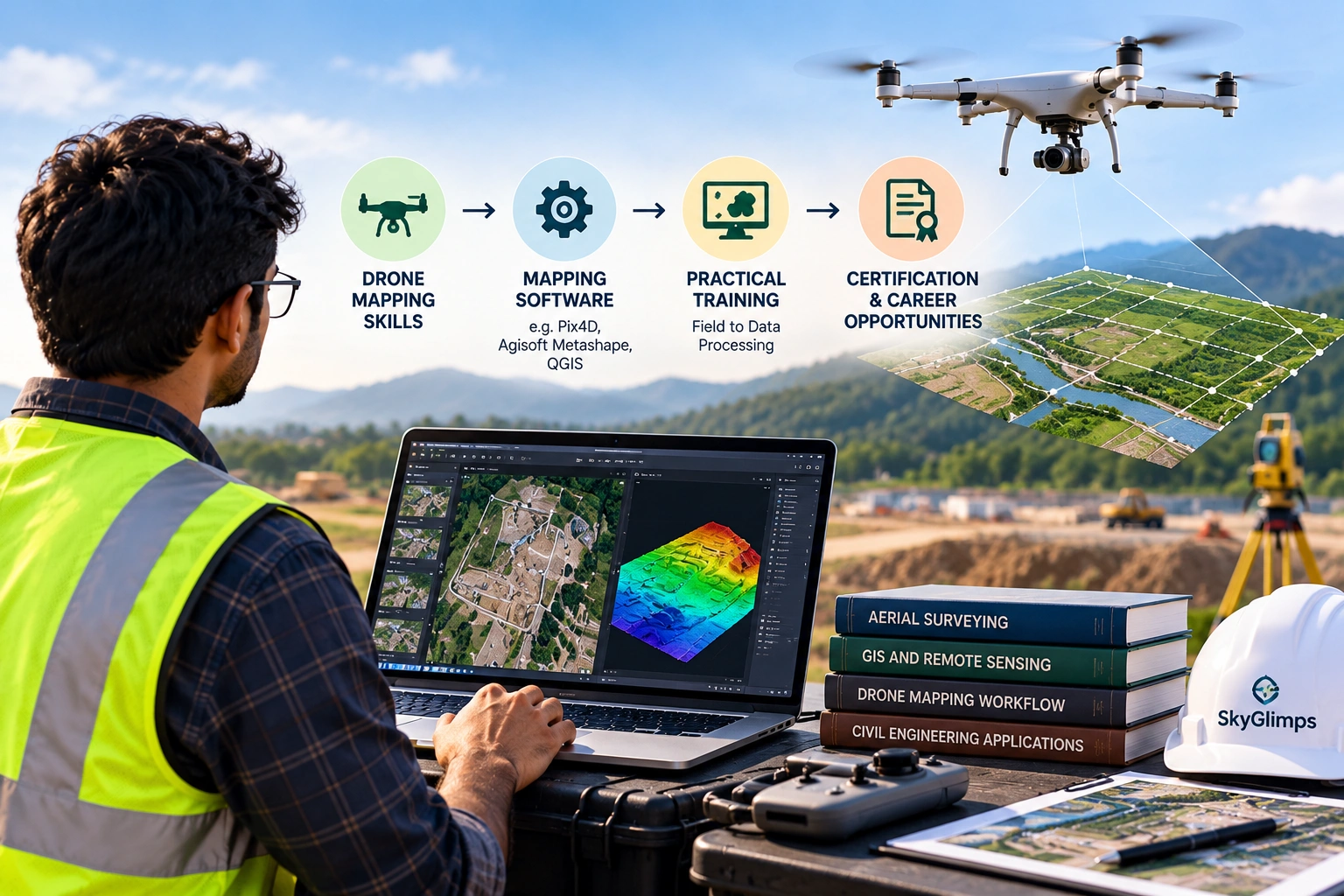
Drone mapping is one of the most useful applications for organisations involved in land, infrastructure and engineering projects.
A mapping-focused programme can cover:
- Survey planning
- Flight planning
- Image overlap
- Ground control
- RTK
- Coordinate systems
- Data capture
- Photogrammetry
- Orthomosaics
- Point clouds
- DEMs
- DSMs
- Contours
- GIS workflows
For example, a government engineering department could train its field team to understand how drone imagery is collected and how it can support existing surveying and GIS workflows.
However, mapping training and pilot certification are separate skill areas.
An employee may need both depending on the role.
Can Group Training Include Drone Inspection?
Yes.
Inspection-focused training can be designed around the assets the organisation works with.
Potential topics include:
- RGB inspection
- Thermal imaging
- Infrastructure inspection
- Industrial assets
- Power infrastructure
- Building inspection
- Documentation
- Reporting
For example, a power-sector organisation may want employees to understand how aerial inspection data is collected around transmission infrastructure.
An industrial company may want employees trained to document difficult-to-access structures.
The training should be designed around the actual inspection workflow rather than simply teaching generic drone photography.
What Is the Difference Between a One-Day Workshop and DGCA Group Training?
This distinction is particularly important for organisations.
One-Day Beginner Workshop
Usually focuses on:
- Drone introduction
- Basic controls
- General safety
- Demonstration
- Introductory practical flying
It can be useful for employees who want to understand drone technology.
DGCA-Certified Training
When the organisation requires applicable RPC training, the programme needs to follow the relevant DGCA framework through an appropriately authorised RPTO.
It involves the applicable:
- Theory
- Practical training
- Assessment
- Certification process
DGCA’s training syllabus specifies both ground and practical components for the relevant remote pilot training pathway.
Application-Specific Training
This goes beyond pilot certification and focuses on how employees use drones for their actual jobs.
For example:
DGCA Pilot Training + Mapping Training
or
DGCA Pilot Training + Inspection Training
The right option depends on the organisation’s objective.
Should Every Employee in a Drone Team Become a Certified Pilot?
Not necessarily.
An organisation should first define the roles within its drone operation.
For example:
Pilot: Operates the aircraft.
Surveyor: Plans and interprets survey data.
GIS Professional: Processes and analyses spatial information.
Inspector: Interprets asset condition.
Project Manager: Uses the resulting information for project decisions.
One person can sometimes perform multiple roles, but this depends on the organisation and project.
If multiple employees are expected to operate the drone, the organisation should evaluate the applicable certification and training requirements for each operator.
What Are the Benefits of Training an Entire Team?
Consistent Knowledge
Everyone learns the same operating principles and safety procedures.
Better Internal Coordination
Pilots, engineers and project managers understand the same workflow.
Faster Deployment
Trained employees can support drone operations without starting from zero each time.
Better Safety Culture
Employees understand the importance of:
- Pre-flight checks
- Airspace
- Weather
- Risk
- Equipment condition
Application-Specific Skills
Training can be built around the department’s actual work.
Reduced Dependence on External Operators
Where appropriate and legally permitted, organisations can develop internal capabilities.
Better Project Understanding
Employees who understand both the drone and the application can communicate more effectively with survey, engineering and GIS teams.
How Should a Government Department Plan Its Drone Training Programme?
A simple five-step process can help.
Step 1: Identify the Use Case
Ask:
“Why do we need drones?”
Examples:
- Surveying
- Mapping
- Inspection
- Surveillance
- Monitoring
- Documentation
Step 2: Identify the Team
Decide which employees will:
- Operate drones
- Plan missions
- Process data
- Analyse outputs
- Manage projects
Step 3: Identify the Drone
Determine:
- Drone class
- Payload
- Camera
- Sensor
- Intended application
Step 4: Determine the Training Requirement
Decide whether employees need:
- Beginner training
- DGCA pilot training
- Mapping training
- Inspection training
- GIS training
- Application-specific training
Step 5: Select an Appropriate Training Provider
Verify:
- Relevant DGCA authorisation where applicable
- Instructor capability
- Practical flying facilities
- Equipment
- Training curriculum
- Assessment process
- Application-specific expertise
This prevents the organisation from purchasing training without first defining what capability it actually needs.
What Should Companies Ask Before Booking Group Drone Training?
Before finalising a programme, ask the training provider:
About Certification
- Is the programme DGCA-certified where applicable?
- Is the provider an authorised RPTO for the required training?
- Which drone category/class does the training cover?
- Is the assessment included?
About Practical Training
- How much hands-on flying does each participant receive?
- How many drones are available?
- Where is the flying conducted?
- What happens in poor weather?
About Curriculum
- Can the syllabus be customised?
- Can it focus on our industry?
- Can mapping or inspection be included?
- Can our actual equipment be used?
About Group Training
- What is the recommended batch size?
- Can multiple departments participate?
- Is group pricing available?
- Can training be conducted around our project schedule?
About Certification
- What documents are required?
- How is the assessment conducted?
- What is the certification process after successful completion?
These questions help organisations compare training providers on actual outcomes rather than just course duration.
Can the Training Be Built Around the Company’s Own Drone?
Potentially, yes, depending on the training provider, aircraft and applicable certification requirements.
This can be particularly useful for organisations that have already purchased drones.
For example, a company may own:
- A mapping drone
- A thermal inspection drone
- A LiDAR platform
- An FPV drone
Training can potentially be designed around the organisation’s operational workflow.
However, if the training is intended to result in a specific DGCA RPC, the organisation should confirm that the aircraft, category/class and training scope are covered by the RPTO’s applicable authorisation.
Can Government Departments Train Employees for Specific Projects?
Yes.
This is one of the strongest use cases for customised organisational training.
Suppose a government department is starting a large infrastructure project.
Instead of providing only generic drone education, the training can be designed around the project’s requirements.
For example:
Project: Road development
Team: Engineers + Surveyors + GIS staff
Training: Drone operations + corridor mapping + data capture + mapping workflow
Or:
Project: Irrigation infrastructure
Team: Engineers + Field staff
Training: Drone operations + canal mapping + documentation + inspection
This approach connects training directly to the organisation’s expected output.
What Does a Typical Group Training Journey Look Like?
A simplified organisational journey can look like this:
Requirement Identification
↓
Employee Selection
↓
Eligibility & Documentation
↓
Training Category Selection
↓
Custom Training Plan
↓
Theory Training
↓
Simulator/Practical Training
↓
Application-Specific Training
↓
Individual Assessment
↓
Certification Process, Where Applicable
↓
Deployment in Organisational Workflows
This structure helps organisations move from simply purchasing a drone to actually building internal capability.
What Is the Role of an RPTO in Group Training?
An RPTO, or Remote Pilot Training Organisation, is an organisation authorised by DGCA to provide remote pilot training under the applicable framework.
For candidates seeking an RPC, the training must be conducted through an appropriately authorised RPTO. DGCA’s framework also requires the RPTO’s training programme and assessment methodology to follow the applicable requirements.
For an organisation arranging group training, this means it should verify the provider’s current authorisation and scope rather than assuming that every drone-training company can conduct RPC training.
This is particularly important when the organisation expects certification for its employees.
How Does SkyGlimps Support Government and Corporate Drone Training?
SkyGlimps currently offers Customized Drone Training specifically for companies, institutions and government bodies.
The programme can be designed around:
- Organisational requirements
- Department objectives
- Job roles
- Project workflows
- Safety requirements
- Skill level
- Industry application
SkyGlimps states that customised training can cover areas such as:
- Drone mapping
- Surveying
- Thermal inspection
- RGB inspection
- FPV
- Aerial cinematography
- Media production
- Progress tracking
- Surveillance
- Operational drone use
The training can therefore be structured around what the organisation actually wants employees to accomplish rather than forcing every team through an identical generic programme.
SkyGlimps also currently operates a DGCA-authorised RPTO and offers DGCA-certified Small Category Drone Pilot Training. Its current website lists RPTO Authorization No. RPTO202600112.
For organisations looking to build a customised training programme, SkyGlimps Customized Drone Training provides details about its current organisational training offering.
What Could a Government Employee Drone Training Programme Look Like?
A department could structure a programme like this:
Day 1: Fundamentals and Regulations
- Drone technology
- Components
- Regulations
- Airspace
- Safety
- Flight principles
Day 2: Operations and Planning
- Weather
- Risk assessment
- Pre-flight checks
- Mission planning
- Battery management
- Equipment handling
Day 3: Practical Flying
- Take-off
- Landing
- Hovering
- Turns
- Orientation
- Flight manoeuvres
Day 4: Application Training
Depending on the department:
- Mapping
- Inspection
- Documentation
- Surveillance
- Surveying
Day 5: Practical Application
Employees perform a project-oriented drone mission under supervision.
Final Stage: Assessment
Where the programme is an applicable DGCA RPC pathway, individual trainees complete the required assessment and certification process.
The exact duration and syllabus should be determined according to the applicable DGCA training requirements, RPTO scope and organisational objective.
What Are the Common Mistakes Organisations Make?
Mistake 1: Buying Drones Before Defining the Use Case
A drone should be selected based on the work it needs to perform.
Mistake 2: Training Everyone the Same Way
A surveyor and a security operator may have completely different training needs.
Mistake 3: Assuming Pilot Training Equals Application Training
Knowing how to fly does not automatically mean someone knows how to conduct a survey, inspection or GIS workflow.
Mistake 4: Ignoring Practical Training
Classroom knowledge alone is not enough for operational drone work.
Mistake 5: Not Checking RPTO Authorisation
If certification is required, verify the training provider’s current DGCA authorisation and applicable scope.
Mistake 6: Training Too Many People Without Enough Equipment
Every participant needs appropriate opportunities to practise.
Mistake 7: Not Planning Post-Training Operations
Training should lead to an actual organisational workflow.
The department should know:
Who flies? Who plans? Who processes? Who checks? Who uses the data?
How Can Organisations Build an Internal Drone Team?
A basic internal structure could look like:
Drone Pilot
Responsible for aircraft operation and flight safety.
Mission Planner
Responsible for planning the flight around the project’s requirements.
Data Specialist
Responsible for processing and managing drone data.
Technical Specialist
Responsible for interpreting mapping, inspection or other technical outputs.
Project Manager
Responsible for integrating drone outputs into project decisions.
A smaller organisation may combine several of these roles.
The important thing is to clearly define responsibilities.
Frequently Asked Questions
Drone training for government employees is professional training designed to help government personnel understand and operate drones for applications such as surveying, mapping, inspection, monitoring, surveillance and documentation.
Yes. Government departments can organise training for multiple employees as a group. The curriculum can be structured around department objectives and specific operational requirements.
Yes. Companies can organise employee training through an appropriately authorised RPTO when the programme is intended for an applicable DGCA Remote Pilot Certificate pathway.
No. Where RPC certification applies, the certification is associated with the individual trainee. Employees must complete the applicable training and assessment requirements individually.
RPTO stands for Remote Pilot Training Organisation. It is an organisation authorised by DGCA to conduct applicable remote pilot training.
Yes. Organisational training can be customised around job roles, project requirements, skill levels and applications such as mapping, inspection, surveillance or documentation.
Yes. A training programme can combine drone operations with mapping-related skills such as mission planning, data capture, GCPs, RTK, photogrammetry and GIS, depending on the intended workflow.
Yes. Training can be designed around RGB inspection, thermal imaging, infrastructure inspection and other relevant inspection workflows.
Build an In-House Drone Capability With the Right Training
For government departments and companies, drone adoption is not simply about purchasing aircraft.
The bigger challenge is building the people, processes and skills required to use those aircraft effectively.
A successful organisational drone programme can involve:
Right Drone → Trained Employees → Safe Operations → Quality Data → Useful Applications
Group training can make this process more structured by allowing several employees to learn together while keeping the programme aligned with the organisation’s actual requirements.
For organisations seeking an applicable DGCA Remote Pilot Certificate pathway, it is important to remember that training may be delivered to a group, but certification is individual. Each relevant trainee must complete the applicable training and assessment requirements.
At the same time, organisations should not stop at pilot training.
A government survey team may need:
DGCA Pilot Training + Mapping + GIS
A construction company may need:
DGCA Pilot Training + Site Mapping + Progress Documentation
An infrastructure company may need:
DGCA Pilot Training + Inspection + Thermal/RGB Data
A security team may need:
DGCA Pilot Training + Surveillance + Operational Procedures
This is why customised organisational training can be valuable.
SkyGlimps currently provides customised drone training for government bodies, companies, institutions and corporate teams, with programmes that can be aligned with department objectives, project workflows and applications such as mapping, surveying, inspection, surveillance and documentation.
For an organisation planning to introduce drones into its operations, the right starting point is therefore not:
“Which drone course should our employees take?”
It is:
“What do we want our employees to accomplish with drones?”
Once that is clear, the organisation can determine the appropriate drone, training category, practical requirements, specialised skills and certification pathway.
The goal is not simply to train employees to fly drones. It is to build a safe, capable and application-ready drone team that can support real organisational work.