
Starting a career as a freelance drone pilot in India can be an attractive option for people who want to turn drone skills into a professional service business.
Construction companies need aerial documentation. Survey teams need drone data. Real estate developers need site visuals. Infrastructure companies need inspection and progress monitoring. Media companies need aerial footage.
This creates opportunities for independent drone professionals.
But buying a drone and finding someone willing to pay you to fly it is not enough.
A professional freelance drone pilot needs to understand:
- Remote Pilot Certificate requirements
- Drone registration and UIN
- Type certification
- Airspace rules
- Third-party insurance
- Pre-flight safety
- Client contracts
- Invoicing and taxes
- Portfolio development
- Pricing
- Client acquisition
There is also an important terminology point.
People commonly search for a “drone licence” in India, but the current professional certification framework uses the term Remote Pilot Certificate (RPC). DGCA’s current public guidance tells RPC holders to fly only applicable type-certified and registered drones, hold the appropriate RPC, check airspace before each flight and maintain valid third-party insurance.
So, if your goal is to become a freelance drone pilot in India, the right approach is to build your career around certification + compliant equipment + practical skills + a clear service offering + client acquisition.
Can You Become a Freelance Drone Pilot in India?
Yes.
You can operate as an independent drone professional and provide services to clients instead of working as a full-time employee.
Depending on your skills and equipment, freelance services can include:
- Aerial photography
- Aerial videography
- Construction progress documentation
- Land and site mapping
- Drone surveying support
- Infrastructure documentation
- Industrial inspection support
- Real estate aerial content
- Agriculture-related aerial data
- Event or location footage
- 3D mapping
- Orthomosaic and other mapping outputs
However, not every service requires the same technical skills.
A pilot who specialises in cinematic video may have a very different setup from someone providing survey mapping.
Therefore, your first decision should be:
“What type of drone service do I want to sell?”
That decision should influence the drone you purchase, the training you take, the software you learn and the clients you approach.
What Is a Freelance Drone Pilot?
A freelance drone pilot is an independent professional who provides drone-related services to clients on a project, assignment or contract basis.
Instead of being permanently employed by one company, the pilot may work with multiple clients.
For example:
Monday: Construction site documentation
Wednesday: Real estate aerial shoot
Friday: Industrial inspection
Next week: Survey mapping project
The pilot may charge:
- Per project
- Per day
- Per flight
- Per site
- Per deliverable
- Through a customised project quotation
The pricing model depends on the type and complexity of the work.
A freelance pilot may also work as part of a larger team.
For example:
Client → Survey company → Freelance drone pilot → Data capture
In this model, you may be responsible only for the flight and data collection while the survey company handles processing and final deliverables.
This can be a useful way to start building professional experience.
Do Freelance Drone Pilots Need a Licence in India?
The applicable requirement depends on the drone category, operation and current regulatory framework. For professional operations, you should not assume that an informal drone course or recreational flying permission is sufficient.
The current DGCA public guidance for RPC holders states that pilots should hold a valid RPC for the applicable drone category, sub-category and class before flight. It also says pilots should fly only DGCA type-certified and registered drones with a UIN and check the Digital Sky airspace map before every flight.
The terminology has also changed over time.
Older content may refer to a Remote Pilot Licence.
The current certification terminology is Remote Pilot Certificate (RPC).
For someone planning professional freelance work, the safest approach is to:
- Identify the drone category you intend to operate.
- Check the current DGCA requirements.
- Complete the applicable training through an authorised RPTO where required.
- Obtain the appropriate RPC.
- Operate only within the privileges and endorsement applicable to your certificate.
Do not rely on an old blog or social media post for current regulatory requirements.
DGCA’s website currently provides the applicable drone regulatory information and eGCA services.
What Is a Remote Pilot Certificate?
A Remote Pilot Certificate (RPC) is the individual certification associated with a trained remote pilot.
It is not the same thing as registering your drone.
Think of it this way:
RPC = Person
UIN/Drone Registration = Drone
You may therefore need to manage two separate compliance areas:
Pilot compliance
Your training and certification.
Aircraft compliance
The drone’s applicable type certification and registration.
DGCA’s current RPC verification page identifies the pilot, certificate details and the endorsed category, sub-category and class.
This distinction is important for freelancers because owning a registered drone does not automatically make the owner a certified pilot.
Likewise, holding an RPC does not mean every drone can automatically be flown by that pilot.
The drone and the pilot both need to meet the applicable requirements.
What Are the Eligibility Requirements for Drone Pilot Training?
The exact requirements should be confirmed with the RPTO for the specific training category.
SkyGlimps currently lists the following eligibility requirements for its DGCA-Certified Small Category Drone Pilot Training:
| Requirement | Current SkyGlimps Requirement |
|---|---|
| Minimum age | 18 years |
| Education | Class 10 pass or equivalent |
| ID | Valid government-issued ID |
| Medical | Medical fitness certificate |
| Training category | Small Category |
SkyGlimps currently offers the programme through its Kolkata-based RPTO and states that the course is suitable for beginners, working professionals, entrepreneurs, surveyors, engineers and others entering the drone industry.
Because regulatory requirements can change, always verify the current eligibility criteria with the RPTO before enrolling.
Do You Need to Register Your Drone?
For drones subject to the registration requirement, yes.
The Drone Rules, 2021 establish registration requirements and a Unique Identification Number (UIN) for applicable unmanned aircraft systems. The registration framework links the UIN to the manufacturer’s unique serial information.
DGCA’s current public guidance also tells RPC holders to fly only type-certified and registered drones with a UIN.
For a freelancer, this means you should not simply buy a drone from a seller and immediately start accepting commercial assignments.
Before purchasing equipment, check:
- Is the drone type-certified where required?
- Is the drone eligible for registration?
- Does it have the required identification details?
- Can it be registered through the current DGCA process?
- Is the model suitable for your intended work?
- Is the registration status clear?
This is especially important because DGCA’s website currently states that registration of non-type-certified (non-TC) UAS is temporarily suspended until further notice.
Therefore, freelancers should verify the current regulatory status before purchasing a drone, rather than assuming that any commercially available drone can be registered and used for paid operations.
What Is a UIN?
UIN stands for Unique Identification Number.
It is associated with the applicable registered drone.
Think of it like an identification number for the aircraft.
For professional operations, you should maintain proper records of:
- Drone manufacturer
- Model
- Serial number
- UIN
- Purchase invoice
- Type certification information where applicable
- Insurance
- Maintenance records
Keeping these documents organised becomes particularly useful when working with corporate clients.
A company may ask you to provide proof that your equipment and operations are compliant before allowing you onto a project site.
Do Freelance Drone Pilots Need Drone Insurance?
Third-party insurance is an important compliance requirement for applicable drone operations.
DGCA’s current public guidance specifically states that RPC holders should ensure their UAS has valid third-party insurance.
The Drone Rules, 2021 provide for third-party insurance for unmanned aircraft systems, with a specific exemption for nano UAS.
For a freelancer, however, it is useful to think beyond minimum compliance.
You may want to investigate insurance options that address risks such as:
- Third-party injury
- Third-party property damage
- Drone damage
- Equipment loss
- Theft
- Accidental damage
- Public liability
- Equipment used during commercial assignments
The availability and terms of commercial drone insurance can vary.
Before buying a policy, specifically confirm that it covers paid/commercial drone operations and the type of work you actually perform.
Do not assume that a personal or recreational policy covers freelance business activities.
What Is the Difference Between Third-Party and Equipment Insurance?
These are different concepts.
Third-Party Insurance
This primarily addresses liability arising from damage or injury to third parties, subject to the policy terms and applicable law.
Equipment/Hull Cover
This can protect your own drone or equipment against specified risks, depending on the policy.
For a freelancer, equipment cover can be worth considering because your drone may be one of your most important business assets.
Imagine your primary drone is damaged during a paid assignment.
Without appropriate coverage, you may have to absorb:
Repair cost + lost working days + cancelled projects
Insurance cannot eliminate the risk, but appropriate coverage can reduce the financial impact.
Do You Need a Business Registration to Become a Freelance Drone Pilot?
You can start as an individual professional, but your business and tax structure should be planned properly as your work grows.
Possible structures can include:
- Individual/proprietorship setup
- Partnership
- LLP
- Private limited company
The right structure depends on your income, clients, liability considerations, tax position and long-term plans.
You should not assume that every freelancer needs to immediately create a private limited company.
A small independent operator may begin with a simpler structure and formalise the business as it grows.
For tax and business-registration decisions, speak with a qualified accountant or tax professional because the applicable requirements depend on your circumstances.
Do Freelance Drone Pilots Need GST Registration?
GST registration is not a drone-specific requirement; it depends on the applicable GST rules and your business circumstances.
For example, CBIC guidance states that GST registration generally becomes applicable when aggregate turnover crosses the prescribed threshold, while other provisions and exceptions can trigger registration in particular situations.
This is important for freelancers because you may work with clients across different states or with businesses that expect formal GST invoices.
Do not decide whether you need GST registration solely based on your first few projects.
Instead, discuss your expected turnover, type of services and client locations with a CA or GST professional.
If you become GST-registered, your business documentation can include:
- GSTIN
- Proper tax invoices
- Service description
- Applicable tax
- Payment terms
- Client details
What Documents Should a Freelance Drone Pilot Keep?
Create a digital folder containing all your important documents.
Pilot Documents
- Remote Pilot Certificate
- Training certificate/records
- Government ID
- Medical documents where applicable
Drone Documents
- Purchase invoice
- UIN
- Serial number
- Type certification information where applicable
- Manufacturer documentation
- Maintenance records
Insurance Documents
- Third-party insurance
- Equipment insurance, if purchased
- Policy terms
- Renewal dates
Business Documents
- PAN
- Bank details
- GST documents, if applicable
- Invoices
- Contracts
- Client records
Project Documents
- Flight plan
- Site permissions where required
- Client brief
- Risk assessment
- Flight logs
- Deliverables
- Project photographs
This documentation can make you look significantly more professional when approaching corporate clients.
Do Freelance Drone Pilots Need Permission for Every Flight?
Not every flight requires the same type of permission. The applicable requirements depend on the location, airspace zone, operation and current DGCA rules.
DGCA’s current public guidance states that pilots should check the Digital Sky airspace map before every flight. It also states that operations in green zones can be conducted without permission, while applicable yellow/red-zone operations require the relevant permissions.
Therefore, never assume:
“I have an RPC, so I can fly anywhere.”
Your certificate does not remove airspace restrictions.
Before every assignment, check:
- Location
- Airspace zone
- Temporary restrictions
- Nearby airports
- Site restrictions
- Client/site permissions
- Weather
- People and property
- Applicable operational requirements
The location should be assessed before the flight, not after arriving at the site.
Can a Freelance Drone Pilot Fly Anywhere in India?
No.
An RPC does not provide unrestricted permission to fly anywhere.
DGCA’s current guidance specifically instructs RPC holders to check the airspace on the Digital Sky platform before each flight and obtain the applicable permission for yellow/red zones.
There may also be temporary restrictions or site-specific restrictions.
A professional freelancer should therefore develop a habit:
Client gives location → Check airspace → Assess site → Plan flight → Confirm permissions → Fly
Never reverse that process.
What Type of Drone Should a Freelancer Buy?
Do not begin by asking:
“Which drone is the best?”
Ask:
“Which service am I selling?”
Your equipment should follow your business model.
For Aerial Photography
You may prioritise:
- Image quality
- Video quality
- Camera performance
- Stabilisation
- Battery life
For Mapping
You may need:
- Appropriate mapping camera
- High-quality positioning
- RTK capability where relevant
- Mission-planning capability
- Sufficient battery capacity
- Mapping software compatibility
For Inspection
You may need:
- High-resolution RGB camera
- Zoom capability
- Thermal sensor where required
- Stable flight
- Appropriate operating range
For Construction Documentation
You may prioritise:
- Reliable camera
- Repeatable flight missions
- Battery life
- Consistent imagery
- Easy data transfer
The most expensive drone is not automatically the best drone for your business.
How Much Does It Cost to Start a Freelance Drone Business?
There is no single starting cost.
Your investment depends on the service you choose.
A basic setup may include:
| Requirement | Purpose |
|---|---|
| Drone | Data or image capture |
| Batteries | Additional flight time |
| Charger | Battery management |
| Memory cards | Data storage |
| Carrying case | Equipment protection |
| Pilot training | Professional flying skills |
| Insurance | Risk protection |
| Laptop/workstation | Data processing |
| Software | Mapping/editing |
| Website/portfolio | Client acquisition |
| Transport | Site visits |
| Backup equipment | Business continuity |
A mapping freelancer may need to spend more on processing hardware and software than a freelancer focused mainly on aerial photography.
An inspection specialist may need additional sensors.
Therefore, calculate your startup budget backwards from your service offering.
What Services Can a Freelance Drone Pilot Sell?
Avoid marketing yourself simply as:
“Drone Pilot Available.”
That tells the client very little.
Instead, sell a specific outcome.
For example:
Construction
“Monthly aerial construction progress documentation.”
Real Estate
“Professional aerial property photography and video.”
Surveying
“Drone-based aerial data capture for survey and mapping projects.”
Mining
“Drone-based stockpile and site documentation.”
Infrastructure
“Aerial infrastructure documentation and inspection support.”
Agriculture
“Aerial field mapping and data collection.”
Media
“Commercial aerial photography and videography.”
Specific services are easier for clients to understand and compare.
What Skills Should a Freelance Drone Pilot Learn?
Flying the drone is only one part of the job.
A professional freelancer should develop at least five skill areas.
1. Drone Operations
Learn:
- Take-off
- Landing
- Hovering
- Orientation
- Turns
- Camera control
- Battery management
- Emergency procedures
2. Safety and Regulations
Understand:
- Airspace
- Flight restrictions
- Pre-flight checks
- Weather
- Site risks
- Privacy
- Emergency response
3. Your Chosen Specialisation
For example:
Mapping: Photogrammetry + GIS
Inspection: RGB + thermal
Media: Cinematography + editing
Construction: Documentation + progress reporting
4. Data Management
Learn:
- File organisation
- Backup
- Storage
- Metadata
- Client delivery
5. Business Skills
Learn:
- Quotation
- Pricing
- Contracts
- Invoicing
- Client communication
- Negotiation
- Follow-ups
Many freelancers focus heavily on flying and almost completely ignore the final two categories.
That can make it difficult to turn drone skills into a sustainable business.
Should You Take a DGCA Drone Pilot Course?
If your intended professional operation requires an RPC, you should follow the applicable DGCA training and certification pathway.
A proper professional course should cover more than joystick controls.
DGCA’s training framework includes areas such as:
- Regulatory framework
- Airspace
- Flight principles
- Aerodynamics
- Weather
- Maintenance
- Risk assessment
- Safety
- Payload operations
- Drone data
- Practical flying
- Assessment
The DGCA training syllabus also includes simulator training and practical flying as part of the applicable training pathway.
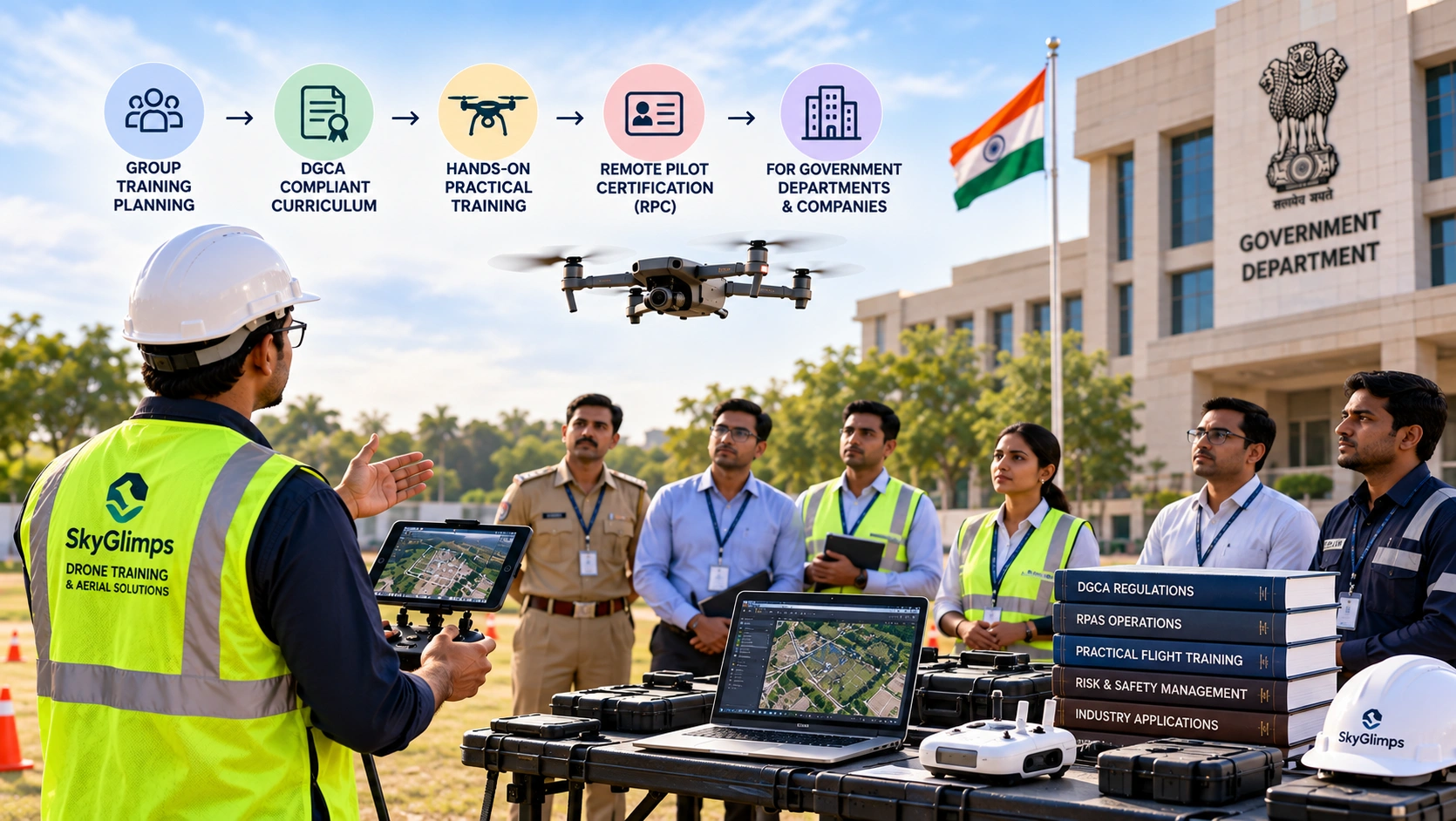
SkyGlimps currently offers a DGCA-Certified Small Category Drone Pilot Training programme that includes theory, simulator training, practical flying, solo-flight progression, night flying and final flying assessment.
For someone planning to start a freelance drone business, this type of structured training can provide the foundation for safe professional operations.
Is DGCA Pilot Training Enough to Start a Drone Business?
Not by itself.
This is one of the biggest mistakes beginners make.
DGCA pilot training helps you develop the required remote-pilot knowledge and flying skills.
But clients may also expect you to know:
- Mapping
- Photography
- Videography
- Inspection
- Data processing
- GIS
- Reporting
- Editing
Think of your skill development as two layers.
Layer 1: Pilot
Can I operate the drone safely?
Layer 2: Professional Service
Can I solve the client’s problem using the drone?
The second layer is what creates commercial value.
For example:
A client does not necessarily want:
“A drone pilot.”
They may actually want:
“A monthly construction progress report with aerial imagery.”
The pilot is the means.
The deliverable is the product.
How Should You Choose Your First Freelance Drone Niche?
Trying to offer everything at the beginning can make your marketing weak.
Instead, select one primary niche.
Option 1: Construction
Good if you understand:
- Sites
- Buildings
- Progress
- Earthwork
- Documentation
Option 2: Real Estate
Good if you have:
- Camera skills
- Video editing
- Property marketing knowledge
Option 3: Mapping
Good if you are interested in:
- Surveying
- GIS
- Photogrammetry
- Engineering
Option 4: Inspection
Good if you want to work with:
- Infrastructure
- Industrial assets
- Power
- Buildings
Option 5: Media
Good if your strengths are:
- Cinematography
- Composition
- Editing
- Storytelling
Start with one strong service.
Expand after you have experience.
How to Get Your First Drone Clients
Getting your first client is usually harder than learning how to fly.
Do not wait for clients to discover you.
Build a simple acquisition system.
Step 1: Create a Portfolio
You do not need 50 projects.
Start with 3–5 strong examples.
For example:
Construction: Site progress example
Real Estate: Property aerial shoot
Mapping: Orthomosaic example
Inspection: Sample asset documentation
Media: Short aerial video
If you do not yet have paying clients, create clearly labelled sample/demo projects rather than pretending they were commercial assignments.
Step 2: Choose a Target Client
Do not approach:
“Everyone who needs a drone.”
Choose a client type.
For example:
50 local construction companies
or:
30 real estate agencies
or:
20 survey companies
or:
20 infrastructure contractors
A focused list is easier to manage.
Step 3: Contact Local Businesses
Start locally.
Look for:
- Construction companies
- Architects
- Real estate developers
- Survey firms
- Engineering consultants
- Infrastructure contractors
- Industrial companies
- Marketing agencies
- Event companies
- Production houses
The goal is not to send a generic message saying:
“I am a drone pilot. Do you need drone services?”
Instead, identify a problem you can solve.
For example:
“We provide recurring aerial progress documentation for construction sites, including scheduled aerial images and organised project records.”
That is much easier for a business owner to understand.
Step 4: Work With Existing Companies
One of the easiest ways to get early projects can be working as a subcontractor.
Approach:
- Survey companies
- Drone service companies
- Construction consultants
- Photography agencies
- Production houses
- GIS companies
They may already have clients but need additional pilots in different locations.
You provide the field operation.
They manage the client relationship.
This can help you build:
- Flight experience
- Professional contacts
- Project experience
- References
- Portfolio material
Step 5: Use LinkedIn
LinkedIn can be particularly useful for B2B drone work.
Build a profile around your niche.
Instead of:
“Freelance Drone Pilot”
consider a more specific positioning such as:
“Drone Mapping & Aerial Data Specialist for Construction and Infrastructure”
Then publish examples of:
- Aerial maps
- Construction progress
- Site documentation
- Before/after comparisons
- Mapping outputs
- Drone workflow explanations
Your content should demonstrate what you can actually deliver.
Step 6: Build Relationships With Surveyors
Surveyors can become valuable partners for a mapping-focused freelancer.
You may provide:
Drone data capture
while the surveyor handles:
Survey interpretation and final professional deliverables
This can be a much better starting point than trying to sell yourself as a complete surveying company before developing the necessary expertise.
Step 7: Offer a Small First Project
For a new client, a smaller assignment can reduce the perceived risk.
For example:
One site → One flight → One defined deliverable
If the client is satisfied, it can become:
Monthly → Quarterly → Multi-site
Recurring work is particularly valuable for freelancers because you do not need to find a completely new customer for every project.
How Should You Price Freelance Drone Services?
Avoid choosing one universal price for every project.
Pricing should consider:
- Travel
- Flight time
- Number of locations
- Equipment
- Crew
- Editing
- Data processing
- Software
- Deliverables
- Turnaround time
- Complexity
- Risk
- Insurance
- Revisions
A simple structure can be:
Base shoot fee + Travel + Processing + Additional deliverables
For example:
Drone capture
Travel
Video editing
Additional revisions
This makes your quotation easier to understand.
For mapping:
Field survey
Data processing
Mapping outputs
Additional analysis
The client should understand exactly what they are paying for.
Should You Charge Per Hour or Per Project?
For professional freelance work, project-based pricing is often easier for the client to understand.
Instead of:
₹X per hour
you could quote:
“Construction site aerial documentation – one site, one flight, 20 edited images + 60-second video.”
The client is purchasing a deliverable rather than buying your flying time.
However, hourly or daily rates can still make sense for:
- Long shoots
- On-location standby
- Multi-day projects
- Production work
Choose the pricing model according to the service.
Should You Sign a Contract With Drone Clients?
Yes, a written agreement is strongly recommended for professional freelance work.
Your contract or work order should define:
- Client
- Project location
- Date
- Scope
- Deliverables
- Number of flights
- Price
- Taxes
- Payment terms
- Cancellation
- Weather delays
- Revisions
- Usage rights
- Data ownership
- Confidentiality
- Liability
- Safety requirements
This becomes especially important when working with corporate clients.
For example, specify whether the client is purchasing:
Raw footage
or:
Edited footage
or:
Raw footage + edited video + photographs
Do not leave important deliverables open to interpretation.
What Should You Include in Your Drone Service Quotation?
A professional quotation can include:
Project
Construction Site Aerial Documentation
Location
Client-provided project site
Scope
One scheduled drone flight
Deliverables
- High-resolution aerial photographs
- Short edited video
- Organised digital delivery
Timeline
Delivery within agreed working days
Price
Project fee
Additional Charges
- Extra location
- Additional flight
- Additional editing
- Rush delivery
- Travel outside agreed area
Terms
- Advance payment
- Weather rescheduling
- Cancellation
- Client permissions
- Flight subject to applicable airspace and safety requirements
This makes your business appear far more professional than simply sending a WhatsApp message with a number.
What Should You Check Before Every Freelance Drone Flight?
Create a repeatable pre-flight checklist.
Regulatory
- RPC applicable and valid
- Drone category/class matches the pilot endorsement
- Drone registration/UIN where applicable
- Type certification where required
- Airspace checked
- Required permissions confirmed
Equipment
- Drone inspected
- Propellers checked
- Batteries charged
- Controller charged
- Memory card available
- Firmware/status checked as appropriate
- Spare batteries available
Site
- Take-off area identified
- Obstacles checked
- People and property assessed
- Weather checked
- Client/site permission confirmed
- Emergency plan understood
Documentation
- Client brief
- Flight plan
- Insurance
- Equipment records
- Deliverable requirements
DGCA’s current public guidance specifically highlights airspace checks, safe distance from people and property, pre-flight checks, OEM maintenance requirements, permitted weather conditions and valid third-party insurance.
What Are the Most Common Mistakes New Freelance Drone Pilots Make?
Mistake 1: Buying the Drone First
They spend heavily before deciding what service they want to sell.
Better approach: Choose the niche first.
Mistake 2: Treating a Drone Like a Camera
A professional drone assignment requires planning, safety and operational discipline.
Better approach: Learn the complete workflow.
Mistake 3: Assuming an RPC Means You Can Fly Anywhere
It does not.
Better approach: Check the airspace before every flight.
Mistake 4: Ignoring Insurance
A drone is an aircraft operating around people and property.
Better approach: Maintain the required third-party insurance and consider additional appropriate commercial coverage.
Mistake 5: Competing Only on Price
The cheapest pilot does not necessarily provide the best service.
Better approach: Sell a defined outcome.
Mistake 6: Having No Portfolio
Clients want evidence of what you can produce.
Better approach: Create sample projects and clearly label them as demonstrations where appropriate.
Mistake 7: Offering Every Service
“Photography, mapping, inspection, agriculture, weddings, surveying, cinematography and everything else” can make your positioning unclear.
Better approach: Start with one primary niche.
Mistake 8: Ignoring Data Processing
For mapping and inspection work, the flight may be only the first stage.
Better approach: Learn the processing workflow or partner with specialists.
Mistake 9: No Written Scope
A client may expect 50 edited photographs while you planned to provide 20.
Better approach: Put deliverables in writing.
Mistake 10: Depending on One Client
One client disappearing can seriously affect your income.
Better approach: Build a pipeline of multiple clients and recurring relationships.
Can You Start a Freelance Drone Business Without Owning an Expensive Drone?
Yes, but your service model will determine what equipment you need.
You can start by:
Option 1: Work as a Subcontractor
Use the client’s or partner company’s equipment where appropriate.
Option 2: Rent Equipment
Rent specialised equipment for projects that require capabilities you do not yet own.
Option 3: Start With One Suitable Drone
Choose one aircraft that matches your initial niche.
Option 4: Build a Team
Partner with another pilot, surveyor, editor or GIS professional.
This can reduce your initial investment.
You do not necessarily need a complete fleet on day one.
Can a Freelance Drone Pilot Work With Government and Corporate Clients?
Yes, but corporate and government projects can have more documentation and compliance expectations.
A client may ask for:
- RPC
- Drone registration/UIN
- Insurance
- Company documents
- PAN
- GST details
- Bank details
- Quotation
- Purchase order
- Invoice
- Safety documentation
- Project-specific permissions
Government-linked projects may also have tender, procurement or vendor-registration requirements.
This is why building professional documentation early can be valuable.
A freelancer who can provide organised compliance and business documents may appear more reliable to corporate procurement teams.
What Industries Can Hire Freelance Drone Pilots?
The potential market is broad.
Construction
- Progress monitoring
- Site documentation
- Earthwork
- Aerial imagery
Real Estate
- Property photography
- Development progress
- Site visuals
Surveying and Mapping
- Aerial data capture
- Orthomosaic generation
- Terrain mapping
Mining
- Site documentation
- Stockpile surveys
- Volume calculations
Infrastructure
- Roads
- Bridges
- Utilities
- Project monitoring
Agriculture
- Field mapping
- Crop-related aerial data
Energy
- Solar sites
- Power infrastructure
- Inspection support
Media
- Commercial video
- Promotional content
- Cinematic aerial footage
Security and Events
- Aerial situational awareness
- Event documentation
The required equipment, training and permissions vary by application.
How Can You Build a Reputation as a Freelance Drone Pilot?
Your reputation will eventually become more valuable than your drone.
Focus on:
Reliability
Arrive when promised.
Safety
Never compromise safety to get a shot.
Quality
Deliver consistent output.
Communication
Keep clients updated.
Documentation
Maintain proper records.
Professionalism
Use quotations, contracts and invoices.
Specialisation
Become known for solving a particular type of problem.
For example:
“The construction drone guy”
can be more commercially useful than:
“I fly drones.”
How Can SkyGlimps Help You Start a Drone Career?
SkyGlimps currently offers DGCA-Certified Small Category Drone Pilot Training designed for people who want to build professional drone operating skills.
The current programme includes:
- Drone regulatory framework
- Flight fundamentals
- ATC procedures
- Aerodynamics
- Weather and meteorology
- Drone maintenance
- Risk assessment
- Safety
- Payload operations
- Drone data processing
- Flight simulator training
- Practical flying
- Solo-flight progression
- Night flying
- Final flying assessment
SkyGlimps specifically lists entrepreneurs looking to launch drone service businesses among the people who can benefit from the programme.
The current programme is conducted through SkyGlimps’ Kolkata-based RPTO, with classroom training in New Town and practical flying at its Singur, West Bengal flying ground.
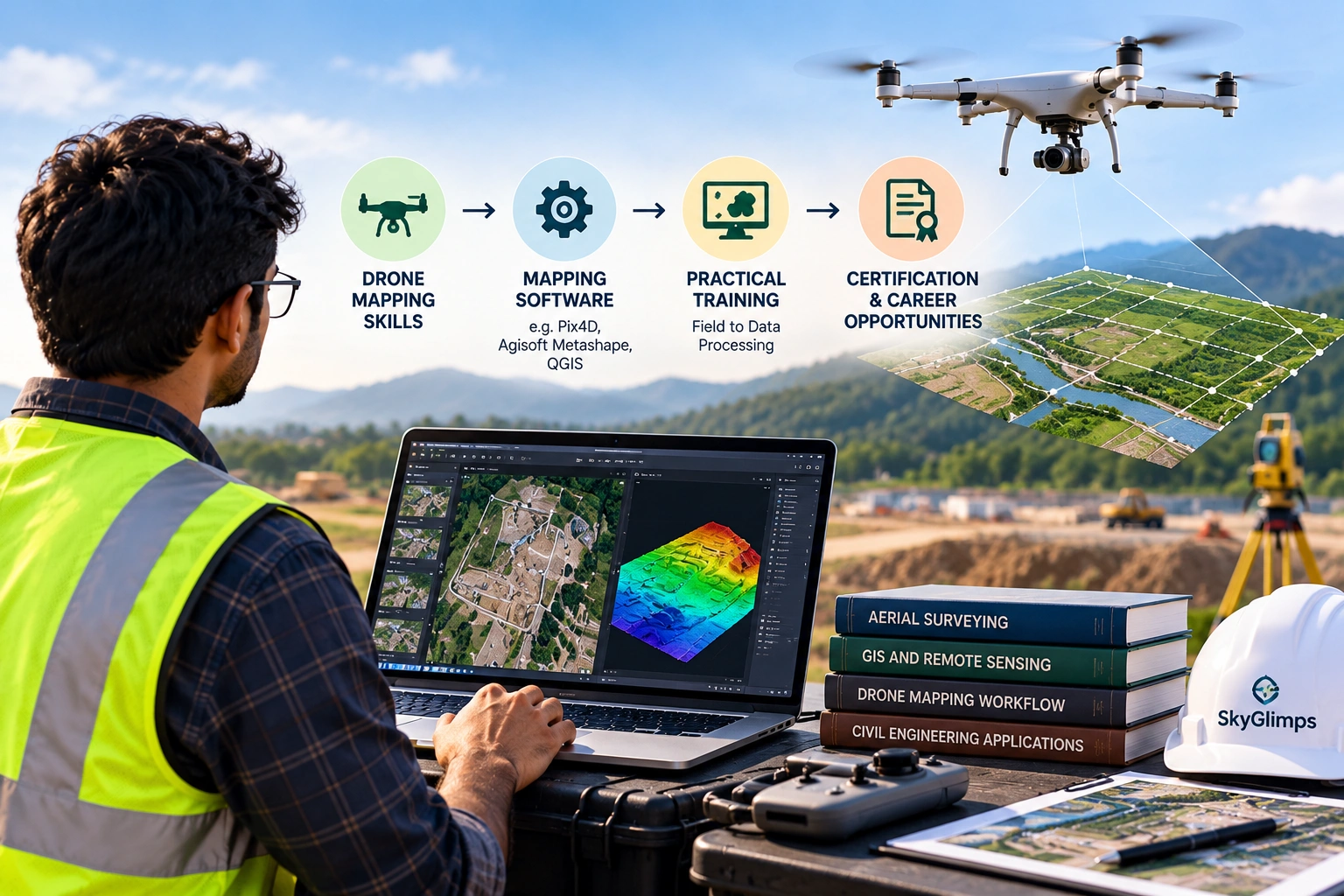
SkyGlimps also provides specialised training in areas such as Drone Mapping & Surveying, which can be useful if your freelance business is going to focus on aerial mapping rather than general drone flying.
For someone starting from zero, a possible learning path is:
DGCA Pilot Training → Choose a Niche → Learn the Required Software → Build Portfolio → Start Client Outreach → Complete Small Projects → Build Recurring Clients
You can explore the current SkyGlimps DGCA-Certified Drone Training programme for current course details.
A Practical Roadmap to Become a Freelance Drone Pilot in India
If you are starting from scratch, use this roadmap.
Step 1: Decide Your Niche
Choose:
Mapping / Construction / Inspection / Media / Real Estate / Agriculture
Step 2: Understand the Regulations
Learn the current:
- Drone rules
- Airspace requirements
- Pilot certification requirements
- Registration requirements
- Insurance requirements
Step 3: Get the Applicable Pilot Training
If your intended operation requires an RPC, complete the applicable training through an authorised RPTO.
Step 4: Choose the Right Drone
Purchase equipment based on the service you intend to sell.
Step 5: Complete Aircraft Compliance
Check:
- Type certification where applicable
- Registration
- UIN
- Insurance
Step 6: Learn Your Specialisation
For example:
Mapping → Photogrammetry + GIS
Media → Cinematography + Editing
Inspection → RGB + Thermal
Step 7: Build Your Portfolio
Create 3–5 strong demonstrations.
Step 8: Create Your Business Documents
Prepare:
- Company/profile document
- Quotation
- Contract
- Invoice
- Payment terms
- Portfolio
Step 9: Find Your First 50 Prospects
Create a list of companies that actually need your service.
Step 10: Start Outreach
Use:
- Phone
- Local networking
- Industry contacts
- Partner companies
Step 11: Take Small Projects
Focus on execution and client satisfaction.
Step 12: Convert Clients Into Recurring Work
Move from:
One project → Repeat project → Monthly/quarterly contract
This is where a freelance drone operation can become a more stable business.
What Should Your First Freelance Drone Portfolio Contain?
Keep it simple.
Page 1: About You
Explain:
- Who you are
- What you specialise in
- Where you operate
Page 2: Certifications
Show applicable:
- RPC
- Training
- Relevant credentials
Page 3: Services
For example:
Construction Progress
Aerial Mapping
Real Estate Photography
Page 4: Sample Projects
Show:
- Before
- Drone capture
- Final output
Page 5: Equipment
Mention relevant equipment without turning the page into a technical catalogue.
Page 6: Process
Explain:
Brief → Site Assessment → Flight → Processing → Delivery
Page 7: Contact
Make it easy for the client to reach you.
The portfolio should answer one question:
“Why should I trust this person with my project?”
What Should You Do Before Accepting Your First Paid Project?
Use this checklist.
- Confirm the client’s exact requirement.
- Confirm the location.
- Check applicable airspace.
- Confirm your pilot certification is applicable.
- Confirm the drone is compliant.
- Confirm registration/UIN requirements.
- Confirm insurance.
- Assess weather and site conditions.
- Confirm client/site permission.
- Define deliverables.
- Agree on price.
- Get the scope in writing.
- Confirm payment terms.
- Plan the flight.
- Conduct pre-flight checks.
- Capture the required data.
- Back up the files.
- Deliver according to the agreed scope.
- Ask for feedback.
- Request a testimonial where appropriate.
This checklist can prevent many beginner mistakes.
Frequently Asked Questions
Yes. You can build an independent drone service business around areas such as aerial photography, mapping, construction documentation, inspection and other applications, subject to applicable regulatory requirements.
The requirement depends on the drone category and operation. For professional operations where an RPC is applicable, the pilot should hold the appropriate Remote Pilot Certificate and fly within its applicable endorsement. DGCA’s current guidance tells RPC holders to maintain a valid certificate for the applicable drone category, sub-category and class.
The RPC relates to the pilot, while drone registration/UIN relates to the aircraft. They are separate compliance requirements.
The Drone Rules, 2021 establish UIN registration requirements for applicable drones, subject to exemptions. DGCA’s current guidance tells RPC holders to fly type-certified and registered drones with a UIN.
No. You should not assume that any consumer or recreational drone is suitable for professional operations. Check the applicable type-certification, registration and operational requirements before using the aircraft commercially.
Third-party insurance is required for applicable UAS operations, with the Drone Rules providing an exemption for nano UAS. DGCA’s current public guidance also instructs RPC holders to ensure valid third-party insurance.
It can be worth considering because your drone may be a major business asset. Check whether the policy covers commercial operations and the specific risks relevant to your work.
Start Small, Build Skills and Grow Your Drone Business
Becoming a freelance drone pilot in India is not simply a matter of purchasing a drone and posting your services online.
A professional freelance operation needs a foundation built around:
Pilot Certification → Compliant Drone → Insurance → Safety → Specialisation → Portfolio → Clients
Start by understanding the regulatory requirements that apply to your intended operation.
If an RPC is applicable, complete the appropriate training and certification through an authorised RPTO. Then make sure your aircraft meets the applicable requirements for type certification, registration and UIN. DGCA’s current guidance also emphasises airspace checks, pre-flight checks, safe distances, valid insurance and operation within the applicable RPC endorsement.
After the compliance side is established, focus on the business.
Do not try to sell yourself as simply:
“A drone pilot.”
Instead, become:
“A drone professional who solves a specific business problem.”
For example:
Construction → Progress Documentation
Surveying → Aerial Mapping
Infrastructure → Inspection Support
Real Estate → Aerial Property Content
Media → Commercial Drone Videography
Then build a portfolio around that service.
Start with smaller projects.
Work with local businesses.
Partner with survey firms and other drone companies.
Build relationships.
Deliver consistently.
Ask satisfied clients for testimonials and referrals.
Over time, the progression can become:
First Flight → First Paid Project → First Repeat Client → Multiple Clients → Recurring Contracts → Professional Drone Business
SkyGlimps currently offers DGCA-Certified Small Category Drone Pilot Training for people interested in professional drone operations and specifically lists entrepreneurs looking to launch drone service businesses among its target learners. Its programme combines regulatory knowledge, simulator training, practical flying, safety, maintenance and final flying assessment.
The most important thing to remember is that your drone is the tool, not the business.
The business is the problem you solve for your client.
Learn to fly safely. Learn to deliver professionally. Choose a niche. Build trust. Then grow your freelance drone career one project at a time.