
Solar farms contain thousands or even millions of photovoltaic modules spread across large areas. Inspecting every panel manually can be time-consuming, especially when the objective is to identify thermal anomalies that may not be visible to the human eye.
This is where solar farm drone thermal inspection can provide significant value.
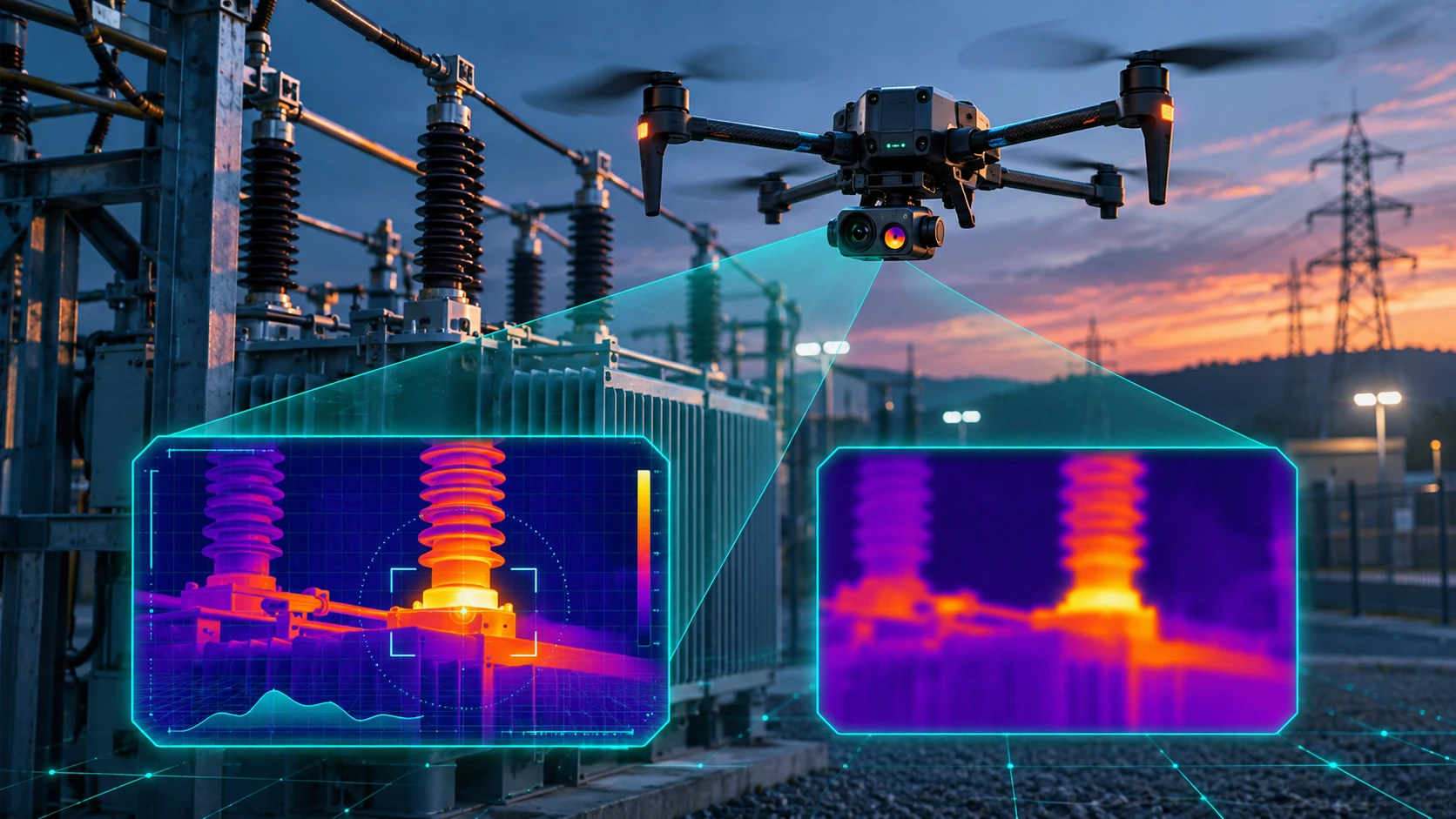
A drone equipped with an infrared thermal camera can capture thermal data across large PV arrays and help maintenance teams identify unusual temperature patterns, including potential hotspots, abnormal module behaviour and other areas requiring closer investigation.
When thermal imagery is combined with high-resolution RGB imagery, inspection teams can compare heat patterns with visible panel conditions such as soiling, vegetation, physical damage or shading.
However, thermal drone inspection is not simply a matter of flying over a solar farm and looking for bright spots.
The quality of the results depends on:
- Thermal camera capability
- Flight planning
- Irradiance
- Wind and weather
- Drone speed
- Image resolution
- Operating conditions
- Data processing
- Thermal interpretation
- Follow-up inspection
IEC TS 62446-3 provides guidance for outdoor infrared thermography of PV systems, including environmental conditions, imaging procedures, evaluation and reporting. It also recognises aerial drones as a method for large-area PV thermographic inspection.
What Is Solar Farm Drone Thermal Inspection?
Solar farm drone thermal inspection uses a drone-mounted infrared camera to capture temperature patterns across photovoltaic modules and associated equipment.
Unlike an RGB camera, which records visible light, a thermal camera detects infrared radiation and displays differences in apparent surface temperature.
A thermal inspection can help identify:
- Localised hotspots
- Abnormal module heating
- Bypass-diode-related thermal patterns
- String or module anomalies
- Possible PID-related patterns
- Uneven thermal behaviour
- Certain electrical connection anomalies
- Areas requiring further investigation
Thermal data can be collected over large solar arrays much faster than inspecting every module individually from the ground.
However, aerial thermography should be treated as a screening and localisation tool for large PV plants. IEC TS 62446-3 notes that drone-based simplified inspections can help identify obvious problems across large arrays, while detailed diagnosis may require more specialised inspection and qualified personnel.
Why Use Drones for Solar Panel Thermal Inspection?
Traditional solar inspections can require significant manpower and access to large numbers of modules.
A drone can cover a large area from the air while collecting thermal and visual information in a repeatable flight pattern.
Faster Coverage
Large solar farms can contain extensive rows of modules.
A drone can capture imagery across the array without requiring inspectors to physically walk between every row.
Safer Access
Drone inspection can reduce the need for personnel to access difficult, elevated or otherwise hazardous areas.
Thermal Detection
Some problems may not be obvious in conventional photographs but can produce detectable temperature differences.
Asset-Level Documentation
Thermal and RGB imagery can be associated with specific areas or modules, helping maintenance teams locate findings for follow-up.
Repeatable Monitoring
Periodic drone inspections can help operators compare thermal conditions over time and identify changes that may require investigation.
SkyGlimps’ Thermal & RGB Inspection service combines synchronised visual and thermal imagery, image processing and annotated reporting for applications including solar assets and energy infrastructure.
What Are Hotspots in Solar Panels?
A hotspot is an area of a PV module that becomes significantly warmer than surrounding areas.
A thermal camera can reveal these temperature differences as abnormal thermal patterns.
Hotspots can be associated with different conditions, including:
- Cell defects
- Cell damage
- Cracks
- Partial shading
- Electrical issues
- Bypass diode behaviour
- Interconnection problems
- Other module-level abnormalities
The exact cause cannot always be determined from a thermal image alone.
This is important because a thermal anomaly is a finding, not automatically a confirmed diagnosis.
The thermal pattern should be correlated with RGB imagery, operating conditions, previous inspection records and, where necessary, electrical or physical testing.
How Does Thermal Imaging Detect Solar Panel Hotspots?
A healthy PV module generally exhibits a relatively consistent thermal pattern under suitable inspection conditions.
When one part of the module behaves differently, it may produce a temperature difference that appears in the thermal image.
For example, a localised area of increased temperature may indicate a condition that requires further investigation.
The inspection workflow generally involves:
Thermal Capture → Anomaly Detection → Location → RGB Correlation → Technical Review → Maintenance Action
The objective is not simply to find the hottest image.
It is to identify meaningful thermal patterns and associate them with the correct module or asset.
IEC TS 62446-3 recommends evaluating factors including maximum temperatures, temperature differences, thermal profiles, wind, soiling, visual observations and irradiance or system load when interpreting thermal inspection results.
Can Drone Thermal Inspection Detect Soiling?
Yes, thermal and RGB drone inspections can help identify areas affected by soiling, but the two sensors provide different information.
Soiling can include:
- Dust
- Dirt
- Bird droppings
- Leaves
- Other surface contamination
Heavy or uneven soiling can affect the way modules heat and can create thermal patterns that need to be distinguished from actual equipment faults.
RGB imagery is particularly useful for visually confirming:
- Dust accumulation
- Bird droppings
- Vegetation
- Debris
- Surface contamination
Thermal imagery can then show whether the affected area is producing an unusual temperature pattern.
IEC TS 62446-3 recommends considering soiling during thermographic inspections and notes that strong soiling or partial shading should be addressed where appropriate. It also refers to IEC 61724-1 for quantification of soiling.
Therefore, a thermal drone inspection should not automatically classify every thermal variation caused by dirt as a panel fault.
What Is PID in Solar Panels?
PID stands for Potential-Induced Degradation.
It is a form of PV module degradation associated with electrical potential differences within the solar system and can affect module performance.
Thermal imaging can sometimes reveal patterns that are consistent with possible PID, particularly when multiple modules or sections show systematic abnormal thermal behaviour.
However, thermal imagery alone should not be treated as definitive proof of PID.
A suspected PID pattern should be reviewed alongside:
- Module performance
- String-level electrical information
- Historical inspection data
- Manufacturer information
- Visual imagery
- Appropriate electrical testing
Recent UAV thermography research has included PID among the thermal anomaly classes that can be screened using aerial infrared data, while also distinguishing between thermal signatures and confirmed diagnoses.
The practical role of drone thermography is therefore to identify and localise areas that deserve closer technical investigation.
How Can Thermal Drones Help Identify Possible PID?
Potential PID-related thermal patterns can appear across multiple modules rather than as a single isolated hotspot.
A drone inspection can help maintenance teams identify:
- Groups of thermally abnormal modules
- Repeated patterns across strings
- Sections with unusual heat distribution
- Areas that differ from surrounding modules
These findings can then be compared with the plant’s electrical and performance data.
A useful workflow is:
Thermal Anomaly → Module/Array Location → RGB Confirmation → String Data Review → Electrical Testing → Corrective Action
This reduces the risk of treating a thermal pattern as a confirmed failure without sufficient evidence.
What Other Solar Panel Problems Can Thermal Drones Detect?
A well-planned thermal inspection can help screen for several types of PV abnormalities.
Bypass Diode-Related Heating
Abnormal heating across a section of a module can indicate bypass-diode behaviour or another issue requiring investigation.
Cell-Level Anomalies
Localised heating can sometimes be associated with damaged or defective cells.
Module-Level Anomalies
A module that behaves differently from surrounding modules may appear as an abnormal thermal pattern.
Electrical Connection Issues
Thermal imaging can help identify unusual heating associated with electrical connections or other components under suitable operating conditions.
Shading
Trees, structures, vegetation or other obstructions can create uneven thermal behaviour.
Soiling
Dust, bird droppings and debris can affect module heating and should be correlated with visible imagery.
Thermal imaging is therefore most useful when the inspection team understands the different thermal patterns and their possible causes rather than simply searching for high temperatures.
Why Combine Thermal and RGB Inspection?
Thermal imagery tells you where something is behaving differently.
RGB imagery helps show what the affected asset actually looks like.
Using both can provide a more complete inspection record.
For example:
Thermal: Shows an abnormal hotspot.
RGB: Shows the same panel has visible soiling or physical damage.
Or:
Thermal: Shows several modules with abnormal heat patterns.
RGB: Confirms there is no obvious surface damage.
The maintenance team can then decide whether further electrical testing or physical inspection is required.
SkyGlimps uses simultaneous RGB and thermal capture and combines the datasets through image processing to support hotspot identification, defect observations and digital inspection reporting.
What Conditions Are Required for Solar Thermal Drone Inspection?
Environmental conditions can have a major effect on thermal inspection quality.
Important factors include:
- Solar irradiance
- Wind
- Cloud cover
- Module operating condition
- Soiling
- Camera resolution
- Flight altitude
- Drone speed
- Camera angle
IEC TS 62446-3 specifies minimum environmental conditions for PV thermography, including adequate irradiance and limits on wind and cloud conditions. The specification also notes that drone flight speed must be considered because excessive movement can cause thermal-image smearing.
This is why professional thermal inspection is not simply a matter of flying whenever convenient.
The flight should be planned around conditions that allow useful thermal contrast and image quality.
Why Does Drone Speed Matter During Thermal Inspection?
A thermal camera needs sufficient time to capture useful information.
If a drone moves too quickly, the thermal image can suffer from motion-related smearing, reducing the ability to distinguish small thermal anomalies.
IEC TS 62446-3 specifically notes that the camera’s detector response time should be considered when selecting the aircraft’s imaging speed.
This means flight planning must balance:
Coverage Speed + Camera Resolution + Thermal Detector Performance + Required Inspection Detail
Flying faster is not automatically better.
The goal is to capture usable data, not simply complete the solar farm as quickly as possible.
What Does a Solar Farm Thermal Inspection Report Include?
The final deliverable should convert thousands of images into information that a maintenance team can act on.
A professional report may include:
- Inspection date
- Solar farm location
- Flight information
- Thermal imagery
- RGB imagery
- Module or asset location
- Thermal anomaly identification
- Temperature information where appropriate
- Visual observations
- Hotspot classification
- Suspected issue category
- Priority or severity
- Recommended follow-up
- Inspection limitations
For larger solar farms, findings can also be organised according to array, block, string or module reference.
This allows maintenance teams to move from:
“There is a thermal anomaly somewhere in the plant.”
to:
“This specific module or area requires inspection.”
Can Thermal Drone Inspection Replace Manual Solar Inspection?
Not completely.
Drone thermography is extremely useful for large-area screening and anomaly localisation, but some findings require closer technical investigation.
A drone can identify a thermal anomaly, but the final diagnosis may require:
- Physical inspection
- Electrical measurements
- String testing
- Manufacturer analysis
- Ground-based thermography
- Maintenance records
- Engineering review
IEC TS 62446-3 distinguishes between simplified thermographic inspection and detailed inspection, with detailed analysis requiring appropriately qualified personnel.
The most effective approach is therefore:
Drone Screening → Finding Localisation → Technical Verification → Corrective Maintenance
How Often Should Solar Farms Be Inspected by Drone?
There is no single inspection frequency that applies to every solar farm.
The appropriate schedule depends on:
- Plant size
- Age
- Environmental conditions
- Performance history
- Maintenance strategy
- Warranty requirements
- Previous inspection findings
- Asset criticality
A plant with recurring thermal anomalies may require more frequent monitoring than a stable site with a strong maintenance record.
Periodic drone inspections can also create a historical dataset that allows operators to compare changes over time.
This can help maintenance teams identify whether an anomaly is:
- New
- Persistent
- Increasing
- Resolved
- Recurring
The inspection programme should therefore be based on the plant’s operational and maintenance requirements rather than a one-size-fits-all schedule.
What Should Solar Plant Operators Check Before Booking a Thermal Inspection?
Before arranging a solar farm drone thermal inspection, define the inspection objective clearly.
Define the Asset
Specify:
- Solar farm location
- Plant capacity
- Module type
- Array layout
- Number of blocks or sections
Define the Inspection Objective
Clarify whether the goal is:
- Hotspot screening
- Preventive maintenance
- Soiling review
- Suspected PID investigation
- Performance investigation
- Post-maintenance verification
- Routine asset monitoring
Define the Deliverables
Decide whether you require:
- Thermal images
- RGB images
- Annotated findings
- Module-level identification
- Temperature analysis
- Inspection report
- GIS/location data
- Before-and-after comparison
Share Available Plant Data
Where possible, provide relevant:
- String information
- Module layout
- Previous inspection reports
- Performance data
- Maintenance records
- Known problem areas
This information can help the inspection team correlate aerial findings with plant conditions.
Why Choose SkyGlimps for Solar Thermal Drone Inspection?
SkyGlimps Technologies provides Thermal & RGB Drone Inspection Services for solar assets, energy infrastructure, industrial facilities and other difficult-to-access environments.
Its inspection workflow combines:
Drone Flight → Thermal & RGB Capture → Image Processing → Anomaly Identification → Reporting
The company states that its thermal and RGB inspection service can help identify failing solar panels, electrical faults, hotspots and other maintenance risks while reducing the need for manual access to large or difficult areas.
SkyGlimps is based in Kolkata and supports drone inspection and aerial data projects across India, including energy, infrastructure and industrial applications.
For solar operators, the objective is not simply to collect thermal images.
It is to turn aerial thermal data into actionable information for maintenance and asset management.
Explore SkyGlimps Thermal & RGB Drone Inspection Services
Frequently Asked Questions
Solar farm drone thermal inspection uses drones equipped with infrared cameras to capture temperature patterns across photovoltaic modules and related equipment. It can help identify hotspots, abnormal heating and areas requiring further investigation.
Yes. Thermal drones can identify localised temperature differences that may indicate hotspots or other module-level abnormalities. The thermal finding should be correlated with visual and technical information before confirming the cause.
Thermal inspection can identify patterns that may be consistent with potential-induced degradation (PID), but thermal imagery alone does not necessarily confirm PID. Further electrical or technical analysis may be required.
Thermal and RGB imagery can help identify areas affected by soiling and distinguish visible contamination from other thermal patterns. Quantifying soiling may require additional measurements and appropriate testing procedures.
Thermal imagery identifies abnormal heat patterns, while RGB imagery provides visible context such as dirt, damage, vegetation, cracks or other physical conditions. Combining both datasets can make findings easier to locate and interpret.
Make Solar Farm Inspection More Data-Driven
Solar farms require regular monitoring because a small number of abnormal modules can be difficult to identify across a large PV installation.
A solar farm drone thermal inspection provides a practical way to screen large areas for thermal anomalies and direct maintenance teams towards locations that need closer investigation.
The most useful workflow is not simply:
Fly → Capture Thermal Images → Find Hotspots
It is:
Plan → Fly Under Suitable Conditions → Capture Thermal + RGB Data → Identify Anomalies → Correlate Findings → Verify → Report → Maintain
Hotspots, soiling and possible PID can produce different thermal patterns, and understanding those patterns is essential for meaningful inspection.
Thermal imaging can help identify where something may be wrong.
RGB imagery can help show what is physically present.
Technical testing and engineering review can determine what the problem actually is.
For solar plant operators looking to improve preventive maintenance, reduce manual inspection effort and identify potential problem areas across large PV assets, drone-based thermal and RGB inspection can become an important part of the asset-monitoring workflow.
SkyGlimps provides thermal and RGB drone inspection services for solar assets and energy infrastructure, combining aerial data capture with image processing and actionable inspection reporting.
The goal is not just to find heat. It is to find the right problems early enough for the maintenance team to act.