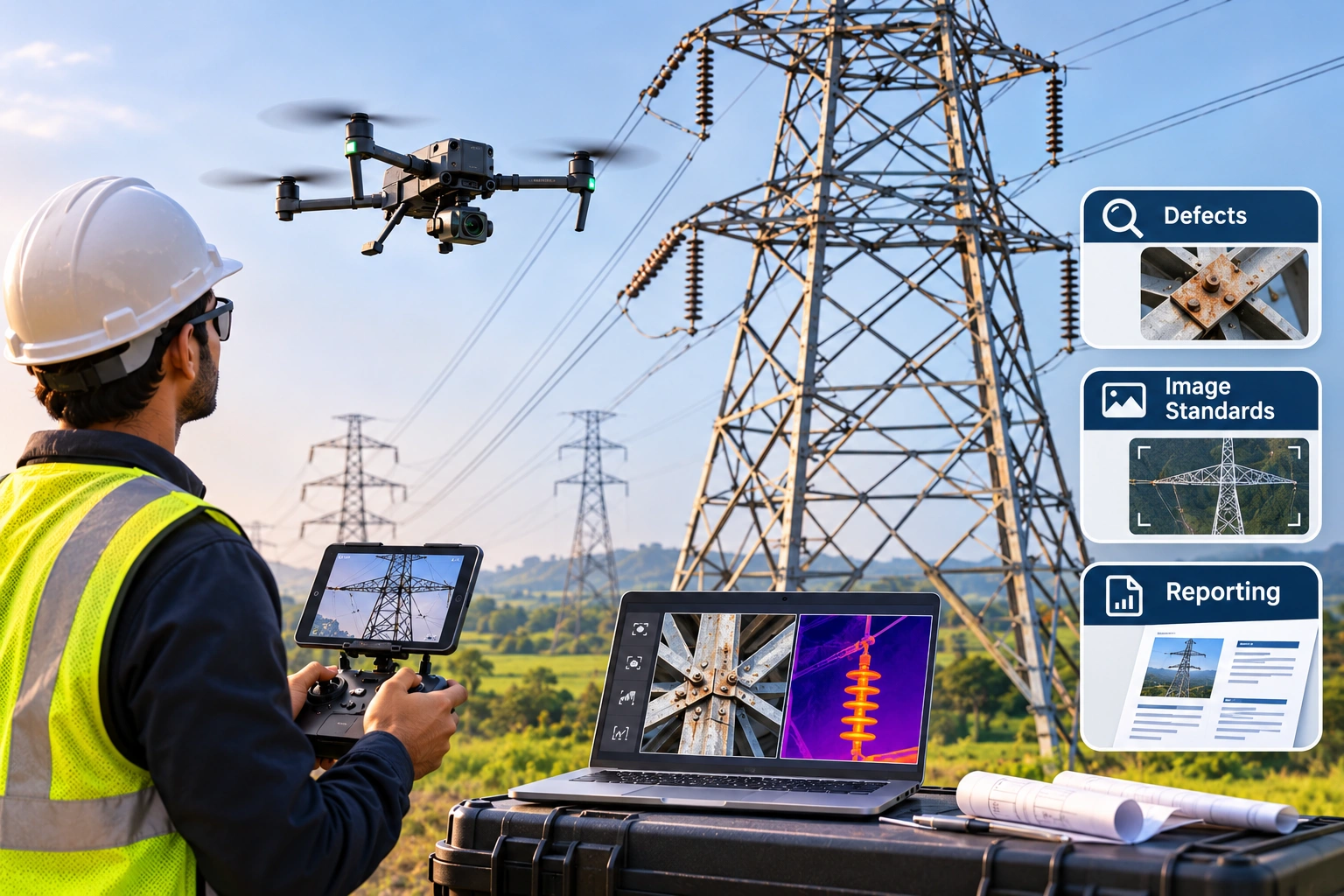
EHV transmission towers are critical components of the electricity transmission network. A single damaged tower member, loose connection, defective insulator or conductor problem can create operational and safety risks.
Traditionally, transmission-line inspection has relied heavily on ground patrols and manual observation. Drone technology now provides utilities and inspection teams with another way to capture detailed visual and thermal information from towers and associated line components.
A transmission tower inspection drone can capture high-resolution imagery from angles that may be difficult or time-consuming to obtain from the ground.
Professional drone inspection can help document:
- Tower members
- Bolts and nuts
- Insulators
- Conductors
- Earth wires
- Jumpers
- Hardware fittings
- Cross-arms
- Foundations
- Earthing components
- Anti-climbing devices
- Danger and phase plates
- Vegetation and right-of-way conditions
POWERGRID’s published transmission-line inspection checklist includes defects such as damaged or missing tower members, loose or missing nuts and bolts, corrosion, damaged insulators, pollution deposits, conductor strand damage and loose jumpers.
Drone inspection does not replace engineering judgement or every form of detailed inspection. Instead, it can provide a structured way to capture, document and prioritise visible conditions across large transmission networks.
Why Use a Drone for EHV Transmission Tower Inspection?
Transmission towers can be tall, difficult to access and distributed across long corridors.
Inspecting them manually can involve:
- Large field teams
- Difficult terrain
- Climbing requirements
- Traffic and access challenges
- Long travel distances
- Significant inspection time
A drone can capture imagery from multiple viewpoints while keeping personnel on the ground.
POWERGRID has already incorporated aerial patrolling using drones equipped with high-resolution cameras into its transmission-line maintenance practices. Its technology-development programme also describes work involving specialised thermal and video sensors and AI/ML-based analytics for transmission-line inspection.
Recent POWERGRID procurement activity also includes drone patrolling of EHV transmission-line towers in live-line charged conditions, demonstrating the growing operational use of drone-based inspection in transmission infrastructure.
The value of the drone is therefore not simply that it flies.
It is that it can create a repeatable visual record of infrastructure condition.
What Defects Can a Transmission Tower Inspection Drone Identify?
A professional visual inspection should cover the complete asset rather than focusing only on the tower body.
Tower Structure
Drone imagery can help identify:
- Missing members
- Bent members
- Damaged members
- Cracks or visible structural damage
- Corrosion
- Damaged protective coating
- Loose or missing bolts and nuts
- Missing step bolts
These findings can be particularly useful when high-resolution imagery allows inspectors to zoom into individual structural components.
Cross-Arms and Tower Connections
Cross-arms and connection points can be inspected for:
- Visible deformation
- Corrosion
- Loose hardware
- Missing hardware
- Damage
- Foreign objects
The inspection team should capture sufficient detail to distinguish the component from surrounding tower members.
Insulators
Insulator strings are another important inspection area.
Drone imagery can help document:
- Broken discs
- Damaged insulators
- Flashover or burning marks
- Pollution deposits
- Unusual string deflection
- Damaged fittings
POWERGRID’s inspection checklist specifically includes surface pollution, unusual deflection, flashover or burning marks, fitting damage and disc damage among transmission-line inspection items.
Conductors and Earth Wires
The inspection can also examine:
- Cut or open conductor strands
- Loose jumpers
- Damaged hardware
- Hanging earth wires
- Dislocated components
- Other visible conductor-related abnormalities
These components require careful image capture because thin wires can be difficult to assess if the image is too distant or affected by motion blur.
Foundation and Tower Base
A tower inspection should not automatically stop at the upper structure.
Where the site and flight plan allow, imagery can document:
- Foundation condition
- Visible cracks
- Soil erosion
- Settlement
- Damage to retaining structures
- Vegetation around the tower base
- Exposed or damaged components
POWERGRID’s published checklist includes foundation damage, uneven settlement, soil erosion and earth-cutting conditions around transmission towers.
Can Drones Detect Thermal Defects on Transmission Towers?
Yes, when an appropriate thermal sensor is used.
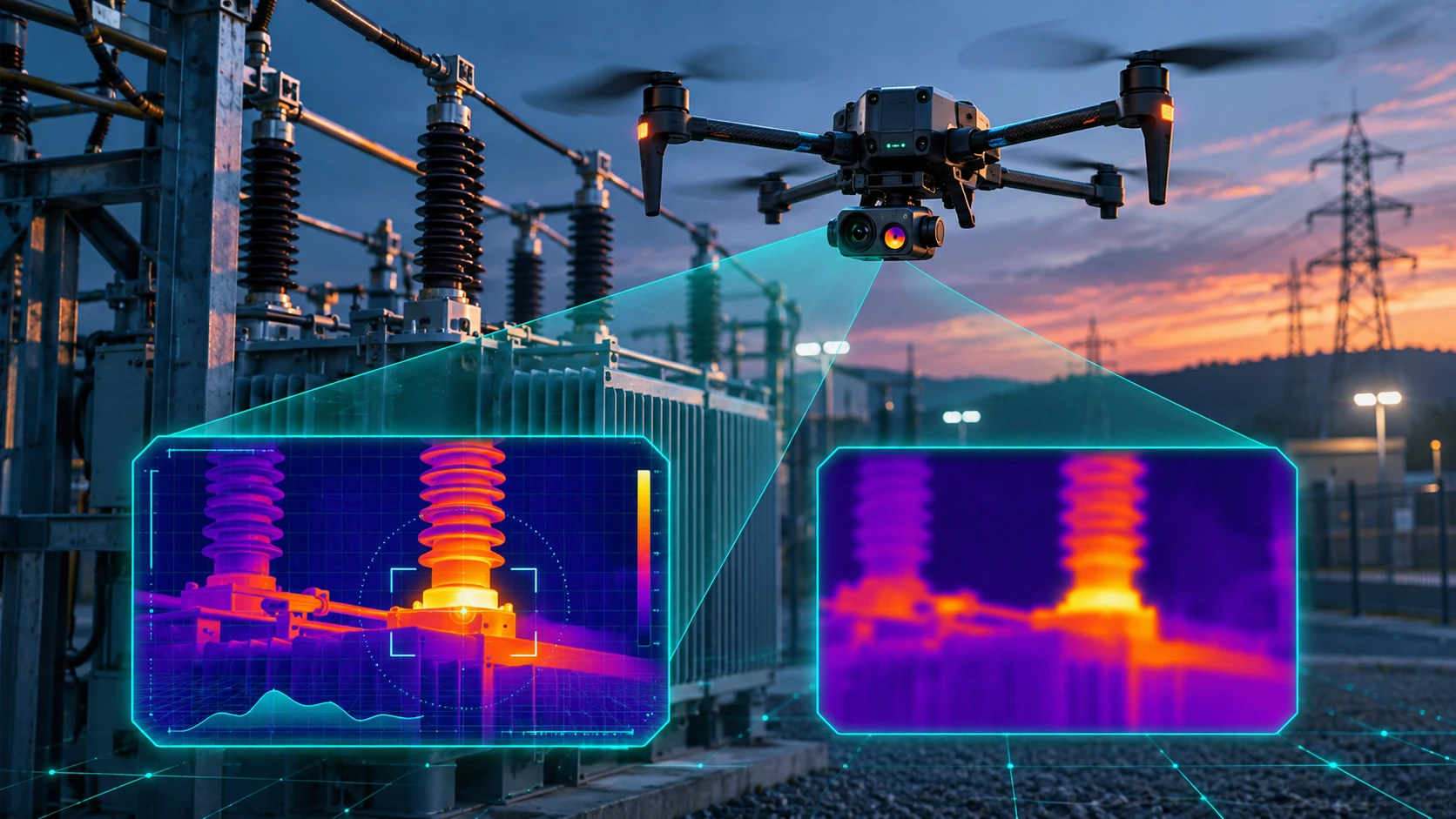
Thermal imaging can add another layer of information to a visual inspection.
A thermal drone inspection may help identify unusual heat patterns associated with components such as:
- Connectors
- Clamps
- Jumpers
- Electrical fittings
- Other heat-generating electrical components
POWERGRID’s aerial-patrolling material identifies thermovision as a method for detecting hotspots during transmission-line inspection.
However, thermal inspection should not be treated as automatic fault diagnosis.
Temperature differences can be influenced by:
- Electrical load
- Solar heating
- Wind
- Viewing angle
- Material properties
- Environmental conditions
- Sensor characteristics
A thermal anomaly should therefore be documented and technically reviewed rather than automatically labelled as a confirmed failure.
What Makes a Good Transmission Tower Inspection Image?
High-resolution imagery alone does not guarantee a useful inspection.
A professional image should make it possible to answer:
What component am I looking at?
Where is it located?
What condition does it appear to be in?
Can the finding be verified later?
A useful inspection image should ideally have:
- Adequate resolution
- Good focus
- Minimal motion blur
- Suitable exposure
- Clear component visibility
- Correct perspective
- Sufficient lighting
- Asset identification
- Location or tower reference
Overview Images
Capture wider images showing:
- Complete tower
- Tower number
- Line direction
- Surrounding environment
- Major components
These provide context for the detailed images.
Component-Level Images
Closer images should show:
- Bolts
- Tower members
- Insulators
- Connectors
- Jumpers
- Conductors
- Plates
- Other specific defects
A good inspection workflow generally requires both context and detail.
Is There a Universal Image Standard for Transmission Tower Drone Inspection?
There is not one universal image-resolution or framing requirement that applies to every transmission-line drone inspection project.
Image requirements should be defined according to:
- Asset type
- Voltage class
- Inspection objective
- Camera capability
- Defect size
- Flight distance
- Client specifications
- Reporting requirements
- Regulatory and safety conditions
Therefore, saying that every transmission inspection must use one fixed resolution would be misleading.
Instead, the practical objective should be fit-for-purpose imagery.
For example, a wide tower image may be sufficient to document the overall structure, while a much closer, sharper image may be required to document a damaged bolt or insulator component.
The image specification should therefore be agreed before fieldwork begins.
What Image Capture Standards Should an Inspection Team Define?
Before the inspection, establish a consistent image-capture protocol.
Coverage Standard
Define which parts of each tower must be photographed.
For example:
- Tower body
- Cross-arms
- Insulators
- Conductors
- Earth wires
- Hardware
- Tower base
- Foundation
- Identification plates
Image Quality Standard
Define minimum expectations for:
- Focus
- Sharpness
- Exposure
- Motion blur
- Visibility
- Image resolution
Identification Standard
Each finding should be traceable to:
- Tower number
- Line section
- Component
- Direction or side
- Image reference
Thermal Standard
If thermal imaging is included, define:
- Thermal camera requirements
- Capture conditions
- Temperature information
- RGB correlation
- Anomaly classification
File and Data Standard
The project should also establish:
- File naming
- Folder structure
- Metadata
- Image format
- Backup procedure
- Reporting format
This makes the final inspection data easier to use and compare.
Why Are RGB Images Important in Transmission Tower Inspection?
RGB imagery provides the visible context that thermal imagery cannot.
A thermal image may show an abnormal heat pattern, but an RGB image can show whether the affected component is:
- A clamp
- Connector
- Jumper
- Insulator
- Conductor
- Hardware fitting
Combining both datasets can make inspection findings much easier to understand.
SkyGlimps’ current drone thermal inspection workflow for power lines combines thermal and RGB cameras, with RGB imagery used to identify the physical component associated with a thermal anomaly and support reporting.
A useful inspection record can therefore contain:
RGB Image + Thermal Image + Tower Reference + Component + Finding + Recommended Follow-Up
How Should Transmission Tower Drone Inspection Be Planned?
Professional inspection begins before the drone reaches the site.
Step 1: Define the Inspection Scope
Confirm:
- Transmission line
- Tower numbers
- Voltage class
- Inspection section
- Known problem areas
- Required deliverables
Step 2: Review Previous Information
Where available, review:
- Previous inspection reports
- Maintenance records
- Known defects
- Fault history
- Tower drawings
- Asset databases
Step 3: Plan the Flight
Consider:
- Tower height
- Camera capability
- Flight path
- Required image angles
- Weather
- Terrain
- Obstacles
- Battery requirements
- Communication
- Emergency procedures
Step 4: Define the Image Protocol
Determine what images need to be captured for every tower and what additional images are required when a defect is identified.
Step 5: Conduct the Inspection
Capture consistent imagery across the entire inspection section.
Step 6: Review and Classify Findings
Each finding should be linked to the correct tower and component.
Step 7: Prepare the Report
The final report should convert raw imagery into information that maintenance teams can act on.
What Should a Transmission Tower Drone Inspection Report Include?
A professional report should be more than a folder containing hundreds of photographs.
A useful report can include:
| Report Element | Purpose |
|---|---|
| Inspection summary | Provides an overall project view |
| Tower reference | Identifies the asset |
| Component | Identifies the affected part |
| RGB image | Shows visible condition |
| Thermal image | Shows heat-related anomalies |
| Defect description | Explains the finding |
| Location reference | Helps field teams locate it |
| Severity/priority | Helps organise maintenance |
| Inspection conditions | Provides technical context |
| Recommended follow-up | Supports maintenance decisions |
| Supporting images | Provides additional evidence |
SkyGlimps’ inspection-deliverable guidance similarly emphasises asset references, RGB and thermal imagery, location-tagged findings, defect notes, hotspot registers, severity classification and structured reports.
How Should Transmission Tower Defects Be Classified?
A consistent classification system can make large inspection projects easier to manage.
For example, findings can be grouped as:
Critical
Conditions that may require immediate technical review or urgent intervention.
High Priority
Defects that could affect asset reliability or require timely maintenance.
Medium Priority
Conditions that should be monitored or addressed through planned maintenance.
Low Priority
Minor visible issues that can be documented for future maintenance.
The exact classification should be agreed with the asset owner or engineering team.
A drone inspection team should avoid making unsupported engineering conclusions simply from an image.
The report should clearly distinguish between:
Observed condition
and
Engineering diagnosis
For example:
“Visible corrosion observed on tower member.”
is more appropriate than automatically stating:
“Tower member is structurally unsafe.”
The second statement may require engineering assessment beyond visual drone inspection.
How Does Drone Inspection Improve Transmission-Line Maintenance?
The biggest advantage is the ability to convert large amounts of infrastructure imagery into structured inspection information.
Instead of relying only on field notes, utilities can build a digital record containing:
- Tower references
- Images
- Defect observations
- Thermal findings
- Locations
- Historical comparisons
- Maintenance priorities
POWERGRID describes its transmission asset-management approach as supporting lifecycle management, risk management and proactive maintenance, while also identifying drones and image processing as technologies for transmission-line monitoring and health assessment.
This makes drone inspection particularly useful when combined with an existing asset-management system.
What Safety Considerations Apply to EHV Drone Inspection?
EHV transmission-line inspection requires a much higher level of operational discipline than recreational drone flying.
The inspection plan should account for:
- Electrical infrastructure
- Required clearances
- Line condition
- Weather
- Wind
- Terrain
- Nearby people
- Other aircraft
- Communication
- Emergency procedures
- Applicable drone regulations
- Client safety procedures
POWERGRID states that EHV transmission installations are subject to safety requirements and that statutory inspections are carried out by the Central Electricity Authority. It also highlights the importance of maintaining electrical clearances and other safety measures around transmission lines.
Drone operators should therefore work under an approved operational plan and follow the requirements specified by the asset owner and applicable authorities.
The fact that a drone can physically reach a tower does not mean that the flight is automatically safe or authorised.
What Skills Are Needed for Professional Transmission Tower Drone Inspection?
Transmission inspection requires more than basic drone-flying ability.
A professional inspection operator may need knowledge of:
- Drone operation
- Flight planning
- Electrical infrastructure
- Tower components
- Inspection photography
- Thermal imaging
- Asset identification
- Data management
- Reporting
- Risk assessment
- Applicable regulations
This is why enterprise drone training can be valuable for professionals entering power and infrastructure inspection.
A pilot who understands the difference between a tower member, insulator string, jumper, conductor and hardware fitting can capture much more useful inspection data than someone who simply flies around the structure.
Where Can You Learn Professional Drone Inspection Skills in India?
SkyGlimps provides professional drone services involving thermal and RGB inspection, infrastructure inspection and aerial data capture.
Its thermal inspection workflow covers power-line and electrical infrastructure applications, including conductors, clamps, connectors, jumpers and insulator strings, with RGB and thermal imagery used together for inspection and reporting.
For professionals looking to build broader drone skills, SkyGlimps also offers DGCA-certified drone pilot training and specialised programmes covering mapping, surveying and other professional applications.
Explore SkyGlimps Drone Training & Inspection Services
Frequently Asked Questions
A transmission tower inspection drone is a drone equipped with suitable cameras or sensors to capture visual and, where required, thermal information from transmission towers, conductors, insulators and associated infrastructure.
Drones can help document visible defects such as damaged or missing tower members, corrosion, loose or missing bolts, damaged insulators, pollution deposits, conductor issues, loose jumpers and other visible abnormalities. POWERGRID’s inspection checklist includes many of these defect categories.
Drone inspection can be performed around live transmission infrastructure under appropriately planned and authorised operations. The specific flight method, clearances, equipment and safety procedures depend on the asset, operating environment, applicable regulations and the utility’s requirements.
RGB imagery provides visible information about the physical condition and identity of a component, while thermal imagery can reveal abnormal heat patterns. Combining both can make findings easier to locate, interpret and report.
A professional report should normally connect each finding to the relevant tower and component and provide supporting imagery, defect descriptions, location references, inspection conditions and maintenance priority or recommended follow-up where appropriate.
Turning Drone Images Into Useful Transmission-Line Intelligence
A successful EHV transmission tower inspection is not simply about collecting thousands of high-resolution photographs.
The real value comes from creating a structured inspection record that connects every important finding to the correct asset.
The workflow can be summarised as:
Plan → Inspect → Capture → Identify → Verify → Classify → Report → Maintain
A transmission tower inspection drone can help teams document tower members, hardware, insulators, conductors, foundations and other components while reducing the need for routine manual visual access to difficult locations.
Adding thermal imaging can provide another layer of information for identifying abnormal heat patterns, while structured RGB imagery provides the visual context needed to understand the physical asset.
The most important part, however, is the reporting process.
A good inspection report should allow a maintenance team to quickly answer:
Where is the defect?
What component is affected?
What evidence supports the finding?
How serious does it appear to be?
What should be checked next?
That is what turns drone photography into a professional transmission-line inspection workflow.
As utilities increasingly adopt drones, thermal sensors, image processing and data-driven asset management, the value of drone inspection will depend not only on how well the aircraft flies, but on how accurately the captured data can support maintenance and engineering decisions.