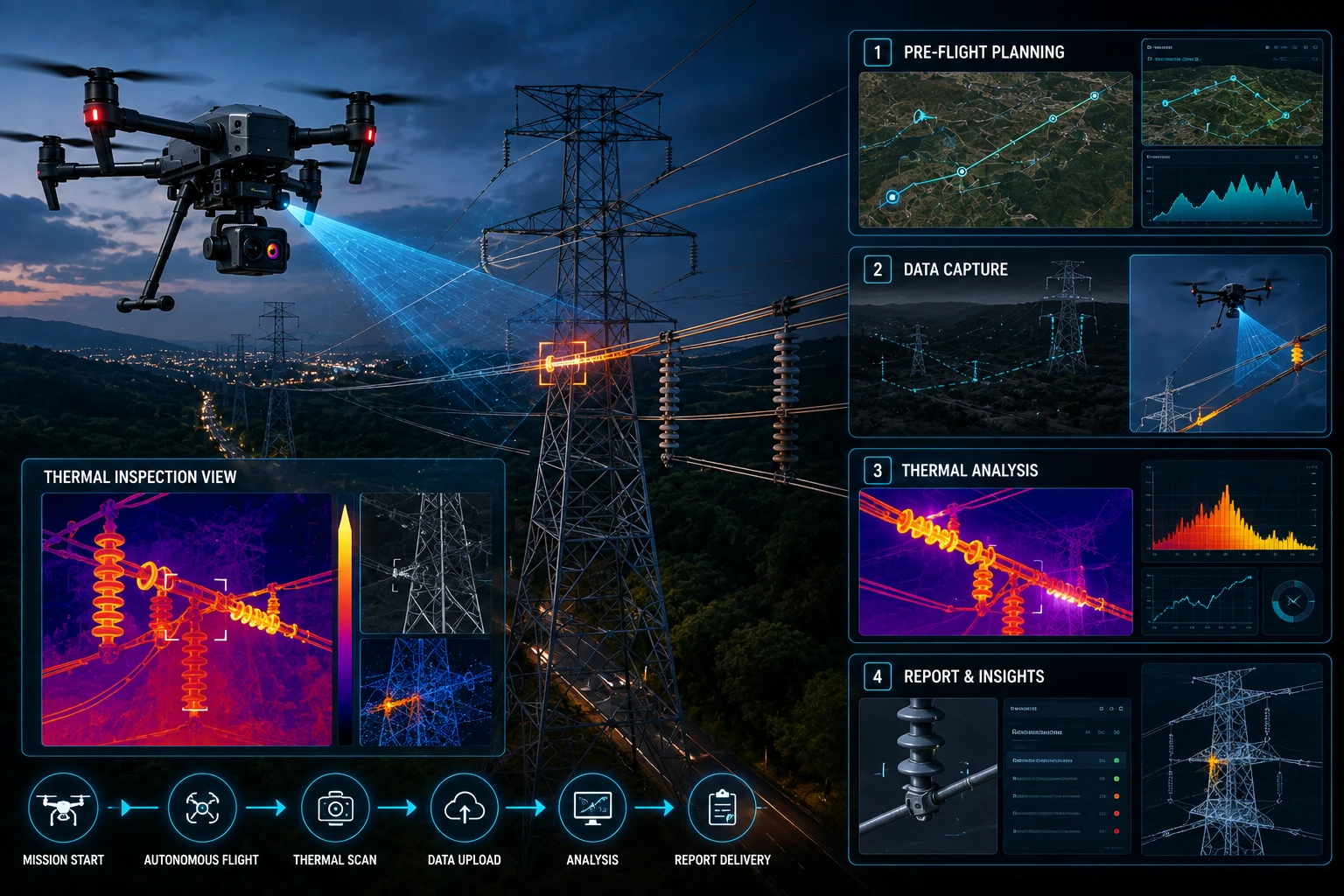
The drone thermal inspection process helps power utilities, infrastructure companies, industrial operators, and maintenance teams inspect power lines with better speed, safety, and visual evidence. By using drone-mounted thermal and RGB cameras, inspection teams can identify abnormal heat patterns, visible defects, damaged components, loose connections, and maintenance-priority areas across transmission and distribution assets.
Power lines are critical infrastructure. A small hotspot on a jumper, connector, clamp, insulator assembly, or conductor joint can indicate a problem that needs closer review. Drone thermal inspection helps detect such issues from a safer distance before they turn into outages, asset failures, or expensive emergency repairs.
This guide explains what happens during a professional drone thermal inspection of power lines, from planning and site safety to thermal capture, reporting, and maintenance follow-up.
What is a drone thermal inspection process?
A drone thermal inspection process is a structured workflow for inspecting power lines using thermal and RGB cameras mounted on a drone. The thermal camera captures heat patterns, while the RGB camera captures normal visual images for component identification and reporting.
Thermal inspection is useful because many electrical issues produce heat before they become visible to the naked eye. A loose connection, corroded fitting, poor contact point, overloaded component, or damaged connector may show a higher temperature than surrounding parts.
A professional drone thermal inspection can cover:
- Transmission lines
- Distribution lines
- Electrical towers
- Conductors
- Clamps and connectors
- Jumpers
- Insulator strings
- Substation-adjacent line assets
- Power corridors
- Industrial electrical infrastructure
Skyglimps Technologies LLP provides Thermal & RGB Inspections for organisations that need aerial inspection support for power, utility, infrastructure, and industrial assets.
Why is thermal inspection used for power lines?
Thermal inspection is used for power lines because abnormal electrical resistance, poor contact, or component stress can create unusual heat patterns. These patterns can help maintenance teams identify areas that need further testing or repair.
A power line component may look normal in a standard visual image but still show abnormal temperature in a thermal image. This is why thermal inspection is valuable for preventive maintenance.
Drone thermal inspection can help identify:
| Possible issue | Thermal indication | Maintenance relevance |
|---|---|---|
| Loose connector | Localised hotspot | Needs closer verification |
| Corroded clamp | Abnormal heat pattern | May indicate resistance |
| Damaged jumper | Uneven thermal reading | Requires inspection |
| Poor contact point | Higher temperature than nearby parts | Can affect reliability |
| Overloaded component | Wider heating pattern | Needs engineering review |
| Insulator concern | Thermal or visible abnormality | Requires technical assessment |
| Fault-prone connection | Repeated hotspot | May need priority action |
Thermal findings should not be treated as final diagnosis by themselves. They are inspection evidence. Engineers may still need load information, electrical testing, maintenance history, and physical verification before deciding the repair action.
Step 1: How is the inspection scope defined?
The first step in the drone thermal inspection process is defining the inspection scope clearly. The asset owner and drone inspection team must agree on what line, tower, section, or component group needs to be inspected.
A clear scope prevents missed assets and poor reporting. Before the field team visits the site, the project team should confirm:
- Line section to be inspected
- Tower numbers or asset IDs
- Voltage class, where relevant
- Transmission or distribution asset type
- Known problem areas
- Fault history, if available
- Previous maintenance notes
- Required deliverables
- Reporting format
- Inspection urgency
- Site access conditions
For example, a utility may need a complete line-section screening before monsoon. An industrial operator may need inspection after repeated tripping. A contractor may need visual and thermal documentation before maintenance work.
Each case requires a slightly different inspection plan.
Step 2: What safety and compliance checks happen before flying?
Before flying, the team checks site safety, airspace conditions, public movement, obstacles, power-line hazards, take-off zones, and emergency procedures. Power line inspection is a high-risk drone operation and must be planned carefully.
The field team should review:
- Airspace zone and permission requirements
- Site owner approval
- Safe take-off and landing area
- Public movement near the flight zone
- Nearby roads, buildings, trees, and water bodies
- Tower height and line alignment
- Wind direction and weather
- Emergency landing options
- Battery plan
- Communication between pilot and observer
- Safe distance from live electrical assets
Drone inspection near power lines is not casual flying. The drone must maintain safe separation from conductors, towers, and utility hardware. The pilot must also avoid flying over people or creating risk for traffic, workers, or nearby property.
For power-sector projects, Skyglimps also supports drone workflows across power, energy, and utilities where aerial inspection and documentation can improve asset visibility.
Step 3: How is the flight plan prepared?
The flight plan defines how the drone will capture each tower, conductor section, jumper, clamp, and line component from safe and useful angles. A good flight plan improves both safety and data quality.
The inspection team decides:
- Flight path
- Inspection altitude
- Stand-off distance
- Thermal capture angle
- RGB capture angle
- Direction of approach
- Sequence of towers or spans
- Battery change points
- Data capture checklist
- Ground team movement
- Communication protocol
Thermal inspection needs stable and focused capture. If the drone is too far, the component may not be visible in enough detail. If the angle is poor, the hotspot may be difficult to interpret. If the drone is too close, safety risk increases.
The goal is to capture useful thermal evidence without compromising safety.
Step 4: What happens during thermal image capture?
During thermal image capture, the drone records infrared images of key electrical components to detect abnormal heat patterns. The operator captures both wider views and closer component-level views where safe and necessary.
Thermal image quality depends on several factors:
- Camera resolution
- Focus
- Distance from component
- Viewing angle
- Wind
- Ambient temperature
- Sun exposure
- Electrical load condition
- Surface material
- Emissivity settings
- Drone stability
The inspection team generally focuses on components where electrical resistance or stress may appear, such as connectors, clamps, jumpers, conductor joints, and terminations.
The thermal camera shows heat differences. It does not automatically explain the root cause. That interpretation comes during analysis, where the thermal pattern is compared with RGB images, field notes, asset references, and maintenance knowledge.
Step 5: Why is RGB imagery captured with thermal data?
RGB imagery is captured with thermal data because maintenance teams need visual context to identify the exact component linked to a thermal anomaly. Thermal images show heat patterns; RGB images show the physical asset.
Without RGB support, a hotspot may be difficult to locate later. A maintenance engineer needs to know whether the heat pattern is on a jumper, clamp, insulator assembly, conductor joint, or another component.
RGB images help document:
- Tower number or asset location
- Component type
- Physical damage
- Corrosion
- Broken or missing hardware
- Insulator condition
- Vegetation encroachment
- Bird nests or foreign objects
- Access limitations
- Surrounding site conditions
A strong inspection report usually presents thermal and RGB images together. This makes the finding easier to understand and easier to act on.
Step 6: How are hotspots and anomalies reviewed?
After data capture, the inspection team reviews thermal images to identify hotspots, unusual temperature differences, and abnormal patterns that require maintenance attention. Each finding should be matched with the correct tower, span, component, and RGB image.
The review process may include:
- Checking thermal image quality.
- Removing unclear or unusable frames.
- Identifying visible temperature anomalies.
- Matching each anomaly with RGB context.
- Linking the finding to a tower or component.
- Comparing similar components where possible.
- Reviewing inspection conditions.
- Classifying maintenance priority.
- Preparing recommended follow-up actions.
Not every warm area is a defect. Some temperature differences may result from sun reflection, material behaviour, viewing angle, load variation, or environmental conditions. This is why interpretation should be cautious and technically grounded.
A reliable inspection partner should clearly explain what is a suspected anomaly and what needs ground verification.
Step 7: What does the final inspection report include?
The final inspection report should include thermal images, RGB images, tower or asset references, hotspot descriptions, location details, inspection conditions, and maintenance-priority observations. The report should help the maintenance team decide what to do next.
A professional report may include:
| Report element | Purpose |
| Inspection summary | Gives management a quick overview |
| Tower or asset reference | Helps locate the finding |
| Thermal image | Shows the heat anomaly |
| RGB image | Shows visual context |
| Component description | Identifies the affected part |
| Location reference | Supports field verification |
| Inspection conditions | Records weather, load, and capture context |
| Severity or priority category | Helps rank maintenance action |
| Recommended follow-up | Guides technical review |
| Appendix images | Provides supporting documentation |
A useful report should not be a random folder of drone images. It should be structured so utility teams, engineers, supervisors, and maintenance contractors can understand the finding quickly.
For repeat inspections, reports can also show whether a problem is new, stable, worsening, or resolved after repair.
Step 8: What happens after the report is delivered?
After the report is delivered, the asset owner reviews the findings, prioritises maintenance, sends field teams for verification, and decides whether repair, replacement, shutdown planning, or monitoring is required. Drone inspection supports the decision; it does not replace engineering judgement.
Possible follow-up actions include:
- Ground verification
- Electrical testing
- Load review
- Component tightening
- Clamp or connector replacement
- Insulator cleaning or replacement
- Shutdown planning
- Emergency repair
- Repeat inspection
- Maintenance record update
For high-priority findings, the utility team may act quickly. For lower-priority observations, the finding may be added to a planned maintenance schedule.
For recurring asset records, drone-based documentation and progress tracking can help teams maintain dated inspection records across maintenance cycles.
When should power lines undergo drone thermal inspection?
Power lines should undergo drone thermal inspection during preventive maintenance cycles, before peak load periods, after fault events, after storms, and when abnormal line behaviour is suspected. Timing affects how useful thermal data will be.
Common inspection windows include:
- Pre-monsoon maintenance checks
- Post-storm inspections
- Before summer peak-load periods
- After repeated tripping incidents
- After visible asset damage is reported
- During annual preventive maintenance
- Before critical infrastructure audits
- After repair work
- During corridor-level asset review
In Kolkata, West Bengal, and Eastern India, monsoon, humidity, storms, vegetation growth, riverine terrain, and access challenges can make power-line inspection more complex. Drone thermal inspection helps teams review assets more safely and efficiently.
The best inspection schedule depends on line criticality, operating load, fault history, weather, and maintenance planning.
How should organisations choose a drone thermal inspection partner?
Organisations should choose a drone thermal inspection partner by checking pilot capability, thermal imaging experience, power-line inspection understanding, safety process, and reporting quality. The right partner should deliver maintenance-ready insights, not only aerial visuals.
Ask these questions before hiring:
- Do you capture both thermal and RGB data?
- Have you inspected power-line or utility assets before?
- How do you maintain safe distance from live assets?
- What inspection conditions do you require?
- How do you identify hotspots?
- Will findings be linked to tower numbers or locations?
- What report format will be delivered?
- Do you classify findings by maintenance priority?
- What are the limitations of thermal inspection?
- Can repeat inspections be compared?
A professional inspection partner should be honest about limitations. Thermal drone data is powerful, but final maintenance decisions require engineering review and field verification.
Why choose Skyglimps Technologies for drone thermal inspections?
Skyglimps Technologies LLP is a Kolkata-based drone services company and DGCA-certified Remote Pilot Training Organisation serving government and enterprise clients across Eastern India. The company supports drone workflows across thermal and RGB inspections, mapping, surveillance, documentation, and training.
Skyglimps Technologies, a DGCA-certified RPTO in Kolkata, is positioned for organisations that need structured aerial inspection workflows with safety and compliance awareness. For power utilities, industrial operators, infrastructure companies, and enterprise teams in Kolkata, West Bengal, and Eastern India, local coordination can help improve site planning, inspection execution, and reporting.
The drone thermal inspection process works best when the inspection is planned around the maintenance decision the data must support.
FAQ: Drone Thermal Inspection Process
The drone thermal inspection process uses drones with thermal and RGB cameras to inspect power lines, capture heat patterns, identify anomalies, document visible conditions, and prepare maintenance-focused reports.
A thermal drone can help detect hotspots, abnormal heating, loose connections, poor contact points, corroded fittings, overloaded components, and other suspected electrical issues.
RGB images show the physical asset and component location. Thermal images show heat patterns. Together, they help maintenance teams understand and locate the finding.
No. Drone thermal inspection helps identify suspected problem areas. Ground verification, electrical testing, engineering review, and repair work may still be required.
Thermal inspection is useful during preventive maintenance, before peak load periods, after storms, after repeated faults, and when abnormal line behaviour is suspected.
The report should include thermal images, RGB images, asset references, hotspot descriptions, location details, inspection conditions, priority levels, and recommended follow-up actions.
It can be safe when performed by trained pilots with proper planning, safe stand-off distance, airspace checks, site coordination, and utility safety procedures.
Make power-line maintenance more data-driven
The drone thermal inspection process gives power utilities and asset owners a safer, faster, and more structured way to review power-line health. Thermal imaging highlights possible overheating issues, while RGB imagery gives visual context for maintenance teams.
For transmission lines, distribution lines, electrical towers, substations, and utility corridors in Kolkata, West Bengal, and Eastern India, drone-based thermal and RGB inspection can support preventive maintenance, outage risk reduction, and better asset documentation.
If your organisation needs thermal inspection for power lines, towers, substations, or electrical infrastructure, connect with Skyglimps Technologies LLP through the Thermal & RGB Inspections service page and share your asset type, location, inspection objective, and reporting requirements.