As the drone industry expands in India, more students, professionals, entrepreneurs, and businesses are looking for structured training to learn how to operate drones professionally. Two terms that frequently appear during this search are drone pilot course and drone operator course.
Although these terms are sometimes used interchangeably, they can refer to different training objectives.
A drone pilot course generally focuses on developing the knowledge and practical flying skills required to operate a drone safely. Where applicable, it can also form part of the training pathway for obtaining a Remote Pilot Certificate (RPC) through an authorised Remote Pilot Training Organisation (RPTO).
A drone operator course, on the other hand, is a broader training term that may cover practical drone operations, equipment handling, mission planning, safety, data capture, and application-specific workflows.
The important point is that “drone operator course” is not itself the name of a separate standard DGCA pilot certification. The current regulatory framework uses terms such as Remote Pilot, Remote Pilot Certificate, and Remote Pilot Training Organisation. The Drone (Amendment) Rules, 2022 replaced the earlier Remote Pilot Licence terminology with Remote Pilot Certificate.
Therefore, if you are comparing a drone pilot course with a drone operator course, you should look beyond the course name and check exactly what training, practical experience, and certification the programme provides.
What Is a Drone Pilot Course?
A drone pilot course teaches individuals how to operate drones safely and develop the theoretical and practical skills required for professional remote-pilot operations.
A structured drone pilot course can include:
- Drone fundamentals
- Flight controls
- Drone regulations
- Airspace awareness
- Weather and meteorology
- Flight safety
- Risk assessment
- Emergency procedures
- Drone maintenance
- Simulator training
- Practical flying
- Flight assessment
For candidates seeking an applicable Remote Pilot Certificate, the training must follow the relevant regulatory framework and be conducted through an authorised RPTO. DGCA’s training framework provides for authorised RPTOs to conduct the prescribed training and assessment for candidates seeking the applicable pilot certification.
A professional pilot course is therefore about more than simply learning how to control a drone.
What Is a Drone Operator Course?
A drone operator course is generally a broader term used for training people in the practical and operational aspects of using drones.
Depending on the training provider, a drone operator course may cover:
- Drone setup
- Pre-flight checks
- Flight planning
- Mission planning
- Battery management
- Equipment handling
- Basic maintenance
- Safety procedures
- Camera and payload operation
- Data capture
- Post-flight procedures
- Site assessment
- Operational planning
However, the exact meaning of “drone operator course” can vary between training providers.
This is why someone searching for a drone operator course should not automatically assume that the programme provides an RPC.
Before enrolling, ask:
What certification will I receive after completing the course?
If the objective is to obtain an RPC, also ask whether the organisation is an authorised RPTO and whether the course covers the applicable category, sub-category, and class of drone.
Is a Drone Pilot Course the Same as a Drone Operator Course?
No. The two terms can overlap, but they are not necessarily the same.
A drone pilot course is generally centred around flight operations and pilot competency. A drone operator course can have a wider operational focus, depending on the provider and intended application.
The difference can be understood through the following comparison:
| Factor | Drone Pilot Course | Drone Operator Course |
|---|---|---|
| Primary focus | Pilot and flight competency | Broader drone operations |
| Flight training | Usually central | May be included |
| Regulations | Usually included | Depends on programme |
| Practical flying | Important | Depends on course |
| Safety | Core component | Usually included |
| Mission planning | Often included | Often included |
| Equipment handling | Usually covered | Often covered |
| Data capture | May be covered | May be covered |
| RPC pathway | May be the main objective | Not necessarily |
| Industry application | Depends on course | Often application-focused |
| Certification | Depends on provider and authorisation | Depends on provider |
The course curriculum and certification outcome matter more than the name of the course.
What Is the Official Certification for Drone Pilots in India?
The current official pilot credential under India’s drone framework is the Remote Pilot Certificate (RPC).
The Drone (Amendment) Rules, 2022 define the Remote Pilot Certificate as the certificate issued by an authorised Remote Pilot Training Organisation under the applicable rules.
This distinction matters because people often search online using terms such as:
- Drone pilot licence
- DGCA drone licence
- Drone operator licence
- Drone operator certificate
- Drone pilot certification
- Drone flying course
These terms can describe what someone is looking for, but the official certification terminology should be checked before enrolling.
| Common Search Term | Current Regulatory Term |
|---|---|
| Drone licence | Remote Pilot Certificate |
| Drone pilot licence | Remote Pilot Certificate |
| DGCA drone licence | Remote Pilot Certificate |
| Drone operator certificate | Depends on the training provider |
| RPL | Older terminology |
| RPTO | Remote Pilot Training Organisation |
For someone planning a professional drone career, understanding this terminology can prevent confusion when comparing training providers.
Does a Drone Operator Course Give You an RPC?
Not necessarily.
A course being advertised as a “drone operator course” does not automatically mean that the participant will receive a Remote Pilot Certificate.
Before enrolling, check:
- Is the organisation an authorised RPTO?
- Is the course intended for RPC training?
- Which drone category does the course cover?
- Does it include theory training?
- Does it include practical flying?
- Is assessment included?
- What certificate is issued after successful completion?
DGCA guidance also provides information that allows candidates to verify the relevant RPTO and RPC details. The current DGCA guidance states that an RPC holder should have a valid RPC applicable to the relevant drone category, sub-category, and class before flying.
This makes verification particularly important when comparing training programmes.
Which Course Is Better for a Drone Career?
For someone who wants to become a professional drone pilot, an appropriately authorised pilot training programme is usually the more important starting point.
However, professional drone careers require more than basic flying skills.
Depending on the career path, a pilot may also need knowledge of:
- Surveying
- Mapping
- Photogrammetry
- GIS
- LiDAR
- Thermal inspection
- RGB inspection
- Construction monitoring
- Agriculture
- Aerial cinematography
- Data processing
- Mission planning
For example, a drone pilot working on a land survey needs to understand more than flight controls. They may also need to understand flight planning, image overlap, ground control, mapping workflows, orthomosaics, elevation models, and survey deliverables.
Similarly, an industrial inspection pilot may need to understand RGB imagery, thermal imaging, asset documentation, and inspection reporting.
This is why a combination of pilot certification + application-specific training can be valuable.
What Does a Professional Drone Pilot Course Teach?
A professional drone pilot course should combine theoretical knowledge with practical flying.
Drone Fundamentals
Students learn about:
- Drone components
- Flight controllers
- Motors
- Propellers
- Batteries
- Remote controllers
- Sensors
- Basic maintenance
Understanding the aircraft helps pilots identify equipment problems and conduct appropriate pre-flight checks.
Drone Regulations and Airspace
Training should introduce:
- Applicable drone regulations
- Airspace awareness
- Flight restrictions
- Operational requirements
- Safety procedures
- Responsible drone operations
A certified pilot must understand not only how to fly but also where and under what conditions the drone can be operated.
DGCA’s current guidance instructs RPC holders to check the Digital Sky airspace map before every flight and comply with the applicable requirements for the relevant airspace zone.
Weather and Meteorology
Weather can significantly influence drone operations.
Training may cover:
- Wind
- Rain
- Visibility
- Temperature
- Cloud conditions
- Weather-related risks
Professional pilots need to recognise when environmental conditions may make an operation unsafe or unsuitable.
Risk Assessment and Safety
A drone mission should be planned around potential hazards.
These can include:
- People
- Buildings
- Roads
- Trees
- Power lines
- Other obstacles
- Restricted areas
- Weather
- Emergency landing locations
Risk assessment helps pilots prepare for potential problems before the drone leaves the ground.
Practical Flying
Practical training develops:
- Take-off
- Landing
- Hovering
- Directional control
- Orientation
- Manoeuvring
- Mission execution
- Emergency handling
Practical experience is particularly important because flight confidence and safety discipline cannot be developed through classroom learning alone.
What Does a Drone Operator Need to Know?
A professional drone operator may need to understand the complete workflow surrounding a drone mission rather than only controlling the aircraft.
This can include:
- Pre-flight inspection
- Equipment preparation
- Mission planning
- Site assessment
- Battery management
- Sensor selection
- Flight operations
- Data capture
- Post-flight checks
- Data management
- Equipment maintenance
- Reporting
For a drone service company, the operator may also need to coordinate with project managers, surveyors, engineers, inspectors, or clients.
This broader operational understanding can be particularly useful when drones are being used for commercial projects.
Drone Pilot vs Drone Operator: What Is the Practical Difference?
The distinction becomes easier to understand through a real-world example.
Suppose a construction company wants aerial documentation of a large project.
The pilot may be responsible for:
- Operating the drone
- Following the flight plan
- Maintaining safe flight
- Controlling the aircraft
- Capturing the required images
The broader operator or project team may be responsible for:
- Defining the project objective
- Coordinating site access
- Planning the mission
- Selecting equipment
- Coordinating the pilot
- Managing the collected data
- Reviewing deliverables
In a small organisation, the same person may perform all of these responsibilities.
This is one reason why the terms “pilot” and “operator” can sometimes be used interchangeably in everyday conversations.
Do You Need a Drone Operator Course to Become a Drone Pilot?
No. You do not necessarily need a course specifically called a “drone operator course” to become a professional drone pilot.
If your goal is professional drone flying, you should look for the applicable Remote Pilot Certificate training pathway through an authorised RPTO.
An additional operator-focused course can still be useful if it provides skills that your pilot training does not cover.
For example:
Professional drone pilot → RPC training + practical flying
Drone survey professional → RPC training + mapping and surveying
Industrial inspection pilot → RPC training + thermal/RGB inspection
FPV professional → Pilot fundamentals + FPV-specific training
Aerial filmmaker → Pilot fundamentals + aerial cinematography
The best combination depends on the work you want to perform after completing your training.
What Should You Check Before Choosing a Drone Operator Course?
Before paying for a drone operator course, review the programme carefully.
Check the Training Provider
Find out:
- Is the organisation an authorised RPTO if RPC training is being offered?
- Is its authorisation current?
- What is the scope of its authorisation?
- Where is training conducted?
- Who conducts the practical training?
Check the Course Curriculum
Look for:
- Drone fundamentals
- Regulations
- Airspace
- Safety
- Risk assessment
- Flight planning
- Practical flying
- Equipment handling
- Maintenance
- Emergency procedures
Check the Certification
Ask:
- What certificate will I receive?
- Is it a Remote Pilot Certificate?
- Is it only an institute-issued participation certificate?
- Does the course include the applicable assessment?
- Is the certification relevant to the drone category I want to operate?
Check Practical Training
Ask about:
- Number of practical sessions
- Instructor supervision
- Aircraft used
- Flying location
- Simulator training
- Assessment process
- Practical exposure
A course that provides only classroom theory may not provide enough practical confidence for professional flying.
What Should Beginners Choose?
Beginners should choose their drone course according to their intended career path rather than simply choosing the course with the most attractive name.
If You Want to Become a Professional Drone Pilot
Start with an appropriate Remote Pilot Certificate training programme.
If You Want to Work in Drone Surveying
Consider:
RPC training + Drone Mapping & Surveying
If You Want to Work in Industrial Inspection
Consider:
RPC training + Thermal and RGB Inspection
If You Want to Work in FPV
Consider:
Pilot fundamentals + FPV training
If You Want to Work in Aerial Filmmaking
Consider:
Pilot fundamentals + Aerial Cinematography
The pilot qualification provides the operational foundation, while specialised training can develop the skills required for a specific industry.
Can a Drone Operator Course Help You Start a Drone Business?
Yes, an operations-focused course can be useful for someone planning to start or manage a drone service business.
However, running a drone business involves more than learning to fly.
A drone service company may provide:
- Surveying
- Mapping
- Inspection
- Aerial photography
- Videography
- Construction monitoring
- Infrastructure documentation
- Agriculture services
- Surveillance
Business owners may also need to understand:
- Regulatory compliance
- Equipment selection
- Safety procedures
- Mission planning
- Data processing
- Client requirements
- Project management
- Deliverables
A person managing the business does not necessarily have to personally fly every mission, but understanding drone operations can help with project planning and quality control.
What Training Does Skyglimps Offer?
Skyglimps Technologies provides drone training programmes designed around professional drone operations and industry applications.
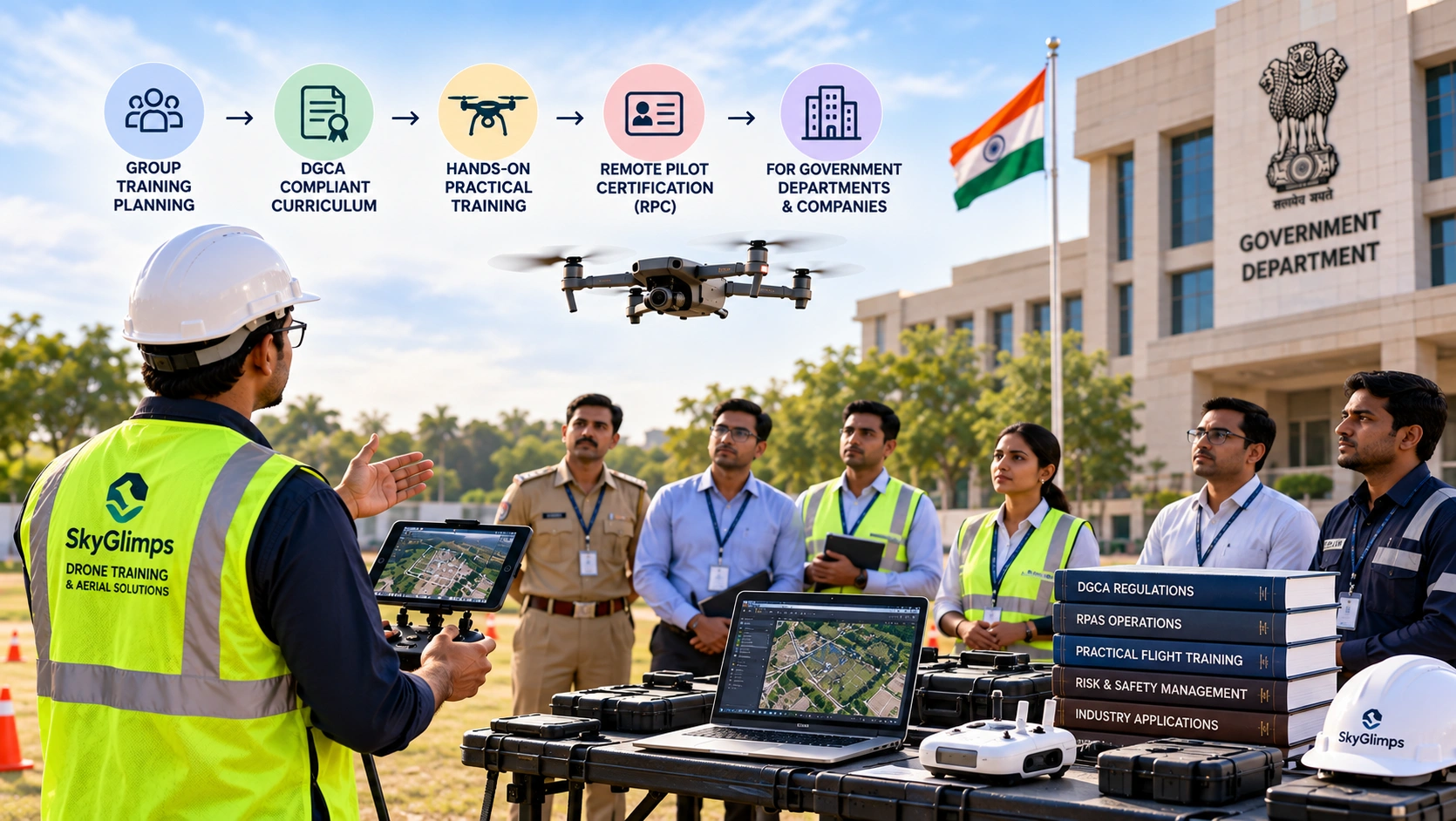
Skyglimps currently offers DGCA-certified small category drone pilot training through its Kolkata-based Remote Pilot Training Organisation. The programme includes regulatory knowledge, simulator training, maintenance basics, risk assessment, supervised practical flying, night flying operations, and final flying assessment.
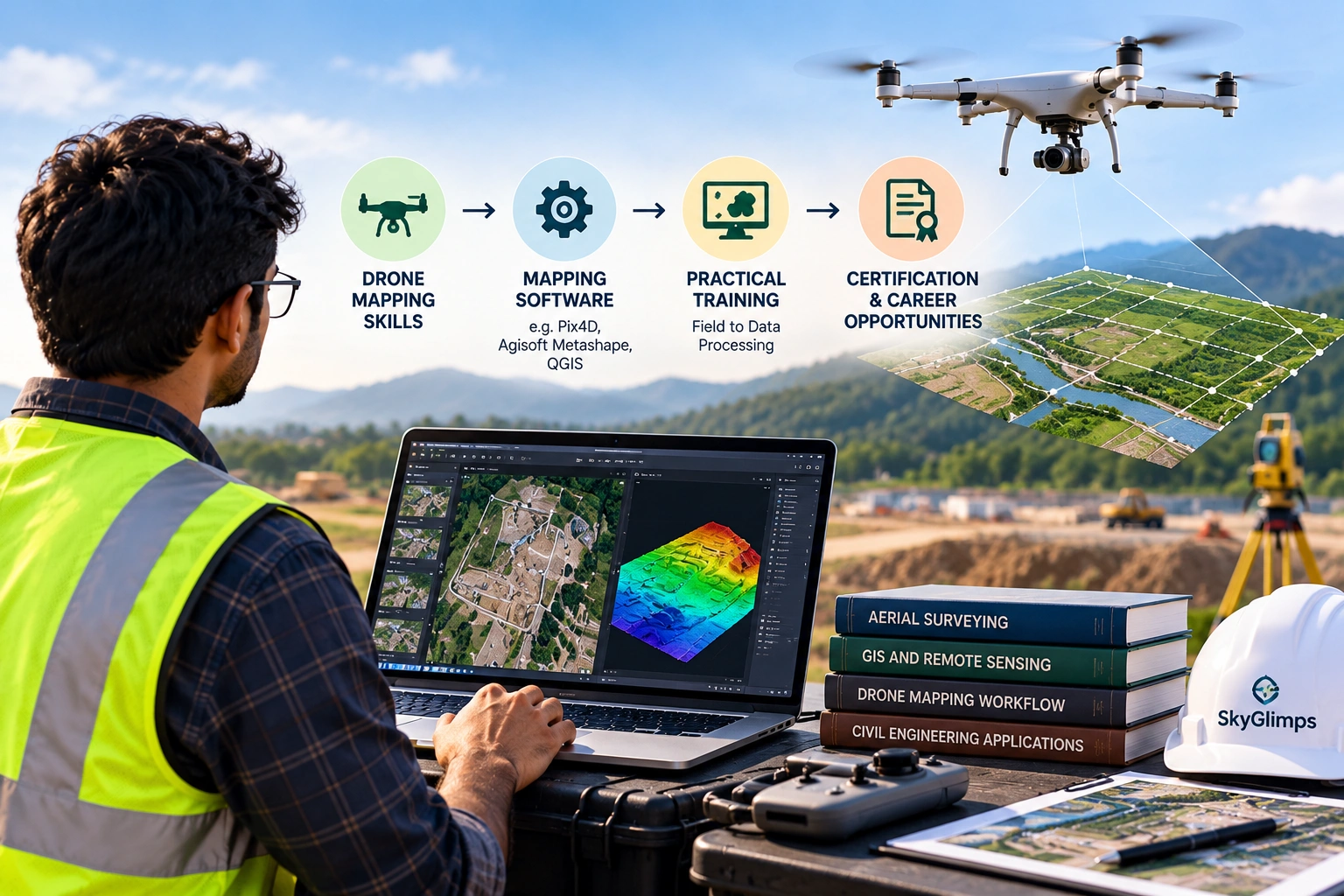
Skyglimps also provides specialised and customised drone training options for different applications. Its training ecosystem includes programmes related to drone mapping and surveying, FPV, aerial cinematography, and customised organisational requirements.
This allows learners to develop their drone skills according to their intended career or industry application.
Drone Pilot Course vs Drone Operator Course: Which Should You Choose?
The right choice depends on what you want to accomplish after training.
| Career Goal | Suitable Starting Point |
|---|---|
| Become a professional drone pilot | DGCA-authorised pilot training |
| Obtain applicable RPC | Authorised RPTO training pathway |
| Learn basic drone operations | Beginner/operator-focused training |
| Start a drone service business | Pilot training + operational/business skills |
| Work in drone surveying | Pilot training + mapping course |
| Work in industrial inspection | Pilot training + inspection training |
| Work in aerial filmmaking | Pilot training + cinematography |
| Work in FPV | Pilot fundamentals + FPV training |
| Manage drone projects | Operator/project-focused training |
The important thing is not simply whether the course is called a drone operator course or a drone pilot course.
Look at:
- Training provider
- Authorisation
- Curriculum
- Practical exposure
- Certification
- Drone category
- Career relevance
- Industry-specific skills
Common Mistakes When Choosing a Drone Course
Choosing Based Only on the Course Name
The term “drone operator course” can mean different things between training providers.
Always read the actual curriculum.
Assuming Every Drone Course Provides an RPC
A private course completion certificate is not automatically the same as a Remote Pilot Certificate.
Check the certification pathway before enrolling.
Ignoring Practical Flying
Drone operations require practical skills that cannot be developed through theory alone.
Choosing Without a Career Goal
Surveying, inspection, agriculture, FPV, cinematography, and mapping all require different technical skills.
Ignoring the Training Provider’s Authorisation
If the course claims to provide RPC training, verify the provider’s current RPTO status and applicable training scope.
Focusing Only on Certification
An RPC establishes the relevant pilot certification, but professional drone work may require additional industry-specific knowledge.
Frequently Asked Questions
A drone pilot course generally focuses on flight operations, pilot competency, and, where applicable, the Remote Pilot Certificate pathway. A drone operator course is a broader term that may cover equipment handling, mission planning, safety, and operational workflows.
“Drone operator course” is not itself the name of a separate standard DGCA pilot certification. If a course claims to provide RPC training, check whether it is conducted through an authorised RPTO and follows the applicable DGCA requirements.
Where an RPC is required for the intended drone operation, the applicable Remote Pilot Certificate is the relevant pilot credential. Candidates should check the current requirements applicable to their drone category and intended operation.
Yes, depending on the role. Drone projects can involve planning, coordination, data processing, equipment management, and other responsibilities. However, anyone actually operating the flight controls must comply with the requirements applicable to that operation.
Beginners should choose based on their career objective. Someone seeking professional pilot work should consider an appropriate authorised pilot training pathway, while someone exploring the industry may start with an introductory drone workshop.
Yes. Practical flying develops aircraft control, flight discipline, situational awareness, emergency handling, and confidence that cannot be developed through theory alone.
Choose Training Based on Your Career Goal
The difference between a drone pilot course and a drone operator course is ultimately determined by what the training is designed to teach and what certification it provides.
If your goal is to become a professional remote pilot, look for an authorised training pathway relevant to the applicable Remote Pilot Certificate. If you want to manage drone missions, operate equipment, or build a drone service business, broader operational training can complement your pilot skills.
For specialised careers, combining pilot training with application-specific skills can provide a stronger foundation. Surveying, mapping, inspection, FPV, agriculture, and aerial cinematography each require knowledge beyond basic drone controls.
If you are planning to build a professional career in drones, explore the DGCA-certified drone training offered by Skyglimps Technologies and choose a training pathway aligned with your intended drone application.