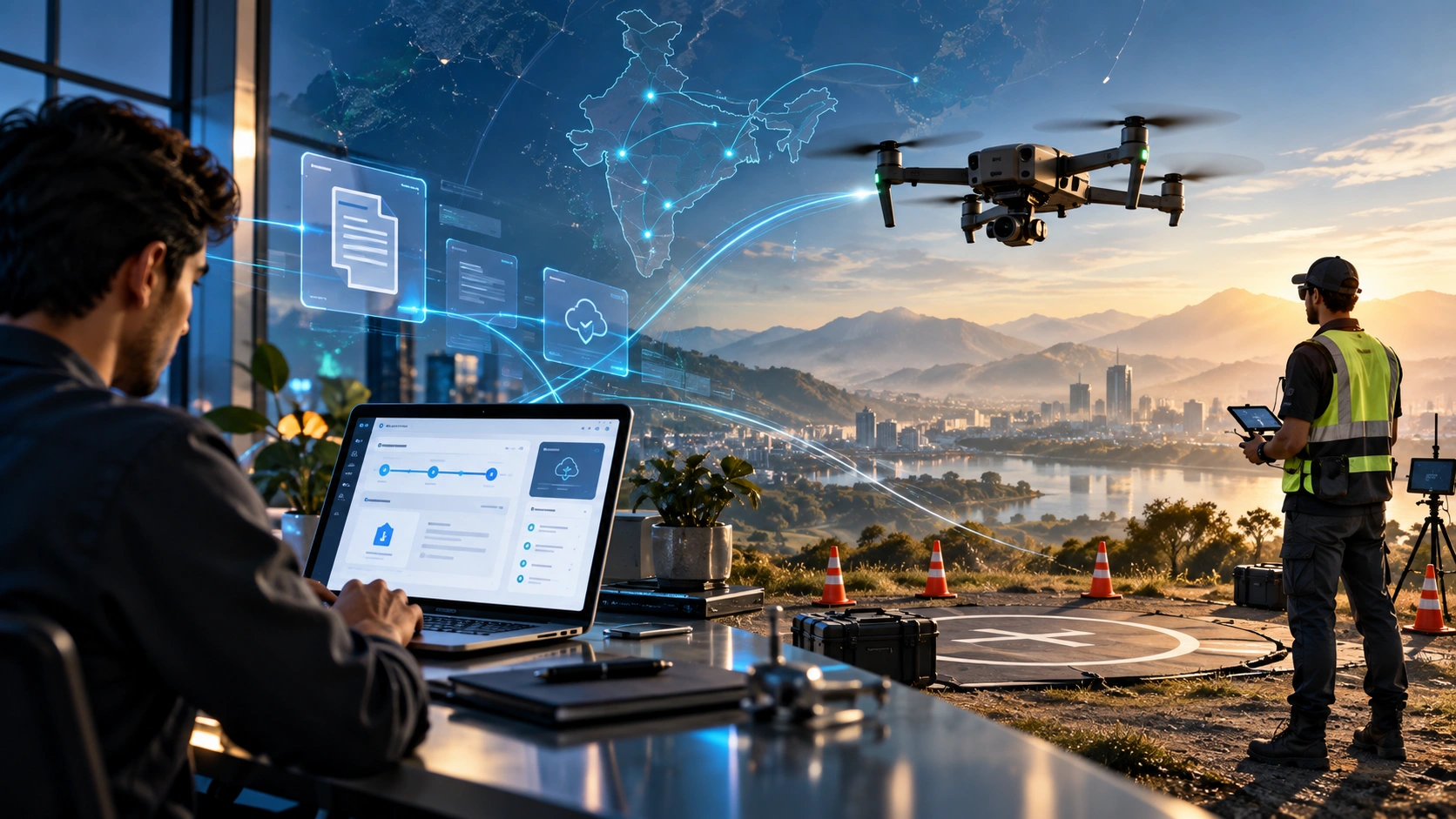
As drone technology becomes more widely used across surveying, mapping, inspection, construction, agriculture, infrastructure and other industries, more people are looking for convenient ways to become qualified drone pilots.
This has led to growing interest in an online drone pilot course India option. Students and working professionals often want to know whether they can complete their entire drone pilot training from home or whether they need to physically attend a training centre.
The answer depends on what part of the training you are talking about.
Drone theory can be taught through digital learning formats where permitted by the training arrangement. Students can study regulations, drone fundamentals, safety, weather, airspace and other theoretical subjects online.
However, professional drone pilot training is not simply an online course followed by a digital certificate.
India’s current regulatory terminology uses the Remote Pilot Certificate (RPC) rather than the older Remote Pilot Licence terminology. The Drone (Amendment) Rules, 2022 replaced the earlier “licence” terminology with “certificate” and define the Remote Pilot Certificate as a certificate issued by an authorised Remote Pilot Training Organisation.
DGCA’s current RPC verification system also records that the pilot has successfully completed both theory and practical training and passed both theory and practical examinations for the endorsed category.
This makes it important to understand the difference between online drone education and professional remote pilot certification training.
Can You Get a DGCA Drone Licence Completely Online?
You should not assume that a completely online drone course can replace the practical training and assessment required for an applicable Remote Pilot Certificate.
An online course can be useful for learning the theoretical side of drone operations. However, a professional remote pilot must also demonstrate the ability to operate the aircraft safely.
This creates an important distinction:
| Online Learning | Practical Training |
|---|---|
| Drone theory | Actual drone flying |
| Regulations | Flight exercises |
| Airspace concepts | Aircraft handling |
| Weather theory | Practical manoeuvres |
| Safety theory | Emergency procedures |
| Equipment knowledge | Physical drone handling |
| Mission planning concepts | Supervised flying |
| Practice questions | Practical assessment |
Therefore, when searching for an online drone pilot course India, you should first find out whether the course is:
- Completely online educational training
- Online theory combined with offline practical training
- A classroom-based drone course
- An authorised Remote Pilot Certificate training programme
These options should not automatically be treated as equivalent.
What Is the Difference Between an Online Drone Course and DGCA Pilot Training?
An online drone course can provide valuable theoretical knowledge without requiring the student to be physically present at a flying ground.
For example, students can study:
- Drone components
- Basic flight principles
- Drone regulations
- Airspace
- Weather
- Safety
- Risk assessment
- Equipment
- Mission planning
- Basic operational procedures
However, completing theoretical lessons does not demonstrate that a student can safely control a drone in real-world conditions.
DGCA’s current RPC verification system specifically records successful completion of both theory and practical training and both theory and practical examinations.
This is why students should carefully check what a course advertised as an online drone pilot course actually provides.
What Can You Study Online During Drone Pilot Training?
A significant portion of drone education involves theoretical knowledge, making these subjects suitable for online learning when the training provider’s approved arrangement permits it.
Drone Regulations
Students can learn about:
- Applicable drone rules
- Pilot responsibilities
- Operational requirements
- Airspace restrictions
- Safety requirements
- Flight permissions
Understanding regulations is important because a pilot’s responsibilities extend beyond simply controlling the aircraft.
Principles of Flight
Online theory can explain:
- Lift
- Drag
- Thrust
- Weight
- Stability
- Aircraft movement
- Basic aerodynamics
These concepts help students understand why a drone behaves differently under different operating conditions.
Weather and Meteorology
Students can study:
- Wind
- Visibility
- Temperature
- Cloud conditions
- Weather hazards
- Flight planning considerations
Weather knowledge becomes particularly important when operating drones outdoors.
Drone Equipment
Online lessons can introduce:
- Motors
- Propellers
- Batteries
- Flight controllers
- Remote controllers
- Sensors
- Cameras
- Payloads
- Basic maintenance
This theoretical understanding helps students become familiar with the equipment before they begin practical flying.
Risk Assessment
Students can also learn how to identify operational hazards such as:
- People
- Buildings
- Roads
- Power lines
- Trees
- Other obstacles
- Restricted areas
- Weather-related risks
The ability to recognise these risks is an important part of responsible drone operations.
What Must Be Done in Person?
The most important component that cannot simply be replaced with online videos is practical flight training.
A professional drone pilot needs to demonstrate that they can control and operate the aircraft safely.
Practical training can involve:
- Drone familiarisation
- Pre-flight inspection
- Aircraft setup
- Take-off
- Landing
- Hovering
- Directional control
- Manoeuvring
- Flight exercises
- Mission execution
- Emergency procedures
- Post-flight checks
DGCA’s current RPC verification record confirms that the applicable Remote Pilot Training Course includes both theory and practical training and that both theory and practical examinations are completed.
This is why candidates seeking professional certification should expect some form of physical practical training and assessment.
Why Is Practical Drone Training Necessary?
Knowing how a drone works is not the same as knowing how to operate one safely.
A student may understand drone theory but still need practical experience to develop:
- Aircraft orientation
- Flight control
- Manoeuvring ability
- Situational awareness
- Take-off and landing skills
- Emergency response
- Operational discipline
Real-world flying also introduces conditions that cannot be completely reproduced through a textbook or video.
These can include:
- Wind
- Physical obstacles
- Changing visibility
- Actual aircraft response
- Battery behaviour
- Take-off and landing conditions
- Unexpected environmental situations
Practical training gives instructors the opportunity to observe how a student actually handles the aircraft.
This becomes particularly important when drones are used around:
- Construction sites
- Roads
- Buildings
- Industrial facilities
- Power infrastructure
- Agricultural areas
- Public spaces
Is the DGCA Drone Exam Online?
The certification process should not be understood simply as an online multiple-choice examination followed by a certificate.
DGCA’s current RPC verification system states that the pilot has completed the Remote Pilot Training Course, including both theory and practical training, and has successfully passed both theory and practical examinations conducted by the RPTO.
This means candidates should ask their training provider exactly how the examination and assessment process works.
Even if some theoretical learning or assessment is delivered digitally, the practical competency component still needs to be addressed through the applicable training and assessment process.
Can Simulator Training Replace Actual Drone Flying?
A simulator is a useful training tool, but it should not automatically be considered a replacement for required practical aircraft training.
Simulators can help students practise:
- Controller inputs
- Aircraft orientation
- Basic manoeuvres
- Flight procedures
- Emergency scenarios
- Mission exercises
They are especially useful for beginners because students can become familiar with controls before handling a physical drone.
However, actual drone flying introduces conditions that a simulator cannot completely reproduce.
These may include:
- Real wind
- Physical surroundings
- Actual aircraft behaviour
- Battery performance
- Real take-off and landing conditions
- Environmental obstacles
- Situational awareness
A well-structured training programme can therefore use simulator training as a complement to practical flying, rather than assuming that simulation alone provides complete flight competency.
Can You Do Drone Training From Home?
You can study some parts of drone training from home, but you should not assume that an applicable professional pilot certification can be completed entirely from home.
Online learning can be useful for:
- Theory lessons
- Regulations
- Study materials
- Recorded lectures
- Live classroom sessions
- Practice questions
- Revision
- Drone fundamentals
Practical training, however, requires access to:
- Training drones
- Appropriate flying facilities
- Instructors
- Safety procedures
- Practical assessment arrangements
Therefore, before enrolling in an online drone pilot course, ask the training provider exactly which parts are conducted online and which require physical attendance.
What Should You Ask Before Enrolling in an Online Drone Pilot Course?
If you are searching for an online drone pilot course India, ask the training provider these questions before making a payment.
1. Is the Course Intended for RPC Training?
Do not assume that every online drone course leads to a Remote Pilot Certificate.
Ask what certification you will receive after successfully completing the programme.
2. Is the Training Provider an Authorised RPTO?
If the programme claims to provide training for an RPC, check whether the organisation is an authorised Remote Pilot Training Organisation for the relevant training scope.
DGCA publishes information relating to RPTO authorisation and requires RPTOs to disclose their scope of authorisation.
3. How Much of the Course Is Online?
Ask whether the online component includes:
- Theory classes
- Live lectures
- Recorded lessons
- Study materials
- Online assessments
- Practice tests
4. Where Does Practical Training Take Place?
Ask for details about:
- Training location
- Flying ground
- Practical sessions
- Training aircraft
- Instructor supervision
- Practical schedule
5. Is Practical Assessment Included?
This is particularly important if the objective is professional pilot certification.
Ask whether the course includes the applicable practical skill assessment and final flying examination.
6. Which Drone Category Is Covered?
The RPC is associated with the applicable drone category, sub-category and class.
DGCA’s current RPC verification system displays these endorsement details along with the RPTO and training information.
Therefore, do not assume that completing one course automatically qualifies you for every type of drone operation.
What Does a Blended Drone Pilot Course Look Like?
A blended training approach combines online theoretical education with in-person practical training.
A typical structure may include:
Stage 1: Online Theory
Students learn:
- Drone regulations
- Drone fundamentals
- Flight principles
- Weather
- Safety
- Risk assessment
- Equipment
Stage 2: Practical Training
Students attend the training facility for:
- Drone familiarisation
- Equipment checks
- Simulator training
- Practical flying
- Instructor-supervised exercises
- Flight practice
Stage 3: Practical Assessment
Students demonstrate the required flight skills through the applicable assessment process.
Stage 4: Certification Process
After completing the prescribed training and assessments successfully, the authorised RPTO follows the applicable process for issuance of the Remote Pilot Certificate.
This type of structure can be useful for students and working professionals who want some flexibility in their theoretical learning while still completing the necessary practical component.
Is an Online Drone Pilot Course Good for Beginners?
Yes, online theory can be very useful for beginners when it forms part of a properly structured training programme.
A beginner can use online learning to understand:
- How drones work
- Drone terminology
- Regulations
- Flight principles
- Safety
- Weather
- Equipment
- Mission planning
The student can then use practical sessions to apply that knowledge while operating an actual aircraft.
The key question is therefore not simply whether a course contains online classes.
The more important question is:
Does the complete programme provide the appropriate theory, practical training, assessment and certification pathway?
Can Working Professionals Take an Online Drone Course?
Yes. Online theory can make drone education more convenient for working professionals.
A blended programme may allow professionals to complete theoretical learning remotely and attend the training facility for practical flying.
This can be useful for professionals working in:
- Surveying
- Engineering
- Construction
- Agriculture
- Photography
- Videography
- Infrastructure
- Security
- Project management
However, candidates should still plan for the required practical attendance and assessment.
Can You Get a DGCA Drone Certificate Without Flying a Drone?
You should not expect to receive an applicable Remote Pilot Certificate simply by completing online theory without completing the required practical training and assessment.
DGCA’s current RPC verification system explicitly records completion of both theory and practical training and successful completion of both theory and practical examinations.
This creates an important difference between:
Online drone education
and
Professional drone pilot certification training.
An online course can teach you about drones, but professional certification requires the applicable competency to be demonstrated through the prescribed training and assessment process.
What Does Skyglimps Offer for Drone Pilot Training?
Skyglimps Technologies provides professional drone training programmes designed around drone operations and industry applications.
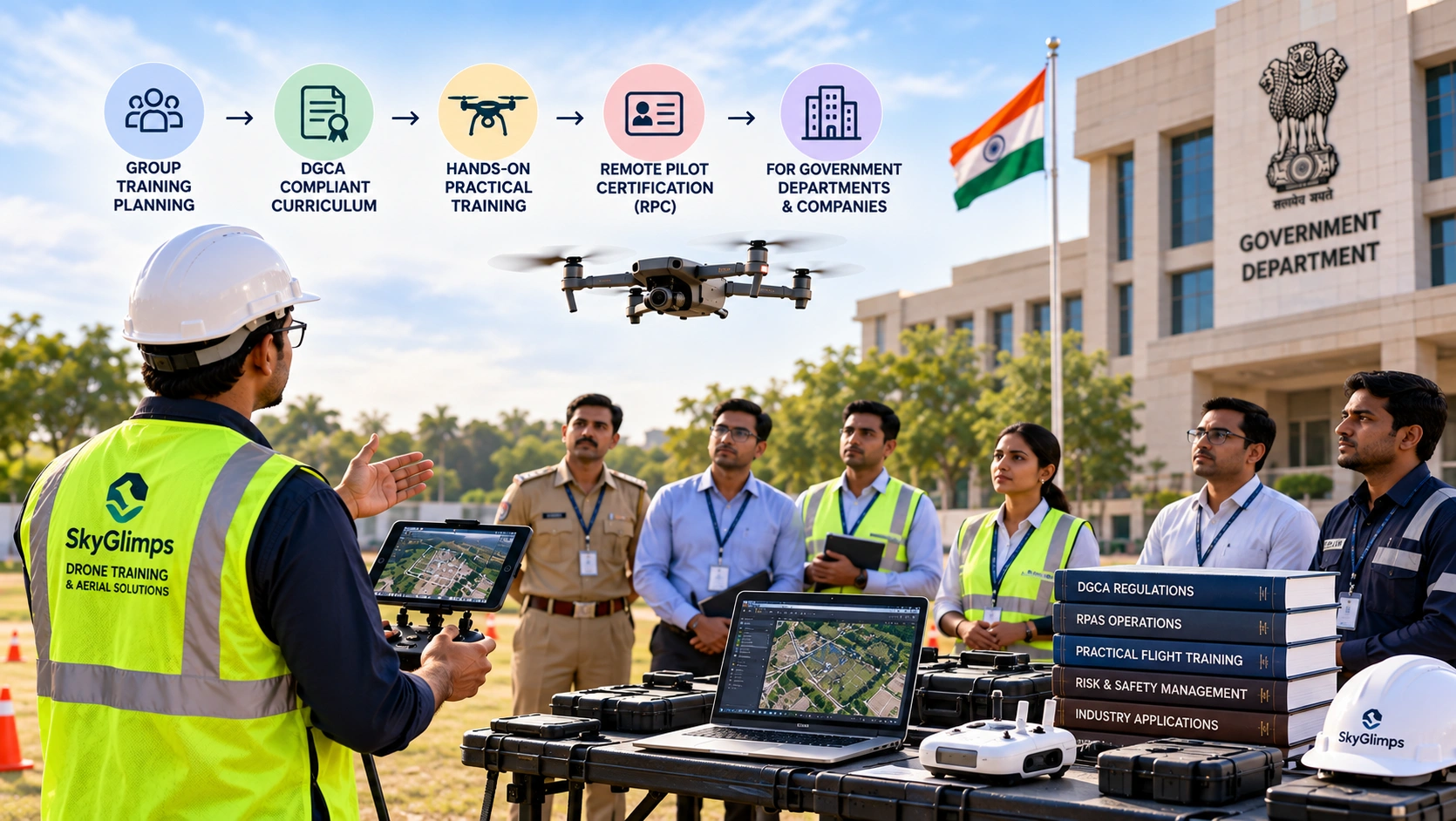
Its DGCA-Certified Drone Pilot Training programme covers areas such as drone regulations, flight fundamentals, simulator training, practical flying, drone maintenance, risk assessment and flight assessment.
For candidates considering an online drone pilot course India, the important point is that online learning should be considered as part of the broader training journey rather than automatically treated as a replacement for practical flying.
Skyglimps also offers specialised drone training for areas such as mapping and surveying, FPV, aerial cinematography and other drone applications.
Candidates can review the DGCA-Certified Drone Pilot Training programme to understand the current training structure, eligibility and practical requirements.
Online Drone Course vs In-Person Drone Training
| Factor | Online Drone Course | In-Person Practical Training |
|---|---|---|
| Drone theory | Suitable | Suitable |
| Regulations | Suitable | Suitable |
| Weather theory | Suitable | Suitable |
| Equipment theory | Suitable | Suitable |
| Simulator training | Can be digital | Can be conducted at facility |
| Physical drone handling | Limited | Yes |
| Actual flight training | Not sufficient by itself | Yes |
| Instructor-supervised flying | Limited/Not applicable | Yes |
| Real-world flight conditions | Limited | Yes |
| Practical skill assessment | Cannot replace practical assessment | Yes |
| Professional certification pathway | Depends on programme | Includes required practical component |
| Convenience | High | Requires physical attendance |
For someone seeking professional drone pilot certification, a blended approach can provide flexibility for theory while retaining the practical training required to demonstrate flight competency.
Common Mistakes When Choosing an Online Drone Pilot Course
Assuming Online Means Fully Certified
A course being available online does not automatically mean that it provides a Remote Pilot Certificate.
Choosing Based Only on Price
An inexpensive online course may provide introductory drone education rather than professional pilot training.
Ignoring Practical Training
Flight skills require experience with an actual aircraft.
Not Checking the Training Provider
If the course claims to provide RPC training, verify the provider’s current RPTO status and scope.
Assuming Every Certificate Is an RPC
A private institute’s course completion certificate is not automatically the same as a Remote Pilot Certificate.
Ignoring the Drone Category
Check which drone category, sub-category and class the training covers.
Not Asking About the Practical Facility
A professional training programme should clearly explain where practical flying and assessment take place.
What Should You Look for in an Online Drone Pilot Course in India?
Before enrolling, consider the following checklist:
- Is the provider an authorised RPTO for the relevant training?
- Does the course include theory training?
- Is practical flying included?
- Is simulator training available?
- Is practical assessment included?
- Which drone category is covered?
- Where is the flying ground?
- Who conducts the practical training?
- What certification is issued?
- How is the RPC issued?
- What documents are required?
- How many practical sessions are included?
These questions can help you distinguish between a basic online drone course and a structured professional training programme.
Frequently Asked Questions
You should not assume that an applicable Remote Pilot Certificate can be obtained through a completely online course. The current DGCA RPC framework records both theory and practical training and both theory and practical examinations.
Yes, online learning can be used for drone theory and classroom-based education. However, candidates seeking professional pilot certification should confirm that the programme also includes the applicable practical training and assessment.
Depending on the training provider and approved training arrangement, some theoretical learning may be delivered online. Candidates should confirm the exact format with the authorised RPTO.
For training that includes required practical flight training and assessment, candidates should expect to attend the designated training or flying facility. Actual flight competency cannot be demonstrated through theory lessons alone.
A simulator is a useful training tool, but it should not automatically be treated as a replacement for the practical aircraft training and assessment required for professional certification.
Online Learning Can Help, But Practical Training Still Matters
If you are searching for an online drone pilot course India, it is important to understand what “online” actually means.
Drone theory, regulations, weather, equipment, safety and other classroom-based subjects can potentially be studied through digital learning formats. This can make drone education more accessible for students and working professionals.
However, professional drone pilot certification is not simply an online course followed by a digital certificate. The current DGCA RPC framework records completion of both theory and practical training and successful theory and practical examinations.
Practical training remains important because a professional pilot needs to demonstrate that they can safely control and operate a drone in real conditions.
For anyone planning a career in surveying, mapping, inspection, construction, agriculture, infrastructure, aerial photography or other drone applications, the stronger approach is to choose training that combines theory, practical flying, safety, regulatory knowledge and the applicable certification pathway.
If you are looking for professional drone pilot training in India, explore Skyglimps’ DGCA-Certified Drone Pilot Training to understand the current training structure and practical requirements.