If you are planning to become a professional drone pilot in India, one of the first things to understand is drone pilot license eligibility.
Many beginners have questions about the minimum age, educational qualification, medical fitness, identity documents, previous flying experience, and training requirements. There is also some confusion because people commonly search for a “DGCA drone pilot licence”, while the current official terminology is Remote Pilot Certificate (RPC).
The Drone (Amendment) Rules, 2022 replaced the earlier Remote Pilot Licence terminology with Remote Pilot Certificate and moved the certification process to authorised Remote Pilot Training Organisations (RPTOs).
For most candidates, the basic eligibility requirements are straightforward:
- Minimum age of 18 years
- Maximum age of 65 years under the Drone Rules eligibility framework
- Class 10 or equivalent qualification
- Completion of prescribed training through an authorised RPTO
- Successful completion of the applicable assessment
- Required identity and address documentation
- Medical fitness documentation where required by the training programme/RPTO
Understanding these requirements before enrolling can help you avoid documentation problems and choose the right training provider.
What Is Drone Pilot License Eligibility in India?
Drone pilot license eligibility refers to the requirements a person must meet to enter the professional remote pilot certification pathway in India.
Although “drone pilot licence” remains a common search term, the current official credential is the Remote Pilot Certificate (RPC).
The basic eligibility framework under the Drone Rules states that an individual seeking the applicable remote pilot credential must be:
- At least 18 years old
- Not more than 65 years old
- A Class 10 pass or equivalent from a recognised Board
- Successfully trained through an authorised Remote Pilot Training Organisation
The applicable training also depends on the category, sub-category, and class of drone for which the pilot is being trained.
This means you do not generally need an engineering degree or aviation degree simply to meet the basic eligibility requirements.
What Is the Minimum Age to Become a Drone Pilot?
The minimum age under the Drone Rules eligibility framework is 18 years.
The same framework specifies an upper age limit of 65 years for obtaining the remote pilot credential.
This makes professional drone training accessible to a wide range of candidates, including:
- Students who have completed the required education
- Young professionals
- Engineers
- Surveyors
- Photographers
- Agriculture professionals
- Construction professionals
- Entrepreneurs
- Experienced professionals changing careers
If you are below 18, you can still learn about drone technology through educational or introductory programmes where the provider permits it. However, you should not assume that completing a beginner workshop makes you eligible for the professional Remote Pilot Certificate.
Is There a Maximum Age for Drone Pilot Certification?
The Drone Rules framework specifies 65 years as the maximum age for the remote pilot eligibility provision.
However, candidates should confirm the current admission requirements with their chosen RPTO before enrolling, particularly if they are close to or above the specified age.
Training organisations may also have operational requirements related to medical fitness and practical flying.
What Educational Qualification Is Required for a Drone Pilot?
The basic educational qualification is Class 10 or equivalent from a recognised Board.
You do not generally need:
- A bachelor’s degree
- An engineering degree
- A diploma in aviation
- A science degree
- Previous professional drone experience
The Drone Rules specifically identify Class 10 or equivalent as the educational requirement for the remote pilot eligibility framework.
This allows candidates from different educational backgrounds to enter professional drone training.
For example, candidates can come from:
- Science
- Commerce
- Arts
- Engineering
- Agriculture
- Surveying
- Construction
- Photography
- Media
- Technical backgrounds
Your educational background can become more important later when you specialise in a particular drone industry.
Do You Need Class 12 to Become a Drone Pilot?
No. Class 12 is not the basic educational requirement specified by the Drone Rules for the remote pilot eligibility pathway.
The minimum qualification is Class 10 or equivalent.
However, completing Class 12 or higher education can still be useful for career development.
For example:
| Educational Background | Potential Drone Specialisation |
|---|---|
| Civil Engineering | Surveying, mapping, construction |
| Geography/GIS | GIS and geospatial mapping |
| Agriculture | Agricultural drone operations |
| Engineering | Inspection and infrastructure |
| Photography/Media | Aerial cinematography |
| Computer/IT | Drone data and GIS workflows |
| General education | General drone operations |
Therefore, Class 10 can satisfy the basic eligibility requirement, while additional education can help you specialise later.
Is Graduation Required for DGCA Drone Pilot Training?
No. Graduation is not required to meet the basic Class 10 educational eligibility requirement.
This is one reason drone pilot training is accessible to candidates who want to enter the industry without completing a specialised aviation degree.
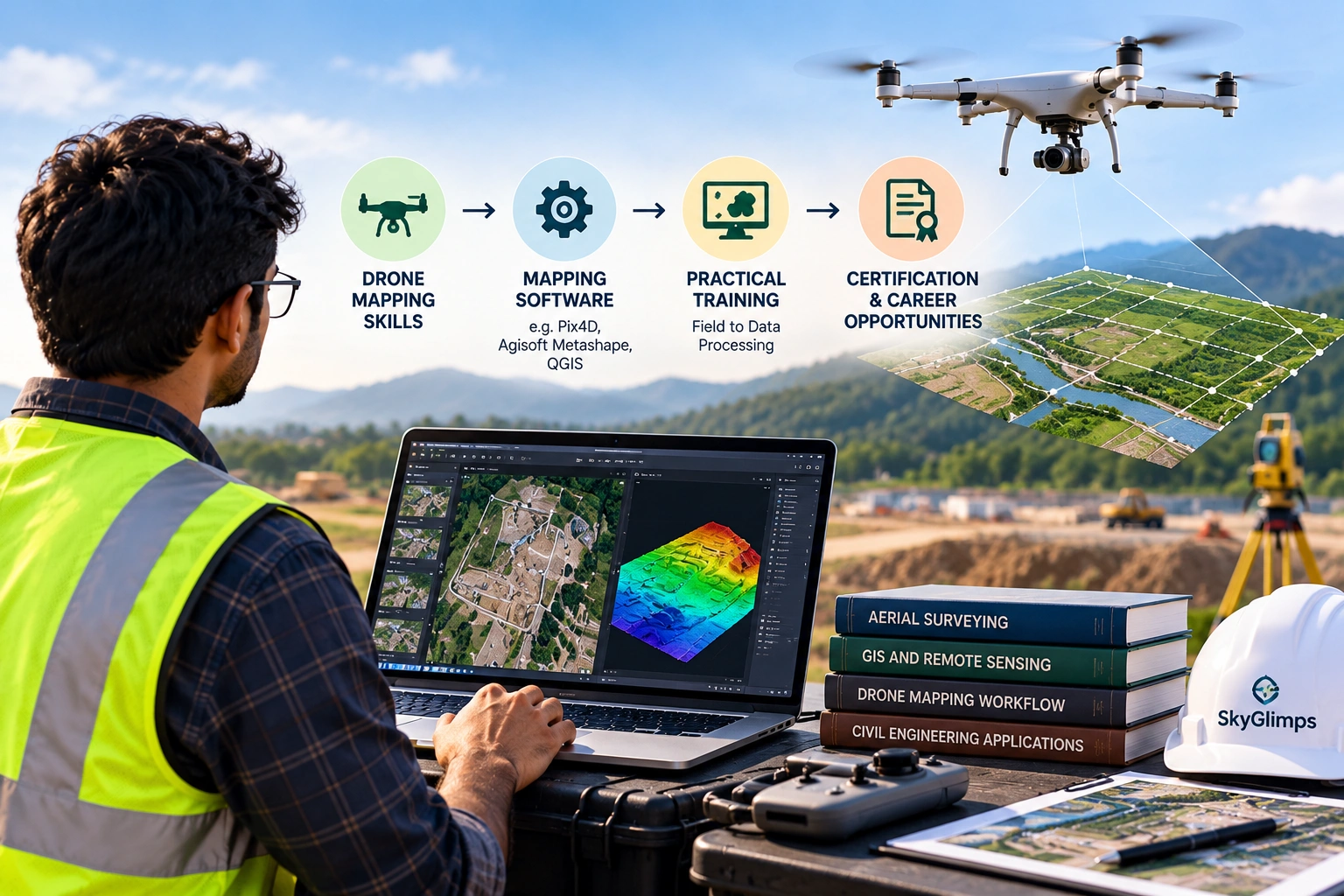
However, if your career goal is drone surveying, GIS, engineering inspection, infrastructure planning, or another technical field, relevant higher education can provide additional advantages.
The important distinction is:
Eligibility to become a remote pilot ≠ qualifications required for every drone-related job.
A company hiring a drone survey professional may require surveying or engineering knowledge even though the basic pilot certification pathway does not require a degree.
Is Medical Fitness Required for Drone Pilot Training?
Medical fitness requirements should be confirmed with the specific RPTO and training programme.
The core eligibility provision focuses on age, education, and completion of the prescribed training, while individual RPTOs may require medical documentation as part of their admission and practical-training process.
For example, Skyglimps currently lists a medical fitness certificate as one of the eligibility requirements for its DGCA-Certified Small Category Drone Pilot Training programme.
Therefore, if you are preparing to enrol, ask the RPTO:
- Is a medical fitness certificate required?
- Who can issue it?
- Is there a prescribed format?
- How recent should it be?
- Are any specific medical tests required?
- Is a Class 2 aviation medical actually required, or is a general medical fitness certificate sufficient?
This last question is important because candidates sometimes assume that drone pilot certification automatically requires the same medical process used for manned-aircraft pilots.
Do not assume a Class 2 aviation medical is required unless your RPTO or applicable DGCA requirement specifically says so.
What Medical Conditions Can Affect Drone Pilot Eligibility?
A candidate should be medically fit enough to safely participate in practical drone training and operations.
The practical concern is whether a medical condition could interfere with safe drone operation.
Depending on the training provider’s requirements, medical fitness may consider areas such as:
- Vision
- Hearing
- Physical coordination
- Ability to concentrate
- General physical fitness
- Ability to safely operate controls
Candidates with an existing medical concern should discuss the specific requirement with the RPTO rather than assuming that they are automatically disqualified.
The exact medical documentation and assessment requirements can vary depending on the applicable training framework and RPTO.
What ID Proof Is Required for Drone Pilot Certification?
Candidates need acceptable identity and address documentation for the certification process.
The Drone (Amendment) Rules, 2023 changed Form D-4 so that the relevant identity documentation can be an Indian Passport or government-issued proof of identity and government-issued proof of address, with examples including a Voter’s ID card, Ration Card, or Driving Licence.
Individual RPTOs can also specify which documents they accept for admission.
For example, Skyglimps currently lists Aadhaar or Passport as examples of valid government-issued identification for its DGCA-Certified Small Category Drone Pilot Training.
Therefore, candidates should confirm the exact document combination with their chosen RPTO before submitting their application.
Is Aadhaar Mandatory for Drone Pilot Training?
Aadhaar is commonly accepted by RPTOs, but it should not be treated as the only identity document available under the current Form D-4 framework.
The 2023 amendment expanded the wording of Form D-4 to include an Indian Passport or government-issued proof of identity and government-issued proof of address. Examples specifically mentioned include:
- Voter’s ID
- Ration Card
- Driving Licence
Skyglimps currently lists Aadhaar or Passport for its own training admission requirements.
If you do not have Aadhaar available, contact the RPTO and confirm which alternative documents it accepts.
Is a Passport Mandatory to Become a Drone Pilot?
A passport should not automatically be treated as mandatory for every candidate.
The 2023 amendment to Form D-4 specifically provides for an Indian Passport or government-issued proof of identity and government-issued proof of address, including documents such as Voter’s ID, Ration Card, or Driving Licence.
However, RPTOs may have specific admission-document requirements.
For example, Skyglimps currently accepts Aadhaar or Passport as examples of government-issued ID for its training programme.
The safest approach is to ask your selected RPTO for its current document checklist before enrolling.
What Documents Should You Keep Ready?
A practical drone pilot document checklist can include the following:
| Document | Purpose |
|---|---|
| Class 10 certificate/marksheet | Education verification |
| Government-issued ID | Identity verification |
| Address proof | Certification/application documentation |
| Passport-size photographs | Training records, if requested |
| Medical fitness certificate | May be required by the RPTO |
| Mobile number | Training and certification communication |
| Email address | Training and certificate communication |
| RPTO admission form | Course registration |
| Additional documents | As requested by the training organisation |
The exact list can vary between RPTOs.
For the formal certification process, Form D-4 documentation requirements should also be considered alongside the RPTO’s own admission checklist. The 2023 amendment specifically updated the identity/address requirements in Form D-4.
Should Your Name Match on All Documents?
Yes. Candidates should make sure that their name and personal details are consistent across their documents.
Before submitting your documents, check:
- Full name
- Date of birth
- Address
- Photograph
- Mobile number
- Email address
For example, if your Class 10 certificate says “Rahul Kumar” but your ID says “Rahul K. Kumar,” the difference may require clarification.
Checking your documents before enrolment can help prevent unnecessary administrative delays.
Do You Need Previous Drone-Flying Experience?
No previous professional drone-flying experience is generally required for beginner-oriented professional training.
A structured RPTO programme can teach candidates the fundamentals before they progress to practical flying.
DGCA’s training syllabus includes areas such as:
- Drone rules
- Airspace
- Principles of flight
- Aerodynamics
- Weather and meteorology
- Drone maintenance
- Risk assessment
- Safety
- Payload operations
- Drone data
- Simulator training
- Practical flying
DGCA’s Drone Training Circular 02 of 2022 establishes the syllabus framework for remote pilot training and examination.
Skyglimps also specifically states that its DGCA-Certified Drone Pilot Training is open to beginners and working professionals.
This means you do not necessarily need to learn how to fly a drone independently before joining professional training.
Do You Need to Own a Drone Before Joining Training?
No. You do not generally need to own your own drone before enrolling in professional pilot training.
A proper training programme should provide access to the required training equipment for the practical component.
For example, Skyglimps’ current programme includes simulator training, basic assembly and maintenance, instructor-supervised practical flying, progression toward solo flight, night flying operations, and final flying assessment.
Owning a drone can be useful later for additional practice, but it should not be confused with a prerequisite for entering professional training.
What Training Is Required After You Meet the Eligibility Criteria?
Meeting the age and education requirements is only the first step.
Candidates must also complete the prescribed training through an authorised RPTO.
DGCA’s Drone Training Circular 02 of 2022 covers the training and examination syllabus for remote pilots. The syllabus includes regulatory knowledge, principles of flight, airspace, aerodynamics, weather, maintenance, risk assessment, payloads, drone data, simulator training, and practical flying.
A professional training programme can therefore include:
Theory Training
Candidates learn the regulatory and technical fundamentals required for drone operations.
Simulator Training
Simulator sessions can help beginners become familiar with controls and flight procedures.
Practical Flying
Candidates develop hands-on skills including:
- Take-off
- Landing
- Hovering
- Manoeuvring
- Aircraft orientation
- Flight control
- Operational discipline
Safety and Risk Assessment
Candidates learn how to identify hazards and operate responsibly around people, infrastructure, buildings, roads, and other obstacles.
Assessment
The applicable training pathway includes theory and practical assessment.
DGCA’s current RPC verification system records that the pilot has successfully completed both theory and practical training and passed both theory and practical examinations for the endorsed category.
What Is an RPTO and Why Does It Matter?
RPTO stands for Remote Pilot Training Organisation.
An RPTO is an organisation authorised to provide the prescribed remote pilot training.
The Drone Rules framework requires candidates seeking the applicable remote pilot certification to complete the prescribed training through an authorised RPTO.
This makes checking the training organisation an important part of your drone pilot license eligibility process.
Before enrolling, verify:
- RPTO authorisation
- Training category
- Drone class
- Course syllabus
- Practical flying facilities
- Instructor supervision
- Assessment process
- Certification process
- Current admission requirements
Do not choose a training institute only because its advertisement contains the words “DGCA drone course.”
Does the Remote Pilot Certificate Cover Every Drone?
No. The Remote Pilot Certificate is associated with the applicable drone category, sub-category, and class for which the pilot has completed the relevant training.
DGCA’s current RPC verification system displays the pilot’s:
- Category of UAS
- Sub-category
- Class of UAS
- Training category
- Date of endorsement
- RPTO name
This means candidates should understand what type of drone they intend to operate professionally before selecting their training programme.
For example, Skyglimps currently offers Small Category DGCA-Certified Drone Pilot Training.
Do You Need a Degree for Drone Surveying Jobs?
A degree is not part of the basic remote pilot eligibility requirement, but specialised drone jobs can have additional qualification requirements.
For example, a company hiring a drone survey professional may prefer candidates with knowledge of:
- Surveying
- Civil engineering
- GIS
- Photogrammetry
- Mapping
- Topography
- RTK/PPK
- CAD
- Drone data processing
Similarly, an inspection company may prefer experience with:
- Thermal imaging
- RGB inspection
- Industrial assets
- Infrastructure
- Inspection reporting
This creates an important distinction:
Pilot certification allows you to build a professional drone career, but specialised technical skills can determine which jobs you qualify for.
Can Arts or Commerce Students Become Drone Pilots?
Yes. The basic education requirement is Class 10 or equivalent, not a specific stream such as Science or Commerce.
This means candidates from different academic backgrounds can pursue drone pilot training if they meet the applicable eligibility requirements.
However, your preferred career path may determine what additional skills you should develop.
For example:
- Commerce student → drone operations + business management
- Arts student → drone operations + media/content
- Science student → drone operations + technical applications
- Civil engineering student → drone operations + surveying
- Agriculture student → drone operations + agricultural applications
The drone industry is broad enough to accommodate different backgrounds.
Can Students Start Learning About Drones Before They Are Eligible?
Yes. Students can build foundational knowledge before reaching the eligibility age for professional certification.
They can learn:
- Drone fundamentals
- Basic aerodynamics
- Drone components
- Types of drones
- Photography
- Mapping concepts
- GIS basics
- Drone regulations
- Safety principles
Introductory programmes can also help students understand whether they want to pursue drones as a career.
However, completing an educational workshop does not automatically bypass the formal eligibility requirements for professional remote pilot certification.
What Happens After You Submit Your Documents?
Once you meet the eligibility criteria and enrol with an authorised RPTO, the general process involves:
Step 1: Eligibility Verification
The RPTO checks your age, education, identity, and other required documentation.
Step 2: Training
You complete the applicable theoretical and practical training.
Step 3: Assessment
You complete the required theory and practical examinations.
Step 4: Certification Process
The authorised RPTO handles the applicable Remote Pilot Certificate process.
The Drone (Amendment) Rules, 2022 define the Remote Pilot Certificate as a certificate issued by an authorised RPTO.
DGCA’s current RPC verification system confirms the pilot’s training and examination status and displays the relevant endorsement information.
What Is the Complete Drone Pilot Eligibility Checklist?
Before enrolling, use this checklist.
Age
- I am at least 18 years old.
- I meet the applicable upper-age requirement.
Education
- I have passed Class 10 or equivalent.
- I have my Class 10 certificate or marksheet.
Identity
- I have an accepted government-issued identity document.
- My name matches my education documents.
Address
- I have acceptable address documentation.
- My address details are accurate.
Medical
- I have checked the medical requirement with my RPTO.
- I have a medical fitness certificate if the course requires one.
Training
- I have selected an authorised RPTO.
- I know which drone category/class the course covers.
- I understand the theory and practical training structure.
- I understand the assessment process.
Certification
- I understand that the current official term is Remote Pilot Certificate.
- I know how the RPTO will process the certificate.
- I will verify my certificate details after issuance.
What Documents Should You Submit for Drone Pilot Training?
A practical document package can look like this:
| Checklist | Document |
|---|---|
| ✓ | Class 10 certificate/marksheet |
| ✓ | Government-issued ID |
| ✓ | Address proof |
| ✓ | Passport-size photographs, if requested |
| ✓ | Medical fitness certificate, if required |
| ✓ | Mobile number |
| ✓ | Active email address |
| ✓ | RPTO application/admission form |
| ✓ | Any additional documents requested by the RPTO |
Remember that this is a practical checklist, not a statement that every RPTO will request every item.
The exact requirements can change depending on the current certification process and training provider.
What Are the Most Common Eligibility Mistakes?
1. Searching Only for “Drone Licence”
The official terminology is now Remote Pilot Certificate.
People still commonly search for “drone licence,” “DGCA drone licence,” and “drone pilot licence eligibility,” but the current regulatory terminology is RPC.
2. Assuming Graduation Is Required
The basic educational requirement is Class 10 or equivalent.
3. Assuming Class 12 Is Mandatory
Class 12 is not the basic educational requirement under the Drone Rules eligibility framework.
4. Assuming a Passport Is Always Mandatory
The 2023 Form D-4 amendment provides for an Indian Passport or government-issued proof of identity and address, including specified alternatives.
5. Assuming Every Drone Course Is an RPTO Course
A private drone workshop and an authorised remote pilot training programme are not automatically the same thing.
6. Ignoring the Medical Requirement
Check the specific RPTO’s current requirements. Skyglimps, for example, currently lists a medical fitness certificate for its pilot training programme.
7. Choosing a Course Without Checking the Drone Category
The applicable RPC endorsement is associated with the category, sub-category, and class for which training is completed.
8. Assuming Certification Is the Same as Career Readiness
A pilot certificate establishes your foundation, but professional jobs may require additional skills in surveying, GIS, inspection, agriculture, cinematography, or another specialised area.
Why Choose Skyglimps for DGCA Drone Pilot Training?
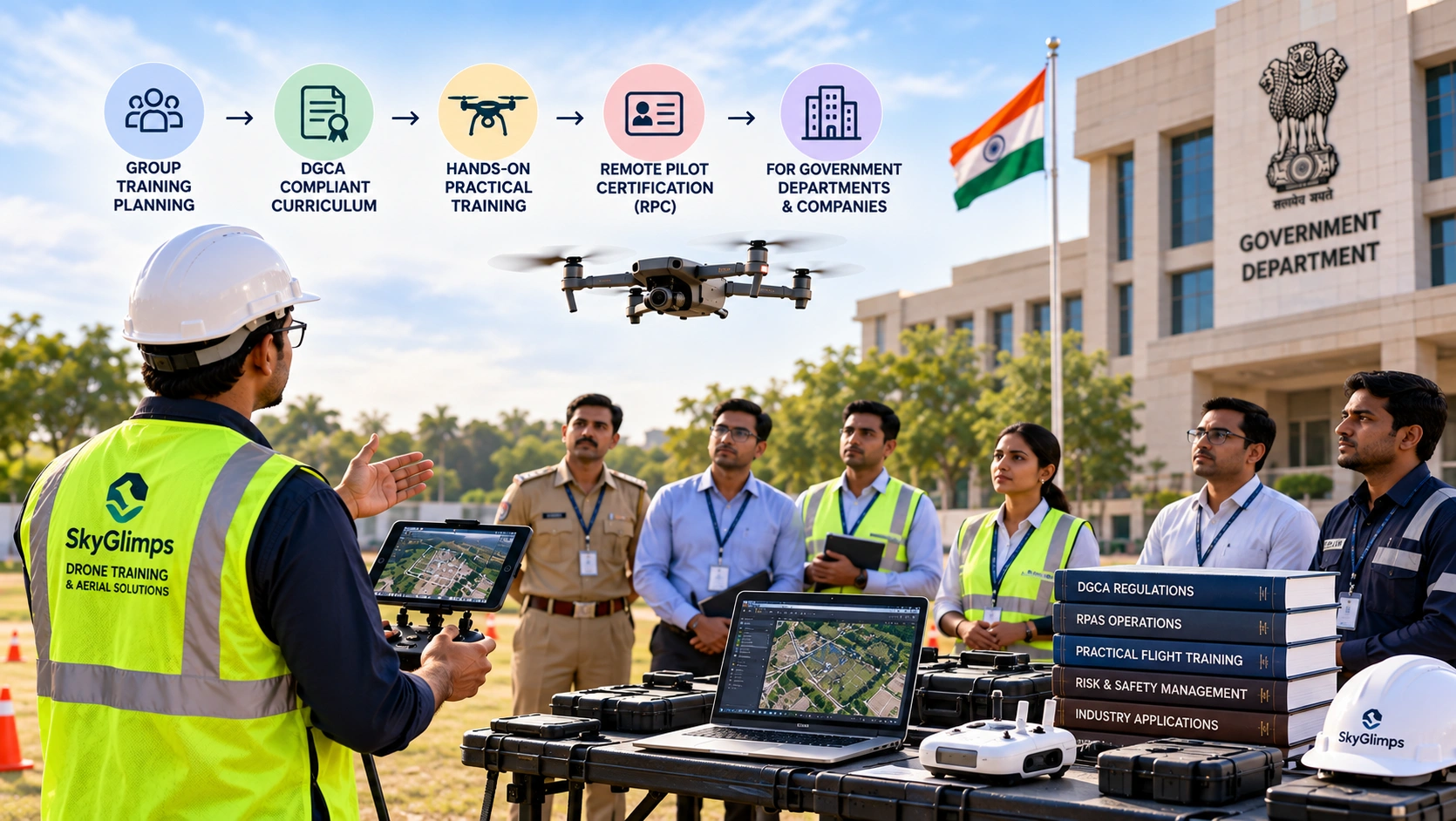
Skyglimps Technologies offers DGCA-certified small-category drone pilot training through its Kolkata-based RPTO.
The current programme is designed for beginners and working professionals and includes:
- Drone regulatory framework
- Flight fundamentals
- ATC procedures
- Aerodynamics
- Weather and meteorology
- Drone maintenance
- Risk assessment
- Safety
- Payload operations
- Drone data processing
- Simulator training
- Practical flying
- Solo-flight progression
- Night flying operations
- Final flying assessment
Skyglimps currently lists the following eligibility requirements:
| Requirement | Current Requirement |
|---|---|
| Minimum age | 18 years |
| Education | Class 10 pass or equivalent |
| Government ID | Aadhaar or Passport |
| Medical | Medical fitness certificate |
| Training category | Small Category |
Classroom training is currently conducted at New Town, Kolkata, while practical flying sessions are conducted at Singur, West Bengal.
For candidates looking for structured training in West Bengal, the Skyglimps DGCA-Certified Drone Training programme provides information about eligibility, training, practical flying, and certification.
Frequently Asked Questions
The Drone Rules eligibility framework specifies a minimum age of 18 years and an upper age of 65 years. Candidates should confirm current RPTO admission requirements before enrolling.
The basic educational requirement is Class 10 or equivalent from a recognised Board.
No. Class 10 or equivalent is the basic educational requirement under the Drone Rules eligibility framework.
No. Graduation is not required for the basic remote pilot eligibility pathway. However, higher education can be useful for specialised drone careers.
Medical documentation should be confirmed with the selected RPTO. Skyglimps currently lists a medical fitness certificate as part of its course eligibility requirements.
Not necessarily. The 2023 amendment to Form D-4 provides for an Indian Passport or government-issued proof of identity and government-issued proof of address, with specified examples such as Voter’s ID, Ration Card, or Driving Licence. Individual RPTOs may specify their own accepted documents.
No, the current Form D-4 wording allows an Indian Passport or specified government-issued identity and address documentation. Always confirm the current accepted documents with your RPTO.
Not necessarily. Beginner candidates can enter structured pilot training if they meet the applicable eligibility requirements. Skyglimps currently states that its training is open to beginners.
No. A professional training programme should provide access to the required training equipment. Skyglimps currently includes simulator training and practical flying in its programme.
RPTO means Remote Pilot Training Organisation. It is an organisation authorised to provide the prescribed remote pilot training for candidates seeking the applicable Remote Pilot Certificate.
The current official terminology is Remote Pilot Certificate (RPC). The Drone (Amendment) Rules, 2022 replaced the earlier Remote Pilot Licence terminology with Remote Pilot Certificate.
No. The current RPC record identifies the applicable UAS category, sub-category, and class for which the pilot has been trained and assessed.
Yes. The basic education requirement is Class 10 or equivalent rather than a specific academic stream.
Keep your Class 10 or equivalent education proof, government-issued ID, address documentation, photographs if requested, medical fitness documentation if required, and the additional forms requested by the RPTO.
Yes. You can learn drone fundamentals and related skills through suitable educational programmes, but you should not assume that an introductory course bypasses the formal eligibility requirements for professional certification.
Check Your Eligibility Before Enrolling
Understanding drone pilot license eligibility is the first step toward building a professional career in India’s drone industry.
The core requirements are straightforward:
18–65 years → Class 10 or equivalent → Accepted identity/address documents → Medical documentation if required → Authorised RPTO → Theory and practical training → Assessment → Remote Pilot Certificate
The most important point is to distinguish between a general drone course, a beginner workshop, and an authorised remote pilot training programme.
You do not generally need an engineering degree, graduation, or previous professional flying experience to begin the basic remote pilot certification pathway. However, specialised drone careers may require additional knowledge in surveying, GIS, inspection, agriculture, construction, cinematography, or another technical field.
Before enrolling, verify the RPTO, drone category, current eligibility requirements, document checklist, practical training, assessment process, and certification pathway.
For candidates in Kolkata and West Bengal, Skyglimps DGCA-Certified Drone Training currently offers small-category drone pilot training for beginners and working professionals, with classroom training in New Town and practical flying at its flying ground in Singur.
Getting the documents ready is only the first step. The right training, practical flying experience, and specialised industry skills are what can turn drone certification into a professional career.