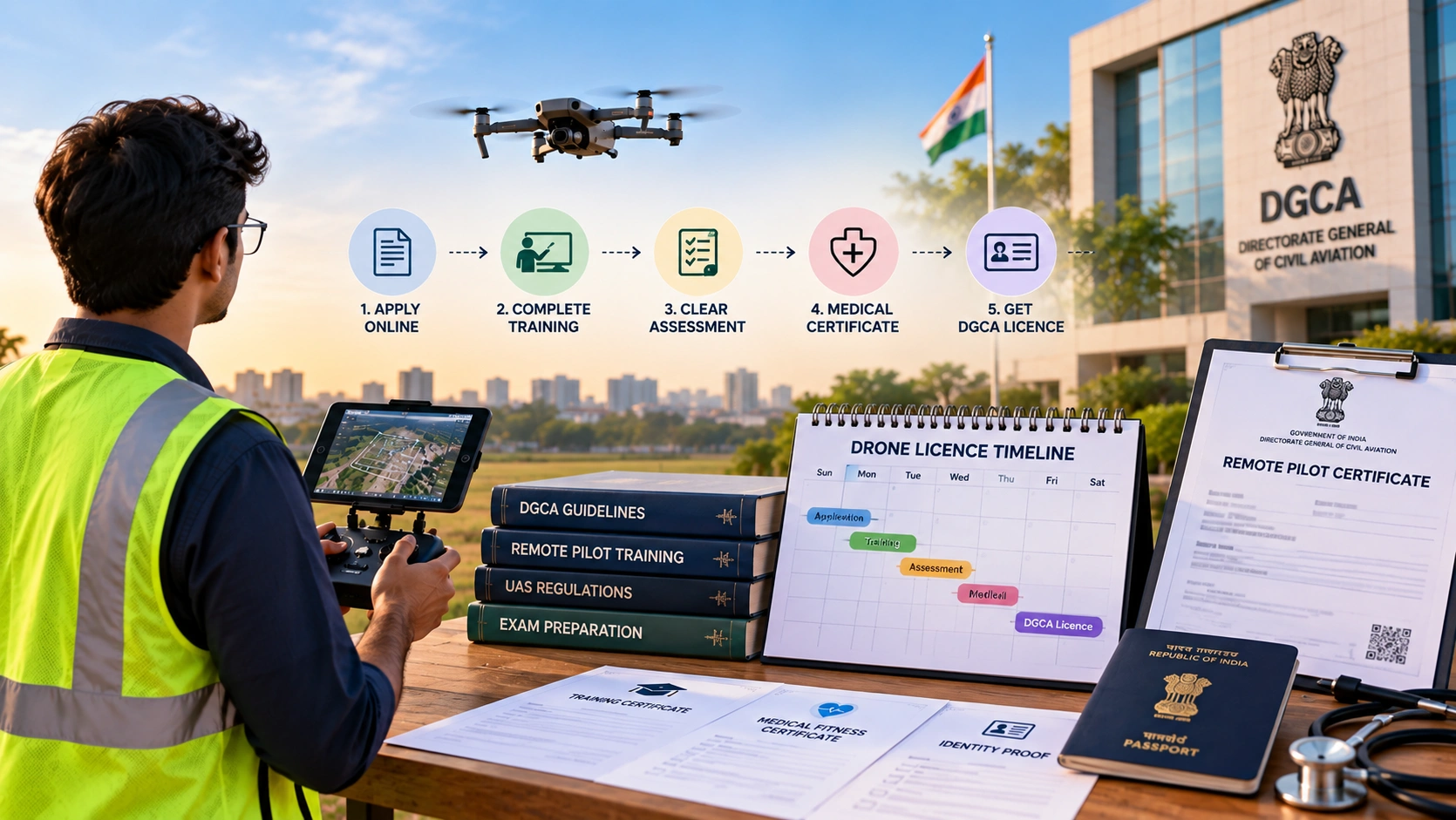
If you are planning to become a professional drone pilot in India, one of the first questions you are likely to ask is: how long does it take to get a drone license in India?
The answer depends on more than just the number of days spent in the classroom.
The complete process can involve:
- Choosing an authorised Remote Pilot Training Organisation (RPTO)
- Completing the admission process
- Submitting the required documents
- Attending theory training
- Completing simulator and practical flying training
- Passing the required assessments
- Completion of the RPTO’s certification process
- Generation of the Remote Pilot Certificate (RPC)
For example, SkyGlimps currently lists its DGCA-Certified Small Category Drone Pilot Training as a 6-day programme, covering theory, simulator training, practical flying, night flying operations and the final flying test.
However, the training duration and the total time until you receive your Remote Pilot Certificate are not necessarily the same thing.
How Long Does It Take to Get a Drone Licence in India?
A professional drone pilot training programme can be completed in a few days, but the total certification timeline depends on the training schedule, assessment, documentation and certificate-processing process.
At SkyGlimps, the current small-category training programme is structured over 6 days:
| Day | Main Training |
|---|---|
| Day 1 | Drone regulations, flight fundamentals, ATC procedures and aircraft overview |
| Day 2 | Weather, maintenance, risk assessment, safety and payload operations |
| Day 3 | Theory assessment, simulator training and basic assembly/maintenance |
| Day 4 | Practical flying with instructor supervision |
| Day 5 | Practical flying and progression toward solo flight |
| Day 6 | Night flying operations and final flying test |
This means a candidate can complete the training and assessment phase in 6 days at SkyGlimps, assuming the candidate attends the scheduled sessions and successfully completes the required assessments.
The certificate-processing timeline is a separate part of the process.
Is the Official Term “Drone Licence” or “Remote Pilot Certificate”?
The current official terminology is Remote Pilot Certificate (RPC).
Many people search for:
- DGCA drone licence
- Drone pilot licence
- Drone licence in India
- DGCA drone licence
- Drone flying licence
- Drone pilot certification
However, the Drone (Amendment) Rules, 2022 replaced the term Remote Pilot Licence with Remote Pilot Certificate. The amended rules define an RPC as a certificate issued by an authorised Remote Pilot Training Organisation.
Therefore, throughout this article, “drone licence” refers to the professional Remote Pilot Certificate that people commonly search for under that term.
What Is the Typical Timeline for Getting a Drone Pilot Certificate?
The process can be understood in several stages.
Stage 1: Choose an Authorised RPTO
Before starting, you need to select an authorised Remote Pilot Training Organisation for the applicable drone category and class.
The Drone Rules require training for the Remote Pilot Certificate to be conducted through an authorised RPTO.
This step can take anywhere from a day to several days depending on how quickly you research providers, compare schedules and complete admission.
Stage 2: Submit Your Documents
You will generally need to provide the documents requested by your RPTO.
These may include:
- Class 10 certificate or equivalent
- Government-issued ID
- Address information
- Passport-size photographs, if required
- Medical fitness certificate, if required by the RPTO
- Other admission documents
Having everything ready before enrolment can prevent unnecessary delays.
Stage 3: Attend the Training
This is the main learning component.
At SkyGlimps, the current small-category programme is completed over 6 days. It combines classroom learning, simulator training, practical flying, night operations and assessment.
Stage 4: Complete the Assessments
The candidate must successfully complete the applicable theory and practical assessments.
DGCA’s current RPC verification system confirms that an RPC holder has completed the required theory and practical training and passed the corresponding examinations for the endorsed category.
Stage 5: RPC Processing
After successful completion of training and tests, the RPTO handles the applicable certification process.
Under Rule 34, the authorised RPTO is required to make the application through the Digital Sky platform within seven days of successful completion of training and passing the tests.
The current DGCA system has also moved drone regulatory services to the eGCA platform, including RPC generation. DGCA’s public notice states that the RPC generation service was introduced on eGCA and that the earlier offline RPC generation procedure was withdrawn after the migration.
Therefore, it is important not to assume that “7 days” means you will necessarily receive your certificate exactly seven days after finishing the course.
Seven days refers to the RPTO’s application timeline, not a guaranteed total certification timeline.
Can You Get a DGCA Drone Certificate in One Week?
It can be possible to complete the training within one week if you join an intensive programme, but the complete process should not be described as a guaranteed one-week certification.
For example, SkyGlimps’ current programme is six days long.
However, the complete journey can include:
Admission → Documents → Training → Assessment → RPTO application → RPC generation
So if someone asks, “Can I become a certified drone pilot in one week?”, the accurate answer is:
You may be able to complete the training and assessment in about a week, but the certificate-processing timeline can extend beyond the training period.
How Long Is the DGCA Drone Pilot Training Course?
The duration depends on the RPTO, drone category/class, training schedule and applicable training requirements.
There is no single course duration that should automatically be applied to every drone training provider.
For example, SkyGlimps currently provides a 6-day small-category programme. The course includes:
- Regulatory framework
- Flight fundamentals
- ATC procedures
- Aerodynamics
- Weather and meteorology
- Drone maintenance
- Risk assessment
- Safety
- Payload operations
- Drone data processing
- Simulator training
- Practical flying
- Night flying
- Final flying test
Candidates should therefore check the actual course schedule of their chosen RPTO rather than assuming every training programme has the same duration.
Does the Training Duration Include the Exam?
The training schedule may include the required theory and practical assessments, depending on the RPTO’s course structure.
At SkyGlimps, the current 6-day schedule includes the theory assessment on Day 3 and the final flying test on Day 6.
This means candidates should ask the training provider whether:
- Theory assessment is included
- Practical assessment is included
- Simulator training is included
- Final flying test is included
- Any additional assessment days may be required
Understanding this before enrolment makes the expected timeline much clearer.
What Happens If You Fail the Drone Pilot Exam?
If a candidate does not successfully complete the required assessment, the timeline can increase.
You may need to:
- Complete additional training
- Practise specific flight skills
- Repeat an assessment
- Wait for the next available assessment slot
The exact procedure depends on the applicable training and assessment process of the RPTO.
This is why the fastest possible timeline assumes that the candidate successfully completes the required training and assessments without needing additional attempts.
What Factors Can Delay Drone Pilot Certification?
Several factors can affect how quickly you receive your certification.
1. Batch Availability
An RPTO may not have a course starting immediately.
If the next batch is several weeks away, your total timeline will increase even if the actual course is only a few days long.
2. Incomplete Documents
Missing or incorrect documents can delay admission or certification processing.
Before joining, verify:
- Name spelling
- Date of birth
- Education documents
- Government ID
- Address details
- Medical documentation, where applicable
3. Weather Conditions
Practical drone training involves actual flying.
Poor weather conditions can affect outdoor flying activities, particularly where safe flying conditions are required.
4. Assessment Results
If you do not successfully complete the required assessment, additional training or another assessment may be necessary.
5. Administrative Processing
After training, the RPTO still needs to complete the applicable certification process.
Under Rule 34, the RPTO must submit the relevant application within seven days after successful training and testing.
6. Portal or Technical Issues
The current drone certification workflow uses DGCA’s eGCA system. Technical or administrative issues can sometimes affect processing timelines. DGCA has migrated RPC generation services to eGCA as part of its digital services transition.
Can You Complete Drone Pilot Training Online?
Professional remote pilot certification training should not be confused with an online-only drone course.
You may find online programmes covering:
- Drone basics
- Regulations
- Drone technology
- Photography
- Mapping concepts
- Flight theory
However, professional remote pilot training involves practical flying and assessment.
SkyGlimps’ current programme includes classroom learning, simulator training, supervised practical flying, night flying operations and a final flying test.
Therefore, an online course may help you learn drone theory, but it should not automatically be treated as a substitute for the applicable authorised RPTO training and practical assessment.
Do You Need to Complete the Whole Process in One Visit?
Not necessarily. The exact arrangement depends on the RPTO and its training schedule.
Some intensive programmes are structured so that classroom training, simulator practice, practical flying and assessments take place within the same scheduled training period.
For example, SkyGlimps currently conducts its classroom training in New Town, Kolkata, while practical flying sessions are conducted at its flying ground in Singur, West Bengal.
Candidates should therefore check:
- Classroom location
- Flying-ground location
- Number of training days
- Daily schedule
- Practical flying dates
- Assessment dates
before booking travel or accommodation.
How Long Does It Take From Enquiry to Certification?
This is different from asking how long the training course lasts.
A practical timeline can look like this:
| Stage | Approximate Timing |
|---|---|
| Research and enquiry | Depends on candidate |
| Admission/document verification | Depends on RPTO |
| Waiting for batch | Depends on availability |
| Training | Can be completed in a short intensive programme |
| Assessment | During/after training depending on RPTO |
| RPTO application | Within 7 days after successful training and tests |
| RPC generation | Depends on the applicable processing workflow |
The important point is that course duration is not the same as total certification time.
At SkyGlimps, for example, the listed training programme itself takes 6 days.
Can You Get a Drone Pilot Certificate Faster If You Already Know How to Fly?
Not necessarily.
Previous flying experience can make practical training easier, but professional certification still requires the applicable training and assessment requirements.
A candidate who already knows how to operate a consumer drone may be comfortable with:
- Take-off
- Landing
- Basic manoeuvring
- Camera control
But professional training covers much more than basic flying.
It can include:
- Regulations
- Airspace
- Weather
- Risk assessment
- Safety
- Maintenance
- Flight planning
- Payload operations
- Simulator training
- Practical assessment
Therefore, previous recreational experience should not be assumed to eliminate the required professional training.
What Should You Prepare Before Starting Drone Pilot Training?
If you want to complete the process without unnecessary delays, prepare before your course begins.
Documents
Keep ready:
- Class 10 certificate or equivalent
- Government-issued ID
- Address details
- Passport-size photographs, if required
- Medical fitness certificate, if required
- Other documents requested by your RPTO
Training Preparation
You can also learn basic concepts before joining:
- Types of drones
- Drone components
- Basic flight principles
- Drone regulations
- Airspace
- Weather
- Safety
- Basic maintenance
This can make it easier to follow the classroom sessions.
Personal Preparation
If your training involves practical flying at a separate location, plan:
- Travel
- Accommodation, if required
- Daily schedule
- Appropriate clothing
- Food and hydration
- Time away from work or studies
Being prepared can help you focus on training instead of administrative issues.
Is a Six-Day Drone Course Enough to Start a Career?
A short professional pilot course can provide the foundation for certification, but certification alone does not make someone an expert in every drone application.
Professional drone jobs can require additional skills.
For example:
| Career | Useful Additional Skills |
|---|---|
| Survey Pilot | Surveying, photogrammetry, GIS |
| Mapping | GIS, mapping software, photogrammetry |
| Inspection | Thermal imaging, RGB inspection |
| Construction | Site documentation, surveying, progress tracking |
| Agriculture | Agricultural drone operations |
| Media | Photography, cinematography, video editing |
| LiDAR | LiDAR processing, point clouds, GIS |
This is particularly important for candidates planning a long-term career.
The Remote Pilot Certificate provides the foundation for professional drone operations, while specialised skills can help you qualify for specific industry roles.
What Can You Do After Receiving the Remote Pilot Certificate?
After receiving your RPC, you can start building experience in your chosen area of the drone industry, while continuing to follow the applicable drone regulations and operational requirements.
Potential areas include:
- Drone surveying
- Mapping
- Construction
- Infrastructure
- Inspection
- Agriculture
- Mining
- Real estate
- Aerial photography
- Videography
- Geospatial data collection
The right career direction depends on your interests and additional technical skills.
SkyGlimps, for example, operates across areas including surveying, inspection and geospatial intelligence and provides specialised drone services alongside professional drone training.
How Can You Reduce Delays in Getting Your Drone Certificate?
You cannot control every part of the certification process, but you can reduce avoidable delays.
Before Enrolment
- Choose an authorised RPTO.
- Confirm the drone category/class.
- Check the next available batch.
- Ask for the complete document checklist.
- Confirm the course duration.
- Confirm the assessment schedule.
- Ask how the RPC is processed.
Before Training
- Submit documents correctly.
- Check that your personal information matches.
- Complete any required medical documentation.
- Plan your travel.
- Attend all scheduled sessions.
During Training
- Attend theory sessions.
- Take simulator training seriously.
- Practise practical flying.
- Follow instructor instructions.
- Prepare for the theory assessment.
- Prepare for the final flying test.
After Training
- Confirm that you successfully completed all assessments.
- Confirm that the RPTO has submitted the required certification application.
- Keep your training and certification records safely.
The goal is not simply to finish the classroom course quickly.
The goal is to complete the entire certification process correctly.
How Long Does It Take to Get a DGCA Drone Licence at SkyGlimps?
SkyGlimps currently offers a 6-day DGCA-Certified Small Category Drone Pilot Training programme.
The current schedule includes:
Day 1: Regulations, flight fundamentals, ATC procedures and aircraft overview
Day 2: Weather, maintenance, risk assessment, safety, payloads and drone data
Day 3: Theory assessment, simulator training and basic assembly/maintenance
Day 4: Instructor-supervised practical flying
Day 5: Practical flying and progression toward solo flight
Day 6: Night flying and final flying test
SkyGlimps currently conducts classroom training in New Town, Kolkata, and practical flying at its flying ground in Singur, West Bengal.
The current programme is intended for beginners, students, working professionals, surveyors, civil engineers, agriculture professionals, inspection personnel and others interested in developing professional drone skills.
Candidates should contact the training provider to confirm the latest batch availability, schedule and certification-processing timeline before enrolment.
Frequently Asked Questions
1. How long does it take to get a drone license in India?
The total time depends on the RPTO, batch availability, training duration, assessment and certification processing. SkyGlimps currently lists a 6-day small-category drone pilot training programme, but the complete certification timeline can extend beyond the training period.
2. Can I become a certified drone pilot in 7 days?
You may be able to complete an intensive training and assessment programme within about a week, but this should not be treated as a guaranteed seven-day certificate-issuance timeline. The RPTO has up to seven days to make the applicable application after successful training and testing.
3. How many days is DGCA drone pilot training?
The duration depends on the applicable programme and RPTO. SkyGlimps currently offers a 6-day small-category programme.
4. Does the drone pilot course include the exam?
The assessment structure depends on the RPTO. SkyGlimps currently includes a theory assessment on Day 3 and a final flying test on Day 6.
5. How long does the Remote Pilot Certificate take after training?
The RPTO must make the applicable application within seven days of successful completion of training and tests. The actual certificate-generation timeline should be confirmed with the RPTO because the seven-day requirement refers to submission of the application, not a guaranteed total certificate-delivery period.
6. Is the drone licence issued by DGCA?
The current official credential is the Remote Pilot Certificate. The Drone (Amendment) Rules, 2022 define the RPC as a certificate issued by an authorised RPTO.
7. Can I get a drone pilot certificate online?
The certification process uses the applicable digital regulatory system, but professional training itself involves practical flying and assessment. An online theory course should not be treated as a substitute for the required authorised RPTO training.
8. Can previous drone experience reduce the training duration?
Previous flying experience can make learning easier, but candidates should still complete the applicable training and assessment requirements for the certification pathway.
9. What can delay drone pilot certification?
Common factors include batch availability, incomplete documents, weather-related practical training changes, unsuccessful assessments, administrative processing and technical issues with the certification system.
10. Do I need to own a drone before joining the course?
No. You do not generally need to own a drone before joining professional training. Training providers such as SkyGlimps provide simulator and practical flying as part of their programme.
11. Is a short drone pilot course enough for a drone career?
It can provide the foundation for becoming a certified pilot, but many professional jobs require additional skills in areas such as surveying, GIS, photogrammetry, inspection, agriculture, construction or cinematography.
12. How can I get my drone certificate faster?
Prepare your documents in advance, choose an available training batch, attend every session, prepare properly for the assessments and confirm the RPTO’s certification-processing procedure before enrolling.
So, How Quickly Can You Become a Certified Drone Pilot?
The answer to “how long does it take to get a drone license in India?” depends on what you mean by “get.”
If you mean complete the professional training, an intensive programme can be completed in a matter of days. SkyGlimps currently offers a 6-day small-category DGCA-certified drone pilot training programme that includes theory, simulator training, practical flying, night operations and final assessment.
If you mean complete the entire certification process, you also need to account for admission, documentation, successful assessments, RPTO submission and RPC generation.
The important distinction is:
Training duration ≠ total certification timeline.
Under the applicable Drone Rules, the authorised RPTO is required to make the certification application within seven days after successful completion of training and tests.
So, rather than choosing a training provider simply because it promises the “fastest drone licence,” look at the complete process:
Authorised RPTO → Proper training → Practical flying → Assessment → Certification application → Remote Pilot Certificate
For candidates looking to start professional drone training, SkyGlimps DGCA-Certified Drone Training provides information about its current training pathway and programme options.
The fastest route is not simply the shortest course. It is a properly structured training programme that allows you to complete the required training, pass the assessments and move through the certification process without avoidable delays.