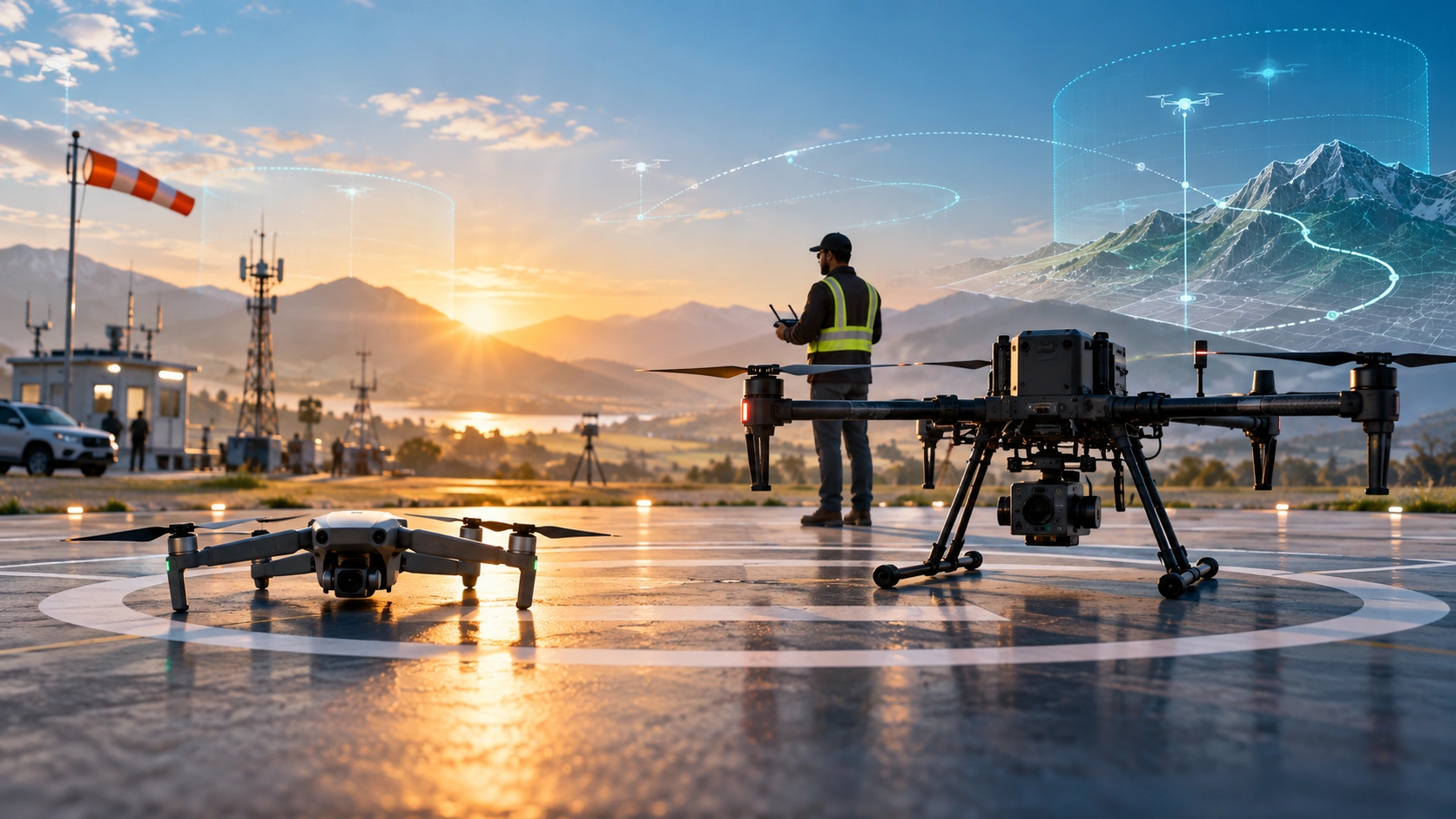
Choosing the right drone pilot certification starts with understanding which category your drone belongs to.
In India, drones are classified according to their maximum all-up weight, including payload. Under the Drone Rules framework, a Small drone weighs more than 2 kg and up to 25 kg, while a Medium drone weighs more than 25 kg and up to 150 kg.
This distinction matters because a Remote Pilot Certificate (RPC) is associated with the applicable drone category, sub-category and class for which the pilot has completed the required training and assessment. DGCA’s current RPC verification system displays these endorsement details.
If you are researching a small category drone license, the first question should therefore be:
What is the maximum all-up weight of the drone I intend to operate, including its payload?
For many professional applications such as surveying, mapping, inspection, construction documentation and aerial data collection, Small category drones are commonly relevant.
But if the aircraft exceeds 25 kg, the Medium category becomes relevant and the pilot needs the appropriate training and RPC endorsement.
What Is a Small Category Drone?
A Small drone is one with a maximum all-up weight greater than 2 kg and up to 25 kg, including payload.
This category covers many professional drone platforms used for commercial and technical applications.
Small drones can be used in areas such as:
- Surveying
- Mapping
- Construction
- Infrastructure monitoring
- Inspection
- Agriculture
- Mining
- Real estate
- Photography and videography
- Geospatial data collection
The important point is that the classification is based on maximum all-up weight, not simply the physical size of the drone.
A compact-looking drone carrying a heavier payload can potentially fall into a different category depending on its applicable maximum all-up weight.
What Is a Medium Category Drone?
A Medium drone has a maximum all-up weight greater than 25 kg and up to 150 kg, including payload.
Medium-category aircraft are generally larger and can support more substantial payload configurations than Small-category drones.
Depending on the aircraft and operation, Medium drones can be relevant to specialised applications involving:
- Large-area operations
- Heavy payloads
- Industrial applications
- Infrastructure
- Agriculture
- Surveying
- Logistics and other specialised operations
However, the drone’s weight category is only one part of operational compliance.
Airspace, aircraft certification, registration, operational conditions and other applicable requirements must also be considered before a flight.
What Is the Difference Between Small and Medium Drones?
The primary difference is the maximum all-up weight including payload.
| Drone Category | Maximum All-Up Weight Including Payload |
|---|---|
| Nano | Up to 250 g |
| Micro | More than 250 g to 2 kg |
| Small | More than 2 kg to 25 kg |
| Medium | More than 25 kg to 150 kg |
| Large | More than 150 kg |
These categories are defined under India’s Drone Rules framework.
The boundary is important.
A drone weighing exactly 25 kg falls within the Small category.
A drone weighing more than 25 kg falls within the Medium category.
The weight should be considered with the applicable payload rather than looking only at the drone’s empty or basic configuration.
Do You Need a Small Category Drone License in India?
If you intend to operate a Small-category drone, you need the applicable Remote Pilot Certificate for that class, subject to the current regulatory requirements.
The terminology can cause confusion because people commonly search for:
- Small category drone license
- Small drone pilot licence
- DGCA small drone licence
- Small drone certificate
- Small category RPC
- DGCA drone pilot certificate
The current official terminology is Remote Pilot Certificate (RPC). The Drone (Amendment) Rules, 2022 replaced the earlier Remote Pilot Licence terminology with Remote Pilot Certificate and provide for the certificate to be issued by an authorised Remote Pilot Training Organisation.
The current DGCA RPC verification system also records the applicable category, sub-category and class of UAS associated with the pilot’s training and endorsement.
Does a Small Category RPC Cover a Medium Drone?
No. You should not assume that a Small-category RPC automatically authorises you to operate a Medium-category drone.
DGCA’s training and certification framework treats the class of UAS as part of the pilot’s endorsement.
DGCA guidance on upgrading an RPC gives the example of a pilot moving from a Small Class RPC to a Medium Class RPC. The pilot must undergo training in the appropriate class through an appropriately authorised RPTO, pass the test and obtain an updated RPC.
This is one of the most important points for pilots planning to move from Small to Medium drones.
A Small-category certificate should not be treated as a blanket certificate for heavier drone classes.
If your planned aircraft changes from Small to Medium, check the applicable training and endorsement requirements before operating it.
Do Small and Medium Categories Have Separate RPCs?
The more accurate way to understand this is that the RPC carries the applicable class endorsement.
DGCA’s current verification system displays:
- Category of UAS
- Sub-category of UAS
- Class of UAS
- Training category
- Date of endorsement
- RPTO name
For example, a current RPC verification record can show a Rotorcraft/RPAS/Small endorsement.
DGCA’s training guidance also provides for an RPC class upgrade, such as moving from Small Class RPC to Medium Class RPC after completing the appropriate training and test.
Therefore, the important question is not simply:
“Do I have a drone licence?”
It is:
“Does my RPC have the appropriate endorsement for the drone class I intend to operate?”
What Is the Weight Limit for a Small Category Drone?
The Small category covers drones with a maximum all-up weight:
More than 2 kg and up to 25 kg, including payload.
Examples could include professional drones used for:
- Surveying
- Mapping
- Inspection
- Construction
- Agriculture
- Infrastructure monitoring
The exact aircraft and payload configuration should always be checked against the applicable classification and certification information.
Do not classify a drone simply based on the manufacturer’s marketing description.
What Is the Weight Limit for a Medium Category Drone?
The Medium category covers drones with a maximum all-up weight:
More than 25 kg and up to 150 kg, including payload.
This is a substantially wider weight range than the Small category.
Because Medium-category platforms can involve heavier aircraft and payload configurations, operators should pay particular attention to:
- Aircraft certification
- Pilot training
- RPC endorsement
- Operational planning
- Payload
- Maintenance
- Safety procedures
- Airspace requirements
The drone’s weight category should be established before selecting the appropriate pilot training route.
What Happens If Your Drone Is Exactly 25 kg?
A drone with a maximum all-up weight of exactly 25 kg falls within the Small category.
The Small category is defined as:
Greater than 2 kg and less than or equal to 25 kg.
The Medium category begins when the maximum all-up weight is greater than 25 kg.
This distinction is particularly important when selecting a drone, payload or configuration for a professional project.
If adding a payload changes the applicable maximum all-up weight or aircraft classification, the pilot and operator should verify the correct regulatory category before flying.
Does Payload Affect the Drone Category?
Yes. Drone classification is based on maximum all-up weight including payload.
This means you should not look only at the aircraft’s basic weight.
Consider a simplified example:
Drone: 23 kg
Payload: 2 kg
Maximum all-up weight: 25 kg
That falls within the Small category.
But if the applicable maximum all-up weight exceeds 25 kg, the aircraft enters the Medium category.
Payload selection can therefore be an important part of project planning.
For professional operations involving cameras, LiDAR sensors, thermal cameras or other equipment, confirm the aircraft’s applicable maximum all-up weight before determining the appropriate pilot certification.
What Training Is Required for Small Category Drone Operations?
The applicable Remote Pilot Certificate training must be completed through an appropriately authorised RPTO.
DGCA’s Remote Pilot Training syllabus covers subjects including:
- Drone Rules
- Airspace
- Principles of flight
- ATC procedures
- Aerodynamics
- Weather and meteorology
- Drone maintenance
- Risk assessment
- Safety
- Payload operations
- Drone data
- Simulator training
- Practical flying
DGCA’s training syllabus specifically includes Micro, Small and Medium classes within the Cat 1 VLOS training framework.
The appropriate training route depends on the class and operational requirements involved.
What Training Is Required for Medium Category Drone Operations?
Medium-category operations require training appropriate to the Medium class and the applicable training category.
DGCA’s training syllabus includes Medium along with Micro and Small within the relevant training frameworks.
However, candidates should not assume that completing a Small-category course automatically provides Medium-category endorsement.
If you already hold a Small Class RPC and want to move to Medium, DGCA’s guidance provides for training in the appropriate class, passing the applicable test and obtaining an updated RPC.
The training organisation you choose should therefore have the appropriate authorisation and training scope for the class you need.
Which Is Better: Small or Medium Category Drone Certification?
Neither category is universally “better.” The correct choice depends on the drone and the work you intend to perform.
For many professional users, a Small-category drone may be the more practical starting point.
A Medium-category drone may become relevant when the project requires a heavier aircraft or payload.
| Requirement | Small Category | Medium Category |
|---|---|---|
| Weight | >2 kg to 25 kg | >25 kg to 150 kg |
| Typical use | Surveying, mapping, inspection, construction | Specialised heavier-payload operations |
| RPC | Appropriate Small endorsement | Appropriate Medium endorsement |
| Training | Small-class training | Medium-class training |
| Payload capability | Lower than heavier platforms | Higher potential payload capability |
| Operational complexity | Depends on project | Can increase with aircraft and mission requirements |
The decision should therefore begin with the project requirement, not the certificate itself.
Who Should Choose a Small Category Drone?
A Small-category drone may be appropriate if your professional work involves:
Surveying and Mapping
Small drones are widely suited to aerial data collection for surveying and mapping workflows.
Applications can include:
- Orthomosaic generation
- Topographic mapping
- 3D modelling
- Contour mapping
- Site surveys
- Volume calculations
Construction
Construction teams can use drones for:
- Site documentation
- Progress tracking
- Mapping
- Earthwork monitoring
- Stockpile measurement
Inspection
Small drones can support inspection of:
- Buildings
- Solar installations
- Industrial assets
- Infrastructure
- Electrical assets
Depending on the project, RGB and thermal payloads can be used for different inspection requirements.
Agriculture
Professional drone platforms can support agricultural data collection and other authorised agricultural applications.
Real Estate and Aerial Media
Small-category platforms can also be used for professional aerial photography and videography where the applicable regulatory requirements are met.
For many candidates entering professional drone operations, the Small category can therefore provide a practical starting point.
Who May Need a Medium Category Drone?
A Medium-category drone may be relevant when the aircraft’s maximum all-up weight exceeds 25 kg but does not exceed 150 kg.
Potential applications can include specialised operations involving:
- Heavier payloads
- Larger aircraft
- Industrial applications
- Large-area operations
- Agriculture
- Infrastructure
- Surveying
- Other specialised drone missions
However, choosing a Medium drone simply because it can carry more weight is not always the best solution.
A larger aircraft can also mean:
- More complex logistics
- More demanding transportation
- More complex maintenance
- Different operational planning
- Greater equipment requirements
- Different training needs
The aircraft should therefore be selected based on the actual project requirements.
Can a Small Drone Be Used for Professional Surveying?
Yes. Small-category drones can be used for professional surveying and mapping applications when the aircraft, pilot, operation and project comply with the applicable requirements.
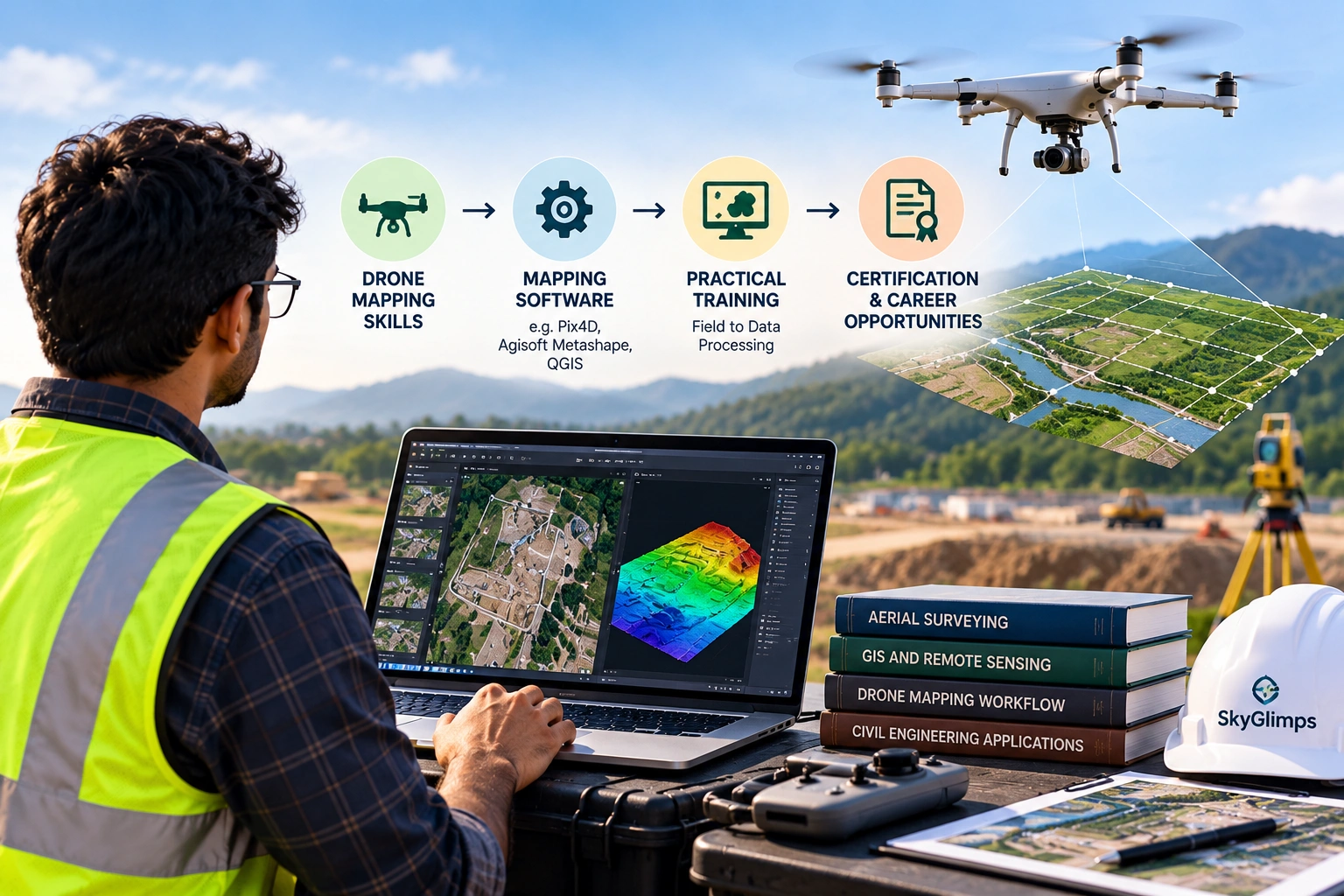
Surveying workflows can involve:
- Flight planning
- Ground control
- RTK/PPK
- Image acquisition
- Photogrammetry
- Orthomosaic generation
- Point clouds
- Digital elevation models
- Contour mapping
- Volume calculations
- GIS
The pilot certificate is only one part of the overall workflow.
For professional surveying, the operator may also need knowledge of:
- Survey principles
- Coordinate systems
- Photogrammetry
- GIS
- Data quality control
- Accuracy requirements
This is why specialised training can be valuable beyond basic drone flying.
Is a Small Category Drone License Enough for Drone Surveying?
The appropriate Small-category RPC can provide the pilot qualification for operating a Small drone, but it does not automatically make the pilot a surveying professional.
A drone survey project can require knowledge of:
- Mission planning
- GCPs
- RTK/PPK
- GSD
- Photogrammetry
- Orthomosaics
- DEM/DSM/DTM
- GIS
- Quality control
- Survey deliverables
A pilot who combines drone certification with surveying and mapping knowledge can therefore be better prepared for technical projects.
This distinction is important for anyone planning a career in drone surveying.
Can You Upgrade From Small to Medium Category?
Yes, DGCA guidance provides a pathway for upgrading the class endorsement on an RPC.
The relevant guidance states that a remote pilot seeking a class upgrade must undergo training in the appropriate class through an appropriately authorised RPTO, pass the test and obtain an updated RPC. The document gives Small Class RPC to Medium Class RPC as an example.
This means you do not necessarily need to start your entire drone career with a Medium-category course simply because you may work with larger drones later.
You can build your experience with the appropriate category and pursue an applicable upgrade when your professional requirements change.
The exact training and assessment requirements should be confirmed with the RPTO conducting the upgrade.
Can You Fly a Medium Drone With a Small Category RPC?
You should not operate a Medium-category drone solely on the basis of a Small-category RPC.
The RPC records the applicable UAS class endorsement, and DGCA’s framework provides for specific training and testing when upgrading from Small to Medium.
For example:
Small RPC → Medium drone
This should not be treated as automatically authorised.
Instead, the pilot should determine:
- What class the drone belongs to.
- What class is endorsed on the RPC.
- Whether additional training is required.
- Whether an assessment is required.
- Whether the RPC needs to be updated.
- Whether the RPTO has the appropriate authorisation.
This simple verification step can prevent a major compliance mistake.
Does the Drone Category Affect the Type of Training You Need?
Yes. The training must correspond to the applicable class and operational requirements.
DGCA’s training syllabus explicitly distinguishes training categories and includes Micro, Small and Medium classes within its applicable frameworks.
Training can cover areas such as:
- Regulations
- Airspace
- Flight principles
- Aerodynamics
- Weather
- Maintenance
- Risk assessment
- Safety
- Payloads
- Simulator operations
- Practical flying
The exact training structure depends on the applicable category and RPTO scope.
Before enrolling, candidates should ask the RPTO:
“Does your authorisation cover the exact drone class I need?”
That question is more important than simply asking whether the institute offers a “DGCA drone course.”
What Is the Difference Between a Small Category RPC and a Medium Category RPC?
The most important difference is the UAS class endorsement.
| Factor | Small Category RPC | Medium Category RPC |
|---|---|---|
| Applicable drone class | Small | Medium |
| Drone weight | >2–25 kg | >25–150 kg |
| Includes payload | Yes | Yes |
| Training | Appropriate Small class | Appropriate Medium class |
| Practical assessment | Required as applicable | Required as applicable |
| Automatic coverage of other class | No | No |
| Upgrade possible | Can be upgraded where applicable | Subject to applicable pathway |
The current DGCA RPC verification framework makes the class endorsement visible on the certificate record.
Therefore, always check the exact endorsement rather than relying on the generic phrase “DGCA-certified drone pilot.”
What Should You Check Before Choosing a Drone Pilot Course?
If you are planning to obtain a small category drone license, check the following before enrolling.
1. RPTO Authorisation
Verify that the organisation is authorised to provide the applicable remote pilot training.
2. Drone Class
Confirm whether the course is for:
- Micro
- Small
- Medium
- Another applicable class
3. UAS Category
Check whether the training covers the type of aircraft you intend to operate, such as:
- Rotorcraft
- Aeroplane
- Hybrid
4. Practical Flying
Check how much supervised practical flying is included.
5. Assessment
Understand the theory and practical assessment process.
6. Training Location
Confirm where classroom and practical flying sessions take place.
7. Certification Process
Ask how the RPTO handles the RPC process after successful completion.
8. Industry Exposure
If your goal is a career, consider whether the training also provides exposure to real-world drone applications.
What Does SkyGlimps Offer for Small Category Drone Training?
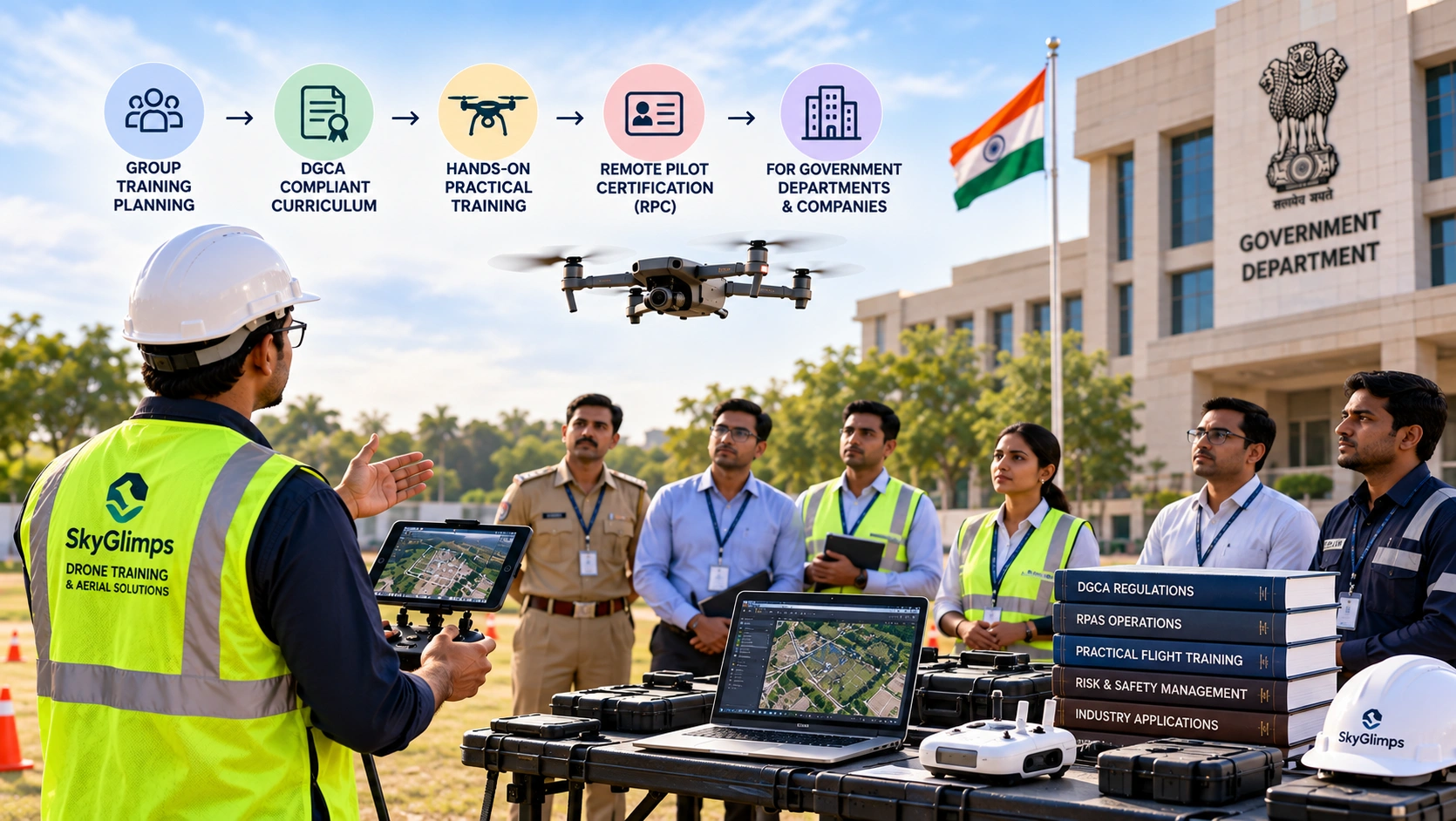
SkyGlimps currently offers DGCA-Certified Small Category Drone Pilot Training through its Kolkata-based Remote Pilot Training Organisation. The programme is designed for beginners and professionals interested in building skills for the drone industry.
The current programme includes:
- Drone regulatory framework
- Flight fundamentals
- ATC procedures
- Aerodynamics
- Weather and meteorology
- Drone maintenance
- Risk assessment
- Safety
- Payload operations
- Drone data processing
- Simulator training
- Basic assembly and maintenance
- Instructor-supervised practical flying
- Solo-flight progression
- Night flying operations
- Final flying test
The programme is structured over 6 days. Classroom training is conducted in New Town, Kolkata, while practical flying takes place at the flying ground in Singur, West Bengal.
SkyGlimps currently lists eligibility requirements including:
- Minimum age of 18 years
- Class 10 pass or equivalent
- Valid government-issued ID
- Medical fitness certificate
The current course page lists RPTO Authorization No. RPTO202600112.
For candidates specifically looking for Small-category training, SkyGlimps DGCA-Certified Drone Pilot Training provides the current course details.
How Do You Know Which RPC You Need?
Use this simple decision process.
Step 1: Check Your Drone’s Maximum All-Up Weight
Include the applicable payload when determining the classification.
Step 2: Identify the Category
Up to 250 g: Nano
More than 250 g to 2 kg: Micro
More than 2 kg to 25 kg: Small
More than 25 kg to 150 kg: Medium
More than 150 kg: Large
The classification is based on maximum all-up weight including payload.
Step 3: Determine Your Operation
Consider:
- Commercial or professional use
- Surveying
- Inspection
- Construction
- Agriculture
- Photography
- Infrastructure
- Other specialised applications
Step 4: Check the Required Pilot Qualification
Determine whether your intended operation requires an RPC and which class endorsement applies.
Step 5: Select the Appropriate RPTO
Choose an RPTO authorised for the class and training route you need.
Step 6: Verify Your RPC Endorsement
After certification, check that your RPC shows the applicable category, sub-category and class.
DGCA’s current verification system provides these endorsement details.
What If You Already Have a Small Category RPC?
If you already hold a Small-category RPC and your employer or project later requires a Medium-category drone, do not simply begin operating the heavier aircraft.
Instead:
- Check the new drone’s classification.
- Confirm its maximum all-up weight.
- Check your current RPC endorsement.
- Contact an appropriately authorised RPTO.
- Complete the applicable Medium-class training.
- Pass the required assessment.
- Obtain the updated RPC endorsement.
DGCA’s training guidance specifically describes this type of class upgrade from Small to Medium.
This approach allows your certification to develop alongside your professional responsibilities.
Frequently Asked Questions
A Small drone is one with a maximum all-up weight greater than 2 kg and up to 25 kg, including payload.
A Medium drone has a maximum all-up weight greater than 25 kg and up to 150 kg, including payload.
“Small category drone license” is a common search term for the pilot qualification applicable to operating a Small-category drone. The current official terminology is Remote Pilot Certificate (RPC).
No. You should not assume that a Small-class RPC covers a Medium-class drone. DGCA guidance provides for appropriate Medium-class training, testing and an updated RPC when upgrading from Small to Medium.
A Small drone can have a maximum all-up weight of more than 2 kg and up to 25 kg, including payload.
A Medium drone can have a maximum all-up weight of more than 25 kg and up to 150 kg, including payload.
A drone with a maximum all-up weight of exactly 25 kg is Small category. Medium begins above 25 kg.
Yes. The classification is based on maximum all-up weight including payload.
Yes. DGCA guidance provides for training in the appropriate class through an appropriately authorised RPTO, passing the test and obtaining an updated RPC.
Yes. SkyGlimps currently offers a 6-day DGCA-Certified Small Category Drone Pilot Training programme and lists beginners among its intended participants.
Small or Medium: Choose Based on the Drone You Will Actually Operate
The difference between Small and Medium drone categories is straightforward when you look at maximum all-up weight including payload:
Small: More than 2 kg to 25 kg
Medium: More than 25 kg to 150 kg
The more important consideration is that your Remote Pilot Certificate should carry the appropriate class endorsement for the drone you intend to operate. DGCA’s current RPC system records the relevant UAS category, sub-category and class, while its training guidance provides a route for upgrading from Small to Medium through appropriate training, testing and an updated RPC.
For many professionals entering drone surveying, mapping, inspection, construction, agriculture and infrastructure applications, a Small category drone license, more accurately referred to as a Small-category Remote Pilot Certificate, can be the appropriate starting point.
If your work later requires a drone above 25 kg, you can evaluate the applicable Medium-category training and certification pathway.
The key is not to choose a certificate simply because one category sounds more advanced.
Choose the certification that matches the drone, payload, project and professional work you actually intend to perform.
For candidates looking to begin with Small-category training, SkyGlimps DGCA-Certified Drone Pilot Training provides the current course structure, eligibility requirements and training details.