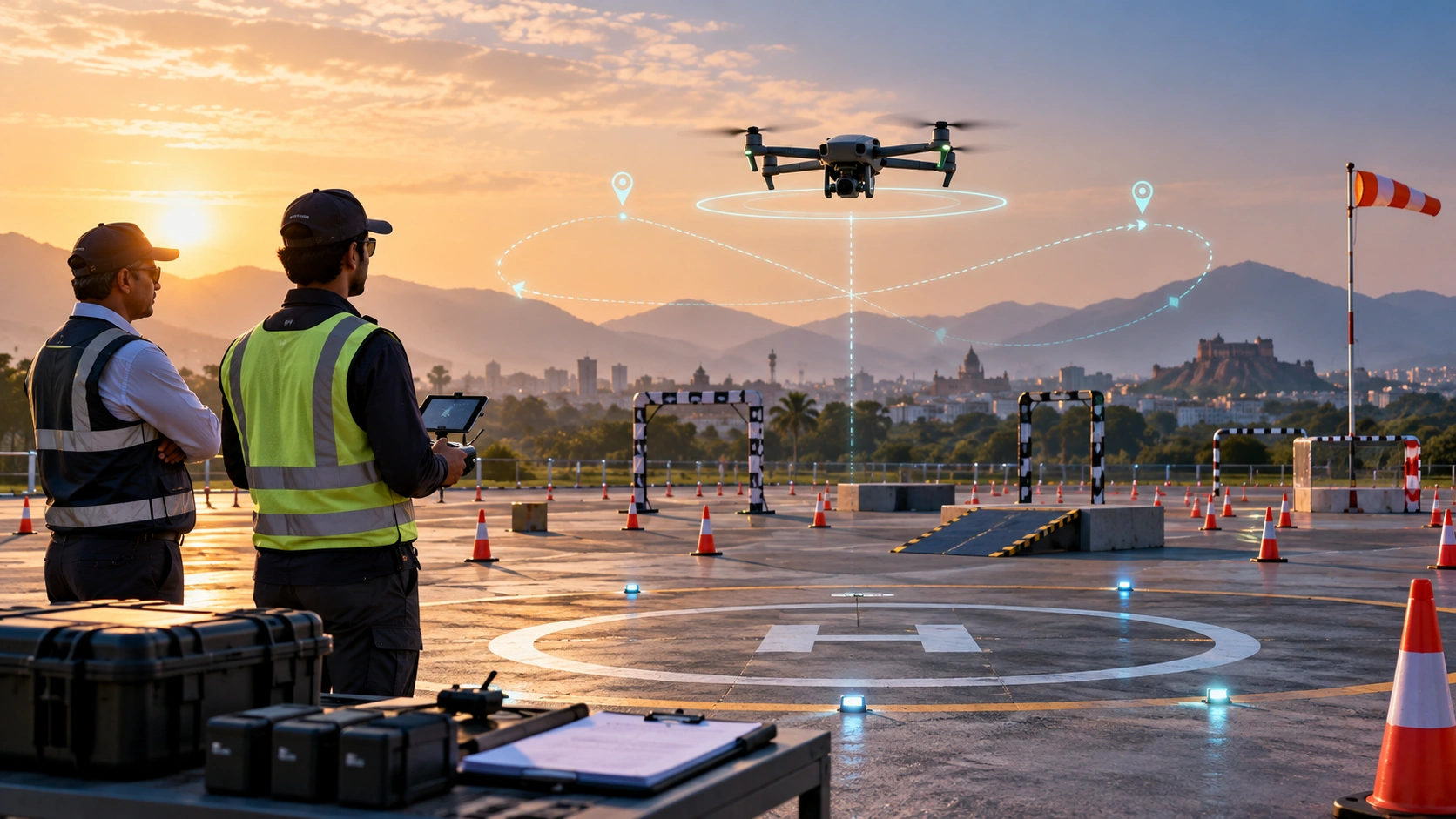
Completing drone pilot training involves more than learning the theory of drone operations. Candidates also need to demonstrate that they can safely and confidently operate a drone during practical flying.
This is where the DGCA drone practical test becomes important.
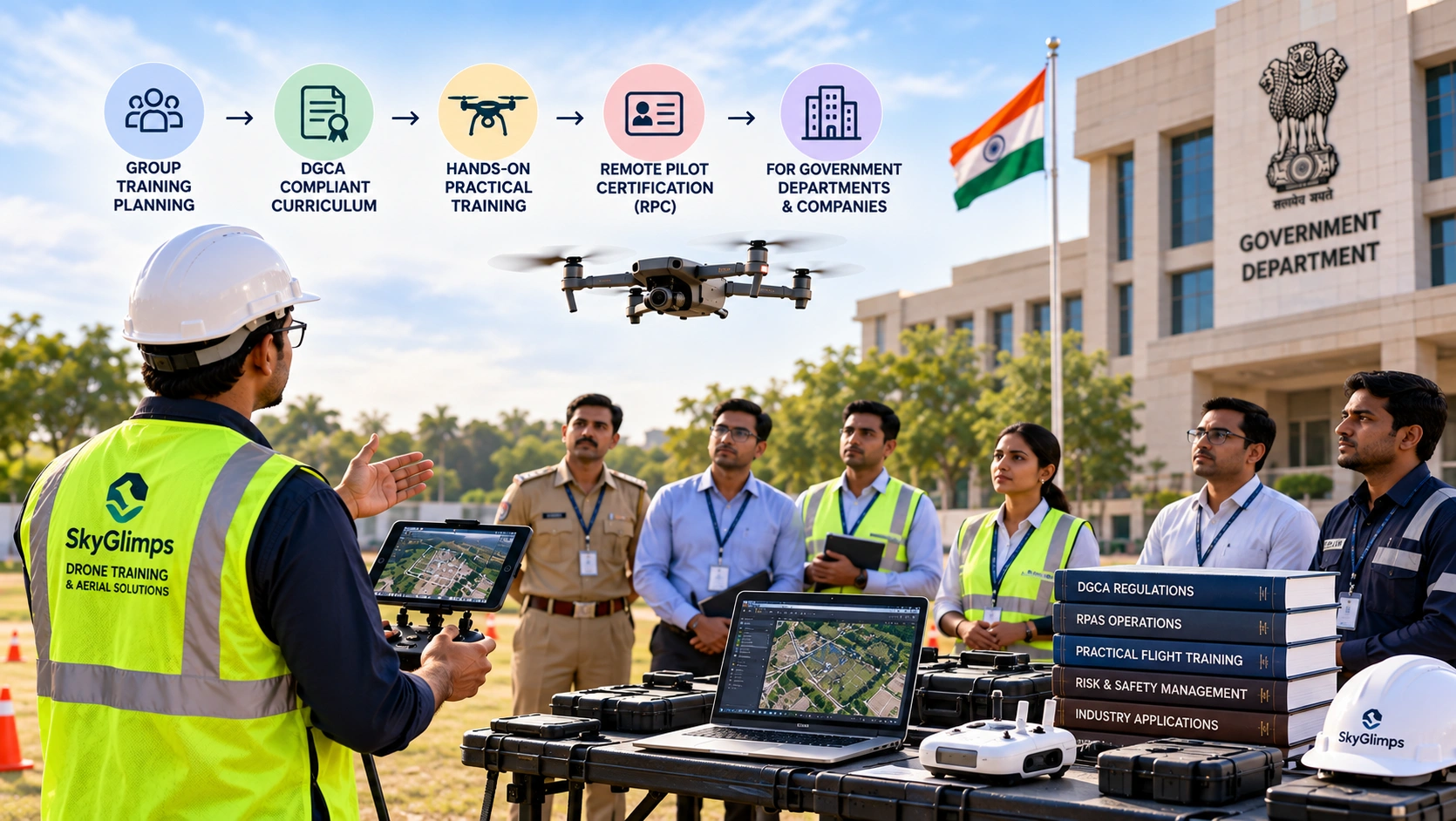
For candidates pursuing a Remote Pilot Certificate (RPC), practical training is designed to develop the flying skills needed for professional drone operations. The DGCA training syllabus includes supervised flying, solo flying, flight simulator training, basic controls, manoeuvres, mission planning, emergency procedures and a final practical test.
For the Cat-1 VLOS multirotor pathway, the syllabus specifically includes a Final Test – Multirotor, listed as a 20-minute test. The training leading up to that assessment covers several manoeuvres and operational skills.
Understanding what you will practise before the test can make the assessment less intimidating and help you prepare more effectively.
What Is the DGCA Drone Practical Test?
The DGCA drone practical test is the practical flying assessment used to verify that a candidate can operate the applicable drone safely and demonstrate the required flying skills.
The practical component forms part of the Remote Pilot training pathway.
DGCA’s Drone Training Circular 02 of 2022 specifies practical flying with instructor and solo flying as part of the Cat-1 VLOS training syllabus. It also includes simulator training, assembly and maintenance, mission planning, night flying and abnormal/emergency procedures.
The final practical assessment is not simply about keeping a drone in the air.
Candidates are expected to develop control over:
- Take-off and landing
- Climb and descent
- Maintaining height
- Pitch, roll and yaw
- Direction and orientation
- Turns
- Square or rectangular patterns
- Circular flight
- Figure-of-eight manoeuvres
- Disorientation and recovery
- Mission planning
- Auto mission and flight
- Night flying
- Abnormal and emergency procedures
The exact assessment depends on the drone category, class and training pathway.
Is the DGCA Practical Test the Same for Every Drone?
No. The practical syllabus varies according to the aircraft category and training pathway.
DGCA’s Cat-1 VLOS syllabus provides separate flying-class blocks for:
- Rotorcraft
- Hybrid
- Aeroplane
- Combination training
The multirotor/rotorcraft syllabus is different from the aeroplane and hybrid syllabus because the aircraft controls and operating characteristics are different.
For example, the multirotor syllabus includes:
- Basic controls
- Level turns
- Climbing and descending turns
- Square circuit patterns
- Circles
- Figure of 8
- Disorientation and recovery
- Mission planning
- Auto mission
- Night flying
- Emergency procedures
The aeroplane syllabus includes different exercises such as:
- Level flight and trim
- Banked turns
- Straight climbs
- Climbing turns
- Gliding
- Approach and landing
- Accuracy manoeuvres
- Procedure turns
- Stalls
Therefore, candidates should prepare according to the specific drone class and aircraft type covered by their course.
How Long Is the DGCA Drone Practical Test?
For the Cat-1 VLOS multirotor pathway, the DGCA syllabus lists the Final Test – Multirotor as 20 minutes.
This should not be confused with the total amount of practical training.
The practical training period is much longer because candidates need time to learn and practise the required skills before the final assessment.
DGCA’s Cat-1 syllabus specifies:
- Theory: 2 days
- Practical flying, including simulator: 3–6 days
- Total Cat-1 basic duration: approximately 5–8 days
The circular also states that the syllabus provided is the minimum and an RPTO can increase the duration or syllabus based on the class and category.
This means the final practical test may be relatively short, but preparation for it is an important part of the training programme.
What Manoeuvres Are Included in the DGCA Drone Practical Test?
For a multirotor-based Cat-1 VLOS training pathway, candidates practise a defined set of flight exercises before the final test.
1. Take-Off
The pilot must be able to initiate the flight in a controlled manner.
Take-off practice helps develop:
- Smooth throttle control
- Aircraft orientation
- Height awareness
- Control coordination
- Safe departure from the take-off area
A controlled take-off establishes the foundation for the rest of the flight.
2. Climbing and Descending
The syllabus includes climbing, descending and maintaining height.
The pilot needs to understand how control inputs affect altitude and maintain the aircraft within the intended operating area.
Good altitude control is important because unnecessary altitude changes can make later manoeuvres more difficult.
3. Pitch, Roll and Yaw
The basic controls of a multirotor involve:
Pitch: Moves the drone forward or backward.
Roll: Moves the drone sideways.
Yaw: Rotates the drone around its vertical axis.
The DGCA practical syllabus specifically includes basic controls involving pitch, roll and yaw.
Candidates should understand these controls individually and be comfortable combining them during flight.
4. Level Turns
The syllabus includes level turns in both directions.
This exercise tests the pilot’s ability to change direction while maintaining controlled flight.
Practise:
- Left turns
- Right turns
- Consistent altitude
- Smooth control inputs
- Correct orientation
Avoid making sudden or excessive control movements.
5. Climbing and Descending Turns
The practical syllabus also includes climbing and descending turns.
This requires the pilot to coordinate directional movement with altitude changes.
It demonstrates that the pilot can manage more than one flight parameter at the same time.
6. Square Circuit Patterns
Candidates are required to practise left and right square circuit patterns.
This helps demonstrate:
- Directional control
- Spatial awareness
- Consistent flight paths
- Turning accuracy
- Orientation
The objective is not simply to move the drone around four corners.
The pilot should maintain deliberate and controlled movement throughout the pattern.
7. Flying in Circles
Circular flight is another listed practical exercise.
This requires the pilot to coordinate movement smoothly while maintaining awareness of:
- Position
- Direction
- Altitude
- Orientation
- Flight path
Practise circles in both directions if your instructor includes both during training.
8. Figure-of-Eight Manoeuvre
The figure-of-eight is specifically included in the multirotor flying syllabus.
This is an important exercise because it combines directional control and spatial awareness.
A common mistake is trying to complete the manoeuvre too quickly.
Instead, focus on:
- Smooth turns
- Consistent altitude
- Correct orientation
- Controlled speed
- Clear crossing point
- Avoiding abrupt stick movements
Accuracy is more important than rushing.
9. Disorientation and Recovery
The syllabus includes disorientation and recovery.
This is particularly important for developing practical pilot judgement.
A pilot can become disoriented when:
- The drone is facing toward the pilot
- The aircraft is farther away
- The pilot loses a clear visual reference
- Orientation changes during a manoeuvre
The objective is to recognise the situation and recover controlled flight safely.
Do not practise deliberate disorientation without proper instructor supervision.
10. Mission Planning
Mission planning is also part of the practical syllabus.
A professional drone pilot should not approach a flight as simply:
“Take off and fly.”
A flight should be planned around:
- Mission objective
- Flight area
- Aircraft
- Weather
- Airspace
- Operational restrictions
- Safety
- Battery considerations
- Payload
- Flight path
Good mission planning helps reduce operational risks before the drone leaves the ground.
11. Auto Mission and Flight
The syllabus includes auto mission and flight.
Depending on the training setup, candidates may be introduced to automated mission planning and execution.
This helps candidates understand the relationship between:
- Mission planning
- Ground control station
- Flight path
- Aircraft behaviour
- Monitoring
- Pilot responsibility
Automation does not remove the pilot’s responsibility to monitor the flight and respond appropriately.
12. Night Flying
Night flying is included in the practical training syllabus.
Night operations require additional attention to:
- Visibility
- Orientation
- Lighting
- Flight environment
- Safety
- Operational conditions
SkyGlimps’ current Small Category Drone Pilot Training programme also includes night flying operations before the final flying test.
13. Abnormal and Emergency Procedures
The practical syllabus includes abnormal/emergency procedures.
Candidates should understand how to respond when something does not go according to plan.
Training can cover situations such as:
- Loss of control link
- Fly-away
- Loss of power
- Other emergencies
- Fail-safe functions
DGCA’s syllabus also includes emergency handling and risk assessment as part of the wider training programme.
The important skill is not memorising an emergency response.
It is developing the ability to remain controlled, identify the problem and follow the correct procedure.
What Does the Practical Test Actually Assess?
The practical assessment is intended to demonstrate that the candidate has developed the required operational competence, rather than simply memorised flight instructions.
DGCA’s training circular describes competency as observable behaviour involving relevant knowledge, skills and attitudes under specified conditions. It encourages RPTOs to use competency-based training and assessment, including grades based on observable behaviour for individual manoeuvres and scenario elements.
This means candidates should focus on how they fly, not just whether they can complete a manoeuvre.
Important areas include:
Aircraft Control
Can you maintain controlled movement without excessive or unpredictable inputs?
Orientation
Can you understand the aircraft’s position and direction during flight?
Altitude Control
Can you maintain the required height while performing manoeuvres?
Directional Accuracy
Can you follow the intended flight path?
Smoothness
Can you operate the controls progressively rather than making sudden corrections?
Safety Awareness
Do you maintain awareness of the aircraft, surroundings and operating conditions?
Recovery
Can you respond appropriately when orientation or flight conditions become difficult?
Procedure
Can you follow the required operational sequence before, during and after flight?
The exact marking methodology and assessment procedure are determined by the applicable RPTO’s approved training and procedure framework. Candidates should therefore ask their RPTO for the current assessment format.
Is There a Fixed DGCA Practical Test Marking Scheme?
Candidates should not assume that there is one universal public marking sheet that is identical for every RPTO and every aircraft type.
DGCA’s training circular establishes the minimum training and assessment framework and encourages competency-based assessment based on observable behaviour.
The practical assessment therefore needs to be understood within the context of:
- Drone category
- Aircraft type
- Training category
- RPTO
- Applicable syllabus
- Approved training procedures
Your instructor should explain the assessment expectations before your final test.
If you are unsure about how your performance will be assessed, ask:
“Which manoeuvres will I be assessed on, and what standard do I need to demonstrate for each one?”
That is a much better preparation strategy than trying to guess what the examiner will ask you to do.
What Happens Before the Final Practical Test?
The final test comes after structured training.
For a typical Cat-1 multirotor pathway, the training sequence includes:
Simulator → Aircraft familiarisation → Safety briefing → Practical flying → Progress check → Manoeuvre practice → Solo flying → Final test
The DGCA syllabus specifically includes practical flying with instructor/solo flying followed by a progress check and the listed manoeuvres before the final multirotor test.
This means candidates should not expect to walk onto the flying ground for the first time and immediately take the final test.
The purpose of training is to progressively build competence.
How Should You Prepare for the DGCA Drone Practical Test?
The best preparation is structured practice rather than last-minute memorisation.
1. Master Basic Controls First
Before attempting advanced patterns, become comfortable with:
- Pitch
- Roll
- Yaw
- Throttle
- Take-off
- Landing
- Hovering
- Climbing
- Descending
If these controls are not comfortable, more complex manoeuvres will become difficult.
2. Practise Orientation
Orientation is one of the most important practical skills.
Practise understanding:
- Drone facing away from you
- Drone facing toward you
- Left/right movement
- Direction changes
- Position relative to the pilot
This becomes particularly important during figure-of-eight and circular manoeuvres.
3. Practise Slowly
Do not try to impress the instructor by flying aggressively.
During preparation, focus on:
Control → Accuracy → Consistency → Speed
Speed should come later.
A slow and controlled manoeuvre is generally easier to correct than a fast and unstable one.
4. Repeat Each Manoeuvre
Do not practise the entire flight only once.
Repeat:
- Left turns
- Right turns
- Square patterns
- Circles
- Figure of 8
- Climb/descent
- Orientation recovery
Repetition builds consistency.
5. Practise Recovery
Ask your instructor to help you understand how to recover safely from orientation problems or abnormal situations.
Do not intentionally create dangerous conditions.
The purpose is to understand the correct response under controlled training conditions.
6. Learn the Pre-Flight Process
Flying skill is only one part of being a professional pilot.
Develop a consistent pre-flight routine.
Check:
- Aircraft condition
- Propellers
- Battery
- Controller
- GPS/positioning status where applicable
- Payload
- Flight area
- Weather
- Airspace
- Safety surroundings
DGCA’s current RPC guidance also emphasises pre-flight checks, OEM maintenance requirements, applicable RPC endorsement, airspace checking and safe distance from people and property.
7. Understand the Aircraft You Are Flying
Do not rely entirely on automated features.
Understand:
- Flight modes
- Control behaviour
- Battery indicators
- Return-to-home settings
- Warning messages
- Emergency procedures
- Controller functions
You should know what your aircraft is doing and why.
Common Mistakes Candidates Make During the Practical Test
Mistake 1: Flying Too Fast
Trying to complete manoeuvres quickly can lead to:
- Overshooting
- Poor turns
- Altitude changes
- Orientation errors
Better approach: Fly at a controlled pace.
Mistake 2: Looking Only at the Drone
A pilot needs to maintain awareness of the wider operating environment.
Do not become so focused on the aircraft that you ignore:
- People
- Obstacles
- Airspace
- Instructor instructions
- Flight boundaries
Mistake 3: Overcorrecting
If the drone moves slightly away from the intended path, avoid making an extreme control input.
Large corrections can create another error.
Use small, controlled inputs.
Mistake 4: Losing Orientation
Orientation mistakes can quickly affect the rest of the manoeuvre.
Practise orientation deliberately during training.
Mistake 5: Ignoring Pre-Flight Checks
Do not treat the practical test as purely a flying exercise.
A professional pilot needs to demonstrate operational discipline.
Mistake 6: Panicking During an Error
Making a small mistake does not automatically mean the flight is lost.
The important skill is recognising the situation and recovering safely.
Mistake 7: Not Listening to the Instructor
During training, follow the instructor’s instructions carefully.
If you do not understand a manoeuvre, ask before attempting it.
How Can Beginners Prepare for the Practical Test?
Beginners often worry because they have never operated a professional drone before.
That is exactly why structured training exists.
A good progression is:
Stage 1: Learn the Controls
Understand pitch, roll, yaw and throttle.
Stage 2: Learn Hovering
Develop basic positional and altitude control.
Stage 3: Learn Movement
Practise forward, backward and sideways movement.
Stage 4: Learn Turns
Practise controlled left and right turns.
Stage 5: Learn Patterns
Progress to:
- Square patterns
- Circles
- Figure of 8
Stage 6: Learn Recovery
Understand disorientation and appropriate recovery procedures.
Stage 7: Practise Missions
Learn mission planning and automated flight where included in the training.
Stage 8: Prepare for the Final Test
Repeat the complete sequence under instructor supervision.
This progressive approach is much more effective than trying to learn every manoeuvre in a single day.
Is Simulator Training Useful for the DGCA Practical Test?
Yes. Simulator training is included in the DGCA Cat-1 practical syllabus and can help candidates practise controls and procedures before or alongside live flying.
Simulator training can help you practise:
- Controls
- Orientation
- Take-off
- Landing
- Turns
- Descending
- Circuits
- Figure of 8
- Emergency procedures
- Night flying scenarios
SkyGlimps’ current training programme includes flight simulator training before practical flying and the final flying test.
However, simulator practice should complement—not replace—the required practical flying experience.
What Should You Do on the Day of the Practical Test?
A calm and structured approach can make the test easier.
Before Flying
- Arrive on time.
- Listen to the briefing.
- Check the aircraft.
- Check the controller.
- Confirm battery status.
- Understand the test instructions.
- Ask questions if anything is unclear.
During the Flight
- Maintain awareness of the drone.
- Follow the instructor’s instructions.
- Use smooth control inputs.
- Maintain appropriate altitude.
- Avoid unnecessary movements.
- Focus on one manoeuvre at a time.
- Stay within the designated operating area.
If You Make a Mistake
Do not immediately panic.
If the situation remains safe:
- Stabilise the drone.
- Regain orientation.
- Follow the appropriate recovery procedure.
- Continue only when instructed.
Safety should always take priority over completing a manoeuvre.
What If You Fail the Practical Test?
If you do not successfully demonstrate the required competence, the next steps depend on the applicable RPTO training and assessment procedure.
You may need:
- Additional practice
- Instructor feedback
- Further training
- A repeat assessment
The important thing is to identify why the manoeuvre was unsuccessful.
For example:
| Problem | What to Improve |
|---|---|
| Poor orientation | Orientation practice |
| Unstable turns | Smooth control inputs |
| Altitude changes | Throttle management |
| Overshooting patterns | Slower, controlled flight |
| Figure-of-eight errors | Spatial awareness |
| Recovery difficulty | Emergency/orientation training |
| Poor pre-flight discipline | Use a checklist |
The objective should be to correct the underlying skill rather than simply memorise the test sequence.
How Does the SkyGlimps Practical Training Prepare You?
SkyGlimps currently offers a 6-day DGCA-Certified Small Category Drone Pilot Training programme.
The current programme includes:
- Regulatory framework
- Flight fundamentals
- ATC procedures
- Aerodynamics
- Weather and meteorology
- Drone maintenance
- Risk assessment
- Safety
- Payload operations
- Drone data processing
- Flight simulator training
- Basic assembly and maintenance
- Instructor-supervised practical flying
- Progression toward solo flight
- Night flying operations
- Final flying test
The current course structure places practical flying on Days 4 and 5, followed by night flying operations and the final flying test on Day 6.
This gives candidates an opportunity to progress from supervised practice toward greater independence before the final assessment.
SkyGlimps currently conducts classroom training in New Town, Kolkata, with practical flying at its flying ground in Singur, West Bengal.
For candidates looking to prepare for professional drone operations, SkyGlimps DGCA-Certified Drone Pilot Training provides information about the current training structure and practical flying programme.
What Should You Ask Your RPTO Before the Practical Test?
Before your assessment, make sure you understand the test requirements.
Ask your instructor or RPTO:
- Which drone class am I being assessed on?
- Is my final test for multirotor, hybrid or aeroplane?
- Which manoeuvres will be assessed?
- How long is the final practical test?
- What are the assessment criteria?
- What happens if I make a mistake?
- What happens if weather affects the test?
- What emergency procedures should I know?
- Is night flying part of my course?
- Will the same aircraft be used for training and assessment?
- What documents or records are required?
These questions can remove unnecessary uncertainty before the test.
DGCA Practical Test Preparation Checklist
Use this checklist before your final assessment.
Flying Skills
- Take-off
- Landing
- Hovering
- Climbing
- Descending
- Maintaining height
- Pitch control
- Roll control
- Yaw control
- Left turns
- Right turns
- Climbing turns
- Descending turns
- Square circuit patterns
- Circular flight
- Figure of 8
- Orientation recovery
Operational Skills
- Pre-flight checks
- Aircraft familiarisation
- Safety briefing
- Mission planning
- Ground control station familiarity
- Auto mission and flight
- Night flying
- Emergency procedures
Personal Preparation
- Understand the aircraft controls
- Understand the test sequence
- Practise with instructor
- Practise consistently
- Ask questions about weak areas
- Avoid last-minute aggressive flying practice
- Stay focused during the assessment
DGCA Drone Practical Test vs Regular Drone Flying
One important distinction is that being able to fly a drone recreationally does not necessarily mean you are prepared for a professional practical assessment.
A recreational pilot may be comfortable with:
- Take-off
- Landing
- Basic camera movements
- Simple flight
The professional training syllabus goes further.
It covers:
- Controlled manoeuvres
- Orientation
- Recovery
- Mission planning
- Safety
- Emergency procedures
- Simulator training
- Night operations
- Practical assessment
The difference is structured competency.
A professional remote pilot is expected to operate the aircraft systematically and safely rather than simply demonstrate that they can keep it airborne.
Does the Practical Test Prove You Are a Professional Drone Surveyor?
No. The practical test assesses remote-pilot skills; it does not by itself make you a surveying, GIS, inspection or engineering professional.
This distinction is important for candidates planning a drone career.
A survey-focused professional may also need knowledge of:
- Surveying
- Photogrammetry
- GIS
- RTK/PPK
- Ground control
- Orthomosaics
- Digital elevation models
- Contour mapping
- Data quality control
Similarly, an inspection professional may need:
- RGB inspection
- Thermal imaging
- Asset inspection
- Reporting
- Infrastructure knowledge
The Remote Pilot Certificate provides the flying foundation. Specialised technical skills can help you apply drone technology to specific industries.
Frequently Asked Questions
The DGCA drone practical test is the final practical flying assessment within the applicable remote pilot training pathway. It evaluates whether the candidate can demonstrate the required flying skills and operational competence.
For the Cat-1 VLOS multirotor syllabus, the Final Test – Multirotor is listed as 20 minutes. Other aircraft categories can have different final-test structures.
The multirotor syllabus includes level turns, climbing and descending turns, square circuit patterns, circles, figure of 8, disorientation and recovery, mission planning, auto mission and flight, night flying, and abnormal/emergency procedures.
Yes. Flying in a figure of 8 is specifically listed in the Cat-1 multirotor practical flying syllabus.
Yes. Night flying is included in the Cat-1 multirotor practical syllabus. SkyGlimps also currently includes night flying operations in its Small Category training programme.
Flight simulator training is included in the DGCA Cat-1 flying-class syllabus. It is designed to help candidates practise flight controls and procedures before and alongside practical flying.
Prepare for the Test by Building Real Flying Skills
The DGCA drone practical test should not be viewed as a single 20-minute flight that you simply need to “get through.”
The final assessment comes after structured training designed to develop practical competence.
For a Cat-1 VLOS multirotor pathway, the training syllabus progresses through:
Simulator Training → Aircraft Familiarisation → Basic Controls → Instructor Flying → Solo Flying → Manoeuvre Practice → Recovery → Mission Planning → Night Flying → Final Practical Test
The final multirotor test is listed as 20 minutes, but the preparation behind that test is much more extensive.
The most important skills to develop are:
- Smooth aircraft control
- Strong orientation
- Accurate manoeuvring
- Consistent altitude
- Safe decision-making
- Emergency awareness
- Proper pre-flight discipline
- Ability to follow procedures
Do not focus only on completing the figure of 8, circle or square pattern.
Focus on why you are performing each manoeuvre, how to maintain control throughout it, and how to recover safely if something changes.
For candidates beginning their professional drone journey, SkyGlimps DGCA-Certified Drone Pilot Training currently combines theory, simulator training, supervised practical flying, solo-flight progression, night flying and a final flying test within its 6-day Small Category programme.
Ultimately, the best preparation for the practical test is not memorising a sequence.
It is developing the confidence, control and operational discipline to fly the drone safely and consistently.