If you are new to drones, choosing the right training programme can be confusing. You may come across 1-day drone workshops, beginner drone courses, drone flying classes, and full DGCA drone pilot training programmes. While all of them can help you learn about drones, they are designed for different purposes.
A one-day workshop is generally suitable for someone who wants an introduction to drones, understands how they work, learns about their applications, and gets an initial look at real drone operations.
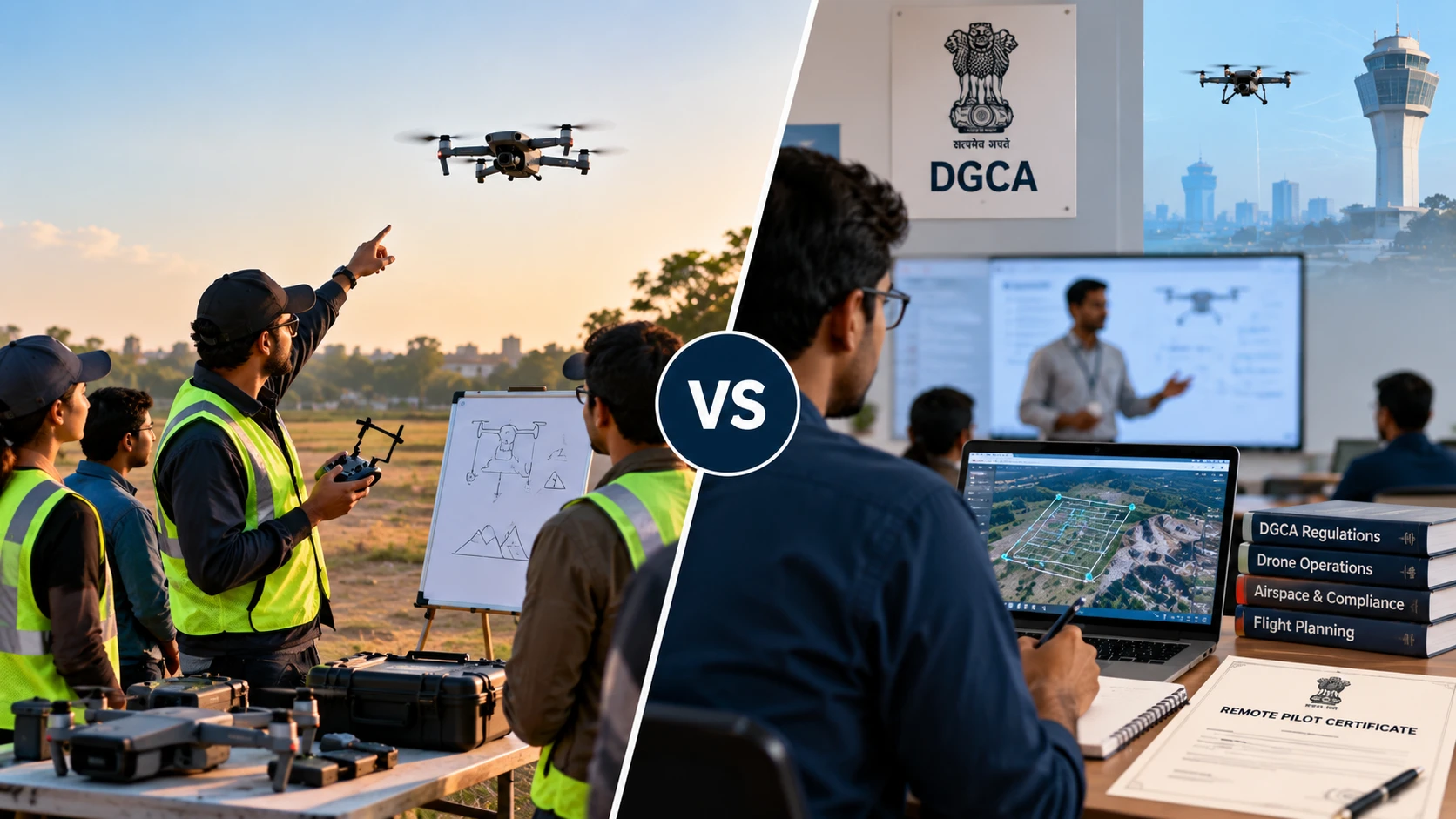
A DGCA drone pilot course is much more comprehensive. It is designed for candidates who want structured professional pilot training and, where applicable, to follow the Remote Pilot Certificate (RPC) training and assessment pathway through an authorised Remote Pilot Training Organisation (RPTO).
The difference is therefore not simply about course duration.
It is about your objective.
If you want to explore drones before committing to a professional career, a beginner drone course or one-day workshop may be enough to get started. If you want to become a professional drone pilot, you need to consider the appropriate authorised pilot training and certification pathway.
What Is a Day Beginner Drone Workshop?
A 1-day beginner drone workshop is an introductory programme designed to help people understand drones and the broader drone industry without committing to a full professional pilot course.
Such workshops are generally suitable for people who are completely new to drones.
A beginner workshop may introduce:
- What drones are
- How drones fly
- Different types of drones
- Common drone applications
- Basic drone terminology
- Drone regulations
- Airspace awareness
- Safety fundamentals
- Industry opportunities
- Basic operational concepts
Some workshops may also include a live demonstration so participants can see an actual drone being operated.
For example, Skyglimps’ 1-Day Beginner Drone Workshop is designed as an entry-level introduction to drones and the Indian drone industry. The programme is primarily theory-focused and includes a live flying demonstration. (skyglimps.com)
This makes a workshop useful for someone who wants to understand the industry before deciding whether to pursue professional training.
What Is a DGCA Drone Pilot Course?
A DGCA drone pilot course is a structured professional training programme that combines theoretical knowledge, practical flying, safety, and assessment for candidates pursuing the applicable Remote Pilot Certificate pathway.
Unlike an introductory workshop, a professional pilot course is designed around developing actual flight competency.
Training can cover areas such as:
- Drone regulations
- Airspace
- Principles of flight
- Aerodynamics
- Weather and meteorology
- Drone equipment
- Maintenance
- Risk assessment
- Safety procedures
- Emergency procedures
- Simulator training
- Practical flying
- Flight assessment
DGCA’s Remote Pilot Certificate verification framework records successful completion of both theory and practical training and successful completion of both theory and practical examinations for the applicable endorsement. (dgca.gov.in)
Therefore, professional pilot training is significantly different from attending a short introductory workshop.
Is a Day Drone Workshop Enough to Become a Professional Drone Pilot?
No. A one-day beginner workshop should not be treated as a replacement for professional remote pilot training.
A workshop can introduce you to drones and help you decide whether you want to pursue further training.
However, professional drone operations require more extensive knowledge and practical experience.
A one-day workshop may help you understand:
- How drones work
- Where drones are used
- Basic regulations
- Drone categories
- Industry opportunities
- What professional drone flying involves
But it generally does not provide enough time to develop comprehensive flight competency.
Professional training requires candidates to learn both theory and practical flying skills.
This distinction is particularly important for anyone planning to work in:
- Surveying
- Mapping
- Agriculture
- Construction
- Infrastructure
- Industrial inspection
- Power utilities
- Mining
- Aerial cinematography
- Drone service businesses
What Is the Difference Between a Beginner Drone Course and DGCA Pilot Training?
The simplest way to understand the difference is to compare the purpose, duration, practical exposure, and outcome.
| Factor | 1-Day Beginner Drone Course/Workshop | DGCA Drone Pilot Course |
|---|---|---|
| Primary purpose | Introduction to drones | Professional pilot training |
| Duration | Usually one day | Multi-day structured programme |
| Suitable for beginners | Yes | Yes |
| Drone fundamentals | Yes | Yes |
| Industry introduction | Yes | Yes |
| Regulations | Basic introduction | Structured regulatory training |
| Practical flying | Usually demonstration/limited exposure | Hands-on practical training |
| Simulator training | May not be included | May be included |
| Flight assessment | Generally not the objective | Included in applicable training |
| Professional certification pathway | No | Yes, where applicable |
| Career preparation | Introductory | Professional foundation |
| Best for | Exploring drones | Becoming a professional pilot |
The right option depends on what you want to achieve.
Who Should Choose a Day Beginner Drone Course?
A one-day beginner drone course is ideal for people who want to explore drones before investing in professional training.
It can be a good starting point for:
Students
Students who are curious about drones can learn the basics of the technology and understand the different career opportunities available in the industry.
Beginners With No Flying Experience
If you have never operated a drone before, an introductory workshop can help you understand whether drone operations interest you.
Working Professionals
Engineers, surveyors, photographers, construction professionals, and other workers may use a beginner course to understand how drones could fit into their existing profession.
Entrepreneurs
People considering a drone service business can use an introductory programme to understand potential applications before investing in equipment and advanced training.
Corporate Teams
Companies exploring drone technology can use a workshop to introduce employees to drone applications, regulations, safety, and industry use cases.
Photographers and Videographers
Media professionals can learn about drone technology and understand what additional training may be needed before incorporating drones into professional work.
The key advantage is that a workshop provides exposure without requiring the learner to immediately commit to a longer professional course.
Who Should Choose a DGCA Drone Pilot Course?
A full DGCA-authorised drone pilot training pathway is more appropriate for people who want to develop professional drone flying skills and pursue the applicable Remote Pilot Certificate.
This can include:
- Aspiring drone pilots
- Students pursuing a drone career
- Survey professionals
- Civil engineers
- Agriculture professionals
- Inspection personnel
- Photographers and videographers
- Construction professionals
- Entrepreneurs
- Drone service providers
- Corporate teams requiring trained pilots
The objective is not simply to understand drones.
The objective is to develop the knowledge, practical skills, safety awareness, and assessment readiness required for professional remote-pilot operations.
What Do You Learn in a Beginner Drone Course?
A beginner drone course is generally designed around understanding rather than professional certification.
Participants may learn:
Drone Fundamentals
You can learn:
- What a drone is
- How a drone flies
- Main drone components
- Different types of drones
- Basic flight controls
Drone Applications
The workshop can introduce applications such as:
- Mapping
- Surveying
- Agriculture
- Infrastructure monitoring
- Inspection
- Construction
- Photography
- Videography
Basic Regulations
Beginners can also be introduced to:
- Drone rules
- Airspace
- Flight restrictions
- Safety responsibilities
This is useful because a person should understand the regulatory environment before beginning independent drone operations.
Industry Opportunities
An introductory workshop can also help participants understand how drone technology is being used across different industries.
This can help students decide whether they want to pursue areas such as surveying, inspection, mapping, agriculture, cinematography, or other drone applications.
What Do You Learn in a DGCA Drone Pilot Course?
A professional pilot course goes considerably deeper.
Drone Rules and Regulations
Candidates learn about the regulatory framework and responsibilities associated with operating drones.
Principles of Flight
Training can cover:
- Lift
- Drag
- Thrust
- Weight
- Stability
- Aircraft movement
- Aerodynamics
Weather and Meteorology
Pilots need to understand how environmental conditions can affect drone operations.
Topics can include:
- Wind
- Visibility
- Temperature
- Weather conditions
- Flight risks
Risk Assessment and Safety
Candidates learn how to identify hazards before a flight.
These may include:
- People
- Buildings
- Roads
- Power lines
- Trees
- Other obstacles
- Restricted areas
- Weather conditions
Simulator Training
Simulator sessions can help candidates develop familiarity with drone controls and basic manoeuvres before or alongside actual aircraft training.
Practical Flying
Practical training allows candidates to develop:
- Take-off skills
- Landing skills
- Hovering
- Directional control
- Manoeuvring
- Aircraft orientation
- Emergency response
- Operational discipline
Flight Assessment
Candidates must demonstrate the required knowledge and practical skills through the applicable assessment process.
This is one of the biggest differences between a beginner workshop and professional pilot training.
How Much Practical Flying Do You Need?
Practical flying is one of the most important differences between an introductory workshop and professional drone pilot training.
During a one-day workshop, participants may observe a live flying demonstration or receive limited practical exposure.
The objective is generally to understand how drones operate.
A professional pilot course, however, needs substantially more practical exposure.
For example, Skyglimps’ current DGCA-Certified Drone Pilot Training programme includes simulator training, hands-on assembly and maintenance, multiple days of instructor-supervised practical flying, progression toward solo flight, night flying operations, and a final flying test. (skyglimps.com)
This progression gives candidates an opportunity to develop practical skills rather than simply observe someone else flying.
Does a Beginner Drone Course Provide a Remote Pilot Certificate?
No. An introductory beginner drone course does not automatically provide a Remote Pilot Certificate.
The certification outcome depends on the specific training programme and whether it is conducted through an authorised RPTO under the applicable framework.
A participation or course-completion certificate from a one-day workshop should not be confused with an RPC.
The distinction is simple:
Beginner workshop: Learn about drones.
Professional pilot training: Develop pilot competency and follow the applicable certification pathway.
DGCA’s current RPC system records the applicable UAS category, sub-category, class, RPTO, and completion of theory and practical training and examinations. (dgca.gov.in)
Can a Beginner Attend a DGCA Drone Pilot Course Directly?
Yes. You do not necessarily need to attend a beginner workshop before joining professional pilot training if you already meet the applicable eligibility requirements.
A professional drone pilot course can be designed for beginners.
For example, Skyglimps states that its DGCA-Certified Drone Pilot Training is open to beginners as well as working professionals. The current course requires candidates to be at least 18 years old, have passed Class 10 or equivalent, and provide the required documentation and medical fitness certificate. (skyglimps.com)
Therefore, a beginner does not necessarily need to take a one-day workshop first.
The workshop is more useful when you are still deciding whether drones are the right field for you.
Should You Take a Workshop Before a DGCA Course?
It depends on your level of certainty.
Take a 1-Day Workshop First If:
- You are completely new to drones.
- You want to understand the industry.
- You are unsure about pursuing drone training.
- You want a short introduction.
- You want to understand drone career opportunities.
- You want to see a real drone demonstration.
Go Directly to DGCA Pilot Training If:
- You already know you want to become a drone pilot.
- You want professional flight training.
- You want to pursue the applicable RPC pathway.
- You are ready for practical flying.
- You want to build a drone career.
- You want to work professionally with drones.
In other words, the workshop is an exploration step, while the pilot course is a professional training step.
How Long Does Each Training Option Take?
Duration is another major difference.
A beginner workshop is designed to provide a broad introduction within a short period.
Skyglimps currently offers its 1-Day Beginner Drone Workshop as a one-day programme in New Town, Kolkata. The workshop focuses on drone fundamentals, types of drones, DGCA rules, airspace regulations, industry applications, and a live flying demonstration. (skyglimps.com)
The professional pilot course is considerably more intensive.
Skyglimps’ current DGCA-Certified Drone Pilot Training is structured over six training days, covering theory, simulator training, practical flying, night operations, and final flying assessment. (skyglimps.com)
This difference in duration reflects the difference in learning objectives.
What About the Cost?
A one-day workshop generally costs less because it provides introductory exposure, while professional pilot training requires significantly more instructor time, practical flying, equipment, facilities, and assessment.
The current Skyglimps website lists:
| Training | Current listed duration | Current listed individual fee* |
|---|---|---|
| 1-Day Beginner Drone Workshop | 1 day | ₹7,500 + GST |
| DGCA-Certified Drone Pilot Training | 6 days | ₹25,000 + GST |
*Fees can change, so confirm the current price with Skyglimps before enrolment. (skyglimps.com) (skyglimps.com)
The difference in price should therefore be considered alongside the difference in:
- Training duration
- Practical exposure
- Instructor involvement
- Simulator training
- Assessment
- Certification pathway
- Career objective
Choosing the cheapest option is not necessarily the right decision if your actual goal is professional drone piloting.
Can a Beginner Drone Course Help With Career Planning?
Yes. A beginner drone course can help you understand which part of the drone industry interests you before choosing a specialised training path.
For example, after an introductory workshop, you may discover that you are more interested in:
Drone Surveying
You can then pursue mapping and surveying skills alongside appropriate pilot training.
Industrial Inspection
You may choose to learn about thermal and RGB inspection workflows.
Aerial Cinematography
You can develop specialised skills in camera operation and cinematic drone movements.
FPV Drones
You may choose specialised FPV building and flying training.
Agriculture
You can explore agricultural drone operations and application workflows.
This makes an introductory workshop useful for career exploration, while professional certification training establishes the foundation for actual pilot operations.
What Should You Look for in a DGCA Drone Pilot Course?
If you decide that you need professional training, do not select a course based only on the words “DGCA” or “drone pilot” in its advertisement.
Check:
- Whether the training organisation is an authorised RPTO
- Applicable drone category
- Course curriculum
- Theory training
- Practical flying
- Simulator training
- Instructor supervision
- Assessment process
- Training location
- Certification process
- Course eligibility
- Current fee
- What is included in the fee
DGCA maintains information regarding approved RPTO scopes, which candidates can use when verifying training providers. (dgca.gov.in)
The goal should be to find a programme that provides genuine training rather than simply a certificate with attractive wording.
What Should You Look for in a Beginner Drone Course?
For a one-day introductory course, the requirements are different.
Look for:
- Clear beginner-friendly curriculum
- Drone fundamentals
- Types of drones
- Industry applications
- Basic regulations
- Airspace awareness
- Safety introduction
- Real drone demonstration
- Experienced instructors
- Clear explanation of next training options
A good beginner workshop should help answer:
Do I actually want to learn drones professionally?
If the answer is yes, you can then move into a more comprehensive pilot training programme.
1-Day Workshop vs DGCA Course: Which One Do You Need?
| If Your Goal Is… | Better Option |
|---|---|
| Understand what drones are | Beginner drone course |
| Explore the drone industry | 1-day workshop |
| See a real drone demonstration | Beginner workshop |
| Learn basic drone concepts | Beginner workshop |
| Decide on a drone career | Beginner workshop |
| Become a professional drone pilot | DGCA-authorised pilot training |
| Develop practical flying skills | DGCA pilot training |
| Pursue the applicable RPC pathway | DGCA-authorised RPTO training |
| Work professionally with drones | Pilot training + specialised skills |
| Start a drone service business | Pilot training + industry/business skills |
| Enter surveying | Pilot training + surveying skills |
| Enter inspection | Pilot training + inspection skills |
The choice is therefore straightforward.
If you are exploring drones, start with a beginner course.
If you already know that you want a professional drone career, consider going directly to the appropriate DGCA-authorised pilot training programme.
Common Mistakes Beginners Make
Assuming a One-Day Course Makes You a Certified Pilot
An introductory workshop is designed for learning and exploration. It should not automatically be treated as professional pilot certification.
Choosing a Course Only Because It Says “DGCA”
Always verify what certification the course actually provides and whether the training provider is authorised for the applicable training.
Ignoring Practical Training
Professional drone flying requires hands-on experience. Watching demonstrations is not the same as operating an aircraft.
Thinking You Must Take a Beginner Course First
If you already know you want a professional drone career and meet the applicable eligibility requirements, you may be able to start directly with professional pilot training.
Focusing Only on Certification
A Remote Pilot Certificate provides the relevant pilot certification foundation, but professional careers may require additional skills in surveying, inspection, mapping, cinematography, agriculture, or other applications.
Frequently Asked Questions
A beginner drone course is an introductory programme designed to teach people the basics of drones, including how they work, different types, common applications, basic regulations, safety, and the drone industry’s career opportunities.
No. A one-day workshop is generally intended as an introduction to drones. Professional pilot training requires more comprehensive theory, practical flying, and applicable assessment through the appropriate training pathway.
Yes. Beginners can join professional pilot training if they meet the applicable eligibility requirements. A separate beginner workshop is not necessarily required before starting professional training.
Not necessarily. An introductory course completion certificate should not be confused with a Remote Pilot Certificate. Candidates pursuing an RPC should verify the authorised training and assessment pathway.
A workshop provides an introduction to drones and their applications, while a professional pilot course provides structured theoretical and practical training designed around the applicable remote pilot certification pathway.
If you are unsure about pursuing drones, a beginner workshop can help you understand the industry before making a larger commitment. If you already know you want to become a professional pilot, you may choose to start directly with the appropriate pilot training.
Yes. The applicable Remote Pilot Training Course includes practical training and assessment. DGCA’s current RPC verification framework records successful completion of both theory and practical training and examinations. (dgca.gov.in)
Yes. An introductory course can help you understand different drone applications and decide whether you are more interested in surveying, inspection, agriculture, cinematography, FPV, construction, or another area.
Choose Training Based on Your Goal
A beginner drone course and a DGCA drone pilot course serve two different purposes.
A one-day workshop is a useful starting point if you are curious about drones, want to understand the industry, or are deciding whether professional training is right for you. It provides an introduction without requiring the commitment of a longer programme.
A professional drone pilot course is the more appropriate route when your objective is to develop structured flight skills and pursue the applicable Remote Pilot Certificate pathway. It requires greater commitment because it combines theory, practical flying, safety training, simulator exposure, and assessment.
For beginners who are still exploring the industry, starting with a 1-Day Beginner Drone Workshop can be a practical first step. For those already committed to a professional drone career, Skyglimps’ DGCA-Certified Drone Pilot Training provides a structured pathway with theory and hands-on practical training. (skyglimps.com) (skyglimps.com)
The best course is therefore not necessarily the longest or the shortest one. It is the one that matches where you are now and what you want to do with drones next.