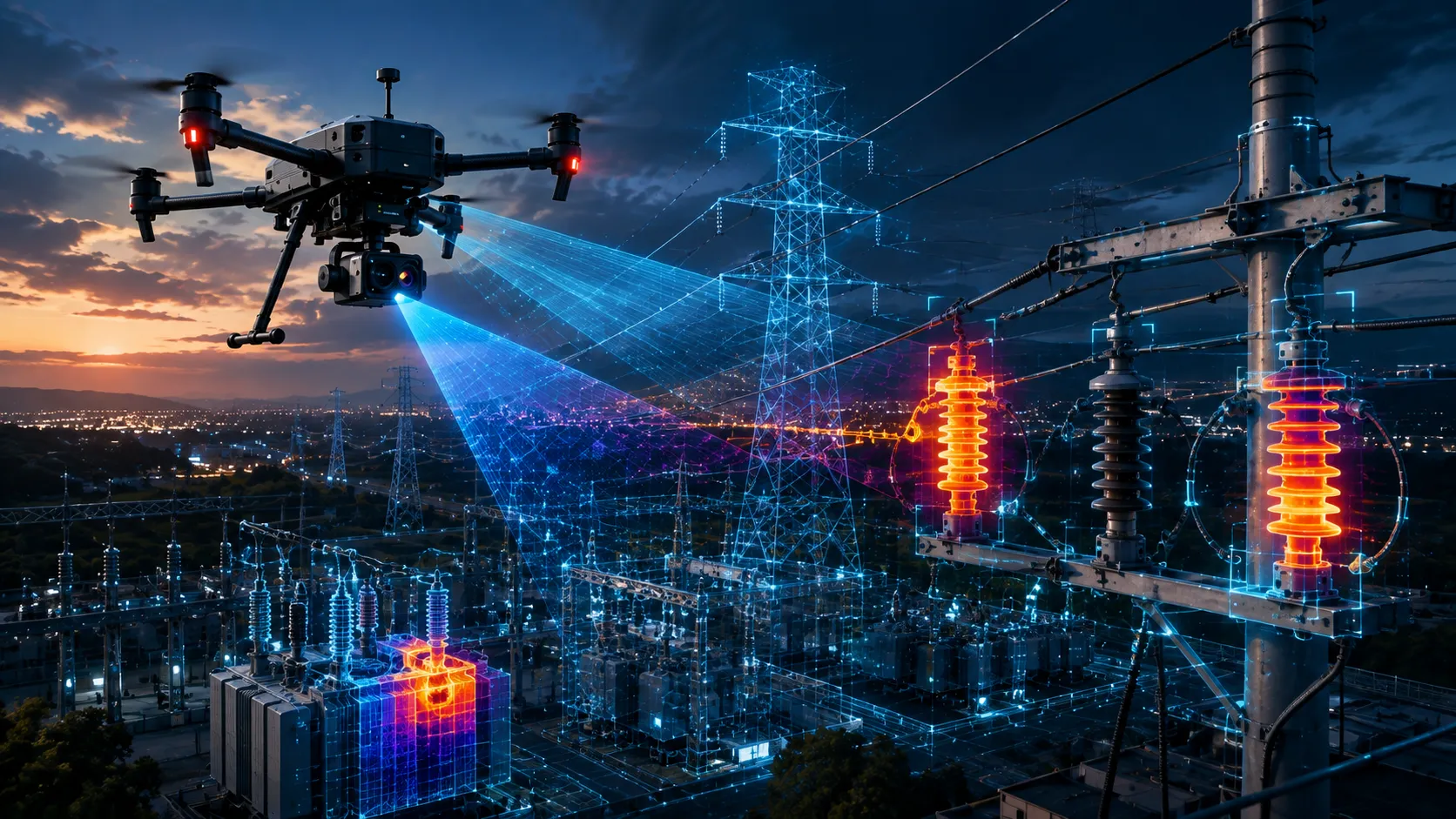
Drone inspection power distribution workflows help DISCOMs, utility teams, industrial power operators, and infrastructure companies inspect electrical assets faster, safer, and with better visual evidence. By using drones with thermal and RGB cameras, power distribution companies can identify hotspots, damaged components, vegetation risks, loose fittings, insulator issues, and corridor problems before they lead to longer outages.
For power distribution companies, downtime is not only a technical issue. It affects service reliability, customer satisfaction, revenue, safety, field-team workload, and regulatory performance. A small fault on a feeder, pole, connector, jumper, transformer area, or overhead line section can create wider disruption if it is not detected early.
This guide explains how drone inspections reduce downtime for power distribution companies and how a structured thermal and RGB inspection workflow can support faster maintenance decisions.
What is drone inspection for power distribution?
Drone inspection for power distribution is the use of unmanned aerial systems to inspect overhead lines, poles, transformers, feeders, distribution structures, vegetation, and related electrical assets. The drone captures visual, thermal, and location-based data that maintenance teams can review.
A power distribution drone inspection can cover:
- Overhead distribution lines
- Feeder routes
- Poles and pole-top equipment
- Transformers
- Crossarms
- Insulators
- Jumpers and connectors
- Distribution towers or structures
- Fuse units and switchgear areas
- Vegetation near conductors
- Roadside and urban electrical assets
- Industrial distribution networks
The drone does not replace electrical engineers or maintenance crews. It gives them better inspection evidence so they can decide where to send teams, what tools to carry, which assets to prioritise, and whether further testing or shutdown planning is needed.
Skyglimps Technologies LLP provides Thermal & RGB Inspections for organisations that need aerial inspection support for power, utility, infrastructure, and industrial assets.
Why does downtime matter for power distribution companies?
Downtime matters because every outage affects customers, operations, repair cost, safety, and utility performance. For DISCOMs and power distribution companies, reducing outage duration is a core maintenance and reliability goal.
Distribution networks are exposed to many operational risks. Overhead assets face weather, heat, rain, humidity, vegetation, bird activity, ageing hardware, road construction, unauthorised interference, and load variation. In India, monsoon, storms, dense urban corridors, and remote rural feeders can make inspection and repair more difficult.
Downtime can increase because of:
- Delayed fault detection
- Slow access to the fault location
- Incomplete asset visibility
- Poor vegetation monitoring
- Lack of current inspection records
- Reactive maintenance instead of preventive planning
- Difficulty inspecting elevated or remote assets
- Limited visibility during post-storm assessment
Drone inspection helps reduce these gaps by improving how quickly and clearly distribution assets can be reviewed.
How do drones reduce downtime in power distribution networks?
Drones reduce downtime by helping utilities detect faults earlier, locate problem areas faster, prioritise repairs, reduce manual inspection time, and maintain better asset records. This supports faster response and more preventive maintenance.
A traditional inspection may require ground patrols, ladder access, pole climbing, bucket trucks, or multiple field teams. These methods are still important, but they can be slow when the line route is long, congested, remote, or difficult to access.
Drones help reduce downtime in five practical ways:
| Downtime challenge | How drone inspection helps |
|---|---|
| Fault location is unclear | Aerial data helps identify the affected section faster |
| Assets are hard to access | Drones inspect elevated or difficult areas from a safer distance |
| Defects are not visible from the ground | Thermal and zoom imagery can reveal hidden or elevated issues |
| Maintenance is reactive | Repeat inspections support preventive planning |
| Reports are scattered | Location-tagged imagery improves maintenance records |
The real value comes from speed and focus. Instead of sending teams to inspect every section manually, the utility can use drone data to identify the most likely problem areas first.
What faults can drones detect in distribution assets?
Drones can help detect visible defects, thermal anomalies, vegetation risks, structural issues, and asset-condition concerns across distribution networks. These findings help maintenance teams decide what needs urgent action and what can be scheduled.
Common findings include:
- Hotspots on connectors
- Loose or corroded clamps
- Damaged jumpers
- Broken or cracked insulators
- Burn marks or arcing signs
- Missing hardware
- Leaning poles
- Damaged crossarms
- Bird nests or foreign objects
- Vegetation close to conductors
- Transformer-area heating
- Physical damage after storms
- Obstructions near lines
- Sagging or visibly stressed components
A thermal hotspot does not automatically confirm the final fault. It shows a suspected abnormal condition that needs technical review. Electrical testing, load checks, field verification, and engineering judgement may still be required.
The advantage is that the drone helps create a shortlist of priority locations before full field action begins.
How does thermal imaging help prevent outages?
Thermal imaging helps prevent outages by detecting abnormal heat patterns that may indicate poor electrical contact, loose connections, overload, corrosion, or component stress. These heat patterns may appear before a component fails completely.
Many electrical faults produce heat. A connector may become hotter because of resistance. A clamp may show abnormal temperature because of looseness or corrosion. A transformer area may show a different thermal pattern under load. A distribution asset may look visually normal but still show heat-related warning signs.
Thermal inspection is useful for reviewing:
- Connectors
- Jumpers
- Pole-top equipment
- Transformer connections
- Fuse units
- Switchgear areas
- Line joints
- Clamps
- Substation-adjacent distribution assets
Thermal data is most useful when captured under suitable operating and weather conditions. Load, sunlight, wind, distance, camera settings, and viewing angle can affect results. That is why drone thermal inspection should be planned carefully and interpreted professionally.
Why is RGB imagery important for distribution inspections?
RGB imagery is important because it shows the visible condition and exact location of the component linked to an issue. Thermal data shows heat patterns, while RGB imagery shows the physical asset.
A maintenance team needs to know exactly what is affected. Is the issue on a connector, jumper, pole, transformer, insulator, crossarm, or nearby vegetation? RGB images help answer that.
RGB inspection can help identify:
- Cracked or broken insulators
- Rusted or damaged hardware
- Leaning poles
- Loose fittings
- Missing components
- Bird nests
- Vegetation encroachment
- Construction activity near lines
- Access constraints
- Visible storm damage
The strongest inspection workflow combines thermal and RGB data. Thermal helps identify abnormal heat. RGB helps verify the physical component and visible context.
For broader utility use cases, Skyglimps also supports drone workflows across power, energy, and utilities where aerial inspection and documentation can improve asset visibility.
How do drones speed up fault localisation after outages?
Drones speed up fault localisation by quickly surveying affected line sections, feeder routes, poles, and visible asset conditions from above. This helps utilities send the right crew to the right location faster.
After an outage, the first challenge is often finding the exact fault location. Ground patrols can take time, especially when the line passes through fields, crowded roads, waterlogged areas, narrow lanes, vegetation, industrial zones, or difficult terrain.
Drone surveys can help review:
- Damaged poles
- Broken conductors
- Fallen branches
- Burn marks
- Vegetation contact
- Transformer-area damage
- Faulted line sections
- Roadwork or third-party interference
- Post-storm damage
- Access route condition
This helps reduce guesswork. If the drone identifies a damaged section, the maintenance team can move directly to that location with the right equipment and safety plan.
For emergency response, speed matters. Faster fault localisation can reduce restoration time, customer complaints, and repeated field movement.
How do drones improve preventive maintenance planning?
Drones improve preventive maintenance planning by creating repeatable inspection records that show which assets are healthy, deteriorating, or at risk. This helps utilities move from reactive repairs to condition-based maintenance.
A distribution company may inspect feeders before monsoon, before peak demand periods, after storms, or during routine asset audits. Drone data from each inspection can be compared over time.
Preventive maintenance can use drone data to track:
- Recurring hotspots
- Ageing hardware
- Vegetation growth
- Pole condition
- Insulator condition
- Access issues
- Corrosion patterns
- Transformer-area risks
- Storm-prone sections
- High-risk feeders
This helps teams prioritise maintenance budgets and field crew deployment. Instead of treating all assets equally, the utility can focus on the sections showing the highest risk.
For recurring inspection documentation, drone-based documentation and progress tracking can help organisations maintain dated asset records and inspection evidence.
How do drone inspections improve field-team safety?
Drone inspections improve field-team safety by reducing the need for personnel to climb poles, approach live assets, or enter difficult terrain during initial inspection. Field crews can then focus on verified priority locations.
Distribution inspection can expose teams to:
- Working at height
- Live electrical assets
- Narrow roadside conditions
- Waterlogged areas
- Vegetation-heavy routes
- Traffic movement
- Post-storm debris
- Heat and weather exposure
- Unstable poles or structures
- Difficult access areas
Drones allow teams to inspect many elevated or risky areas from a safer distance. This does not remove the need for trained line staff, but it reduces unnecessary exposure during early screening.
A safer inspection process can also support faster restoration. When crews know the issue location and likely defect before arrival, they can plan the repair more efficiently.
What deliverables should power distribution companies expect?
Power distribution companies should expect deliverables that help maintenance teams locate, prioritise, and act on inspection findings. A professional drone inspection report should be organised, location-tagged, and linked to asset references wherever possible.
Useful deliverables include:
| Deliverable | Purpose |
| Thermal images | Show suspected heat anomalies |
| RGB images | Show visible asset condition |
| Feeder-wise inspection report | Organises findings by network section |
| Pole or asset reference | Helps crews locate the issue |
| Hotspot register | Lists suspected thermal problems |
| Vegetation risk map | Supports trimming and clearance planning |
| Severity classification | Helps prioritise maintenance action |
| Geo-tagged findings | Supports GIS and field navigation |
| Before-after comparison | Tracks repair or repeat inspection |
| Summary report | Supports management review |
A folder of unlabelled images is not enough. The report should help field teams understand what was found, where it is located, and what action may be required.
When should power distribution companies schedule drone inspections?
Power distribution companies should schedule drone inspections before high-risk seasons, after storms, before peak load periods, after repeated faults, and during routine maintenance cycles. Timing should match the risk profile of the network.
Useful inspection windows include:
- Pre-monsoon checks
- Post-storm damage assessment
- Before summer peak demand
- After repeated feeder trips
- Before planned maintenance shutdowns
- After vegetation complaints
- During annual asset audits
- Before critical infrastructure events
- After construction near electrical assets
- After customer-reported fault clusters
For Eastern India, monsoon, humidity, vegetation growth, and waterlogging can increase inspection challenges. Scheduled drone inspections can help DISCOMs identify risks before conditions become more difficult.
How should DISCOMs choose a drone inspection partner?
DISCOMs should choose a drone inspection partner by checking power-sector inspection experience, thermal and RGB capability, safety procedures, compliance awareness, reporting quality, and GIS-ready deliverables. The partner should understand utility maintenance needs.
Ask these questions before hiring:
- Do you capture both thermal and RGB data?
- Have you inspected power distribution or utility assets before?
- Can findings be linked to feeder, pole, or asset references?
- What safety distance and operating procedures do you follow?
- How do you manage flights near roads, people, and live assets?
- What report format will be delivered?
- Do you provide hotspot registers or severity categories?
- Can you support repeat inspections?
- Can outputs be used in GIS or asset-management systems?
- What are the limitations of the inspection?
A professional partner should not overpromise. Drone inspection can improve visibility and speed, but final repair decisions require field verification and utility engineering review.
Why choose Skyglimps Technologies for power distribution drone inspections?
Skyglimps Technologies LLP is a Kolkata-based drone services company and DGCA-certified Remote Pilot Training Organisation serving government and enterprise clients across Eastern India. The company supports drone workflows across thermal and RGB inspections, mapping, surveillance, documentation, progress tracking, and training.
Skyglimps Technologies, a DGCA-certified RPTO in Kolkata, is positioned for organisations that need structured aerial inspection workflows with safety and compliance awareness. For power distribution companies, industrial operators, utilities, and infrastructure teams in Kolkata, West Bengal, and Eastern India, local coordination can help improve planning, field execution, repeat inspection, and reporting.
Drone inspection power distribution workflows are most valuable when they are tied to a maintenance decision: fault localisation, preventive maintenance, vegetation clearance, asset condition review, or outage reduction.
FAQ: Drone Inspection Power Distribution
Drone inspection for power distribution uses drones with thermal and RGB cameras to inspect overhead lines, poles, transformers, feeders, vegetation, and related electrical assets.
Drones reduce downtime by helping teams locate faults faster, detect defects earlier, prioritise repairs, reduce manual inspection time, and improve maintenance planning.
Drones can help detect hotspots, damaged insulators, loose connectors, corroded hardware, vegetation encroachment, damaged poles, storm damage, and visible asset defects.
Thermal imaging helps identify abnormal heat patterns that may indicate loose connections, overload, corrosion, poor contact, or component stress before failure occurs.
No. Drone inspections support line crews by identifying priority areas and improving visibility. Field verification, electrical testing, and repair work are still required.
They should be done before monsoon, after storms, before peak load periods, after repeated faults, during asset audits, and before planned maintenance work.
A report should include thermal images, RGB images, asset references, geo-tagged findings, hotspot lists, vegetation risks, severity levels, and recommended follow-up actions.
Reduce distribution downtime with better inspection data
Drone inspection power distribution workflows help utilities and DISCOMs reduce downtime by improving fault visibility, speeding up inspection, supporting preventive maintenance, and helping field teams act with better evidence.
For distribution lines, feeders, poles, transformers, industrial networks, and utility corridors in Kolkata, West Bengal, and Eastern India, drone-based thermal and RGB inspection can support safer, faster, and more structured maintenance planning.
If your organisation needs power distribution inspection, feeder route assessment, thermal hotspot detection, vegetation-risk documentation, or utility asset reporting, connect with Skyglimps Technologies LLP through the Thermal & RGB Inspections service page and share your asset type, location, inspection objective, and reporting requirements.