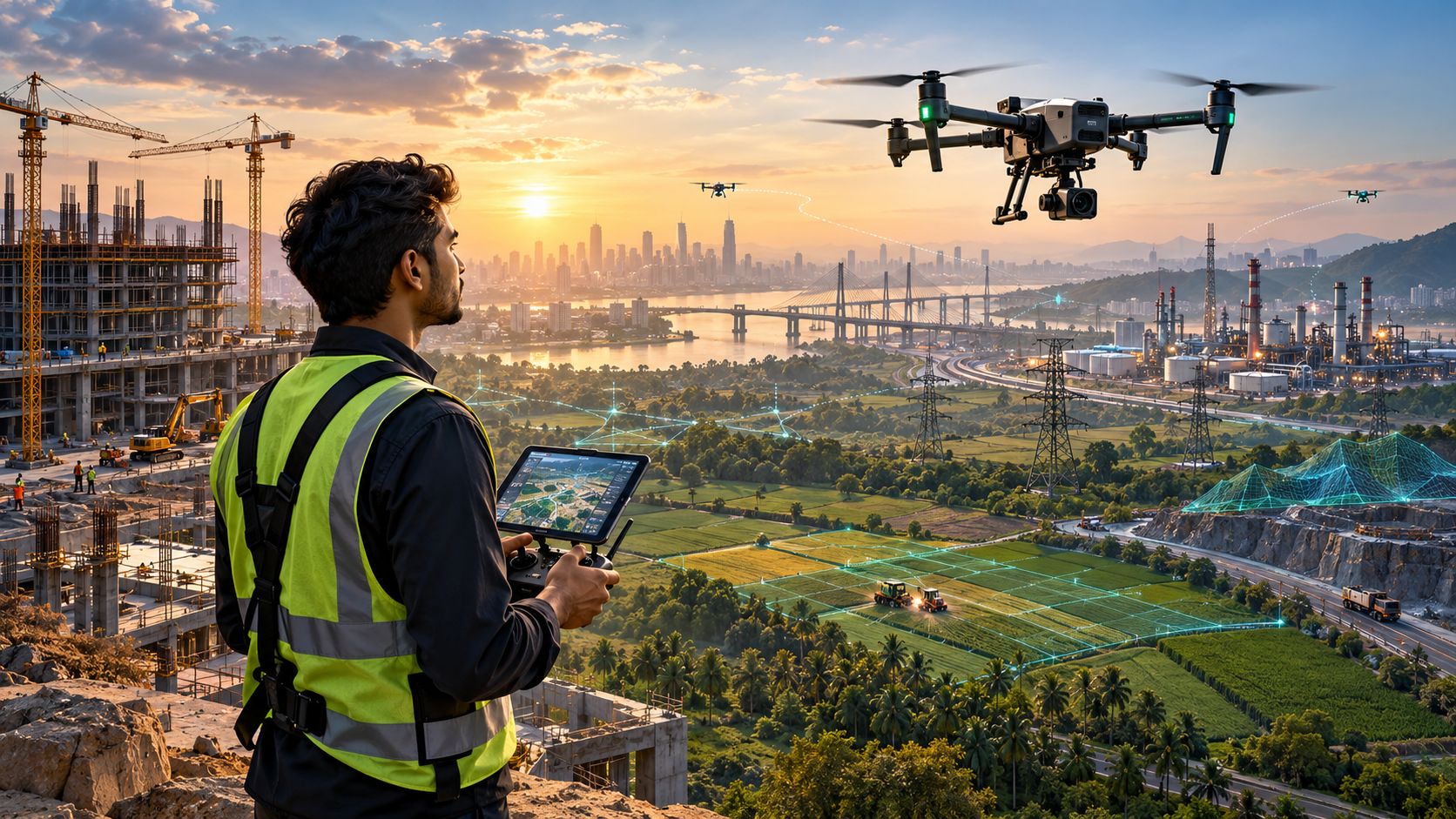
India’s drone industry has expanded beyond photography and recreational flying. Drones are now used across surveying, mapping, construction, infrastructure, agriculture, inspection, mining, real estate, disaster management, media, and other professional applications.
As businesses adopt drones for data collection and monitoring, people with professional drone-flying skills are finding opportunities across multiple industries.
This makes drone pilot jobs in India an increasingly relevant career option for students, working professionals, and people looking to enter the growing drone ecosystem.
However, getting a Remote Pilot Certificate is only the beginning.
A professional drone pilot may need additional technical skills depending on the industry they want to enter. A survey pilot, for example, may need knowledge of photogrammetry and GIS, while an inspection pilot may benefit from thermal imaging and asset-inspection knowledge.
The career opportunities are therefore broader than simply searching for a job titled “Drone Pilot.”
What Does a Professional Drone Pilot Do?
A professional drone pilot is responsible for safely operating an unmanned aircraft for a specific project or business purpose.
Depending on the job, responsibilities can include:
- Preparing the drone and equipment
- Conducting pre-flight checks
- Planning flight missions
- Operating the drone
- Monitoring weather and operating conditions
- Managing batteries and equipment
- Capturing aerial photographs or video
- Collecting survey or inspection data
- Operating specialised payloads
- Following safety procedures
- Maintaining flight records
- Supporting post-flight data processing
- Coordinating with surveyors, engineers, inspectors, or project teams
The exact role depends on the industry.
A construction drone pilot may collect progress imagery and site data, while a survey pilot may conduct planned flights for mapping and measurement.
What Qualification Do You Need for Drone Pilot Jobs in India?
A Remote Pilot Certificate (RPC) can provide an important foundation for professional drone operations, but employers may also expect relevant technical skills and practical experience.
The current DGCA framework uses the term Remote Pilot Certificate. DGCA’s current RPC verification system records the applicable UAS category, sub-category and class, along with confirmation that the pilot completed the required theory and practical training and passed the relevant theory and practical examinations.
Depending on the job, employers may look for:
- Remote Pilot Certificate
- Practical drone-flying experience
- Knowledge of drone regulations
- Mission planning
- Safety awareness
- Equipment handling
- Camera or payload experience
- Surveying knowledge
- GIS knowledge
- Photogrammetry
- Thermal imaging
- Data collection
- Data processing
- Industry-specific experience
The exact requirements vary from one employer and role to another.
For example, a surveying company may prioritise candidates who understand mapping and geospatial workflows, while a media company may focus more on aerial photography and cinematography.
Where Can You Find Drone Pilot Jobs in India?
There is no single job category that contains every professional drone opportunity.
You should search through several channels at the same time.
1. Online Job Portals
General job portals can be a useful starting point.
Search for different variations of the role because companies may use different job titles.
Try terms such as:
- Drone Pilot
- UAV Pilot
- UAS Pilot
- Drone Operator
- UAV Operator
- Remote Pilot
- Drone Surveyor
- Survey Drone Pilot
- UAV Technician
- Drone Operations Executive
- Drone Mapping Specialist
- Drone Inspection Pilot
Searching multiple job titles can significantly broaden the number of relevant opportunities you find.
2. Professional Networking Platforms
Professional networking platforms can be useful for finding drone-related vacancies and connecting directly with companies and recruiters.
Search for:
- Drone pilot jobs
- UAV pilot jobs
- Drone operator jobs
- Drone survey jobs
- Drone mapping jobs
- Drone inspection jobs
- UAV jobs
You can also follow organisations working in:
- Geospatial technology
- Construction
- Infrastructure
- Agriculture
- Inspection
- Energy
- Aerospace
- Surveying
Maintaining a professional profile that clearly lists your certification, technical skills, drone experience, and project work can also improve your visibility.
3. Drone Companies
Drone companies are one of the most obvious places to look for professional pilot opportunities.
These companies may provide:
- Surveying
- Mapping
- Inspection
- Agriculture
- Surveillance
- Infrastructure monitoring
- Photography
- Videography
- LiDAR services
- Drone data collection
Instead of waiting for a vacancy, you can identify companies operating in your preferred sector and regularly check their career pages or contact their recruitment teams.
4. Surveying and Geospatial Companies
Surveying and geospatial companies can offer opportunities for pilots who understand more than basic drone operation.
A drone pilot may work alongside:
- Surveyors
- GIS professionals
- Civil engineers
- Geologists
- Data-processing teams
- Project managers
Projects may involve:
- Topographic surveys
- Orthomosaic mapping
- Digital elevation models
- Contour mapping
- 3D modelling
- Volume calculations
- Land mapping
Candidates with both drone-flying and geospatial skills can therefore qualify for a wider range of roles.
5. Construction Companies
Construction is another important application area for drones.
Construction teams can use aerial data for:
- Site documentation
- Progress tracking
- Mapping
- Earthwork monitoring
- Stockpile measurement
- Inspection
- Project reporting
A drone pilot working in construction may need to coordinate closely with engineers, surveyors, site managers, and project teams.
Understanding construction workflows can therefore be an advantage.
6. Infrastructure Companies
Large infrastructure projects can require aerial data across:
- Roads
- Highways
- Bridges
- Railways
- Power infrastructure
- Pipelines
- Industrial facilities
Drone pilots may support these projects through aerial imagery, inspection, mapping, documentation, and monitoring.
These roles may also involve frequent travel and field-based work.
7. Agriculture and Agri-Drone Companies
Agriculture is another major application area for drones.
Depending on the operation, pilots may support:
- Crop monitoring
- Field mapping
- Agricultural surveys
- Crop-health assessment
- Data collection
- Other authorised agricultural drone operations
Candidates interested in this sector can benefit from understanding both drone operations and agricultural workflows.
8. Inspection Companies
Drones can provide visual access to assets that may be difficult, expensive, or time-consuming to inspect manually.
Professional inspection work can involve:
- Solar panels
- Electrical towers
- Power lines
- Buildings
- Bridges
- Industrial structures
- Roofs
- Other infrastructure
Inspection pilots may also need knowledge of RGB and thermal imaging, depending on the project.
9. Media and Production Companies
Drones are widely used for aerial photography and video production.
Potential opportunities can exist with:
- Production houses
- Advertising agencies
- Film teams
- Real estate media companies
- Event companies
- Tourism businesses
- Wedding photography teams
For these roles, flying skills alone may not be enough.
Employers may also value:
- Camera operation
- Composition
- Cinematic movements
- Video production
- Editing
- Storytelling
What Are the Main Career Paths for Drone Pilots?
The drone industry includes several specialised career paths.
Choosing one area can help you develop skills that match specific employer requirements.
Drone Survey Pilot
A drone survey pilot collects aerial data for surveying and mapping projects.
Useful skills include:
- Mission planning
- Survey fundamentals
- Photogrammetry
- Ground control
- RTK/PPK
- Mapping software
- GIS
Drone Mapping Specialist
A mapping specialist works with aerial imagery and geospatial outputs.
Work can involve:
- Orthomosaics
- Point clouds
- 3D models
- Digital elevation models
- Contour maps
- GIS analysis
Drone Inspection Pilot
Inspection pilots collect detailed visual or thermal information from assets.
They may work with:
- RGB cameras
- Thermal cameras
- Asset documentation
- Inspection workflows
- Visual defect identification
Construction Drone Pilot
Construction-focused pilots can support:
- Site mapping
- Progress documentation
- Earthwork monitoring
- Stockpile calculations
- Site inspections
- Aerial documentation
Agricultural Drone Pilot
Agricultural pilots operate drones for authorised agricultural applications such as field mapping, crop monitoring, or other agricultural operations.
Aerial Photography and Videography Pilot
These professionals combine drone operation with visual production skills.
They may work on:
- Real estate
- Weddings
- Advertising
- Films
- Tourism
- Corporate videos
Drone Operations Executive
Some organisations need professionals who combine drone operations with administrative and project responsibilities.
These roles can include:
- Mission planning
- Equipment management
- Flight scheduling
- Pilot coordination
- Documentation
- Data management
What Skills Should You Learn After Drone Certification?
Combining pilot certification with an industry-specific skill can help you become more competitive in the job market.
| Career Direction | Useful Additional Skills |
|---|---|
| Surveying | Surveying, photogrammetry, GIS |
| Mapping | Photogrammetry, GIS, mapping software |
| LiDAR | Point clouds, GIS, LiDAR processing |
| Inspection | Thermal imaging, RGB inspection |
| Construction | Surveying, progress tracking, volume calculations |
| Agriculture | Crop monitoring, agricultural drone operations |
| Cinematography | Camera operation, composition, video production |
| Real Estate | Aerial photography, video editing |
| Infrastructure | Inspection, mapping, documentation |
| Mining | Surveying, volumetric calculations, GIS |
This is why certification should be viewed as a foundation rather than the complete skill set.
A company hiring a survey pilot may need someone who can collect usable survey data, not simply someone who knows how to fly a drone.
Is DGCA Certification Enough to Get a Drone Pilot Job?
Not necessarily. Certification can be an important qualification, but employers may also expect practical experience and specialised skills.
Consider two candidates.
Candidate A:
Has a Remote Pilot Certificate and basic flying experience.
Candidate B:
Has a Remote Pilot Certificate plus experience with surveying, mission planning, photogrammetry, GIS, and drone data collection.
For a surveying company, Candidate B may have a stronger skill match.
The same principle applies to other industries.
For inspection jobs, thermal imaging can be valuable.
For construction jobs, surveying and progress tracking can help.
For media jobs, camera and cinematography skills can make a difference.
Your certification provides the foundation.
Your specialised skills demonstrate what you can do with that certification.
How Can Freshers Find Drone Pilot Jobs in India?
Freshers can enter the industry by combining certification, practical experience, specialised learning, and a strong portfolio.
Build a Professional Resume
Your resume should clearly mention:
- Remote Pilot Certificate
- Applicable drone category
- Training completed
- Practical flying experience
- Drone models operated
- Technical skills
- Software knowledge
- Project experience
Avoid simply writing:
“Drone Pilot.”
Explain what type of work you can perform.
Create a Drone Portfolio
A portfolio can help demonstrate your practical capabilities.
Depending on your career direction, include examples of:
- Aerial photographs
- Mapping outputs
- Orthomosaics
- 3D models
- Survey projects
- Inspection imagery
- Thermal images
- Construction documentation
- Video projects
A portfolio can be particularly valuable for freshers who do not yet have extensive professional employment history.
Gain Practical Experience
Where legally and professionally appropriate, participate in projects that allow you to develop real-world experience.
You may gain exposure to:
- Site documentation
- Mapping
- Construction progress photography
- Survey data collection
- Agricultural field documentation
- Aerial photography
Always follow applicable drone regulations, permissions, and safety requirements.
Network With Industry Professionals
Networking can help you discover opportunities that may not appear on traditional job portals.
Consider participating in:
- Drone industry events
- Geospatial conferences
- Training programmes
- Construction technology events
- Agriculture technology events
- Industry exhibitions
Building relationships with professionals and companies can help you understand what employers actually look for.
Can Drone Pilots Work as Freelancers?
Yes, some drone professionals work independently or provide drone services to businesses, subject to applicable regulations and project requirements.
Potential freelance services include:
- Aerial photography
- Real estate photography
- Construction documentation
- Mapping
- Survey data collection
- Agricultural services
- Inspection support
- Event coverage
However, freelance drone work involves more than flying.
You may also need to manage:
- Client requirements
- Project planning
- Equipment
- Data management
- Deliverables
- Pricing
- Invoicing
- Safety
- Regulatory compliance
For someone planning to build a drone service business, business and project-management skills can be just as important as flying skills.
Are There Government Opportunities for Drone Pilots in India?
Government departments and public-sector projects can involve drone operations, but recruitment depends on the organisation, project, position, and published eligibility requirements.
Potential areas of work can include:
- Land surveying
- Infrastructure
- Agriculture
- Disaster assessment
- Forest monitoring
- Urban planning
- Public works
- Geospatial projects
However, a Remote Pilot Certificate alone should not be treated as a guarantee of government employment.
Some positions may also require:
- Specific educational qualifications
- Technical experience
- Industry knowledge
- Other professional qualifications
Candidates should always check the official recruitment notification for the exact position.
How Much Can a Drone Pilot Earn in India?
Drone pilot income can vary considerably depending on:
- Experience
- Location
- Industry
- Technical skills
- Type of drone
- Project complexity
- Travel requirements
- Employer
- Employment type
An entry-level pilot may initially work on basic field operations.
With experience and specialised skills, a professional may move into roles involving:
- Surveying
- Mapping
- GIS
- Inspection
- LiDAR
- Construction
- Infrastructure
- Agriculture
- Data collection
- Project coordination
Rather than focusing only on a salary figure, aspiring pilots should focus on developing skills that are valuable to their target industry.
What Industries Hire Drone Pilots in India?
Drone pilots can work across a broad range of industries.
Construction
Applications include:
- Site surveys
- Progress tracking
- Documentation
- Earthwork monitoring
Infrastructure
Applications include:
- Roads
- Highways
- Bridges
- Railways
- Power infrastructure
- Pipelines
Surveying and Mapping
Applications include:
- Topographic surveys
- Orthomosaic mapping
- 3D modelling
- GIS
- Volume calculations
Agriculture
Applications include:
- Crop monitoring
- Field mapping
- Agricultural data collection
Mining
Applications include:
- Stockpile measurement
- Quarry mapping
- Volume calculations
- Site monitoring
Energy and Utilities
Applications include:
- Power line inspection
- Electrical tower inspection
- Solar inspection
- Infrastructure monitoring
Real Estate
Applications include:
- Property photography
- Site documentation
- Aerial video
- Development monitoring
Media and Entertainment
Applications include:
- Films
- Advertising
- Events
- Tourism
- Commercial video
This wide range of applications means that aspiring pilots should decide which industry they want to enter, rather than focusing only on learning how to fly.
What Should You Put on a Drone Pilot Resume?
A strong resume should communicate both your pilot qualification and your ability to contribute to a project.
Certification
Mention your applicable Remote Pilot Certificate and category.
Drone Experience
List the types of drones you have experience operating.
Technical Skills
Include skills you can genuinely demonstrate, such as:
- Mission planning
- Photogrammetry
- GIS
- Mapping
- Thermal imaging
- RGB inspection
- LiDAR
- Data collection
- 3D modelling
Project Experience
Describe the projects you have worked on and what you actually did.
For example:
Construction Site Mapping:
Collected aerial imagery for site documentation and mapping.
Survey Data Collection:
Conducted planned drone flights for aerial data acquisition.
Software Skills
If relevant to the position, include software you actually know how to use for:
- Photogrammetry
- GIS
- CAD
- Mapping
- Data processing
- Video editing
A specialised resume is more useful than a generic resume that simply lists “drone pilot.”
How Can You Stand Out When Applying for Drone Pilot Jobs?
Getting certified is only the first step.
To become more competitive, build expertise in one or two specialised areas.
For example:
Drone Pilot + Surveying
Drone Pilot + GIS
Drone Pilot + Thermal Inspection
Drone Pilot + Construction
Drone Pilot + LiDAR
Drone Pilot + Aerial Cinematography
This gives employers a clearer picture of the value you can provide.
Instead of presenting yourself only as someone who can operate a drone, demonstrate that you can use drone technology to solve a specific technical or business problem.
Should You Learn Drone Surveying After Certification?
Drone surveying can be a valuable specialisation for pilots interested in construction, infrastructure, mining, land development, and geospatial projects.
Surveying workflows can involve:
- Mission planning
- Ground control
- RTK/PPK
- Photogrammetry
- Orthomosaic generation
- Point clouds
- Digital elevation models
- Contour mapping
- Volume calculations
- GIS
Skyglimps provides DGCA-certified drone training and specialised training related to drone mapping and surveying.
For someone interested in technical drone careers, combining pilot training with surveying and mapping skills can provide a stronger professional foundation.
How Can You Start Your Drone Pilot Job Search?
A structured job-search approach can make it easier to identify suitable opportunities.
Step 1: Choose Your Industry
Decide whether you want to work in:
- Surveying
- Construction
- Inspection
- Agriculture
- Infrastructure
- Mining
- Real estate
- Media
- GIS
- Drone operations
Step 2: Identify Required Skills
Research the skills commonly requested for roles in your selected industry.
Step 3: Build Your Resume
Highlight:
- Certification
- Flying experience
- Technical skills
- Software
- Projects
Step 4: Create a Portfolio
Show practical examples of your work.
Step 5: Search Multiple Job Titles
Do not search only for:
Drone Pilot
Also search for:
- UAV Pilot
- UAV Operator
- Drone Operator
- Drone Surveyor
- Survey Drone Pilot
- Drone Mapping Specialist
- Drone Operations Executive
- Remote Pilot
- Drone Inspection Pilot
- UAV Technician
Step 6: Contact Relevant Companies
Identify companies that use drones in your chosen industry and check their current opportunities.
Step 7: Continue Learning
Keep developing technical and operational skills as drone technology and industry applications evolve.
What Should You Check Before Accepting a Drone Pilot Job?
Not every drone job is the same.
Before accepting a position, understand:
- Job responsibilities
- Drone category
- Type of equipment
- Expected flying hours
- Travel requirements
- Field conditions
- Safety procedures
- Data-collection responsibilities
- Data-processing responsibilities
- Required software
- Reporting structure
- Employment terms
- Training requirements
A job advertised as a “Drone Pilot” may actually involve surveying, equipment maintenance, data processing, reporting, or extensive field travel.
Understanding the complete role before joining can help you choose an opportunity that matches your career goals.
Frequently Asked Questions
You can search online job portals, professional networking platforms, company career pages, drone companies, surveying firms, construction companies, infrastructure organisations, inspection companies, and other businesses using drone technology.
Potential roles include drone pilot, UAV pilot, drone operator, survey drone pilot, mapping specialist, inspection pilot, agricultural drone operator, construction drone operator, and aerial photography pilot.
A Remote Pilot Certificate can be an important qualification, but employers may also expect practical flying experience and industry-specific skills such as surveying, GIS, photogrammetry, inspection, thermal imaging, or photography.
Yes. Freshers can pursue entry-level opportunities by obtaining the applicable certification, developing practical experience, learning specialised skills, building a portfolio, and applying to relevant organisations.
Drone pilots can find opportunities in surveying, mapping, construction, infrastructure, agriculture, mining, energy, utilities, inspection, real estate, media, and other drone-enabled industries.
Yes. Some professionals provide independent drone services such as aerial photography, mapping, construction documentation, agricultural services, and inspection support, subject to applicable regulations and project requirements.
Build Your Career Beyond Flying the Drone
Getting certified as a drone pilot can be an important first step, but professional drone careers extend far beyond simply operating an aircraft.
The strongest career profiles often combine pilot certification with specialised industry knowledge.
If you are interested in surveying, develop skills in mapping, photogrammetry, and GIS. If inspections interest you, learn about thermal and RGB imaging. If construction is your target sector, understand site documentation, mapping, and progress tracking. If you want to work in media, build aerial photography and cinematography skills.
When searching for drone pilot jobs in India, look beyond the exact job title. Search for UAV pilot, drone operator, survey pilot, mapping specialist, inspection pilot, and drone operations positions.
Most importantly, build evidence of what you can actually do through projects, practical experience, and a professional portfolio.
The Remote Pilot Certificate provides an important foundation, but specialised skills, practical experience, and the ability to deliver useful project outcomes can help turn drone training into a sustainable professional career.
For those looking to begin their professional journey, explore Skyglimps DGCA-Certified Drone Training and learn about the training pathway for developing professional drone-pilot skills in India.