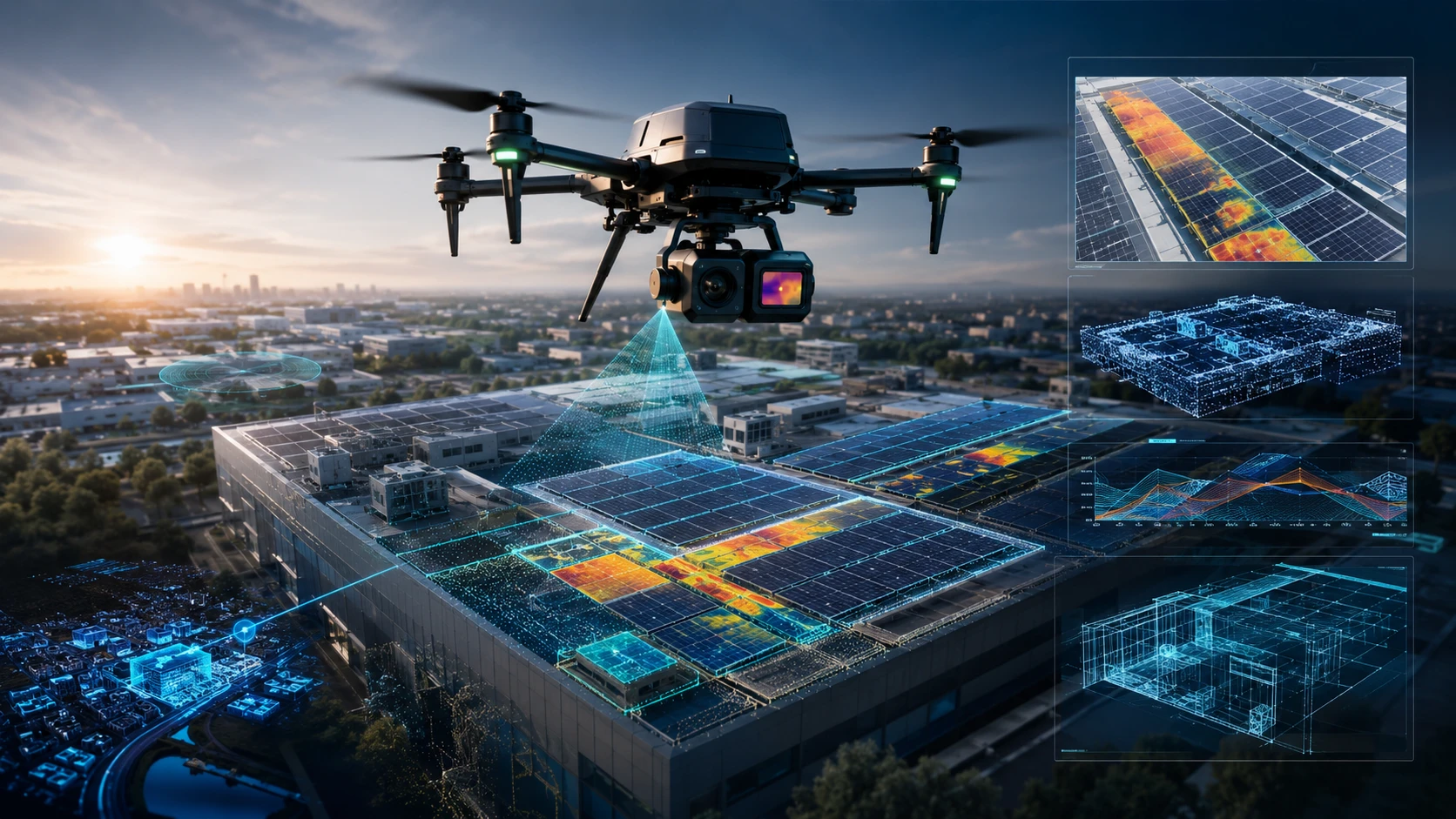
Drone solar panel inspection helps solar plant owners, EPC teams, facility managers, and maintenance contractors identify faults faster, inspect large PV sites safely, and plan repairs with better evidence. By using thermal and RGB cameras, drones can detect heat anomalies, visible damage, soiling patterns, disconnected strings, cracked modules, shading issues, and other signs of performance loss.
For solar assets in India, inspection speed matters. Rooftop systems, industrial solar plants, utility-scale parks, and distributed solar sites need regular maintenance to protect generation output. Manual inspection can be slow, risky, and inconsistent when panels are spread across rooftops, factories, warehouses, open land, or large solar farms.
This guide explains how drone inspection works, what problems it can detect, and why it can save money over the life of a solar asset.
What is drone solar panel inspection?
Drone solar panel inspection is the use of drones equipped with thermal and RGB cameras to inspect photovoltaic modules and related solar assets from the air. Thermal imagery highlights temperature differences, while RGB imagery shows visible condition and physical context.
Solar panels are expected to operate evenly. When one module, cell area, connector, string, or section becomes hotter than surrounding areas, it may indicate an issue that needs maintenance review. Thermal inspection helps identify these abnormal heat patterns quickly.
A drone solar inspection may review:
- PV modules
- Module strings
- Rooftop solar arrays
- Utility-scale solar farms
- Industrial solar installations
- Mounting structures
- Junction boxes
- Inverter areas
- Cable routes
- Shading and vegetation issues
- Soiling or surface contamination
- Access and maintenance constraints
Skyglimps Technologies LLP provides Thermal & RGB Inspections for organisations that need aerial inspection support for solar, power, infrastructure, and industrial assets.
How does drone solar panel inspection work?
Drone solar panel inspection works by flying a planned route over the solar array and capturing thermal and visual images of the panels. The data is then reviewed to locate abnormal heat patterns, visible defects, and sections that need closer ground verification.
A typical workflow includes:
- Define the inspection objective.
- Review the solar site layout.
- Check airspace and site safety conditions.
- Plan the drone flight path.
- Capture thermal imagery.
- Capture RGB imagery.
- Match thermal anomalies with visual panel locations.
- Prepare an inspection report.
- Prioritise maintenance follow-up.
- Conduct ground verification where required.
The drone does not repair the problem. It helps the maintenance team know where to look first. This reduces random checking and helps focus field teams on the panels, strings, or sections that show abnormal patterns.
For best results, drone inspection should be performed during suitable sunlight, weather, and operating conditions. Poor weather, very low irradiance, heavy wind, or incorrect camera settings can reduce the usefulness of thermal data.
What faults can drones detect in solar panels?
Drones can help detect thermal anomalies and visible defects that may indicate underperforming or damaged solar components. Common findings include hotspots, bypass diode issues, disconnected modules, cracked panels, soiling, shading, and string-level irregularities.
Common solar inspection findings include:
| Finding | What it may indicate | Why it matters |
|---|---|---|
| Hotspot | Localised overheating | May reduce module life or output |
| Hot module | Module-level performance issue | Needs maintenance review |
| Hot string section | String, wiring, or connection issue | Can affect generation |
| Bypass diode pattern | Diode or module fault | May reduce module performance |
| Cracked module | Physical damage | Can worsen over time |
| Soiling pattern | Dust, bird droppings, or surface contamination | Can reduce output |
| Shading issue | Obstruction from nearby object or vegetation | Can create uneven generation |
| Disconnected module/string | Electrical or connection issue | Can cause energy loss |
| Mounting or visible damage | Physical asset concern | Requires inspection or repair |
A thermal anomaly is not the final diagnosis by itself. It is evidence that helps maintenance teams decide which component needs closer review. Electrical testing, performance data, string-level checks, and physical inspection may still be required.
The main value is speed. Drones can scan many panels quickly and create a shortlist of possible problems.
Why does thermal imaging matter for solar inspections?
Thermal imaging matters because many PV faults show up as temperature differences before they are obvious in normal photographs. A module may look fine visually but still show an abnormal heat pattern under operating conditions.
Solar panels generate electricity through sunlight. When part of the system is damaged, shaded, disconnected, or electrically stressed, heat patterns may change. A thermal camera can reveal these patterns from above.
Thermal imaging is useful for finding:
- Hotspots
- Overheated cells
- Faulty bypass diode patterns
- String irregularities
- Underperforming module sections
- Connector-related heating
- Load-related anomalies
- Potential safety concerns
RGB imagery is still important because thermal images need context. If a hotspot appears in the thermal image, the RGB image helps identify the exact panel, row, surface condition, shading source, or visible damage.
The strongest inspection workflow combines both thermal and RGB data. Thermal shows where the issue may be. RGB helps explain what the issue looks like.
How does drone inspection save money for solar plant owners?
Drone inspection saves money by reducing manual inspection time, improving fault detection, prioritising maintenance, reducing unnecessary site movement, and helping prevent small problems from becoming larger losses. It supports smarter maintenance decisions.
Solar plants lose money when faults remain unnoticed. Even a small percentage of underperforming panels can reduce total generation over time. For large solar assets, delayed detection can become expensive.
Drone inspection can reduce costs in five practical ways:
- Faster coverage: Large arrays can be inspected faster than manual panel-by-panel checking.
- Lower field effort: Maintenance teams can focus on flagged areas instead of walking the entire site blindly.
- Better prioritisation: Thermal reports help rank defects by severity and location.
- Reduced downtime: Issues can be identified before they affect larger sections of the plant.
- Improved records: Dated inspection reports support asset history, warranty review, and maintenance planning.
Drone inspections do not remove the need for technicians. They help technicians work more efficiently. Instead of searching randomly, the team can go directly to the panels or strings that need attention.
For recurring solar maintenance, drone data can also support documentation and progress tracking by creating repeatable visual records over time.
Is drone solar inspection safer than manual inspection?
Drone solar inspection improves safety by reducing the need for personnel to walk across large solar farms, climb rooftops, access elevated structures, or inspect live electrical assets at close range during initial screening. Ground teams can then verify only the priority areas.
Manual solar inspections can involve risks such as:
- Working at height on rooftops
- Walking between dense panel rows
- Heat exposure in open solar plants
- Electrical hazards
- Slippery or fragile roof surfaces
- Remote or uneven terrain
- Cable and structure obstacles
- Time pressure during maintenance windows
Drones help by collecting inspection data from above. This is especially useful for industrial rooftops, warehouses, factories, schools, hospitals, commercial buildings, and large solar parks where access can be difficult.
Safety still depends on proper flight planning. Drone pilots must maintain safe distances, avoid people and structures, follow airspace rules, and coordinate with the site team.
What deliverables should you expect after a drone solar inspection?
A professional drone solar inspection should deliver thermal images, RGB images, anomaly locations, panel or row references, inspection summaries, and maintenance-priority recommendations. The report should help the technical team take action.
Useful deliverables include:
| Deliverable | Purpose |
| Thermal image set | Shows heat anomalies |
| RGB image set | Shows visible condition and panel context |
| Hotspot register | Lists suspected problem areas |
| Location-tagged findings | Helps technicians find the affected panel or row |
| Severity classification | Helps prioritise maintenance |
| Summary report | Gives management a clear overview |
| Before-after comparison | Useful for repeat inspection |
| Asset documentation | Builds maintenance history |
For larger plants, the report should be organised so the maintenance team can locate faults quickly. A folder full of images is not enough. The findings should be mapped, labelled, and explained.
For solar plants connected to broader energy infrastructure, drone data may also support operations across power, energy, and utilities.
When should solar panels be inspected by drone?
Solar panels should be inspected by drone during preventive maintenance cycles, after storms, after visible generation drops, before warranty reviews, after installation, and before major asset handovers. The best timing depends on the asset type and maintenance schedule.
Useful inspection windows include:
- After commissioning
- Before project handover
- During annual maintenance
- Before peak generation seasons
- After severe weather
- After inverter or string-level alerts
- When generation data shows unexplained loss
- Before warranty claim discussions
- After cleaning or repair work
For recurring inspections, the same flight pattern and reporting structure should be used where possible. This makes it easier to compare current and previous data.
Solar assets in India face dust, heat, monsoon exposure, humidity, bird droppings, vegetation growth, and weather-related wear. Regular inspection helps asset owners identify visible and thermal risks before they become more expensive to correct.
How should businesses choose a drone solar inspection partner?
Businesses should choose a drone solar inspection partner by checking thermal imaging capability, RGB capture quality, pilot compliance, solar inspection experience, reporting structure, and safety process. The partner should provide actionable findings, not only drone photos.
Ask these questions before hiring:
- Do you capture both thermal and RGB images?
- What kind of solar assets have you inspected?
- How will the flight be planned?
- What weather and sunlight conditions are required?
- How will hotspots be identified and reported?
- Will findings be location-tagged?
- What deliverables are included?
- What are the inspection limitations?
- Can the inspection be repeated for comparison?
- How will maintenance teams use the report?
A good inspection partner will not promise that drones can diagnose every electrical issue. It will explain what drone data can reveal, what needs ground verification, and how the report supports maintenance planning.
Why choose Skyglimps Technologies for drone solar panel inspection?
Skyglimps Technologies LLP is a Kolkata-based drone services company and DGCA-certified Remote Pilot Training Organisation serving government and enterprise clients across Eastern India. The company supports drone workflows across thermal and RGB inspections, mapping, surveillance, documentation, and training.
Skyglimps Technologies, a DGCA-certified RPTO in Kolkata, is positioned for organisations that need structured aerial inspection workflows with safety and compliance awareness. For solar asset owners, EPC teams, industrial operators, and facility managers in Kolkata, West Bengal, and Eastern India, local coordination can help improve site planning, repeat inspection, and reporting.
A solar inspection project works best when the drone team understands the inspection objective before flying. The output should help the maintenance team make better decisions, not simply create attractive aerial visuals.
FAQ: Drone Solar Panel Inspection
Drone solar panel inspection uses drones with thermal and RGB cameras to inspect PV panels, detect hotspots, identify visible defects, and support maintenance planning.
Drones can help detect hotspots, damaged modules, bypass diode patterns, disconnected strings, soiling, shading, cracked panels, and visible structural issues.
Yes, thermal imaging is important because many PV faults appear as abnormal heat patterns before they are clearly visible in RGB images.
Yes. Drone inspection can reduce manual inspection time, prioritise maintenance, identify underperforming areas faster, and improve repair planning.
No. Drone inspection helps identify suspected issues. Electrical testing and ground verification may still be required before final diagnosis or repair.
Solar plants should be inspected after commissioning, during preventive maintenance, after storms, after generation drops, before warranty reviews, and after repair work.
Yes. Drone inspection is useful for rooftop solar because it reduces the need for repeated roof access and provides thermal and visual evidence from above.
Improve solar maintenance with faster inspection data
Drone solar panel inspection helps asset owners find problems faster, reduce manual inspection effort, improve safety, and plan maintenance with better evidence. Thermal imaging highlights possible performance issues, while RGB imagery gives the visual context needed for repair teams.
For solar plants, industrial rooftops, commercial buildings, warehouses, and distributed energy assets in Kolkata, West Bengal, and Eastern India, drone-based thermal and RGB inspection can support smarter maintenance planning.
If your organisation needs solar panel inspection, thermal hotspot detection, rooftop PV inspection, or solar asset documentation, connect with Skyglimps Technologies LLP through the Thermal & RGB Inspections service page and share your site location, system size, inspection objective, and reporting requirements.